Canyon painting: its unique characteristics
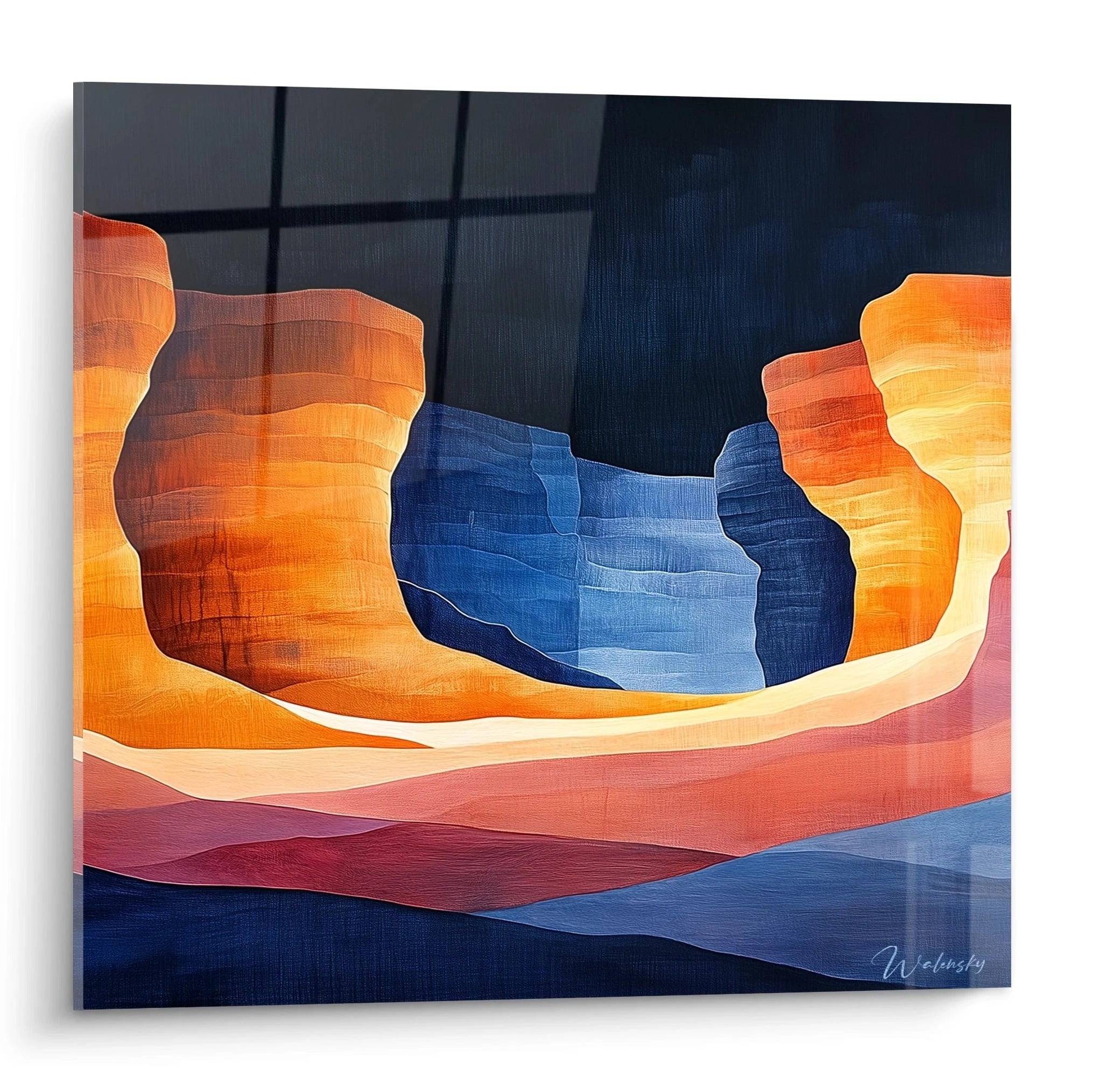
This canyon painting captivates instantly through its striking representation of stratified rock formations bathed in warm and contrasted light. The work presents a modern and refined vision of a deep canyon, where flaming orange walls frame a central blue crevasse. The composition perfectly evokes the immensity of American desert landscapes while proposing a contemporary artistic interpretation of geological strata and the light play that transforms them.
How this stratified canyon painting is structured
The composition of this stratified canyon painting articulates around a pronounced horizontal division. The upper third presents the canyon walls that rise majestically from both sides, creating a central passage that immediately attracts the gaze. The lower two-thirds represent horizontal geological layers with contrasted colors, suggesting the canyon floor and its extensions. This structure creates a visual tension between the verticality of the cliffs and the horizontality of the colored strata.
Fluid and undulating lines traverse the entire work, guiding the gaze in dynamic movement that evokes the millennial erosion of rocks. The perspective is slightly plunging, as if the spectator were overlooking the canyon, which amplifies the sensation of depth and immensity. The tight framing on rock formations reinforces the visual impact of chromatic contrasts and light interplay.
The colors of the canyon painting and their harmony
The chromatic palette of this canyon painting articulates around a striking contrast between warm and cool tones. The dominant hues are:
- Bright orange and warm terracotta illuminating rock walls like beneath a setting sun
- Delicate pink softening transitions between different zones
- Deep blue evoking both sky and shadow depths
- Light blue bringing a sensation of freshness and depth
This chromatic harmony rests on the complementary contrast between orange and blue, creating a visual vibration that energizes the entire composition. Warm hues seem to radiate from within, as if the rock itself were a light source, while blue zones bring contrasting coolness that perfectly balances the work. This tension between warmth and coolness is characteristic of desert landscapes at sunrise or sunset.
Textures and technical details of the luminous canyon painting
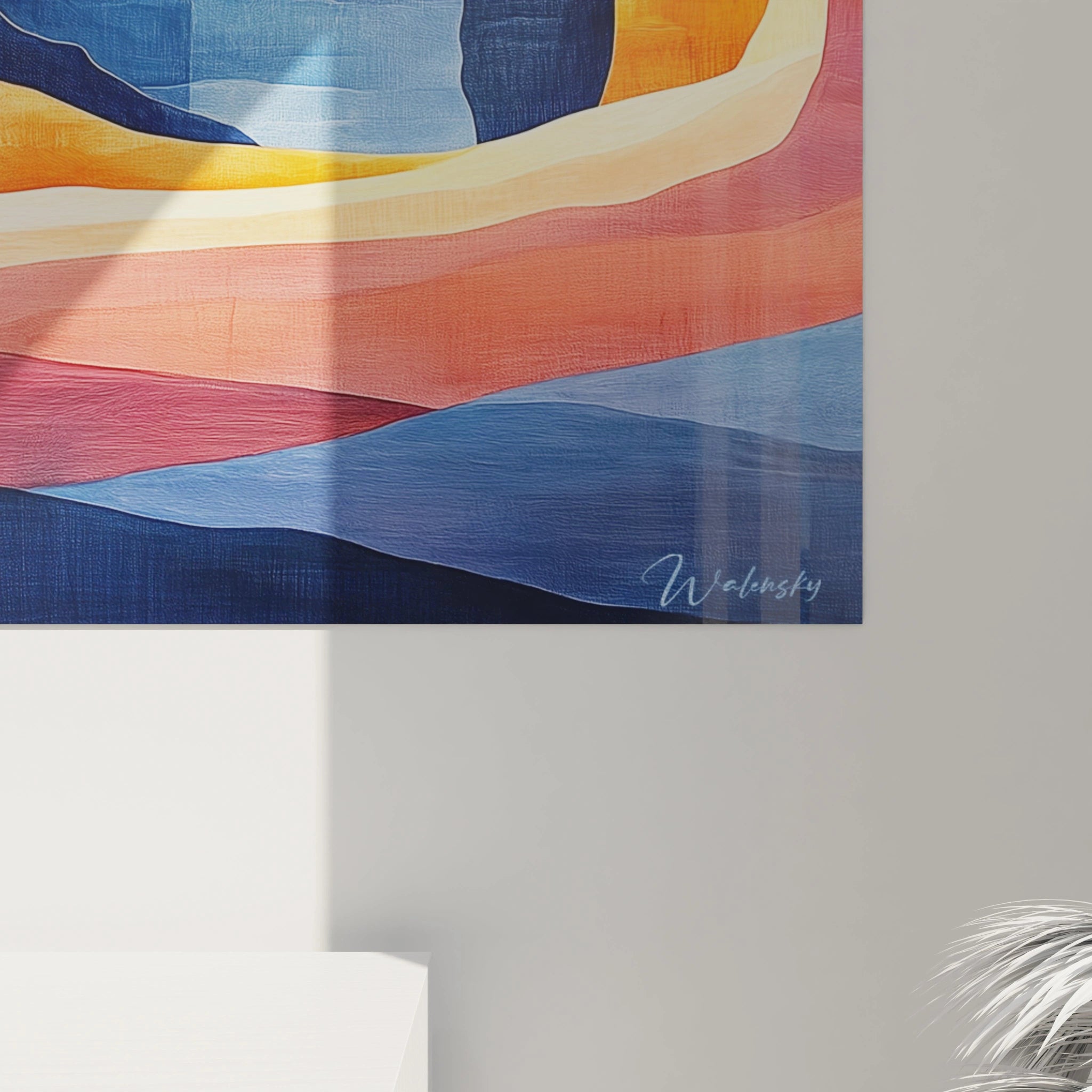
The surface of the luminous canyon painting presents a smooth and silken finish that allows colors to reveal their full intensity. The artist worked through successive layers of transparent colors, thus creating an effect of depth and inner luminosity. Transitions between different colored zones are both sharp in their delimitation and soft in their gradation, accurately evoking the natural stratification of rock formations.
One observes particular attention to subtle variations of hues within each colored zone, suggesting the different mineral compositions of geological strata. Light reflections seem to emanate from the walls themselves, creating an almost translucent effect in places, as if light traversed certain rock layers. This technique brings an almost spiritual dimension to the representation, transcending simple illustration to reach a poetic interpretation of landscape.
What makes this desert canyon painting unique
The originality of this desert canyon painting lies in its capacity to combine abstraction and naturalistic representation. Unlike a simple photographic reproduction, this work captures the emotional and spiritual essence of the canyon through simplification of forms and exaltation of colors. The artist succeeded in extracting the essential from these geological formations to reveal their intrinsic architectural beauty.
The slightly elevated perspective offers an original viewpoint, as if the spectator were floating above the landscape. This canyon wall decor also distinguishes itself through its contemporary treatment of colors, whose intensity exceeds reality to reach an almost dreamlike dimension. The absence of explicit sky and anecdotal elements (vegetation, characters) concentrates attention on the pure colored geometry of the landscape, thus reinforcing its visual impact and presence in the space.
Depth and details of the canyon painting
Observed from a distance, this canyon painting reveals a remarkable depth that deploys differently according to viewing distance. From afar, the work presents a harmonious and balanced composition, dominated by the contrast between orange and white zones. This general vision immediately evokes a desert landscape with majestic rock formations.
Drawing closer, a multitude of subtle nuances within each colored zone emerges progressively. Oranges range in variations from golden yellow to deep red, while blues oscillate between indigo and azure. These delicate transitions create a visual movement that animates the apparently smooth surface of the work. One also discovers slight textures that evoke the granularity of rock, perceptible only at short distance. This ancient rocks painting offers thus a visual experience that renews itself according to observation distance and viewing angle, rewarding careful examination with ever-new richness of detail.
Where and how to showcase your rocky canyon painting
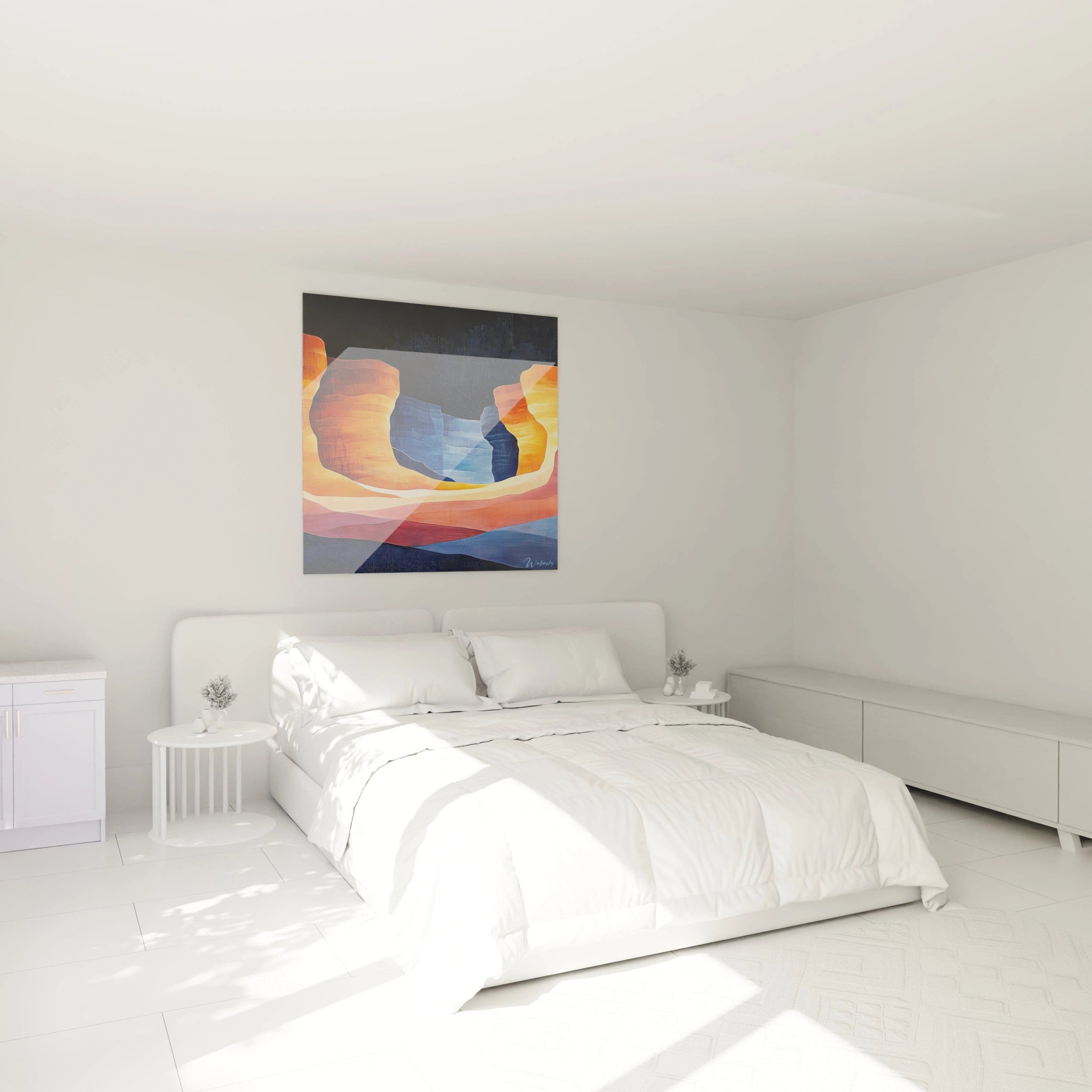
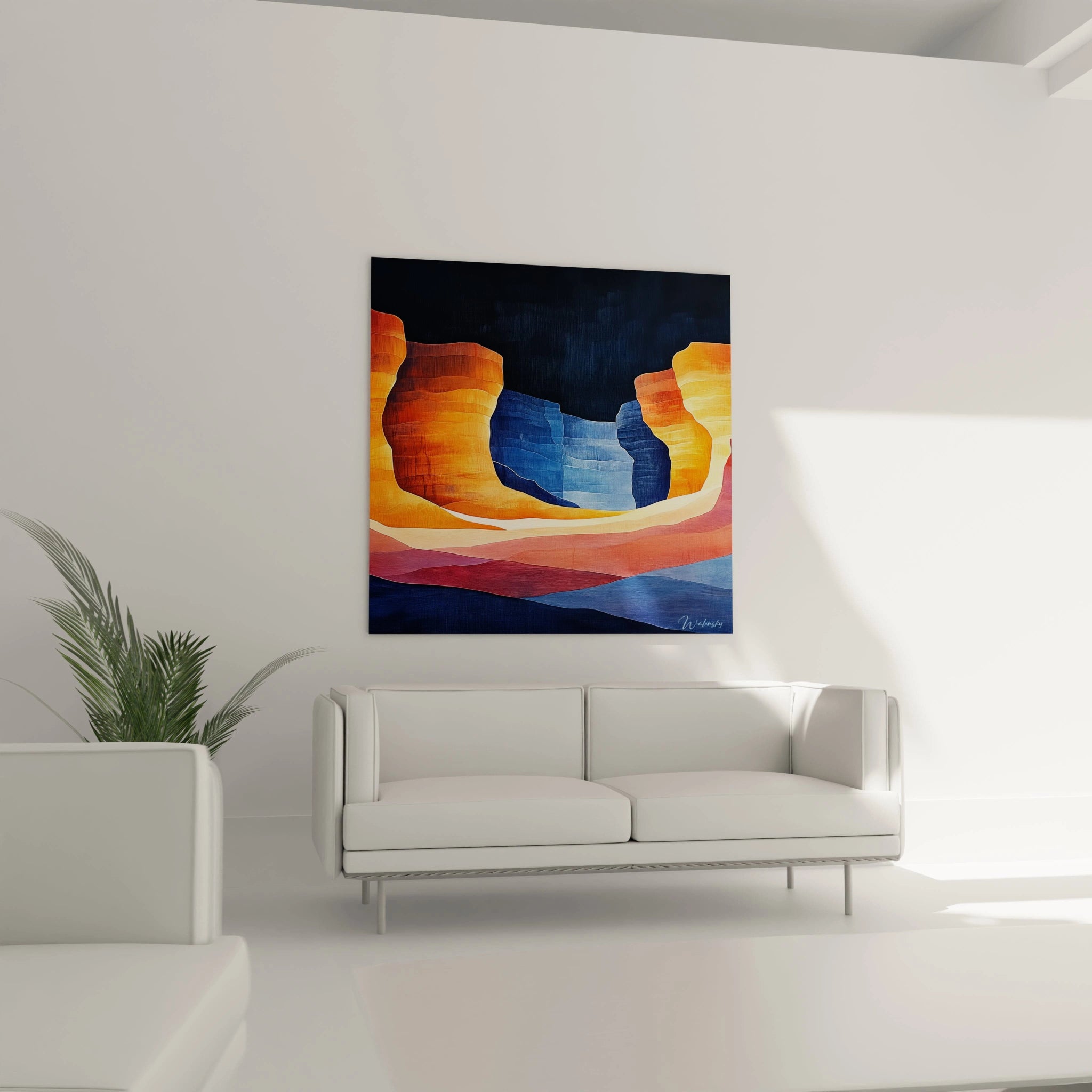
This rocky canyon painting will ideally find its place in a contemporary space with clean lines, where its vibrant colors can fully express themselves without visual competition. A neutral-colored wall (white, light gray or very pale beige) will constitute the ideal background to enhance its dazzling hues. The work will integrate perfectly into a living room, dining room or spacious entrance hall, where it can be admired both in its details and in its overall impact.
A directed light, preferably with a neutral color temperature (4000K), will reveal all the nuances of the work without distorting its colors. Avoid placing the canyon painting in direct sunlight to preserve the intensity of its colors. To complete the arrangement, favor furniture with simple lines in neutral tones that will not compete with the work. A few decorative accessories taking up the orange or blue of the painting will create visual continuity throughout the space.