


Hot Air Balloon Wall Art
Discover the magic of hot air balloons in flight through creations that capture aerial elegance and landscapes viewed from the sky. Each artwork celebrates the serenity of ascension, the shimmering colors of balloons, and the beauty of horizons soaring overhead. Perfect for dreaming of travel and escape, these wall pieces bring poetry and lightness to your décor. Transform your spaces into odes to peaceful freedom and contemplation of Earth's wonders from great heights.
 Vintage Hot Air Balloon Painting - Sunset Journey - Hot Air Balloon Edition273,90 €
 Hot Air Balloons at Sunset - Colorful Festival by the Water - Balloon Edition228,90 €
 Colorful Hot Air Balloons Above a Provençal Landscape - Mediterranean Flight - Balloon Edition273,90 €
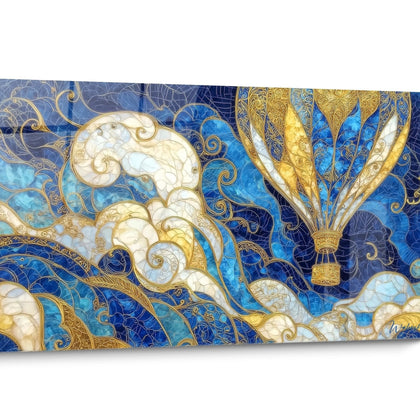
 Art Nouveau Hot Air Balloon Painting - Majestic Flight - Balloon Edition228,90 €
 Golden Ornamental Hot Air Balloon Painting - Celestial Journey - Balloon Edition273,90 €
In the same family
Also explore the theme Landscapes
-
 View all1531
artworks
View all1531
artworks
-
 Rainbow74
artworks
Rainbow74
artworks
-
 Architecture30
artworks
Architecture30
artworks
-
 Northern Lights32
artworks
Northern Lights32
artworks
-
 Other Landscapes117
artworks
Other Landscapes117
artworks
-
 Campaign51
artworks
Campaign51
artworks
-
 Cascade104
artworks
Cascade104
artworks
-
 Waterfalls12
artworks
Waterfalls12
artworks
-
 Lavender Fields7
artworks
Lavender Fields7
artworks
-
 Sky14
artworks
Sky14
artworks
-
 Starry Sky8
artworks
Starry Sky8
artworks
-
 Sunset37
artworks
Sunset37
artworks
-
 Desert82
artworks
Desert82
artworks
-
 Underwater Depths38
artworks
Underwater Depths38
artworks
-
 Forest148
artworks
Forest148
artworks
-
 Gorges and Canyons41
artworks
Gorges and Canyons41
artworks
-
 Natural Caves565
artworks
Natural Caves565
artworks
-
 Islands and Archipelagos55
artworks
Islands and Archipelagos55
artworks
-
 Jungle9
artworks
Jungle9
artworks
-
 Lakes77
artworks
Lakes77
artworks
-
 The World of the Sea189
artworks
The World of the Sea189
artworks
-
 Marine71
artworks
Marine71
artworks
-
 Sea77
artworks
Sea77
artworks
-
 Mountain304
artworks
Mountain304
artworks
-
 Ocean16
artworks
Ocean16
artworks
-
 Abstract Landscape25
artworks
Abstract Landscape25
artworks
-
 Lighthouses34
artworks
Lighthouses34
artworks
-
 Beach113
artworks
Beach113
artworks
-
 Ports19
artworks
Ports19
artworks
-
 Savanna5
artworks
Savanna5
artworks
-
 Tropics9
artworks
Tropics9
artworks
-
 Volcanoes57
artworks
Volcanoes57
artworks
-
 Aerial View17
artworks
Aerial View17
artworks


All about Hot Air Balloon Wall Art
- Presentation Hot Air Balloon Wall Art
- Symbolism and emotional impact
- Visual compositions and aerostatic perspectives
- Integration according to living spaces
A hot air balloon wall art instantly transforms your interior by inviting escape and travel. This mural representation of colorful aerostats captures the very essence of aerial adventure and the dream of elevation. Discover how these large-format works create unique atmospheres and revolutionize the spatial perception of your living spaces.
The evocative power of hot air balloons in mural decoration
Acquiring a hot air balloon wall art far exceeds a simple decorative gesture to become part of a deep psychological approach. These representations of aerostats floating in the skies trigger specific emotional reactions linked to our ancestral fascination with flight and the conquest of the skies. Unlike other wall decorations, hot air balloon imagery instantly activates our imagination linked to freedom, transcending terrestrial limits, and exploring new horizons.
Why do hot air balloons create such a particular atmosphere?
The answer lies in the universal symbolism of balloon flight, perceived as the most poetic and contemplative form of aerial travel. A painting representing large-format hot air balloons generates an ascending dynamic in the space, visually creating the illusion of a room with volumes enlarged upward. This impression of accentuated ceiling height remains exclusive to representations of flying objects in elevation, particularly aerostats which, unlike airplanes, suggest a gentle and meditative ascent. The warm tones traditionally associated with hot air balloon envelopes—solar yellows, bright reds, luminous oranges—diffuse positive energy comparable to that of a permanent sunrise in your interior.
The psychological impact of flight scenes on daily life
Neuroscience confirms that regular observation of hot air balloon representations positively influences our state of mind by stimulating brain areas associated with dreaming and mental projection. In a child's bedroom, a large-format hot air balloon painting becomes a catalyst for imagination, encouraging adventure narratives and nurturing curiosity for exploration. For adults, contemplating these suspended aerostats daily acts as a visual reminder of the importance of gaining perspective on daily challenges. This metaphor of physical elevation translates unconsciously into mental elevation.
Collectors of thematic travel wall decoration systematically favor representations of hot air balloons over other means of aerial transport. This preference is explained by the nostalgic and romantic dimension intrinsic to hot air balloons, evoking the first aerial adventures of the Montgolfier brothers in the eighteenth century. A painting depicting multiple hot air balloons flying over undulating landscapes or ancient cities creates a temporal bridge between our modern era and the golden age of aerostation, a period when each flight constituted a spectacular event attracting awestruck crowds.
Distinct effects according to flight configurations represented
A hot air balloon wall art presenting a solitary balloon in a vast sky generates a sensation of tranquility and solitary meditation, perfect for rest spaces such as adult bedrooms or reading corners. Conversely, a composition showing multiple colored aerostats in formation creates a festive and social dynamic, ideal for collective living spaces. Representations of hot air balloons at different altitudes—some ascending, others hovering, a few beginning their descent—visually tell a temporal narrative that keeps the eye in constant motion across the mural surface.
The presence of miniature characters in the baskets, though discreet on an imposing mural format, adds a crucial narrative dimension. These human silhouettes allow the viewer to mentally project themselves into the experience of hot air balloon flight, transforming passive observation into active imaginative journey. This psychological identification remains specific to hot air balloons, as their slow speed and moderate altitude make them more mentally accessible than representations of airplanes or other fast aircraft.
The involuntary color therapy of aerostatic palettes
Hot air balloon manufacturers traditionally use saturated primary colors and contrasting geometric patterns for reasons of aerial visibility. Transposed onto a large-format wall painting, these bold chromatic combinations act as energizing visual stimuli. A hot air balloon painting with dominant reds and yellows activates morning spaces by reinforcing the natural energy of sunrise, while compositions favoring deep blues and violets create soothing twilight atmospheres for nighttime spaces.
The purchase of a hot air balloon mural representation thus constitutes an investment in a specific atmosphere impossible to reproduce with other decorative themes. The unique combination of ascending symbolism, historical nostalgia, energizing palettes, and narrative potential makes the hot air balloon painting a powerful transformative element for any living space seeking to escape terrestrial ordinariness.
Visual compositions and unique perspectives of aerostatic scenes
Mural representations of hot air balloons obey specific visual codes that distinguish them radically from any other form of decoration. A large-format hot air balloon wall art systematically exploits the verticality of mural space to create compositions in atmospheric layering, mimicking the different altitude layers that hot air balloons actually traverse. This visual stratification—terrestrial ground at the bottom, intermediate flight zone, celestial vault at the top—generates exceptional depth of field that draws the eye upward and creates the illusion of a window open onto infinity.
How do viewing angles transform spatial perception?
The majority of hot air balloon paintings adopt an upward-looking perspective, positioning the viewer on the ground looking up at the aerostats. This compositional choice is never insignificant: it places the observer psychologically in a position of wonder, reproducing the authentic experience of spectators witnessing a hot air balloon flight. This upward-looking angle visually enlarges the perceived height of your room, a precious architectural effect in spaces with standard ceilings. Balloon envelopes occupying the upper portion of the frame seem literally to burst beyond the physical limits of the wall, creating an illusory extension of your living volume.
Some bolder compositions adopt an aerial view, showing hot air balloons flying over patchwork landscapes—fields, forests, miniaturized villages. This inverted perspective produces a radically different effect: it invites the viewer to mentally adopt the point of view of the aeronauts, transforming the mural space into a panoramic porthole over the world seen from above. These representations are particularly suited to spaces of reflection or work, as they subtly evoke the stepping back and comprehensive vision necessary for strategic decision-making.
Specific atmospheric elements in hot air balloon paintings
A hot air balloon wall art masterfully exploits atmospheric phenomena to create depth and movement. Clouds become essential altitude markers: fluffy cumulus clouds at mid-height suggest that some balloons fly below while others soar above them, thus creating three distinct planes in a two-dimensional composition. This atmospheric layering technique remains exclusive to aerostatic representations, as only hot air balloons evolve in this intermediate zone between earth and upper atmosphere, where cloud formations remain accessible and detailed.
Variations in celestial brightness constitute another major distinctive element. Paintings representing hot air balloons at sunrise or sunset capture spectacular chromatic gradients—from powder pink to deep purple, from burnished orange to midnight blue—which the curved surfaces of balloon envelopes reflect and amplify. These lighting effects create multiple focal points of luminosity on your wall, unlike compositions with a single light source. The eye naturally circulates from one illuminated balloon to another, maintaining prolonged visual engagement.
What decorative motifs on envelopes enrich the composition?
Historical and contemporary hot air balloons display a diversity of motifs—vertical stripes, checkerboards, spirals, color fields, national flags—that transform each aerostat into a unique graphic element within the overall composition. A hot air balloon wall art presenting five to seven different balloons thus offers visual richness comparable to a collection of individual works, while maintaining thematic coherence. This multiplicity of geometric motifs on spherical surfaces creates effects of texture and depth impossible to obtain with static subjects at ground level.
Cast shadows of hot air balloons on the landscapes below add a fascinating temporal dimension. Depending on the represented sun angle, these shadows stretch or condense, implicitly indicating the time of day and creating a visual link between the aerial balloons and the terrestrial world. This shadow-light dialogue between sky and earth anchors the composition in tangible physical reality despite the dreamlike character of the subject.
The management of proportions in monumental formats
On a large-format painting, the relative proportions between hot air balloons, clouds, horizon, and sky become critical to maintaining perspective realism. Foreground balloons must display visible details—ropes, basket, burners—while those in the background reduce to suggested colored shapes, creating a natural impression of atmospheric distance. This dimensional gradation guides the viewer's gaze through different depths of field, transforming a flat wall into a three-dimensional aerial landscape.
The most successful compositions integrate identifiable terrestrial elements—steeples, hills, waterways—that serve as scale reference and accentuate the impressive altitude of the aerostats. A hot air balloon painting showing balloons evolving above recognizable monuments simultaneously creates geographic anchoring and a sensation of travel, two complementary psychological dimensions that enrich the daily contemplative experience of the mural work.
Integration strategies for aerostatic representations according to living spaces
Installing a large-format hot air balloon wall art requires precise understanding of spatial dynamics specific to each environment. Unlike generic wall decorations, representations of hot air balloons interact specifically with the architectural verticality and natural luminosity of your rooms. The strategic positioning of these aerostatic works determines the amplitude of their transformative impact on the overall atmosphere of your interior.
Which placement optimizes the ascending effect in collective living space?
In a living room or family room, a hot air balloon painting finds its full expression on the main wall visible from the room's entrance. This welcoming position creates an effect of emotional surprise: the visitor instantly discovers a visual window open onto the skies, transforming their perception of confined space into a sensation of unlimited openness. For rooms with standard ceilings between two and three meters, favor a pronounced vertical format that visually amplifies ceiling height, balloon envelopes nearly touching the upper frame edge to suggest their continuation beyond architectural limits.
Living spaces bathed in natural light particularly benefit from hot air balloon paintings with luminous palettes—golden yellows, solar oranges, vermillion reds. These warm tones capture and reflect daylight, creating mobile points of brightness that evolve according to the sun's course. Conversely, north-facing rooms or naturally dark spaces illuminate with representations of hot air balloons against brilliant azure skies, artificially introducing the missing celestial luminosity. This chromatic compensation transforms an architectural disadvantage into a distinctive decorative opportunity.
Furnishing children's rooms with the aerostatic theme
A hot air balloon wall art in a child's bedroom activates spatial and narrative imagination in a unique way. Position the work facing the bed, creating thus the first and last visual stimulus of the day—an invitation to dream of adventure at bedtime, a promise of exploration upon waking. Compositions showing animals or characters in balloon baskets enrich narrative potential, transforming the wall into a support for invented stories. This interactive dimension remains exclusive to hot air balloons, as their slow speed and accessible appearance make them mentally


