


Mount Fuji Wall Art
Discover our Mount Fuji Wall Art collection in acrylic glass, a series of artworks that capture the majesty and serenity of this famous Japanese volcano. Each Mount Fuji artwork reveals enchanting landscapes, enhanced by precise details and deep nuances. Perfect for nature lovers and zen enthusiasts, this collection will bring a peaceful atmosphere to your interior. Immerse yourself in the fascinating world of Mount Fuji and transform your space into a visual sanctuary with these elegant and timeless creations.
 Beyond the Clouds Wall Art - Mount Fuji Asia Edition273,90 €
 Mist and Cherry Blossoms Wall Art - Asia Edition273,90 €
 Sacred Mountain Awakening Canvas - Mount Fuji Asia Edition273,90 €
 Mountain Soul Canvas - Mount Fuji Asia Edition273,90 €
In the same family
Also explore the theme Asia
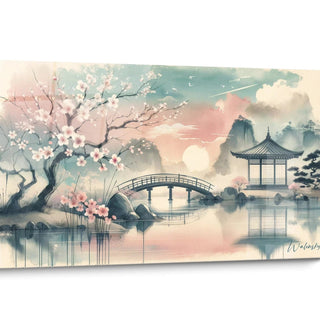


All about Mount Fuji Wall Art
- Mount Fuji Wall Art Mount Fuji
- Mount Fuji Wall Art Japanese Symbolism
- Mount Fuji Wall Art Zen Atmosphere
- Mount Fuji Wall Art Changing Seasons
Mount Fuji wall art represents far more than simple wall decoration. These captivating artworks instantly transport your interior to Japan's iconic landscapes, dominated by the majestic and instantly recognizable silhouette of Mount Fuji. A true national Japanese symbol, this sacred mountain has inspired artists worldwide for centuries.
Our Mount Fuji wall art stands out through its ability to radically transform your space's ambiance. Each representation captures a specific moment - whether Mount Fuji at sunrise, surrounded by cherry blossoms in bloom, or its imposing silhouette reflected in a peaceful lake. These artworks embody the perfect balance between natural grandeur and Japanese serenity.
Explore our collection to discover how these artworks can bring rich cultural dimension and a soothing atmosphere to your interior. Whether you're passionate about Japanese culture, an admirer of Asian art, or simply seeking a striking piece for your decor, our Mount Fuji wall art will transform your space with elegance.
Browse our different sections to explore the many facets of these exceptional works - their deep symbolism in Japanese culture, their ability to create a zen atmosphere, and how their seasonal representations can differently influence your living space.
Mount Fuji Wall Art: Embodiment of Japanese Symbolism in Your Interior
Mount Fuji wall art represents far more than a simple mountain image – it is the embodiment of a millennia-old Japanese cultural heritage that will radically transform your space's ambiance. This sacred mountain, venerated for centuries, brings with it all the symbolic richness of Japanese spirituality directly into your interior.
Why is Mount Fuji wall art considered a bearer of prosperity?
In Japanese tradition, Mount Fuji is deeply associated with longevity, stability, and prosperity. Integrating an artwork depicting this emblematic mountain into your living or working space is considered a means of attracting these positive energies. Traditional ukiyo-e prints featuring Mount Fuji were often offered as talismans of good fortune – a tradition our contemporary artworks perpetuate with elegance.
Representations of Mount Fuji retain this mystical aura that transcends mere decorative aspect. Placing such an artwork in a meeting or negotiation space is particularly propitious for reinforcing the atmosphere of success and stability sought in these professional contexts. For connoisseurs of Japanese art wall art, this symbolic dimension adds significant depth to their decorative choice.
The balance of elements in Mount Fuji wall art
Artistic representations of Mount Fuji stand out through their exceptional mastery of balancing natural elements. The mountain itself symbolizes stable earth, often juxtaposed with aquatic elements (lakes, rivers, waves), aerial elements (clouds, sky), and sometimes fiery elements (sunset, auroras). This harmony of contrasting elements creates characteristic visual tension that distinguishes these artworks from other landscape representations.
This particularity makes Mount Fuji wall art ideal pieces for spaces requiring balance and harmony. In an interior dominated by modern and technological elements, these works introduce a balancing natural presence. Conversely, in an already very natural space, they bring complementary structure and spiritual elevation.
The specific chromatic codes of Mount Fuji representations
Color palettes traditionally associated with Mount Fuji wall art follow precise codes that have crossed centuries. The deep blues of lakes and sky, the immaculate whites of the snow-covered peak, and touches of red (often associated with the rising sun or Japanese maples) form a powerful and immediately recognizable chromatic trinity.
These specific color combinations create a strong visual signature that subtly influences your space's chromatic ambiance. A Mount Fuji wall art with dominant cool tones will bring freshness and serenity to a warm, sunny room, while a representation with warm sunset tones over the mountain will visually warm a space with neutral or cool tones.
The influence of Japanese perspective on your spatial perception
Mount Fuji artworks often inherit unique composition techniques from traditional Japanese art. Unlike Western perspectives, Japanese representations play with multiple perspectives, superimposed planes, and a different relationship to empty space – the famous concept of "ma" (間).
This distinctive spatial approach subtly transforms your perception of the room where the artwork is displayed. A large Mount Fuji artwork using these perspective techniques can create an illusion of openness and depth in a confined space. Conversely, in a large room, these works can become visual anchor points that harmoniously structure the environment.
Mount Fuji art is part of the long tradition of "meisho-e" (paintings of famous places), where certain emblematic sites are depicted according to codified angles and framings. This approach transforms your wall into a portal to a place steeped in history and symbolism, deeply enriching your interior's spatial experience.
Mount Fuji Wall Art: Creators of Zen and Meditative Atmosphere
Mount Fuji wall art stands out through its unique ability to instantly transform the emotional acoustics of a space. Beyond their aesthetic dimension, these representations of Japan's sacred mountain act as genuine atmosphere modulators, inducing a sensation of profound calm and meditative contemplation that few other wall artworks can match.
How does Mount Fuji wall art influence breathing and heart rate?
The visual compositions of Mount Fuji wall art present a fascinating characteristic: their dominant horizontal lines and subtle gradations naturally guide the eye in a slow and regular movement. Studies in neuroesthetics suggest that this specific visual organization unconsciously influences our breathing rate, bringing it into synchronization with the horizontal lines of the represented landscape.
This subtle physiological modulation explains why spaces adorned with Mount Fuji wall art are particularly conducive to decompression after a stressful day. Unlike more dynamic or complex artistic representations that stimulate the nervous system, Mount Fuji panoramas invite physiological slowing, creating what interior designers call a "breathing space".
Minimalist representations of Mount Fuji and mental clarity
The Japanese artistic tradition has often represented Mount Fuji with remarkable economy of means – a few essential strokes capturing its iconic silhouette. This minimalist approach, inherited from zen aesthetics, provokes what environmental psychologists call a "mental clarity effect": the mind, confronted with a pared-down yet powerful image, naturally sheds superfluous thoughts.
Large Mount Fuji wall art with pared-down compositions thus constitute ideal pieces for spaces dedicated to reflection, meditation, or simply disconnection. Their presence creates a visual decompression zone that effectively contrasts with the information overload of our daily environments. This effect is particularly pronounced when the artwork is placed in a dominant position, creating a focal point that anchors attention without overstimulation.
The seasonality of Mount Fuji and its impact on interior atmosphere
A remarkable particularity of Mount Fuji wall art lies in its distinct seasonal representations, each influencing your space's atmosphere differently. Winter representations, with their dominant white and blue, bring a sensation of freshness and purity, ideal for compensating overheated or visually crowded environments.
Conversely, wall art depicting Mount Fuji in spring, often framed by cherry blossoms, introduces an energy of gentle renewal and vitality, particularly beneficial in transitional or transformational spaces like entryways or hallways. Autumn versions, with their warm tones of red maples contrasting with the blue-gray of the mountain, create a reflective atmosphere conducive to study or reading spaces.
The specific depth of field in Mount Fuji landscapes
Mount Fuji wall art generally presents spectacular depth of field, with several distinct planes staged from the foreground to the majestic mountain. This spatial visual structuring creates what interior architects call a "spatial expansion effect": the room appears to extend visually beyond its physical limits.
This characteristic makes Mount Fuji wall art strategic choices for confined spaces or windowless areas, such as certain offices or hallways. Unlike mirrors that create sometimes disorienting spatial illusion, these artworks offer spatial extension that remains anchored and directed, contributing to a sense of space without attention dispersion.
Large panoramic Mount Fuji formats particularly accentuate this effect, literally transforming an entire wall into an opening toward a soothing elsewhere. This ability to transcend physical spatial limits constitutes one of the unique signatures of artworks depicting this emblematic mountain, distinguishing them radically from other types of landscape representations.
Mount Fuji Wall Art: The Art of Seasonal Metamorphosis
Mount Fuji wall art stands out through its unique ability to capture the seasonal metamorphoses of this Japanese natural monument. Unlike other landscape representations, it offers exceptional temporal narrative richness, transforming your interior space according to the represented seasons and the emotions they evoke.
How do "Red Fuji" artworks transform your space perception?
Representations of "Red Fuji" (Akafuji) – capturing the mountain at sunrise when it takes on a reddish glow – constitute a specific sub-genre of Mount Fuji wall art. This rare and spectacular chromatic variation is considered particularly propitious in Japanese tradition.
These artworks with dominant reds and oranges create a psychological effect of activation and dynamism in the space where they are displayed. Perfect for zones dedicated to creativity or social exchanges, they instill subtle yet perceptible energy. Unlike more classical representations with blue tones, these works visually warm the ambiance and are particularly effective in spaces with cold lighting or light walls.
"Snow-Covered Fuji" wall art and their influence on perceived temperature
Artworks depicting Mount Fuji beneath its snowy mantle (Yukifuji) possess a fascinating visual thermoregulatory quality. Studies in environmental psychology have demonstrated that the presence of snowy landscapes in a space can reduce perceived temperature by 1 to 2 degrees Celsius, a phenomenon known as the "cognitive cooling effect".
This property makes snow-covered Mount Fuji wall art strategic choices for naturally warm spaces or south-facing rooms. They effectively counterbalance excessive heat without resorting to air conditioning, creating an impression of natural freshness. To maximize this effect, choose large formats that occupy a significant portion of your visual field.
The impact of "Spring Mount Fuji" representations on your seasonal well-being
Artworks illustrating Mount Fuji surrounded by cherry blossoms (Harunofu) play a particular therapeutic role during winter months. This specific variant of Mount Fuji wall art can help mitigate symptoms of seasonal affective disorder by introducing spring visual markers into the environment.
Strategically placed in daily living spaces, these artworks act as "alternative seasonal windows", offering visual connection with a different season than the one experienced outside. This controlled seasonal dissonance can be particularly beneficial in regions with long, dark winters, bringing compensatory luminosity and chromatic liveliness.
"Misty Mount Fuji" wall art and visual density modulation
Representations of Mount Fuji enveloped in mist (Kasumifuji) possess a unique quality of modulating a space's visual density. Unlike artworks with sharp outlines that clearly define and delimit space, these works with diffuse outlines create what interior designers call "permeable boundaries".
This characteristic makes them ideal choices for transitional spaces like entryways or hallways, where they soften the passage between different functional zones. In large open spaces, these artworks can also serve to create soft visual separations without resorting to physical partitions, subtly structuring space while preserving its fluidity.
FAQ on Mount Fuji Wall Art
What is the ideal size for Mount Fuji wall art in a modern living room?
For a modern living room, choose large-format Mount Fuji wall art (120-150 cm minimum width) to create genuine visual impact. The iconic silhouette of the mountain retains its power even at distance, allowing you to appreciate the artwork from different room points. For optimal panoramic effect, select a format whose width is at least 1.5 times its height.
Is Mount Fuji wall art suitable for professional spaces?
Mount Fuji wall art is particularly appropriate for professional environments seeking both prestige and serenity. Their symbolism of stability and permanence subtly reinforces a company's image of solidity, while their soothing aesthetics favor concentration and reduce ambient stress. They are particularly effective in meeting rooms and reception areas.
How do I maintain Mount Fuji wall art to preserve its colors?
To preserve your Mount Fuji wall art's color brilliance, avoid direct sun exposure that accelerates fading. Regular dusting with a soft feather duster is generally sufficient for routine maintenance. In case of staining, use only a cloth slightly dampened with demineralized water, avoiding chemicals that could alter the pigments. Application of protective varnish every 5-7 years by a professional will considerably extend your artwork's lifespan.
L'art qui suscite l'envie
Maison belge d'art mural grand format
14 jourspour changer d'avis*
Protection Walenskyincluse
Fabriquéen Italie
FormatXXL
Kit de fixationtoujours fourni
* Hors tableaux personnalisés et tailles personnalisées


