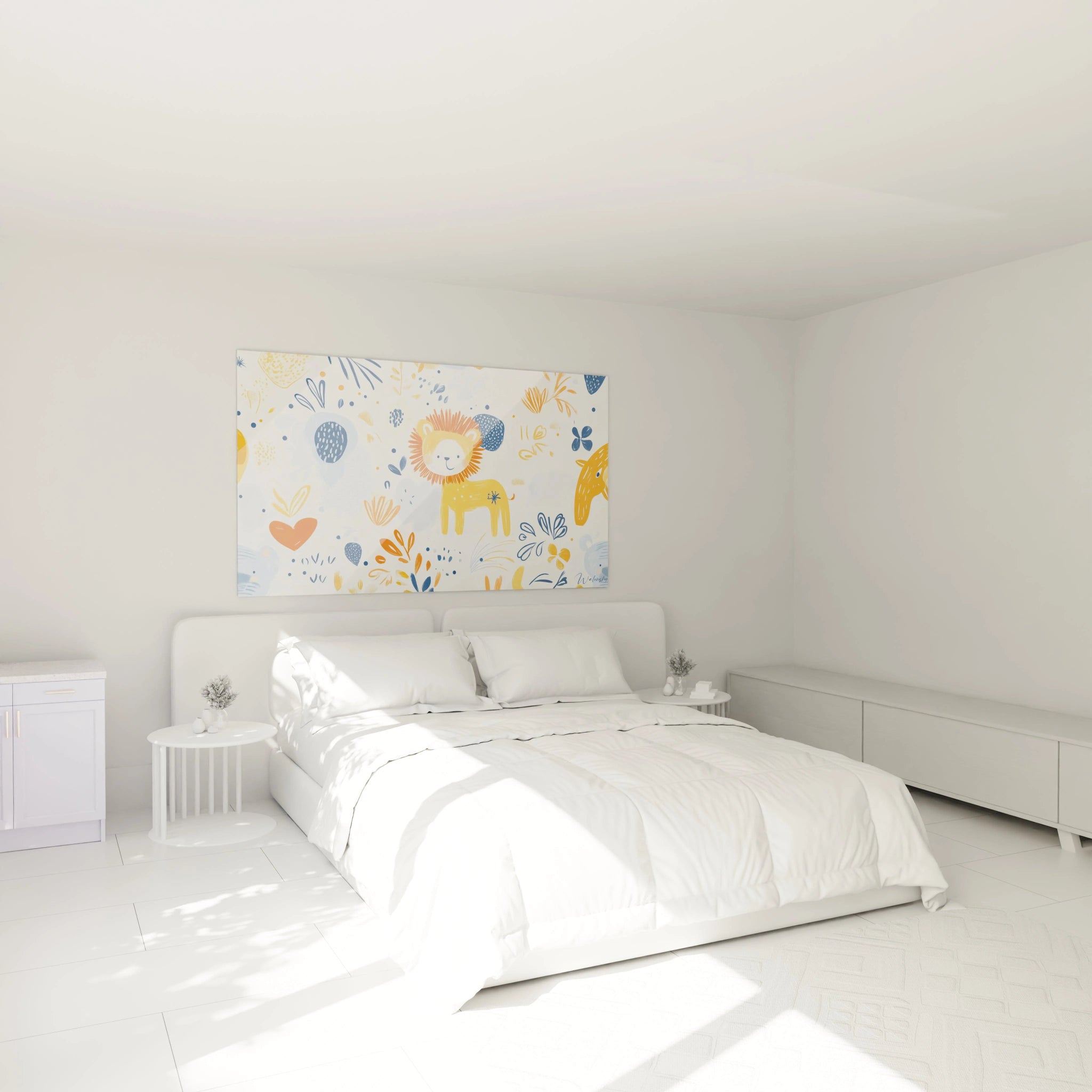
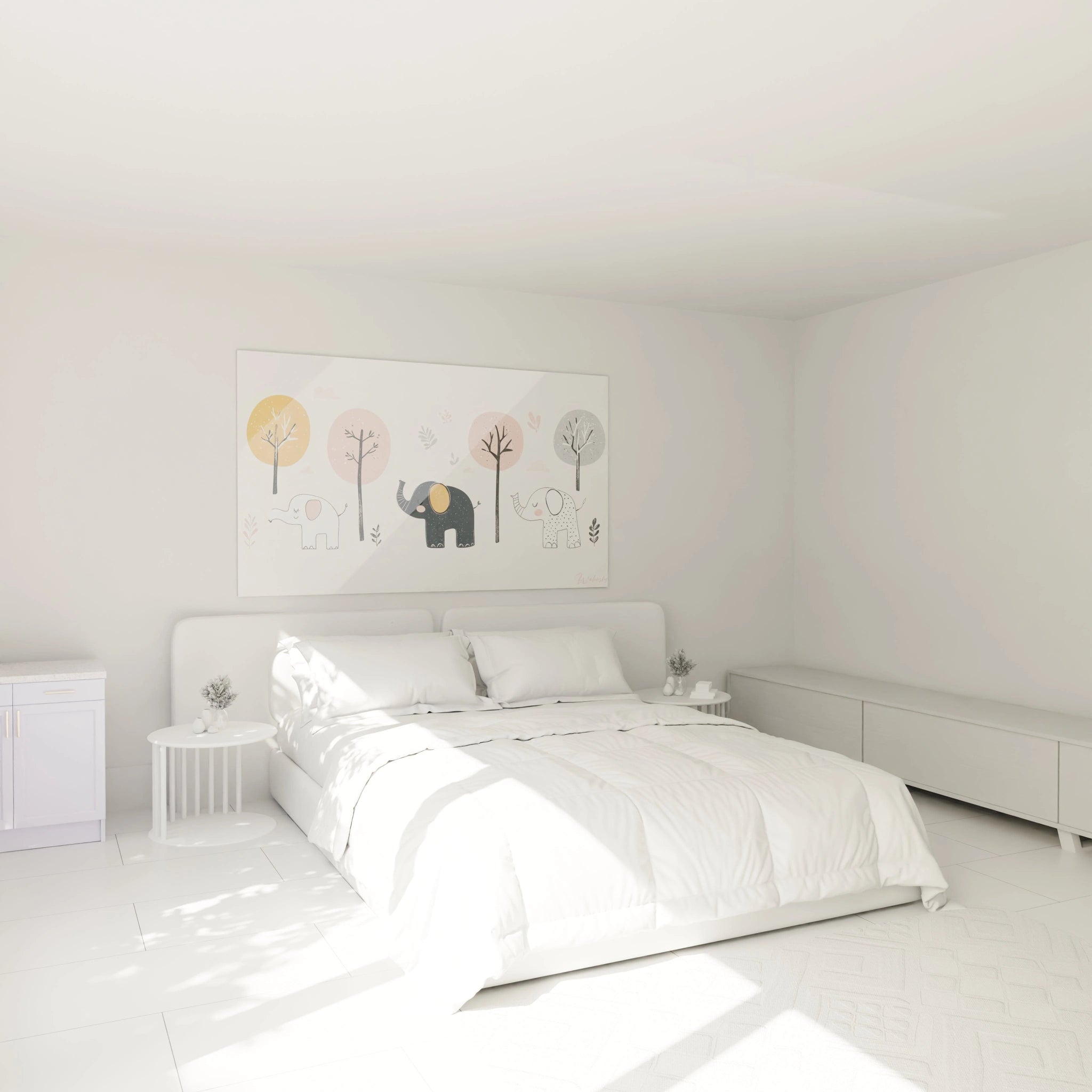
- Children's drawing artwork overview
- Children's drawing artwork for creative development
- Children's drawing artwork and artistic growth
- Children's drawing artwork in playful spaces
Children's drawing artwork represents far more than a simple developmental accessory - it's a space for personal expression that stimulates imagination while developing fine motor skills. Specifically designed for small hands, this playful learning support offers an ideal surface for your child's first strokes, scribbles, and artistic creations.
Unlike traditional supports such as paper, children's drawing artwork offers a reusable surface that encourages unlimited experimentation and regular practice of graphic skills. Its robust design resists the sometimes abrupt movements of young artists, while its adapted dimensions allow the freedom of movement essential for developing hand-eye coordination.
Discover in the following sections how this educational tool promotes creative development, supports artistic growth, and transforms any space into a genuine creative workshop for children. You'll also find our tips for seamlessly integrating this artwork into your child's room and maximizing its educational potential while preserving your interior aesthetics.
Children's drawing artwork: Essential catalyst for creative development
Children's drawing artwork constitutes a fundamental tool in the creative flourishing of the youngest. Unlike traditional surfaces, this specially designed support offers an expression space that stimulates imagination while accompanying different phases of artistic learning. Let's explore together why this type of artwork represents a true springboard for children's creativity.
Why does children's drawing artwork stimulate expression more than classical supports?
The verticality of children's drawing artwork radically transforms the artistic experience. This standing position engages different muscle groups and encourages freedom of movement impossible to achieve on a horizontal surface. Young artists can thus perform broad gestures that simultaneously develop their overall motor skills and graphic expression. This vertical configuration also allows natural distance from the work being created, developing more sophisticated spatial perception from an early age.
The amplitude of movements permitted by a
large-format children's artwork promotes artistic disinhibition. Freed from small-format constraints, children explore more dynamic strokes and develop increased confidence in their graphic expression. This gestural freedom helps reduce creative blocks often observed on more restrictive supports.
The sensory dimension also plays a crucial role. The contact between chalk or markers and the artwork surface creates distinctive friction that provides immediate tactile feedback. This slight resistance intuitively guides the child's gesture and helps them better control their stroke, unlike the sometimes overly fluid glide of pencil on paper.
The specific cognitive benefits linked to regular use of children's drawing artwork
Regular use of children's drawing artwork generates remarkable and often little-known cognitive advantages. The vertical position of the artwork specifically activates certain brain areas associated with spatial planning. By drawing standing before an artwork, the child must constantly adapt their movements and anticipate available space, thus developing essential planning skills for future mathematical reasoning.
The erasable nature of the artwork encourages iteration and perseverance. Unlike a sheet of paper thrown away after a mistake, the artwork allows successive modifications that naturally teach the trial-and-error method. This approach develops creative resilience and habitualizes the child to perceive errors as learning steps rather than failures.
The imposing size of the artwork also facilitates the development of visual storytelling. The available space allows children to create sequential stories in multiple scenes, thus stimulating their narrative abilities. This practice establishes neural connections between visual and verbal expression, strengthening the foundations of future literacy.
How to effectively integrate children's drawing artwork into daily learning routines
Strategic integration of children's drawing artwork into the daily environment maximizes its educational impact. Placed at adapted height in a frequently-used passage area, it invites spontaneous creative sessions that are often the most fruitful. Unlike scheduled activities, these moments of free expression capture the child's natural inspiration and reinforce the association between creation and pleasure.
Regular rotation of available drawing tools maintains interest and stimulates technical exploration. Alternating between colored chalk, erasable markers, and even special pastels encourages children to discover different stroke qualities and visual effects. This technical diversity progressively broadens their graphic vocabulary and refines their artistic sensitivity.
The creation of an "ephemeral gallery" transforms the artwork into temporary exhibition space. Before erasing a particularly successful creation, take time to celebrate it, discuss the techniques used, and encourage the child to explain their artistic intentions. This ritual values the creative process while developing verbal expression abilities and self-confidence.
Children's drawing artwork can also serve as support for thematic learning. To explore seasons, geometric shapes, or the alphabet, propose targeted creative challenges that transform these abstract concepts into concrete visual experiences. This multisensory approach deeply anchors knowledge while maintaining a playful format that preserves intrinsic motivation.
In conclusion, children's drawing artwork transcends its primary function as a simple expression support to become a genuine development tool. Its positive influence extends well beyond artistic skills, touching cognitive, emotional, and social development. By judiciously integrating this artwork into your child's daily environment, you offer them a powerful learning catalyst whose benefits will manifest throughout their educational journey.
Children's drawing artwork: Supporting each stage of artistic evolution
Children's drawing artwork represents far more than a simple creative support - it's a privileged witness to the graphic and artistic evolution of the youngest. Through different developmental phases, this artwork naturally adapts to the changing needs of the child, offering an expression space that evolves with them. Let's explore together how this unique support accompanies the fascinating transformations of children's graphic language.
The evolution of strokes by age: how children's drawing artwork adapts to different phases
Between 18 months and 3 years, children discover the pleasure of graphic gesture through pendular and circular movements. At this stage, children's drawing artwork offers ideal resistance that allows these first creative impulses to materialize. The verticality facilitates these broad, rhythmic movements, while the generous surface welcomes without constraint the exploratory scribbling characteristic of this phase.
From 3 to 5 years, shapes begin to emerge and the child enters the period of "tadpole figures". The artwork then becomes the confidant of these first symbolic representations. Its adjustable height allows accompanying the child's physical growth, while its erasable surface encourages multiplying attempts without fear of error, thus accelerating the development of graphic precision.
Between 5 and 7 years, a genuine representational revolution occurs. Drawings gain in details and increasingly respect real proportions. Children's drawing artwork then reveals its full potential by offering the necessary space for these increasingly elaborate compositions. Children particularly appreciate the possibility of working by zones, organizing their creation with new spatial intention that testifies to their cognitive maturation.
After 7 years, critical awareness awakens and the child seeks to perfect their techniques. The artwork supports this evolution by allowing erasing and restarting without frustration, thus promoting artistic perseverance. Its surface can also welcome preliminary sketches then successive layers of details, naturally initiating the child to sketching techniques used by confirmed artists.
How does children's drawing artwork support the development of hand-eye coordination?
Hand-eye coordination constitutes a fundamental skill whose optimal development will influence the child's entire educational journey. Children's drawing artwork plays a determining role in this acquisition thanks to several distinctive characteristics.
The vertical position of the artwork substantially modifies motor challenges compared to horizontal drawing. The child must maintain their arm at constant height while controlling the pressure and orientation of their tool. This configuration intensely solicits stabilizer muscles and develops fine proprioception - body awareness in space - essential for graphic precision.
The distance between eye and hand imposed by the artwork is also greater than on a sheet, obliging the child to develop more sophisticated visuo-motor coordination. This particularity indirectly prepares for skills necessary for handwriting, where coordination between gaze and gesture must be perfectly synchronized.
The trajectory of movements on an artwork involves the shoulder and elbow articulation more than table drawing. This mobilization of large articulations strengthens the motor bases that will later allow refinement of more precise wrist and finger movements. This natural progression from global to specific respects the laws of neuromotor development.
Graphic markers revealing maturity visible only in large format
Children's drawing artwork, through its generous dimensions, illuminates developmental indicators often invisible in standard formats. These graphic markers constitute precious witnesses to the child's cognitive and motor maturation.
Global spatial organization represents one of these privileged indicators. In a large format, the child must manage the entire available space, revealing their ability to plan and structure their creation. The evolution of this competence - from random filling toward compositional balance - becomes particularly observable on the artwork, offering parents a concrete glimpse of their child's conceptual development.
The consistency of proportions between different drawn elements constitutes another significant marker. On an artwork, the child has the necessary space to develop this proportional awareness, a fundamental skill that testifies to maturing spatial perception and abstract reasoning abilities.
Thematic persistence - ability to maintain and develop a single subject across the entire creation - also becomes measurable in large format. This aptitude, invisible in small supports that only accommodate isolated representations, reveals the development of sustained attention and narrative thinking, crucial skills for future structured learning.
From spontaneous expression to mastered technique: stages facilitated by the artwork
The artistic journey of the child follows a natural progression that children's drawing artwork accompanies with unique relevance. This evolution manifests through subtle but significant transitions in creative approach.
The transition from impulsive gesture to intentional stroke constitutes the first fundamental stage. The artwork, through its specific resistance and vertical format, allows the child to physically feel the consequences of their movements. This bodily awareness accelerates the passage from exploratory scribbling to first deliberate strokes, a crucial stage in developing graphic expression.
The evolution from monochrome to strategic color use represents another significant progression. The ample artwork surface encourages children to experiment with different color combinations and progressively develop a personal chromatic language. This visual exploration stimulates the development of neural connections associated with fine visual discrimination.
The transition from symbolic representation to realistic representation perhaps constitutes the most visible transformation. Children's drawing artwork, through its capacity to welcome successive and evolving creations, allows observing this graphic maturation in real time. The possibility of erasing and restarting encourages the child to refine their techniques until achieving personal satisfaction, thus developing critical sense and artistic perseverance.
In conclusion, children's drawing artwork reveals itself as far more than a simple creative support - it's a true revealer of the child's overall development. By offering the space necessary for expression at each stage of graphic maturation, it harmoniously accompanies the evolution of motor, cognitive, and emotional abilities. Observing successive creations on this artwork allows parents and educators to concretely appreciate progress made and adapt their support to the specific needs of each young aspiring artist.Children's drawing artwork: Transforming playful space into permanent creative workshop
Integrating children's drawing artwork into living space fundamentally transforms the child's relationship with their daily environment. Beyond a simple decorative accessory, this creative support becomes a structuring element that influences play dynamics, stimulates autonomy, and enriches the spatial experience of the youngest. Let's explore together how this educational tool reconfigures playful space into a genuine permanent creative workshop.
Layout strategies to maximize the impact of children's drawing artwork in the bedroom
The strategic placement of children's drawing artwork greatly determines its frequency of use and educational impact. Contrary to common ideas, the ideal position is not necessarily an isolated wall, but rather an area of transition regularly frequented. This location favors spontaneous micro-creative sessions which, accumulated, constitute a powerful learning lever.
Lighting represents an often-neglected but fundamental factor. An insufficiently lit artwork limits not only visual comfort but also precise perception of colors and nuances. Installing non-glare directional lighting, ideally oriented at 45° to avoid reflections, transforms the creative experience by minimizing visual fatigue and revealing all subtleties of children's creations.
The area around the artwork deserves particular attention. Setting up an accessible storage space, incorporating transparent containers for chalk, markers, and other creative tools, promotes autonomy and responsibility. This visual organization of resources also stimulates preliminary project planning, a valuable executive skill for all future learning.
Creating an "inspiration zone" adjacent to the artwork significantly amplifies its pedagogical potential. This dedicated space can accommodate reference images, particularly successful previous creations, or regularly renewed graphic challenges. This device nourishes imagination while proposing structured progression of artistic explorations.
How does children's drawing artwork modify social interactions in playful space?
Children's drawing artwork, through its shareable nature, profoundly redefines relational dynamics in playful space. Unlike individual supports that isolate each child in their creation, the artwork naturally promotes collaborative creation and develops essential social skills through artistic expression.
The experience of simultaneous drawing by multiple people transforms creative approach into a spatial negotiation exercise. Children intuitively learn to respect others' space while defending their own, establishing flexible boundaries that evolve as creation progresses. This practice develops social adaptation skills transferable to many life situations.
The artwork also promotes learning through direct observation, a fundamental mechanism of skill acquisition in children. By observing the techniques and approaches of peers or adults on the same support, children naturally integrate new graphic strategies they wouldn't have discovered alone. This social dimension of learning significantly accelerates artistic development.
The vertical dimension of the artwork also modifies the posture of accompanying adults. Rather than leaning over the child as in table drawing, the adult naturally positions themselves beside the young creator, establishing a more egalitarian relationship conducive to authentic exchanges. This spatial configuration facilitates verbal interactions during creative activity, simultaneously enriching vocabulary and expressive skills.
The seasonal evolution of the artwork: thematic adaptations to maintain interest
To preserve its power of attraction over the long term, children's drawing artwork benefits from a dynamic approach aligned with the year's natural rhythms. This planned evolution transforms a static piece of equipment into a constantly renewed learning device.
Seasonal renewal of drawing tools constitutes an effective first strategy. Introducing chalk in autumn colors in September, metallic markers during winter period, or natural pigments in spring creates correspondence between external sensory experience and internal artistic expression. This consistency reinforces the child's temporal anchoring while regularly stimulating technical curiosity.
Adapting visual framing according to seasons also amplifies creative engagement. Temporarily adding thematic decorative frame, seasonal visual guides, or scenographic elements around the artwork transforms overall aesthetic experience. This periodic metamorphosis of the creative environment stimulates new graphic explorations by suggesting varied visual universes.
Proposing creative challenges aligned with annual events also maintains sustained interest dynamics. By synchronizing certain directed activities with calendar highlights or significant family/school moments, the artwork becomes space for creative celebration of meaningful moments. This contextualization of artistic projects grants them particular emotional and memorial dimension that's especially motivating.
The seamless integration of children's drawing artwork into the room's overall aesthetic
Far from being a disruptive element in a child's room's decorative harmony, children's drawing artwork can become an aesthetic focal point that valorizes the entire space. This successful integration rests on several interior design principles adapted to this equipment's specific constraints.
Chromatic coordination between the artwork frame and the room's structural elements creates soothing visual continuity. By choosing a frame whose tint responds to baseboards, door handles, or other architectural elements, the artwork naturally inscribes itself in existing visual language. This subtle harmonization preserves aesthetic coherence while valorizing the space's creative function.
The "evolving picture rail" concept transforms the area adjacent to the artwork into a genuine personal gallery. Installing a simple hanging system allows temporarily displaying the most significant creations before they join a more permanent portfolio. This visual validation valorizes artistic expression while creating a visually stimulating environment that evolves at the pace of productions.
Integrating the artwork into a coherent "creative ecosystem" amplifies its aesthetic and functional value. By associating it with complementary elements - coordinated storage shelf, matching adjustable stool, or integrated lighting fixture - the artwork becomes the central element of a harmonious ensemble dedicated to creation. This global approach reinforces space identity while facilitating daily use.
FAQ on children's drawing artwork
At what age can children's drawing artwork be installed in a bedroom?
Children's drawing artwork can be installed once the child stands stably, generally around 18-24 months. At this age, the artwork's vertical position perfectly corresponds with the natural need for movement and exploration. Simply ensure installation at adapted height and choose drawing tools appropriate for age (dust-free chalk for youngest, erasable markers for older children).
How to efficiently clean children's drawing artwork without damaging it?
The cleaning method depends on artwork type. For magnetic whiteboard artwork, use specific cleaner or a mixture of water and isopropyl alcohol (70%) on microfiber cloth. For chalk artwork, favor slightly damp cloth followed by dry wiping. Avoid abrasive products that would scratch the surface and progressively diminish future drawing quality.
What is the ideal size of children's drawing artwork according to age?
Optimal size evolves with age: for 2-4 year-olds, approximately 60x45cm artwork matches their movement amplitude. For 4-7 year-olds, favor 80x60cm format accompanying their more elaborate graphic development. Beyond 7 years old, large 100x70cm format or greater offers necessary space for complex and detailed compositions characterizing this developmental period.
In conclusion, children's drawing artwork transcends its primary function as expression tool to become a genuine architect of playful space. Its influence extends far beyond moments dedicated to drawing, structuring the child's physical and relational environment. By carefully considering its spatial, temporal, and aesthetic integration, this creative support deploys its full transformative potential, making every space it inhabits a permanent laboratory of exploration and expression.