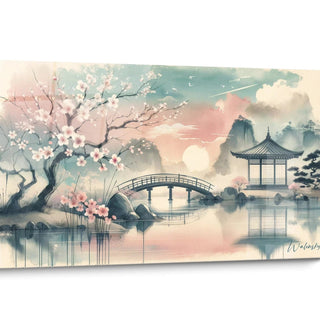
- Traditional Asian Wall Art Presentation
- Traditional Asian Wall Art and Ancestral Symbolism
- Traditional Asian Wall Art and Modern Feng Shui
- Traditional Asian Wall Art and Noble Materials
Traditional Asian wall art represents much more than simple wall decoration – it is a reflection of a rich artistic history spanning millennia that continues to captivate art and interior design enthusiasts worldwide. These exceptional works distinguish themselves through ancestral techniques, profound symbolism, and their ability to radically transform the atmosphere of any space.
Each traditional Asian wall artwork tells a unique story, transmitting the values, beliefs, and aesthetics of the civilizations that created them. Whether Japanese ink paintings, Chinese compositions on silk, or traditional Korean illustrations, these creations are characterized by exceptional execution finesse and incomparable philosophical depth.
In contemporary decorative art, these artworks depicting sacred animals such as cranes, koi fish, or tigers occupy a privileged place. They bring not only aesthetic dimension but also symbolic meaning, often associated with prosperity, longevity, or protection.
These wall art pieces stand out for their ability to create a bridge between tradition and modernity, offering powerful visual presence that transcends eras without ever becoming outdated. Their integration into contemporary interiors testifies to their remarkable adaptability and timeless evocative power.
Discover through our various sections the fascinating specificities of traditional Asian wall art, their profound meanings, and how to harmoniously integrate them into your space to create an atmosphere infused with serenity and timeless elegance.
Ancestral Symbolism in Traditional Asian Wall Art
Traditional Asian wall art fundamentally distinguishes itself from other artistic styles through its rich symbolic language developed over millennia. Unlike often-literal Western representations, traditional Asian wall art communicates through a complex system of symbols where each element carries profound significance rooted in Oriental philosophies.
What hidden meanings do the motifs in traditional Asian wall art carry?
In the universe of traditional Asian wall art, the dragon symbolizes far more than a simple mythological creature – it represents imperial power, good fortune, and divine protection. Unlike Western dragons often depicted as threatening, this majestic figure embodies benevolent forces when adorning your walls, bringing luck and prosperity to your home.
The misty mountain, a recurring motif in traditional Asian wall art, transcends simple landscape representation to evoke permanence, meditation, and spiritual elevation. These compositions with subtle lines invite contemplation and create a unique meditative atmosphere in contemporary spaces.
The cherry blossoms (sakura) that adorn certain traditional Japanese wall artworks perfectly illustrate the philosophy of "mono no aware" – that poignant awareness of impermanence. Their ephemeral beauty reminds us of life's fragility and invites appreciation of the present moment, offering exceptional philosophical depth to your interior decoration.
Specific color codes in traditional Asian wall art
Unlike Western palettes, traditional Asian wall art privileges a chromatic approach where each hue carries precise cultural significance. Vermilion red, omnipresent in Chinese works, symbolizes luck and vitality, while the deep blue of Korean artworks evokes stability and serenity.
Traditional Asian wall art is also characterized by masterful use of void and negative space – a fundamental concept absent from Western pictorial traditions. These unpainted spaces do not represent absence but rather invisible presence, inviting the viewer's imagination to complete the work in a unique contemplative interaction.
- Red symbolizes joy, luck, and prosperity in traditional Chinese wall art
- Black represents depth, mystery, and the essence of all things in Japanese art
- Gold evokes divine light and spiritual wealth in Buddhist artworks
- White suggests purity and mourning in certain Asian pictorial traditions
Spatial arrangement in traditional Asian wall art reflects Oriental cosmological principles, where balance between opposing forces (yin and yang) guides composition. This approach creates immediately recognizable unique visual dynamics deeply anchored in Taoist philosophy.
The influence of seasons in traditional Asian wall art iconography
Each traditional Asian wall artwork representing the seasons transcends simple temporal illustration to evoke specific emotional and spiritual states. Autumn, with its glowing red maple leaves, symbolizes the melancholic beauty of time's passage, while winter evokes the necessary rest before renewal.
Bamboo representations, omnipresent in traditional Asian wall art, perfectly illustrate resilience and flexibility – qualities highly valued in Oriental philosophy. These wall artworks transmit profound life teachings through images of timeless elegance.
Unlike other types of decorative wall art, traditional Asian wall art often integrates calligraphy as a central artistic element, thus fusing image and text in perfect harmony. This particularity offers dual reading where poem and image complement each other to create a multidimensional aesthetic experience.
Famous traditional Asian wall artworks such as Hokusai's "The Great Wave off Kanagawa" or "shanshui" landscape paintings are not simple representations but philosophical interpretations of the relationship between humanity and nature, offering conceptual depth rarely matched in other artistic traditions.
Integration of Traditional Asian Wall Art According to Feng Shui Principles
Traditional Asian wall art occupies a central place in authentic Feng Shui practice, far beyond simple decorative elements. Unlike other wall artworks, they function as genuine energy activators capable of significantly influencing Chi (vital energy) flow in your living or working space.
In the ancient science of Feng Shui, traditional Asian wall artworks depicting specific mountainous landscapes are strategically placed in the north zone of your home to activate career energy and life path. This precise application differs radically from intuitive hanging usually associated with other artistic styles.
How to position your traditional Asian wall art according to your personal Bagua?
Positioning traditional Asian wall art according to your personalized energy map (Bagua) represents a sophisticated approach exclusive to this type of wall art. By analyzing your birth date and the favorable orientations derived from it, you will discover specific locations where these works amplify your personal energy rather than simply decorating your space.
Traditional Asian wall artworks featuring koi fish swimming symbolically against the current are particularly recommended in the abundance zone (southeast) according to authentic Feng Shui principles. This specific application activates energies of perseverance and financial success in a way other artistic representations cannot match.
- East Zone: Traditional Asian wall art of bamboos or plants to stimulate family growth
- South Zone: Phoenix or sun representations to reinforce social recognition
- North Zone: Aquatic landscapes to smooth professional advancement
- Northwest Zone: Portraits of masters or mentors to attract collaboration opportunities
In sophisticated residential Feng Shui application, traditional Asian wall artworks depicting cranes in flight are specifically recommended for communication zones (west) to facilitate harmonious exchanges between family members. This targeted use far exceeds the simple decorative function usually associated with wall artworks.
Which representations should be avoided in certain zones according to authentic Feng Shui?
Unlike simplified Western beliefs, not all traditional Asian wall art suits every zone of your home. Representations of tumultuous waterfalls, though visually impressive, should be avoided in sleeping areas as they create energy agitation incompatible with restorative rest according to authentic Feng Shui precepts.
Traditional Asian wall artworks depicting snowy winter landscapes introduce the Water element in its crystallized form, creating refined energy vibration particularly beneficial in meditation or study spaces. This specific application generates an atmosphere conducive to contemplative concentration rarely achieved with other wall art styles.
In advanced Feng Shui application, traditional Asian wall artworks illustrating Mount Fuji or other sacred mountains are considered powerful energy anchors that stabilize the atmosphere of overly "yang" (active) spaces. This balancing function far exceeds the purely aesthetic aspect generally associated with decorative wall art.
Traditional Asian wall artworks incorporating peony or lotus flower representations manifest abundance and spiritual elevation energies when placed in the southwest zone, seat of harmonious relationships according to traditional Bagua. This specific energy activation represents sophisticated use absent from conventional artwork hanging.
For people born under certain signs of the Chinese zodiac, traditional Asian wall artworks depicting their antagonistic animal can create subtle but real energy tensions in their daily environment. This complex astrological consideration illustrates the depth of interactions between Asian wall art and personal energetic well-being.
Traditional Asian wall artworks featuring the Big Dipper constellation possess particular protective properties against negative influences when placed in your home's main entrance. This specific protective application testifies to the profound functional dimension of this wall art beyond its evident aesthetic value.
Noble Materials and Authentic Techniques of Traditional Asian Wall Art
Traditional Asian wall art fundamentally distinguishes itself from other wall artworks through unique supports developed over centuries. Unlike Western creations, these exceptional works use Japanese washi rice paper or Chinese Xuan paper, endowed with incomparable absorption properties that enable the creation of subtle gradations impossible to reproduce on other mediums.
Authentic production of inks used in traditional Asian wall art involves an ancestral process of calcination of specific pines and selected resins, then their mixture with natural binders according to jealously guarded proportions. This complex alchemy confers exceptional depth and longevity to works that modern inks cannot match.
Why do traditional inks give traditional Asian wall art its unique depth?
Genuine Chinese ink (sumi) used in traditional Asian wall art possesses up to 70 perceptible shades of black, creating tonal richness inaccessible to modern mechanized productions. This extraordinary tonal variety enables atmospheric representations of incomparable subtlety, particularly in the misty mountainous landscapes so characteristic of this art.
Mineral pigments extracted from semi-precious stones like lapis lazuli or malachite confer traditional Asian wall art with internal luminosity that evolves according to ambient lighting. This almost living quality of color creates a dynamic visual experience absent from reproductions using synthetic dyes.
- Pulverized azurite creates the characteristic celestial blues of mountainous landscapes
- Mineral cinnabar generates the vibrant reds of seals and calligraphy
- Mineral orpiment produces the brilliant golden yellows of imperial details
- Bohemian green earth offers the delicate greens of bamboo foliage
The mounting technique on natural silk, exclusively used for high-end traditional Asian wall art, creates a surface reactive to ambient humidity that subtly modifies the artwork's appearance through the seasons. This natural breathing of the artwork establishes a living relationship between art and environment, nonexistent in productions on synthetic supports.
How to recognize authenticity of wash techniques in traditional Asian wall art?
Mastery of "fei bai" (flying white) in traditional Asian wall art represents the culmination of decades of practice, where the artist uses unpainted spaces on paper to suggest clouds, mist, or water. This sophisticated technique, absent from Western pictorial traditions, creates a unique contemplative dimension that invites the viewer to complete the work.
Authentic brushes used for traditional Asian wall art are manufactured from specific hair – notably mountain goat hair for fine lines and wolf hair for washes – mounted on bamboo handles whose perfect balance enables the pressure variation necessary for the expressive strokes characteristic of this art.
Unlike modern synthetic varnishes, traditional Asian wall art is protected by natural preparations based on alum and animal gelatin that allow paper to continue "breathing" while preserving it. This specific treatment explains why certain century-old works retain their freshness while recent productions on modern supports degrade rapidly.
Exceptional traditional Asian wall artworks often incorporate genuine gold leaf applications according to the "kirikane" technique, where precious metal is cut into microscopic patterns then applied using natural resins. This extremely fine craftsmanship creates luminous points that capture and reflect light dynamically throughout the day.
FAQ on Traditional Asian Wall Art
How to properly maintain traditional Asian wall art?
Traditional Asian wall art requires specific maintenance to preserve its beauty and integrity. Avoid direct sunlight and heat sources, maintain stable humidity between 45-55%, and gently dust with natural feather duster. For framed works, use only UV and anti-glare glass to preserve natural pigments.
What is the difference between traditional Chinese and Japanese wall art?
Traditional Chinese wall art often privileges grandiose compositions with majestic mountains and vast panoramas, using primarily black ink with touches of color. Japanese works tend toward minimalism with focus on an isolated element (flower, bird) and employ more refined lines. Calligraphy also occupies different roles, central in Chinese art and more discreet in Japanese creations.
How to integrate traditional Asian wall art into contemporary interiors?
Traditional Asian wall art harmonizes perfectly with contemporary interiors through the stimulating contrast between old and modern. Favor simple framing without ornaments, create a dedicated space where the work can breathe, and avoid surrounding it with brightly colored objects that would compete visually. Indirect lighting with adjustable spots ideally highlights the subtleties of ink and texture variations of traditional paper.


 Asia Painting No. 2 - Asia Edition233,90 €
 Hair in Flowers Wall Art - Asia Edition233,90 €
 The Art of Tea Wall Art - Traditional Asia Edition233,90 €
 The Grace of the Fan Wall Art - Traditional Asia Collection233,90 €
 River Melody Wall Art - Traditional Asia Edition233,90 €