


Train Paintings for Children
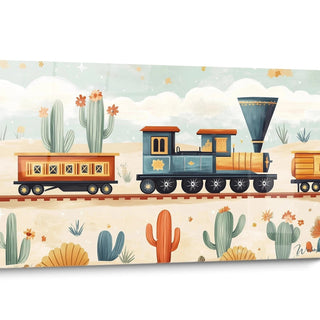
Embark on an unforgettable journey with our train paintings for children ! Between steam locomotives, modern trains and picturesque landscapes, each painting transports your child on a captivating railway adventure. Perfect for sparking curiosity and enriching imagination, this dynamic decor brings a touch of movement and escape to their room.
 Train Painting No. 2 - Kids Edition273,90 €
 Train Painting No. 1 - Kids Edition273,90 €
In the same family
Also explore the theme Children
-
 View all54
artworks
View all54
artworks
-
 Angels for Children3
artworks
Angels for Children3
artworks
-
 Knights for Children2
artworks
Knights for Children2
artworks
-
 Children's Drawings2
artworks
Children's Drawings2
artworks
-
 Children's Dinosaurs3
artworks
Children's Dinosaurs3
artworks
-
 Kids Miscellaneous26
artworks
Kids Miscellaneous26
artworks
-
 Dragons for children2
artworks
Dragons for children2
artworks
-
 Magical for children3
artworks
Magical for children3
artworks
-
 Unicorns for Children3
artworks
Unicorns for Children3
artworks
-
 Pirates for Kids2
artworks
Pirates for Kids2
artworks
-
 Princesses for Children2
artworks
Princesses for Children2
artworks
-
 Witches for Kids2
artworks
Witches for Kids2
artworks
-
 Vampires for Kids2
artworks
Vampires for Kids2
artworks


All about Train Paintings for Children
- Train Wall Art for Children Presentation
- Train Wall Art for Children Motor Skills Learning
- Train Wall Art for Children Educational Bedroom Decor
- Train Wall Art for Children Imagination Awakening
The train wall art for children represents far more than simple wall decoration - it is a complete railway universe that comes to life on a captivating visual support. Combining the universal appeal of trains with educational and playful elements, this type of wall art transforms any children's space into an immersive railway adventure.
Ideal for children's bedrooms of those passionate about locomotives, wagons and the entire railway universe, these large-format wall artworks offer an interactive alternative to traditional toys. Unlike other wall decorations, train wall art for children is specifically designed to stimulate imagination, encourage narrative development and even facilitate learning of concepts such as colors, shapes and logical sequence.
These railway visual representations stand out for their ability to evolve with the child - first a simple object of visual fascination for toddlers, then support for imaginative play for older children, before becoming a nostalgic decorative element appreciated even as they grow up. With their detailed illustrations of railway landscapes, miniature stations and colorful locomotives, these wall art for children create a visual focal point that instantly animates any bedroom.
Parents particularly appreciate their dual function - a stylized decorative element that integrates harmoniously into a child's bedroom while offering educational and playful value. Unlike wall stickers or generic paintings, these train wall artworks offer visual depth and richness of detail that captivates children's attention and stimulates their natural curiosity about mechanisms and movement.
Train Wall Art for Children: Motor and Cognitive Development Through the Railway World
Train wall art for children stands out as an exceptional motor development tool, far beyond simple wall decoration. Unlike static representations, these large-format railway artworks encourage children to trace the winding paths of rails with their fingers, naturally and playfully developing their hand-eye coordination.
How does train wall art stimulate fine motor coordination?
Detailed illustrations of trains, wagons and stations invite the child to precise tracing that strengthens manual dexterity. Parents often observe their children spending countless minutes methodically following the route of locomotives, an exercise that unconsciously prepares for future learning in writing and drawing. This tactile interaction radically differentiates these wall artworks from other wall decorations that remain purely contemplative.
Child neuropsychologists recognize the value of these repetitive tracing movements for creating essential neural connections during formative years. A strategically placed train wall art for children at an appropriate height transforms an ordinary wall into an accessible motor learning station available at any time.
- Development of hand-eye coordination through following railway circuits
- Strengthening of spatial perception through different levels and perspectives
- Improvement of fine motor skills through interaction with illustrated details
What cognitive benefits does a child gain from train wall art?
Beyond motor aspects, these railway artworks remarkably stimulate cognitive development. Representations of complex railway networks with their interconnections, tunnels and bridges naturally introduce concepts of sequential logic and problem-solving. Children spontaneously engage in planning exercises by imagining optimal routes between different represented destinations.
The inherent narrative richness of railway scenes also encourages language development. Parents regularly report the vocabulary expansion of their children who quickly integrate specific terms such as "locomotive," "level crossing" or "switch." This contextual linguistic immersion proves particularly effective for natural language acquisition.
Educators recognize the value of train wall art for children as supports for intuitive mathematical learning. Counting wagons, estimating distances between stations and even notions of relative speed are naturally addressed through these dynamic railway representations.
For children with attention difficulties, these wall artworks offer a structured point of focus that can reduce restlessness and productively channel their energy. The intrinsic linearity of railway circuits naturally guides attention sequentially, progressively developing prolonged concentration abilities.
Developmental psychologists also emphasize the positive emotional dimension associated with these representations. Trains universally evoke feelings of adventure and discovery that nurture children's natural curiosity. This positive emotional association strengthens cognitive engagement and maximizes the developmental effectiveness of the wall art.
By integrating train wall art for children into living spaces, parents offer much more than thematic decoration - they install a genuine multidimensional development tool that will harmoniously accompany their child's cognitive and motor growth during several formative years.
Train Wall Art for Children: Creating an Immersive Educational Railway Environment
The integration of train wall art for children radically transforms the atmosphere of a bedroom, creating a micro-immersive educational environment centered on the railway universe. Unlike conventional thematic decorations, these large-format wall artworks quickly become the architectural focal point that defines the complete spatial identity of the room.
Why do educators recommend train wall art in learning spaces?
Specialists in educational space design recognize the unique value of railway wall representations for cognitively structuring the learning environment. The inherent linear arrangement of railway circuits naturally introduces notions of progression and sequencing that unconsciously transfer into the child's learning approach.
Judiciously placed train wall art for children establishes implicit activity zones in the bedroom, creating natural transitions between play, reading and rest areas. This subtle structuring of space contributes significantly to the child's autonomy who progressively internalizes these functional spatial reference points.
- Establishment of permanent visual landmarks facilitating spatial orientation
- Creation of thematic continuity that strengthens educational immersion
- Introduction of visual dynamics that stimulate exploratory curiosity
Interior designers specializing in children's spaces emphasize the extraordinary chromatic versatility of train wall art. Their generally balanced palettes incorporating soothing blues, natural greens and contrasting accent touches create an ideal visual balance for an environment that is both stimulating and serene.
How to maximize the educational impact of train wall art in the bedroom?
To optimize the pedagogical value of these railway representations, experts recommend installation at the child's eye level rather than the traditional high position. This direct visual accessibility promotes daily engagement and transforms the wall art into a true interactive learning tool rather than a passive decorative element.
Strategic addition of soft directional lighting on train wall art for children creates ambient variations that maintain visual interest over time. This simple scenographic technique allows different details of the illustration to be progressively revealed, regularly renewing the child's exploratory experience facing this complex railway landscape.
Environmental psychologists note that large-scale railway wall representations positively modify children's spatial perception in modestly-sized bedrooms. The visual deployment of railway horizons creates an impression of expansion that effectively counterbalances any sense of confinement, particularly beneficial in contemporary often-restricted urban spaces.
Parents regularly report that these railway artworks become effective behavioral transition tools. An evening ritual including identification of specific elements on the train wall art significantly facilitates the transition toward bedtime routines, transforming a potentially conflictual moment into a positive connection experience.
In terms of decorative longevity, train wall art for children demonstrates remarkable thematic durability. Unlike patterns based on ephemeral media characters, fascination with the railway universe crosses ages with rare consistency, allowing this decorative investment to retain its relevance throughout the child's development phase.
Space design consultants recommend extending the thematic influence of train wall art to adjacent bedroom elements without falling into visual overload. Coordinated punctual railway touches amplify the immersive impact of the wall art while preserving the aesthetic balance essential to an environment conducive to harmonious development.
Train Wall Art for Children: Catalyst for Imagination and Interactive Narrative
Train wall art for children transcends its primary decorative function to become a genuine mural narrative generator. Unlike generic illustrations, these detailed railway compositions deploy a complete universe with its implicit protagonists, potential situations and multiple narrative possibilities that daily stimulate creative imagination.
In what way does train wall art differ from other imaginative stimuli?
The narrative particularity of train wall art for children lies in their intrinsically sequential structure. Illustrated railway circuits naturally suggest routes, journeys and destinations that become so many invitations to story elaboration. This structural characteristic fundamentally distinguishes these wall artworks from other wall decorations that generally offer static scenes without inherent narrative progression.
Psychologists specializing in creative development observe that these railway wall representations specifically activate brain areas associated with sequential narration and scenario projection. A child facing train wall art unconsciously develops narrative construction skills that will subsequently transfer to other forms of creative expression.
- Stimulation of narrative projection capacities through illustrated routes
- Development of temporality in the construction of imagined stories
- Strengthening of connections between spatial visualization and narrative elaboration
Montessori educators particularly recognize the value of train wall art for children as supports for "open narration" - these illustrations sufficiently detailed to suggest but sufficiently incomplete to require the child's active imaginative engagement. This quality of "partial completeness" constitutes the ideal trigger for personal creative elaboration.
How can parents exploit the narrative potential of train wall art?
To maximize the imaginative awakening potential of these artworks, cognitive development specialists recommend that parents regularly initiate guided interactive sessions. The adult can initially point to different elements of the railway illustration by asking open-ended questions that invite the child to elaborate micro-narratives - "Where is this train going? Who is traveling in this wagon? Why is it stopping at this station?"
This practice of guided narrative elaboration progressively establishes habits of autonomous imaginative engagement. Parents report that after several accompanied sessions, children spontaneously develop elaborate narrative monologues facing their train wall art, a sign of complete appropriation of the support as a personal story generator.
Speech therapists also emphasize the potential therapeutic value of these railway artworks for children presenting speech expression challenges. The permanent visual anchor offered by the illustration effectively structures narrative thinking and facilitates verbal articulation of complex ideas that would otherwise remain unexpressed.
In terms of emotional development, this train wall art for children offers valuable opportunities to explore feelings through projection. Through the implicit characters of travelers, conductors and other protagonists of the illustrated railway world, the child can indirectly explore different emotions and social situations in a safe setting.
FAQ about train wall art for children
At what age is train wall art for children most beneficial?
Train wall art for children begins to exert its positive influence from 18 months with simple visual recognition, but deploys its maximum potential between 3 and 8 years, the period during which narrative imagination and projection capacities are in full development. Beyond that, it retains its decorative and evocative value.
How to choose ideal dimensions for train wall art in a child's bedroom?
For optimal immersive impact, prioritize train wall art for children occupying at least one-third of the length of the main wall. This proportion ensures sufficient visual presence to transform the room's atmosphere while maintaining balance with other essential decorative elements.
Can train wall art for children suit a girl as much as a boy?
Absolutely. The appeal of train wall art for children transcends traditional gender stereotypes. The railway universe, with its narrative richness, fascinating mechanics and adventure possibilities, captivates children's imagination regardless of gender, offering universal developmental benefits.
How to effectively maintain train wall art for children?
Modern train wall art for children generally benefits from anti-dust and anti-UV treatments that maintain their brilliance over time. Simple occasional dusting with a dry microfiber cloth is sufficient for routine maintenance. Avoid any chemical product that could alter the vibrant colors essential to visual impact.


