


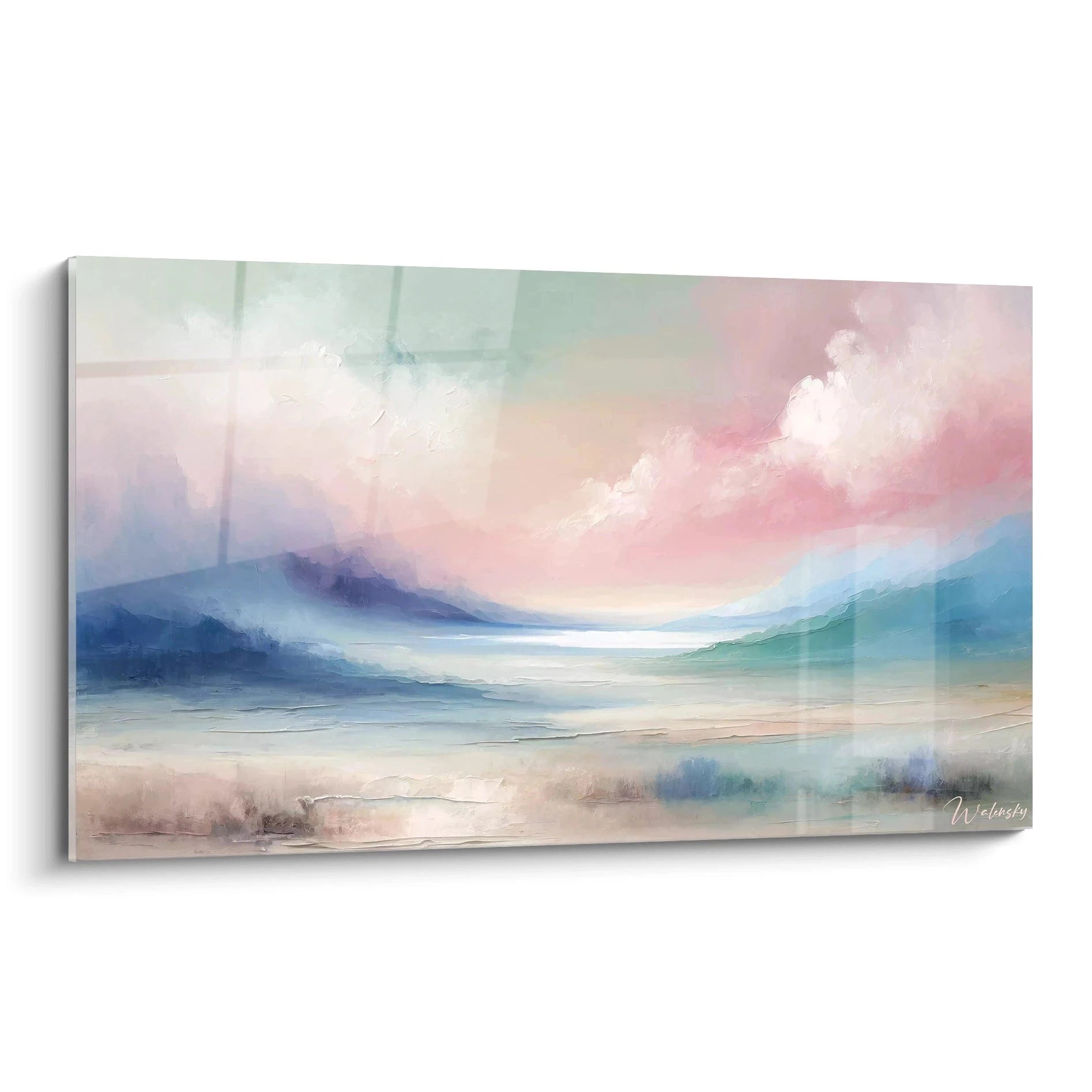


Paintings inspired by Johannes Vermeer
The paintings inspired by Johannes Vermeer showcase mastery of light and intimate details. Each artwork reflects a peaceful atmosphere, evoking the grace and elegance of everyday life. This collection celebrates the subtlety of colors and the precision of Vermeer's iconic scenes, embodying the soul of classical art.
 Painting Inspired by View of Delft by Johannes Vermeer No.2 – Homage to Celebrated Artist273,90 €
 Painting Inspired by View of Delft by Johannes Vermeer No.1 – Tribute to a Celebrated Artist273,90 €
 Painting Inspired by The Concert by Johannes Vermeer No.2 – Tribute to a Celebrated Artist273,90 €
 Painting Inspired by The Concert by Johannes Vermeer N°1 – Tribute to Celebrated Artist273,90 €
 Painting Inspired by The Milkmaid by Johannes Vermeer N°2 – Celebrated Artist Tribute273,90 €
 Painting Inspired by The Milkmaid by Johannes Vermeer No. 1 – Tribute to Celebrated Artist273,90 €
 Painting Inspired by Girl with a Pearl Earring by Johannes Vermeer No.2 – Tribute to Celebrated Artist273,90 €
 Painting Inspired by Girl with a Pearl Earring by Johannes Vermeer No. 1 – Tribute to a Celebrated Artist273,90 €
 Painting Inspired by Woman in Blue Reading a Letter by Johannes Vermeer No. 2 – Tribute to a Celebrated Artist273,90 €
 Painting Inspired by Woman in Blue Reading a Letter by Johannes Vermeer No. 1 – Tribute to Renowned Artist273,90 €
In the same family
Also explore the theme Famous Artists ( inspirations )
-
 View all265
artworks
View all265
artworks
-
 Alfred Sisley10
artworks
Alfred Sisley10
artworks
-
 Amedeo Modigliani12
artworks
Amedeo Modigliani12
artworks
-
 Camille Pissarro7
artworks
Camille Pissarro7
artworks
-
 Caspar David Friedrich11
artworks
Caspar David Friedrich11
artworks
-
 Claude Joseph Vernet3
artworks
Claude Joseph Vernet3
artworks
-
 Claude Monet10
artworks
Claude Monet10
artworks
-
 Edgar Degas8
artworks
Edgar Degas8
artworks
-
 Edvard Munch11
artworks
Edvard Munch11
artworks
-
 Edward Hopper8
artworks
Edward Hopper8
artworks
-
 Frida Kahlo6
artworks
Frida Kahlo6
artworks
-
 George Braque5
artworks
George Braque5
artworks
-
 Giuseppe Arcimboldo9
artworks
Giuseppe Arcimboldo9
artworks
-
 Goya8
artworks
Goya8
artworks
-
 Gustav Klimt8
artworks
Gustav Klimt8
artworks
-
 Gustave Courbet8
artworks
Gustave Courbet8
artworks
-
 Henri Matisse4
artworks
Henri Matisse4
artworks
-
 Hieronymus Bosch2
artworks
Hieronymus Bosch2
artworks
-
 Jean Baptiste Camille Corot9
artworks
Jean Baptiste Camille Corot9
artworks
-
 Jean François Millet7
artworks
Jean François Millet7
artworks
-
 Jean-Auguste-Dominique Ingres10
artworks
Jean-Auguste-Dominique Ingres10
artworks
-
 JMW Turner6
artworks
JMW Turner6
artworks
-
 Leonardo da Vinci5
artworks
Leonardo da Vinci5
artworks
-
 Michelangelo6
artworks
Michelangelo6
artworks
-
 Paul Gauguin6
artworks
Paul Gauguin6
artworks
-
 Peter Paul Rubens6
artworks
Peter Paul Rubens6
artworks
-
 Pierre-Auguste Renoir6
artworks
Pierre-Auguste Renoir6
artworks
-
 Piet Mondrian11
artworks
Piet Mondrian11
artworks
-
 Pieter Bruegel the Elder6
artworks
Pieter Bruegel the Elder6
artworks
-
 Rembrandt van Rijn4
artworks
Rembrandt van Rijn4
artworks
-
 Sandro Botticelli9
artworks
Sandro Botticelli9
artworks
-
 Sonia Delaunay6
artworks
Sonia Delaunay6
artworks
-
 Théodore Géricault7
artworks
Théodore Géricault7
artworks
-
 Vincent Van Gogh11
artworks
Vincent Van Gogh11
artworks
-
 Wassily Kandinsky10
artworks
Wassily Kandinsky10
artworks


All about Paintings inspired by Johannes Vermeer
- Presentation Johannes Vermeer Painting
- The timeless elegance of Vermeer's masterpieces
- Light and atmosphere in Vermeer's paintings
- Cultural impact of Vermeer reproductions
Johannes Vermeer's paintings represent the pinnacle of the Dutch Golden Age of 17th-century painting. Recognized for their masterful use of light, meticulous precision, and intimate compositions, these masterpieces bring commanding presence to any contemporary interior. Acquiring a high-quality reproduction of a Vermeer work allows you to introduce the peaceful atmosphere and emotional depth characteristic of this major artist into your home.
Vermeer is particularly celebrated for his ability to capture moments of everyday life with almost photographic intensity, centuries before photography was invented. His carefully orchestrated compositions, often centered on female figures in domestic interiors bathed in lateral light from a window, create a meditative ambiance that transcends the centuries.
The current selection of famous paintings inspired by Vermeer provides access to these timeless works to enhance your living space. Whether you are drawn to "Girl with a Pearl Earring", "The Milkmaid" or "View of Delft", these faithful reproductions bring the understated elegance and technical mastery that established Johannes Vermeer's worldwide reputation.
Discover in the following tabs the unique characteristics of Vermeer's paintings, their aesthetic and technical particularities, as well as the psychological and decorative impact they can have in different environments. You will also find expert advice for harmoniously integrating these exceptional works into your contemporary interior.
The timeless elegance of Vermeer's works to enhance your interior
The Johannes Vermeer painting represents far more than simple wall decoration – it is a genuine window into the 17th-century Dutch world, radically transforming the atmosphere of any contemporary space. Unlike ordinary artistic reproductions, Vermeer's works impose their presence through incomparable subtlety and narrative depth that continues to fascinate experts and art lovers four centuries after their creation.
Why do Vermeer's paintings create such a particular ambiance?
Johannes Vermeer's paintings distinguish themselves through their unique ability to create silent dialogue with the observer. The Dutch artist perfectly mastered the art of suspending time, capturing moments of domestic intimacy with extraordinary sensitivity. This quality allows his reproductions to instantly transform a room's ambiance, introducing a rare contemplative dimension to modern decorative art.
Each Vermeer painting constitutes an island of visual serenity in an environment often overwhelmed by stimulation. The delicate blues, warm ochres, and pearlescent whites characteristic of his palette naturally create a soothing focal point in any space. This chromatic harmony explains why Vermeer's works integrate seamlessly into almost all interior decoration styles, from contemporary minimalism to more classical interiors.
The digital exclusivity of Vermeer reproductions
Beyond their intrinsic beauty, Johannes Vermeer's paintings benefit from a fascinating digital exclusivity. With only 35 authenticated works in the entire world, each reproduction represents access to an extremely rare artistic heritage. This rarity confers significant cultural value on these paintings and explains why they constitute a privileged choice for receptive spaces and professional offices where one wishes to project an image of refinement and culture.
Reproductions of "Girl with a Pearl Earring", often nicknamed "The Mona Lisa of the North", offer this unique combination of immediate recognition and mystery that characterizes timeless masterpieces. The enigmatic gaze of the model, turned toward the viewer, establishes a direct emotional connection rarely equaled in art history.
Psychological impact of Vermeer's paintings in daily space
Studies in environmental psychology confirm that daily exposure to quality artworks positively influences our mental wellbeing. Vermeer's paintings, through their perfect visual balance and subtle narration, exert a particularly beneficial effect on a space's psychological atmosphere.
The presence of a Vermeer painting in a living room or waiting area naturally encourages contemplation and reflection. The intimate scenes depicted – a woman reading a letter, pouring milk, or playing an instrument – invite the observer to slow down and appreciate the simple gestures of daily life, thus creating a valuable counterpoint to our often frantic contemporary pace.
Numerous clients report that installing a reproduction of "The Astronomer" or "View of Delft" in their workspace has considerably improved their concentration and creativity. This positive influence is explained by the perfect balance between visual complexity and compositional clarity that characterizes Vermeer's paintings.
How Vermeer's works dialogue with modern architecture
Johannes Vermeer's paintings present a remarkable ability to dialogue with contemporary architecture. Their rigorous geometric compositions, organized according to sophisticated mathematical principles, resonate particularly well with the streamlined lines of modern interiors.
In spaces with white walls characteristic of contemporary aesthetics, the rich and deep tones of Vermeer's paintings create a striking contrast that naturally draws the eye. This visual dynamic transforms even the most neutral spaces into visually captivating environments.
Vermeer's interior compositions, often structured around lateral windows, create a fascinating mise-en-abyme effect when placed near actual room openings. This architectural resonance explains why these works function particularly well in transition spaces like hallways or stairway landings, where they can benefit from lateral lighting similar to that depicted by the artist.
The generally modest format of Vermeer's original works – adapted to 17th-century Dutch bourgeois interiors – allows remarkable flexibility in their placement. Unlike vast historical or religious paintings, these intimate scenes adapt perfectly to the spatial constraints of contemporary urban apartments, while maintaining considerable visual impact.
Light and atmosphere in Vermeer's paintings for your interior
The Johannes Vermeer painting stands out for its exceptional mastery of light, creating an unequaled atmosphere in the history of pictorial art. Acquiring a quality reproduction allows you to introduce this characteristic luminosity into your personal space, radically transforming the visual and emotional perception of your interior.
The unique luminous phenomenon of Vermeer's works
The visual signature of Vermeer's paintings lies in his incomparable mastery of natural Northern light. Unlike the majority of painters who use light as merely a technical element, Vermeer makes it the true subject of his compositions. This revolutionary approach explains why his works retain their ability to visually illuminate an interior space four centuries after their creation.
Interior design experts frequently recommend Vermeer reproductions for spaces suffering from a lack of natural light. Perceptual studies demonstrate that the presence of a painting like "The Milkmaid" or "Lady Writing a Letter with Her Maid" can create the optical illusion of an additional light source, increasing the sensation of space and clarity in a room.
Owners of north-facing apartments regularly testify to the transformative impact of a reproduction like "View of Delft" or "The Little Street" on their living room's atmosphere. These paintings, bathed in the light characteristic of the Netherlands, bring a particularly valuable luminous quality during winter months.
How do Vermeer's paintings interact with different lighting sources?
The technical peculiarity of Johannes Vermeer reproductions lies in their ability to interact dynamically with ambient lighting. Unlike the flatter works of many other masters, Vermeer's paintings reveal different nuances and depths depending on the angle and intensity of light they receive.
Soft directional lighting, similar to that used in museums, optimizes the perception of subtle tonal variations and spatial depth characteristic of Vermeer's compositions. This interaction creates an evolving visual effect throughout the day, transforming the reproduction into a living presence rather than a static decorative element.
Owners of "Girl with a Pearl Earring" reproductions often notice how the expression of the face and the earring's luster seem to change subtly according to lighting conditions, creating a constantly renewed visual experience. This kinetic quality fundamentally distinguishes Vermeer's works from simple decorative reproductions.
The spatial dimension of Vermeer's paintings in interior design
Beyond their luminous qualities, Johannes Vermeer's paintings possess a remarkable ability to transform the spatial perception of a room. Their rigorous perspectival construction, often based on camera obscura principles, creates visual depth that far exceeds the physical frame of the painting.
Interior architects strategically employ reproductions of works like "The Art of Painting" or "The Geographer" to create the illusion of spatial extension in rooms with reduced dimensions. By leveraging the sophisticated geometry of interiors represented by Vermeer, these paintings act as virtual windows visually enlarging available space.
For spaces without windows such as certain hallways or bathrooms, a reproduction of "View of Delft" brings exceptional visual opening, introducing architectural breathing and a sense of horizon in otherwise enclosed environments.
The atmospheric influence of Vermeer's colors on sensory perception
The distinctive color palette of Johannes Vermeer exerts a subtle yet profound influence on a space's sensory experience. The vibrant ultramarine blues, luminous Naples yellows, and golden ochres create a visual harmony with quasi-synesthetic properties, influencing our perception beyond the visual register alone.
Research in environmental psychology suggests that regular exposure to the chromatic harmonies characteristic of Vermeer's paintings can positively influence mood and reduce stress. This quality explains their growing popularity in spaces dedicated to relaxation and recovery.
The famous "Vermeer blue", originally obtained from expensive lapis lazuli, possesses particular optical properties that seem to modify the perceived temperature of a room. Owners of reproductions like "Woman in Blue Reading a Letter" often report an increased sensation of coolness in summer and enveloping warmth in winter – a fascinating phenomenon of environmental resonance.
Vermeer's paintings depicting female subjects clothed in yellow – such as "Woman with a Pearl Necklace" – introduce golden luminosity that transforms the quality of ambient light, particularly effective for compensating for the often-too-cold artificial lighting of contemporary interiors.
Cultural impact of Vermeer reproductions in your decoration
The Johannes Vermeer painting far transcends its decorative function to become a genuine cultural marker within a personal or professional space. Integrating a quality reproduction of this Dutch master into your interior is not simply an aesthetic choice – it is a sophisticated cultural statement that positions your space in dialogue with the history of Western art.
What sets Vermeer's paintings apart from other artistic reproductions?
The fundamental particularity of a Johannes Vermeer painting lies in its exceptional rarity and unique cultural status. With only 35 authenticated works in existence worldwide, each reproduction represents access to an extremely limited artistic heritage, unlike the thousands of available works by artists like Monet or Van Gogh.
This digital exclusivity confers particular cultural distinction on Vermeer reproductions. They signal in-depth knowledge of art history and aesthetic sensitivity that surpasses conventional choices. For cultured visitors, recognizing a lesser-known work like "The Music Lesson" or "Woman Holding a Balance" immediately testifies to the intellectual refinement of the owner.
Unlike reproductions of more frequently displayed artists, Vermeer's paintings retain visual freshness and fascination power intact. Their rarity in the daily visual environment allows them to escape the banalization affecting certain over-exposed masterpieces, thus preserving their ability to provoke authentic aesthetic experience.
Cinematic influence and its impact on the perception of Vermeer's works
Johannes Vermeer's paintings benefit from significantly enhanced cultural status through their recurrent appearances in prestigious cinematic productions. Films like "Girl with a Pearl Earring" featuring Scarlett Johansson or "Vermeer and the Light" have transformed certain works into veritable contemporary cultural icons, transcending their initial status as historical works.
This cinematic presence confers additional narrative dimension to Vermeer reproductions, considerably enriching their impact in an interior space. For cinema enthusiasts, owning a "Girl with a Pearl Earring" reproduction immediately evokes the multiple cultural layers associated with this iconic work.
Contemporary filmmakers regularly draw inspiration from Vermeer's compositions and luminous aesthetics for their own visual creations. This persistent influence in modern visual culture explains why these paintings resonate so powerfully in our contemporary interiors – they represent an aesthetic continuity that spans centuries to present-day audiovisual productions.
The conversational dimension of Vermeer's paintings
An often-overlooked aspect of Johannes Vermeer reproductions is their extraordinary ability to stimulate conversation and intellectual exchange. These works, through their unique combination of familiarity and mystery, naturally become dialogue catalysts within a social or professional space.
In a residential setting, a painting like "The Astronomer" or "The Geographer" invariably sparks fascinating discussions about the Dutch Golden Age, the history of science, or artistic techniques – transforming simple decoration into a genuine intellectual opening. This conversational dimension considerably enriches the social experience in your living space.
For professional environments, such as medical practices or law offices, Vermeer reproductions offer a reassuring and stimulating cultural anchor point. "The Lacemaker" or "Woman Holding a Balance" create an atmosphere of concentration and precision that elegantly reflects professional values while offering a humanizing counterpoint to sometimes austere environments.
The transformative effect of a Vermeer painting in different residential contexts
The impact of a Johannes Vermeer painting varies considerably depending on the architectural context into which it is inserted, creating specific visual dialogues with different types of dwellings. This contextual adaptability explains their growing popularity among professional interior decorators.
In Haussmann-style apartments, Vermeer reproductions resonate naturally with the classical proportions and generous light characteristic of these spaces. The dialogue between ornamental moldings and the geometric rigor of Vermeer's compositions creates a particularly sophisticated visual tension.
For contemporary industrial lofts, Vermeer's intimate scenes provide a humanizing counterpoint to raw surfaces and imposing volumes. "The Milkmaid" or "Woman Writing a Letter" introduce a human scale and welcome intimacy into these sometimes intimidating spaces with their dimensions.
In country homes, urban landscapes like "View of Delft" or "The Little Street" establish a fascinating dialogue between interior and exterior, between rural and urban. This juxtaposition enriches spatial experience by introducing a complementary dimension that transcends simple decoration.
FAQ about Johannes Vermeer paintings
What is the ideal size for a Johannes Vermeer painting reproduction?
To respect the original visual impact, favor formats between 60 and 90 cm in width. These dimensions preserve technical subtleties while allowing a distinctive presence on a wall. Works larger than 100 cm risk distorting the fine details that established Vermeer's reputation.
Do Johannes Vermeer paintings suit all decoration styles?
The compositional sobriety and balanced color palette of Vermeer's works allow them to integrate harmoniously into nearly all decorative environments. They function particularly well in contemporary minimalist interiors, classical décor, and transitional-style spaces where they bring cultural depth without visually overwhelming.
How to maintain a Johannes Vermeer painting reproduction?
Avoid direct exposure to sunlight, which would gradually alter the colors. Regular dusting with a dry microfiber cloth is generally sufficient. For high-end reproductions, applying a non-yellowing protective varnish every five years or so will considerably extend their aesthetic lifespan while preserving the visual depth characteristic of Vermeer's works.
Further reading
Our articles on this topic
L'art qui suscite l'envie
Maison belge d'art mural grand format
14 jourspour changer d'avis*
Protection Walenskyincluse
Fabriquéen Italie
FormatXXL
Kit de fixationtoujours fourni
* Hors tableaux personnalisés et tailles personnalisées


