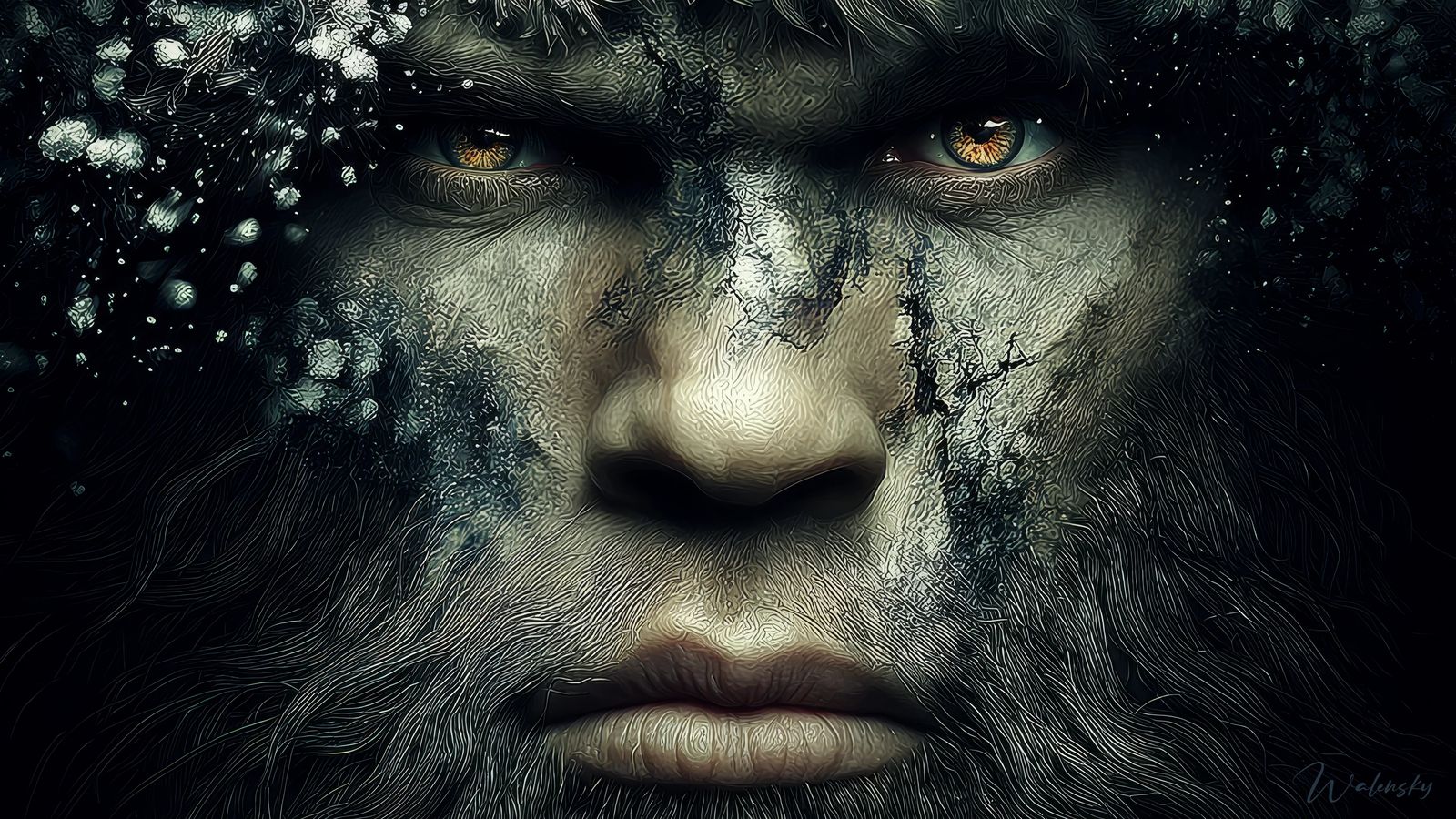
- Bigfoot Wall Art Presentation
- Bigfoot Wall Art - Cryptozoology and Mystery
- Bigfoot Wall Art - Wild Nature Atmosphere
- Bigfoot Wall Art - Decorative Masterpiece
A Bigfoot wall art instantly transforms your space into a sanctuary dedicated to the unfathomable mysteries of wild nature. This mural representation of the legendary Sasquatch captures the very essence of decorative cryptozoology, bringing a fascinating narrative dimension to your interior. Forest legend enthusiasts and mythical creature aficionados find in these monumental artworks a way to express their passion for the unexplained and their deep connection with the primordial forests of North America.
The Cryptozoological Universe of Sasquatch in Wall Décor
The Bigfoot wall art fits into a decorative trend celebrating legendary creatures and unexplained phenomena. Unlike conventional artistic representations, this cryptozoological imagery dives into the fascinating universe of unresolved testimonies and mysterious observations reported for decades in remote areas of the Pacific Northwest. Thematic décor collectors specifically seek these imposing visuals evoking the thrill of the unknown and the tangible possibility that a colossal bipedal creature still roams the unexplored depths of ancient forests.
Why choose a Sasquatch representation for your living space?
The appeal of a Bigfoot wall artwork far exceeds simple aesthetic appreciation. This mythical creature embodies symbolic resistance against modern civilization, representing the last untamed wild bastions of our planet. Owners of spaces dedicated to North American legends favor these monumental visuals for their ability to generate profound conversations about exploration, environmental preservation, and our complex relationship with wild nature. An imposing format considerably amplifies the emotional impact of this emblematic creature, creating an almost tangible presence in the room.
Cryptozoology enthusiasts particularly appreciate detailed representations showing the Sasquatch in its presumed natural habitat, among giant redwoods and lush ferns of temperate rainforests. These dense forest scenes, often enveloped in morning mist, reinforce perceived authenticity and instantly transport the observer to remote mountainous regions where reported observations historically concentrate.
The distinctive visual elements of cryptid creatures in wall art
A quality Bigfoot wall art captures specific anatomical details reported by eyewitnesses over decades: the massive stature far exceeding human proportions, the powerful musculature suggesting perfect adaptation to difficult mountainous environments, and especially that characteristic bipedal gait fundamentally distinguishing the Sasquatch from other known great apes. Representations of legendary creatures generally favor dynamic poses capturing the typical movement described in famous testimonies, notably the wide stride immortalized in the Patterson-Gimlin film.
Color palette plays an essential role in perceived authenticity. Dominant earthy tones - deep browns, slate grays, darkened forest greens - reflect the most frequent descriptions while allowing harmonious integration into rustic or contemporary décors. Some representations subtly incorporate elements of forest bioluminescence or light effects filtering through the canopy, adding an almost supernatural dimension to the scene.
How to integrate cryptozoological themes into different spaces?
Owners of mountain cabins or forest residences find in the Bigfoot wall artwork a natural narrative complement to their environment. Positioned strategically in a living room with views of surrounding woods, it creates a troubling continuity between domesticated interior and wild exterior. This visual porosity between fiction and reality considerably amplifies the immersive experience sought by enthusiasts of enigmatic atmospheres.
In urban spaces, this type of décor functions as a powerful reminder of persistent mysteries despite our hyperconnected society. A large format installed in a home office or game room evokes the spirit of exploration and fascination with the unexplored, stimulating intellectual curiosity and imagination. Collectors of paranormal memorabilia frequently associate these visuals with other thematic artifacts to create cohesive wall galleries celebrating unsolved enigmas.
Stylistic variations in Sasquatch representation
The market offers radically different artistic approaches to capture the essence of Bigfoot. Photorealistic renderings prioritize troubling hyperrealism, faithfully reproducing testimonial descriptions with quasi-documentary precision that deliberately blurs boundaries between photographic evidence and artistic creation. This approach particularly appeals to serious cryptozoology enthusiasts seeking credible representation based on compiled observations.
Conversely, stylized interpretations adopt more abstract or impressionistic aesthetics, suggesting the massive silhouette through vigorous brushstrokes and marked contrasts. This artistic approach emphasizes the elusive and fleeting aspect of the creature, capturing emotion and atmosphere rather than precise anatomical details. Contemporary décor enthusiasts often favor these versions for their ability to function simultaneously as conversation starter and artistically ambitious piece.
Cultural authenticity of North American forest legends
Beyond the modern Bigfoot phenomenon, these wall representations anchor themselves in centuries-old indigenous traditions. Many Native American nations possess ancestral narratives describing colossal forest beings known by various names: Sasquatch among the Salish, Ts'emekwes among other Pacific Northwest peoples. Wall art respectful of these cultural origins brings additional narrative depth, transforming simple décor into a tribute to traditional wisdom and the richness of continental folklore.
This cultural dimension particularly resonates with collectors concerned about narrative authenticity. Rather than simply displaying a fantastic creature, they integrate a fragment of thousand-year-old legendary heritage, perpetuating stories transmitted orally for generations before the term "Bigfoot" appeared in modern popular consciousness in the twentieth century.
Creating a Wild Nature Atmosphere with the Legendary Sasquatch
Installing a Bigfoot representation transcends ordinary décor to become a visual portal to the untamed wild territories of North America. This dense forest imagery, dominated by the imposing silhouette of the Sasquatch, instantly injects raw, primitive energy into any living space. Authentic natural atmosphere enthusiasts favor these monumental visuals for their unique ability to simultaneously evoke both the intimidating majesty of ancient forests and the electrifying thrill of the unexplained.
Which natural elements reinforce the Bigfoot forest atmosphere?
An effective Bigfoot wall art systematically incorporates distinctive botanical elements characteristic of Pacific Northwest ecosystems where observations traditionally concentrate. Centuries-old redwoods with massive moss-covered trunks, tree ferns creating impenetrable understories, and suspended lichens impart indispensable geographic authenticity. This lush, primitive vegetation serves not merely as décor but biologically contextualizes the plausible presence of a creature adapted to these humid, isolated environments.
Represented atmospheric conditions considerably amplify emotional impact. Morning mist infiltrating between tree trunks, light rays sporadically piercing the dense canopy, or twilight conditions create the characteristic visual ambiguity of observation accounts. These meteorological effects psychologically reinforce the possibility that a massive partially-observed form could indeed be the legendary Sasquatch rather than mere shadow play.
Harmonizing the wall art with mountain lodge-inspired décor
Owners of rustic lodge-style residences or forest cabins find in the Bigfoot visual a perfect narrative complement to their architectural aesthetics. Combined with raw materials like reclaimed exposed wood beams, natural river stones, and thick wool textiles, this representation reinforces cohesive wilderness theming. The imposing format works particularly well in high-ceilinged spaces typical of mountain architecture, where the colossal creature can be appreciated in appropriate proportions.
Strategic lighting plays a determining role in activating wild atmosphere. Rather than direct spotlights that would flatten the image, indirect light sources or lamps imitating campfire glow create dynamic shadow play on the wall surface. This subdued lighting approach recalls forest nighttime conditions where statistically the majority of reported Sasquatch encounters occur.
Complementary thematic decorative associations
A Bigfoot wall artwork gains considerably in impact when integrated into a mural collection celebrating fauna and mysteries of North American wild zones. Representations of giant footprint casts, detailed topographic maps identifying observation concentration zones, or atmospheric forest photographs create a cohesive immersive environment. This decorative stratification transforms a simple wall into an actual thematic exhibition exploring the cryptozoological phenomenon from multiple angles.
Three-dimensional objects further authenticate the sought atmosphere. Antlers, giant pinecones from Pacific conifers, or ancient bark fragments displayed on nearby shelves establish tactile connections with the forest environment visually evoked. This multisensory approach amplifies immersion, allowing occupants and visitors to feel momentarily transported to remote territories where the Sasquatch presumably maintains its hidden existence.
Adapting atmosphere to contemporary urban spaces
Paradoxically, Bigfoot imagery functions remarkably well in modern urban contexts by creating striking contrast with surrounding built environment. In an industrial loft with exposed brick walls and metal finishes, the wall art introduces chaotic organic elements that humanize the space while preserving its bold character. This visual juxtaposition between primitive nature and contemporary architecture generates stimulating creative tension.
Urban residents frequently use these representations as psychological escape from metropolitan stress. Positioned strategically in a relaxation or meditation space, the Sasquatch forest visual functions as an imaginary window toward tranquil wild spaces, offering instant mental respite. The creature itself symbolizes existence liberated from social constraints, resonating deeply with urbanites aspiring to greater nature connection.
Seasonality and forest atmosphere evolution
Sophisticated collectors sometimes alternate between different seasonal Sasquatch representations to maintain continuous decorative freshness. A spring scene showing the creature near a snowmelt-swollen stream evokes renewal, while autumn representation with flaming russet tones captures winter preparation. This thematic rotation allows exploration of different presumed Bigfoot behavioral facets while regularly renewing the visual impact of your space.
Diurnal variations offer distinct narrative possibilities. A twilight scene bathed in sunset orange tones suggests the privileged moment when observations become more frequent, while nocturnal representation lit only by filtered moonlight creates a deliciously eerie atmosphere. These temporal choices profoundly influence the emotional energy transmitted by the wall art in its display environment.
Bigfoot Wall Art as Conversation Starter and Central Element
No other decorative imagery generates as many spontaneous reactions and passionate discussions as an imposing Sasquatch representation. This legendary creature possesses near-universal cultural recognition while remaining sufficiently mysterious to spark animated debates, personal testimonies, and speculative theories. Owners of large-scale Bigfoot formats consistently report that their acquisition instantly becomes the focal point of all visits, catalyzing memorable conversations extending well beyond simple artistic appreciation.
Why does Sasquatch fascinate collective imagination so much?
The persistence of the Bigfoot phenomenon in popular culture explains its unique position at the intersection of several fundamental human fascinations. Unlike clearly fantastical mythological creatures, the Sasquatch maintains sufficient biological plausibility to sustain rational doubt. This gray area between science and legend transforms each wall artwork into an invitation to questioning: what if an unknown great ape species actually survived in vast insufficiently-explored forest expanses?
A large-scale Bigfoot wall art amplifies this psychological effect by imposing physically impressive presence in space. Visitors confront the creature's monumental scale, experiencing visually the intimidating proportions described by witnesses. This dimensional immersion transcends simple observation to create a quasi-visceral experience activating imagination and stimulating discussions about our zoological knowledge limits.
Integrating humor and irony into cryptozoological décor
While many enthusiasts approach the Sasquatch subject seriously, others appreciate the playful and slightly ironic aspects of cryptozoological décor. Representations showing Bigfoot in humorous situations - examining curious hikers, inadvertently posing for photographers, or simply going about forest occupations - inject welcome self-deprecating touches. This approach allows affirming interest in the phenomenon while openly acknowledging its speculative nature.
Owners of entertainment spaces like game rooms, personal bars, or home theaters particularly favor these lighter versions. The wall art then functions as perfect icebreaker, inviting guests to share their own strange nature experience stories or personal theories about unidentified creatures. This social dynamic transforms décor into genuine catalyst for memorable convivial moments.
How does monumental format transform decorative impact?
The generous dimensions characterizing premium Bigfoot representations constitute not merely an aesthetic choice but narrative necessity. The creature's legendary stature - estimated between 7 and 9 feet according to compiled testimonies - demands proportional representation scale to faithfully transmit its presumed visual impact. A reduced format would considerably dilute the intimidating presence fundamentally defining the experience of a Sasquatch encounter.
This visual monumentality also fulfills crucial architectural function in large residential spaces. Spacious rooms with high ceilings frequently suffer from a difficult-to-fill emptiness sense. An imposing Bigfoot wall artwork effectively occupies this vertical volume while maintaining thematic coherence, avoiding visual clutter that multiple smaller elements would occasion.
Certifications and guarantees validating acquisition
Beyond visual aspects, discerning buyers seek guarantees concerning durability and conservation of their decorative investment. Premium Sasquatch representations use UV-resistant printing processes preventing progressive discoloration, particularly important for installations near windows with direct sun exposure. Professional rigid substrates ensure perfect flatness even for the most imposing formats, eliminating ungraceful warping affecting lower-quality support frequently.
Reinforced mounting systems specifically designed for large dimensions guarantee secure, durable installation. This technical consideration becomes absolutely critical for formats exceeding 5 feet, where substantial weight requires precisely calculated wall anchor points. Professional suppliers systematically include detailed instructions and appropriate materials, enabling confident installation even for non-DIY enthusiasts.
Building an evolving collection around legendary cryptids
Many owners of initial Bigfoot wall artwork quickly discover growing interest in the broader cryptozoological spectrum. This initial acquisition frequently opens the door to a larger thematic collection including other enigmatic creatures: the Himalayan Yeti, the Latin American Chupacabra, or the Scottish Loch Ness Monster. This creative diversification allows exploring different worldwide legendary traditions while maintaining decorative coherence founded on mystery and the unexplained.
Progressive acquisition strategy offers several practical advantages. It allows spreading financial investment while observing how each new piece visually interacts with existing ones. This iterative approach also facilitates adjusting overall stylistic direction, avoiding premature commitment to aesthetics that might cease satisfying after months of daily exposure.
FAQ - Frequently Asked Questions about Bigfoot Wall Art
Does Bigfoot wall art suit all interior styles?
Absolutely, Sasquatch representations adapt remarkably well to varied aesthetics thanks to available artistic approach diversity. Mountain rustic interiors naturally welcome realistic forest versions, while contemporary spaces favor stylized or abstract interpretations. The essential aspect involves selecting color palette and artistic treatment harmonious with existing environment.
What is the ideal size to maximize Bigfoot visual impact?
Generous formats between 39 and 59 inches in width offer the best balance between imposing presence and installation practicality. These dimensions allow appreciating the creature's anatomical details while maintaining the monumental scale essential to narrative experience. For particularly vast spaces, formats exceeding 6.5 feet create genuinely spectacular immersion.
How to sustainably maintain Sasquatch wall representation?
Quality cryptozoological wall art requires minimal maintenance thanks to protective treatments applied during manufacturing. Occasional dusting with a dry microfiber cloth generally suffices. Absolutely avoid prolonged direct sun exposure accelerating pigment degradation, and maintain stable ambient humidity preventing any support deformation.
Can one associate Bigfoot wall art with other decorative themes?
This representation pairs particularly well with wild nature, exploration, outdoor adventure, and North American heritage themes. Successful associations include authentic forest fauna, majestic mountain landscapes, and imagery related to outdoor activities like hiking or camping. This thematic flexibility facilitates harmonious integration into preexisting decorative environments.