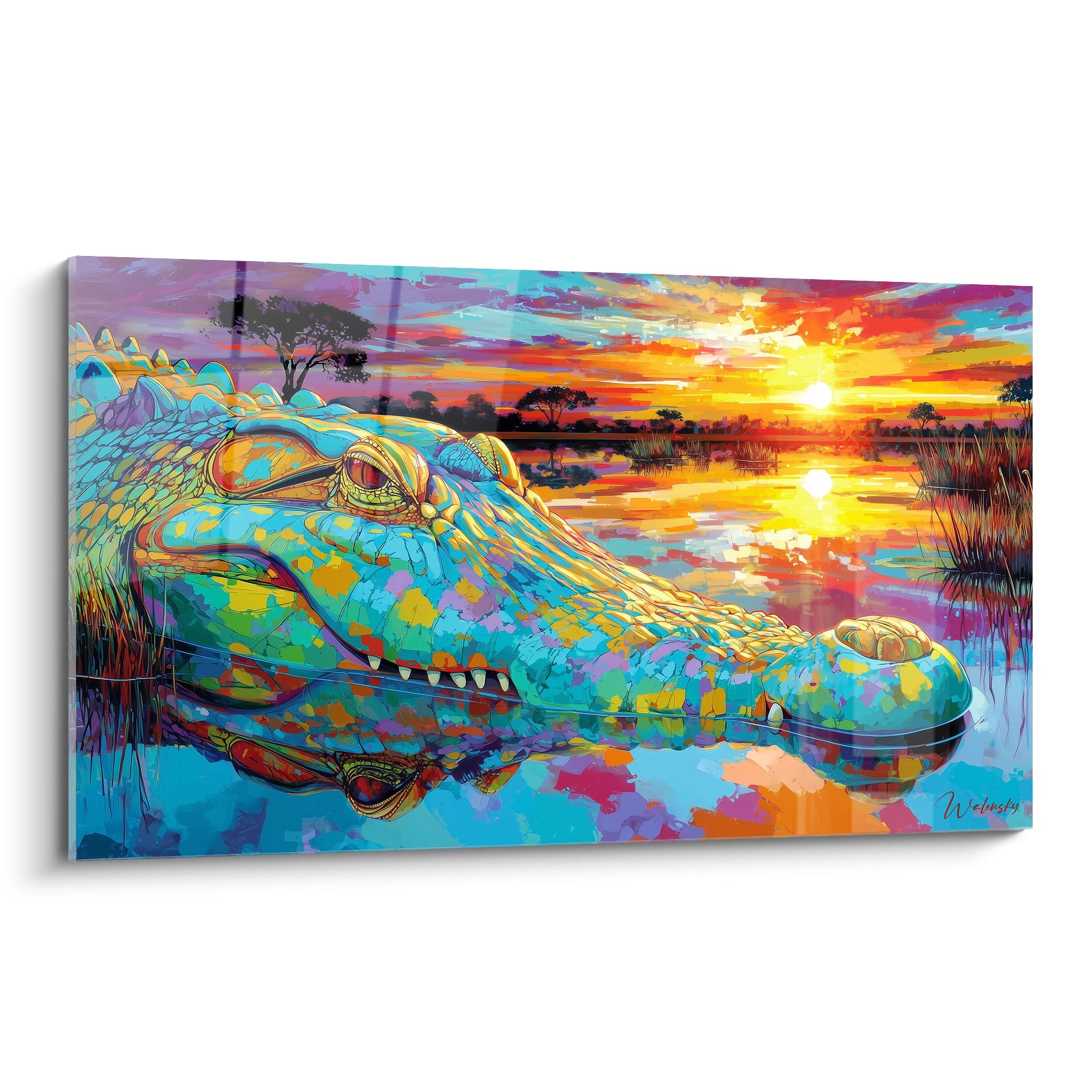
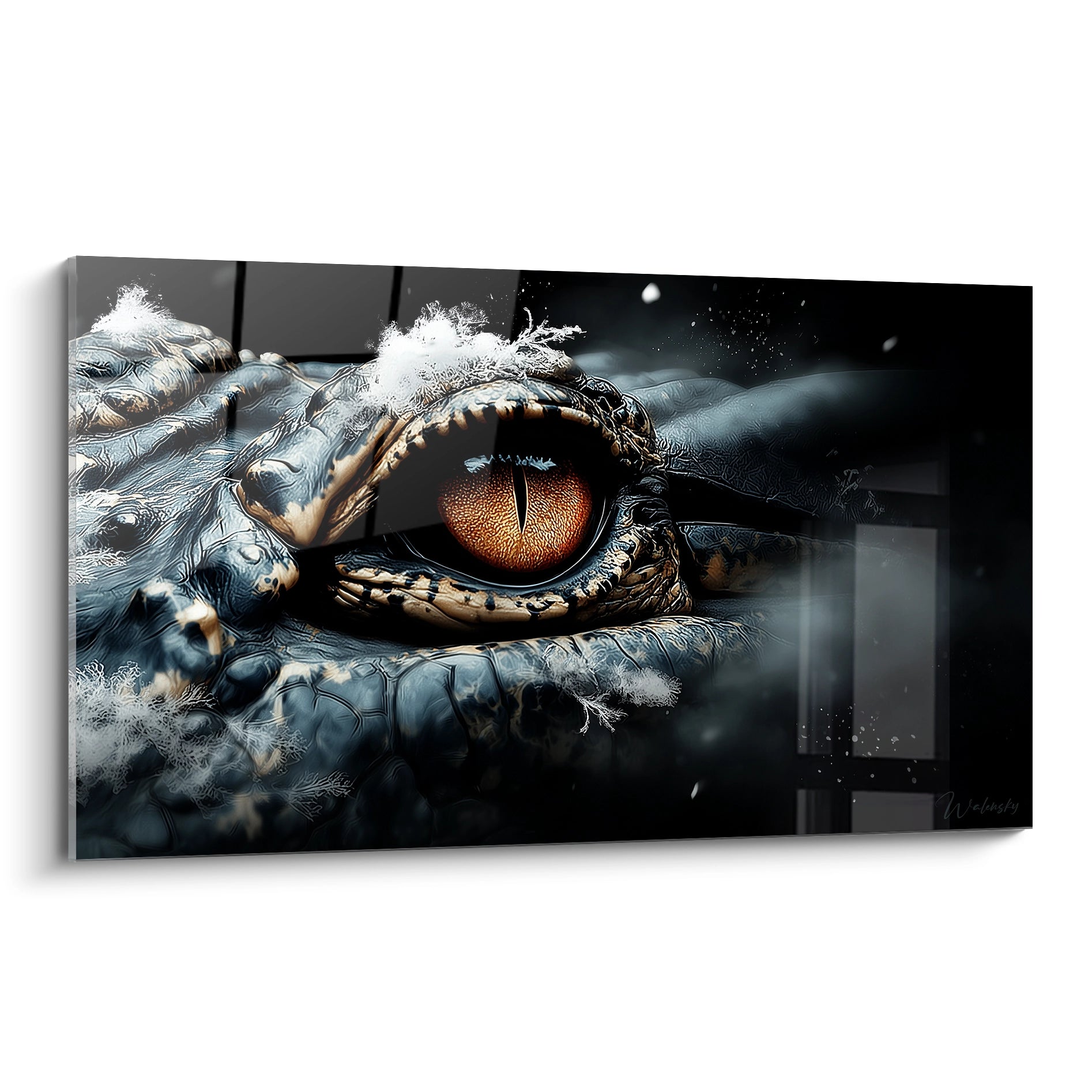
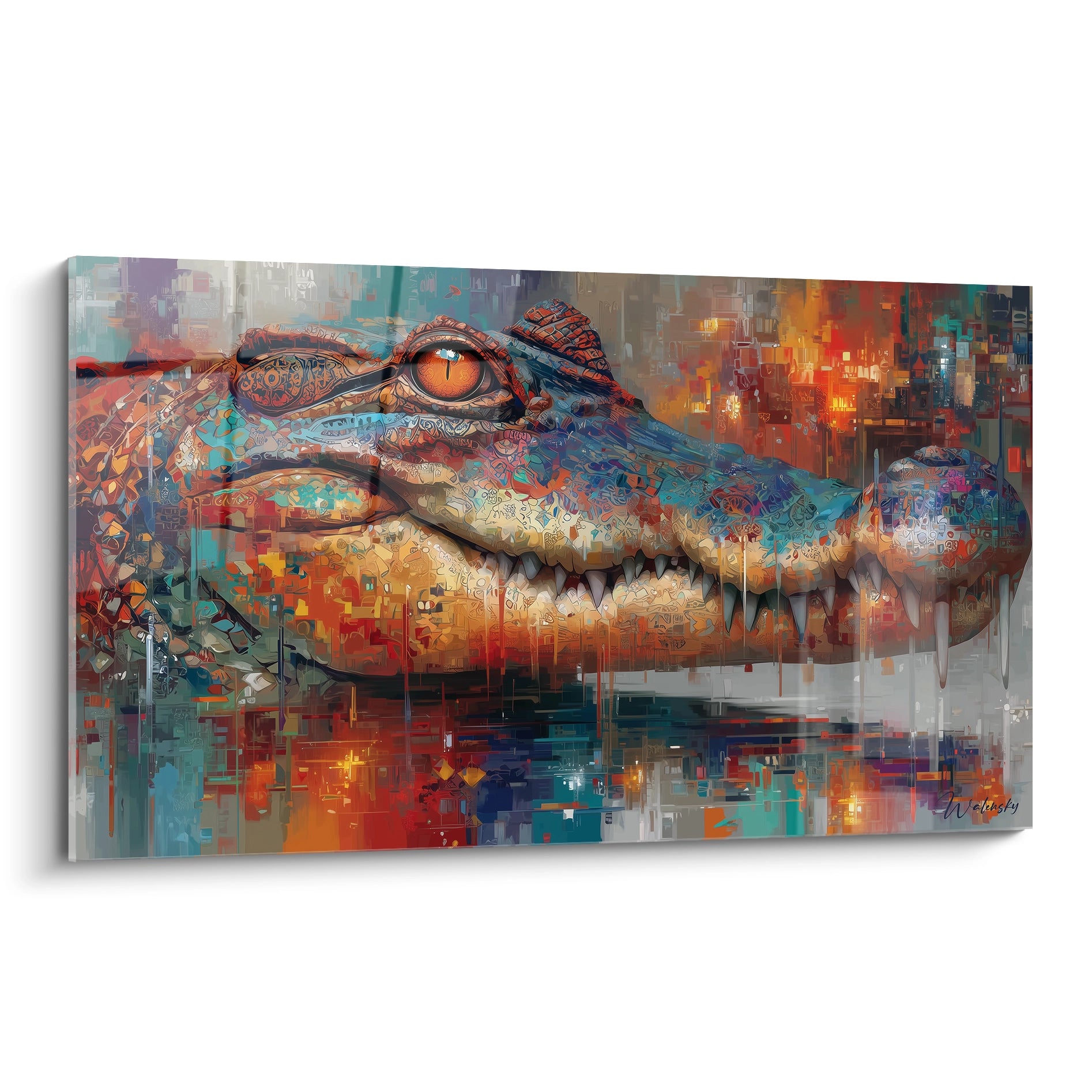
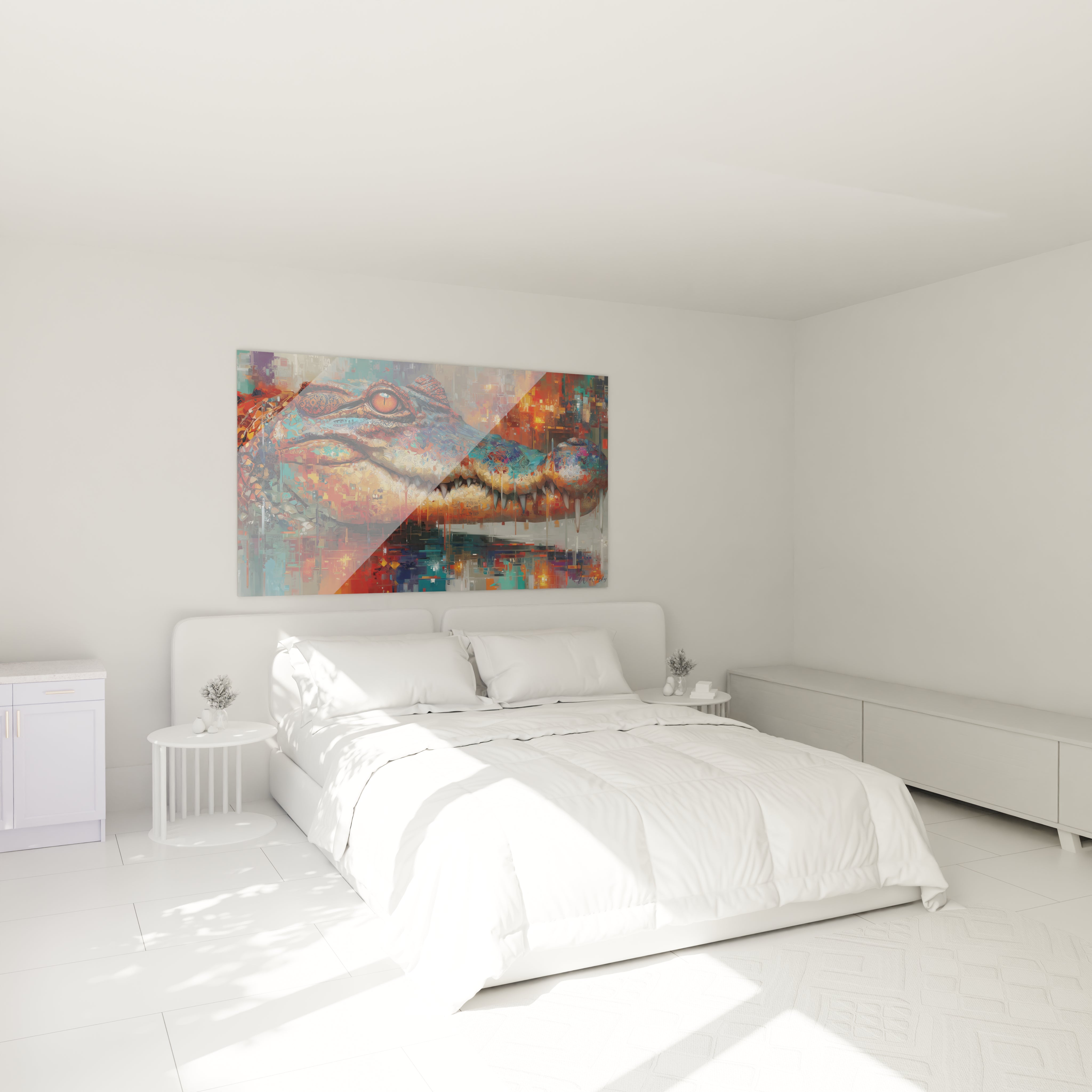
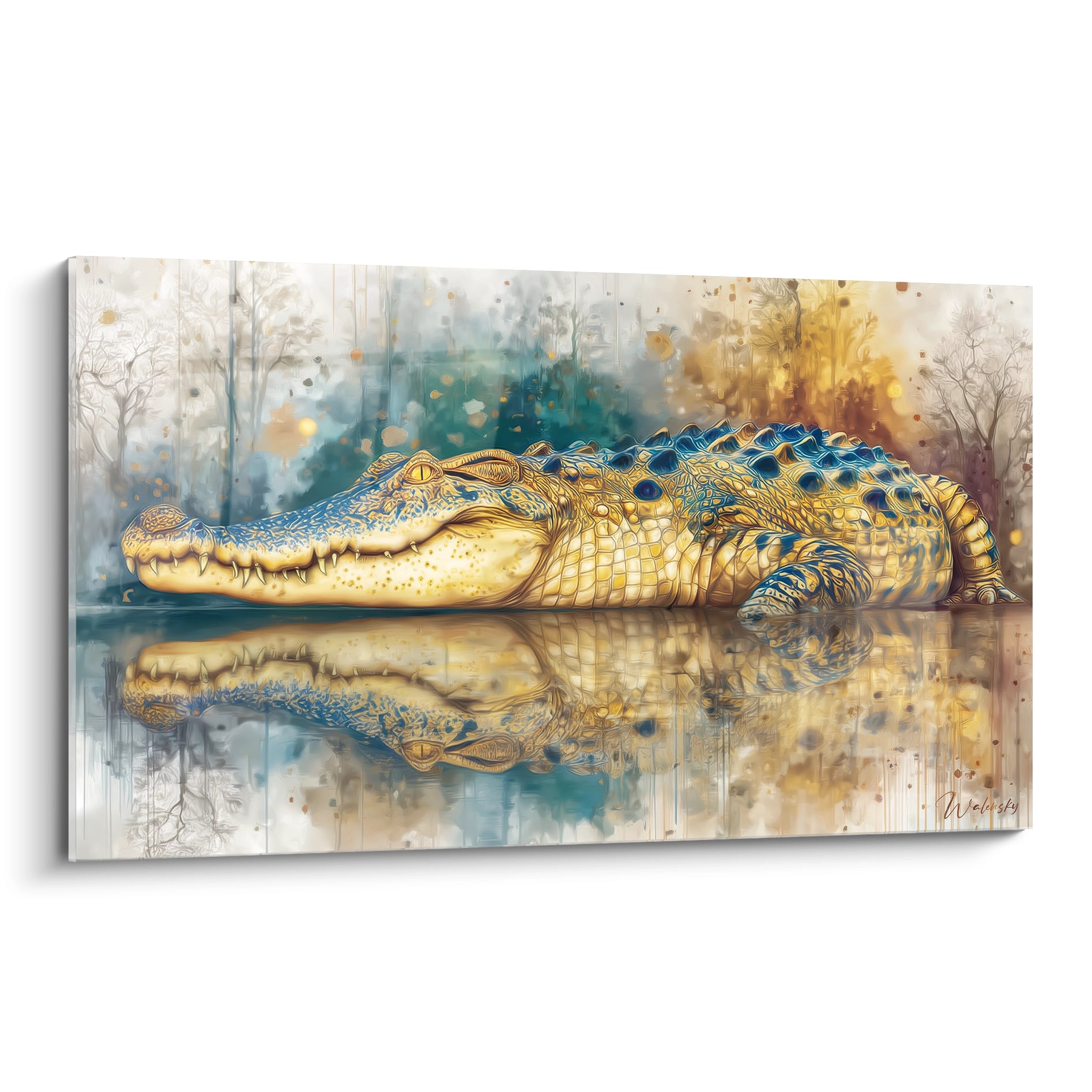
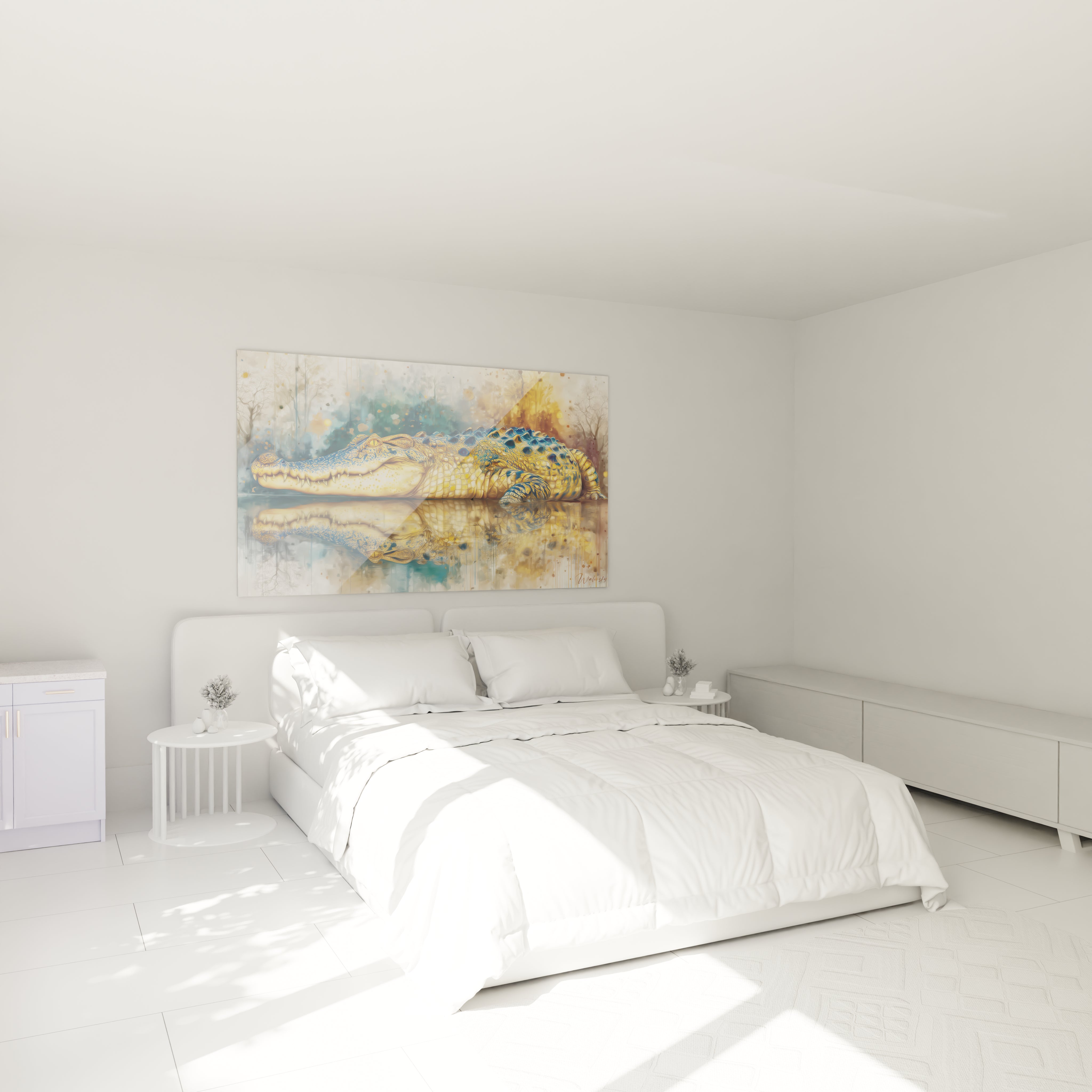
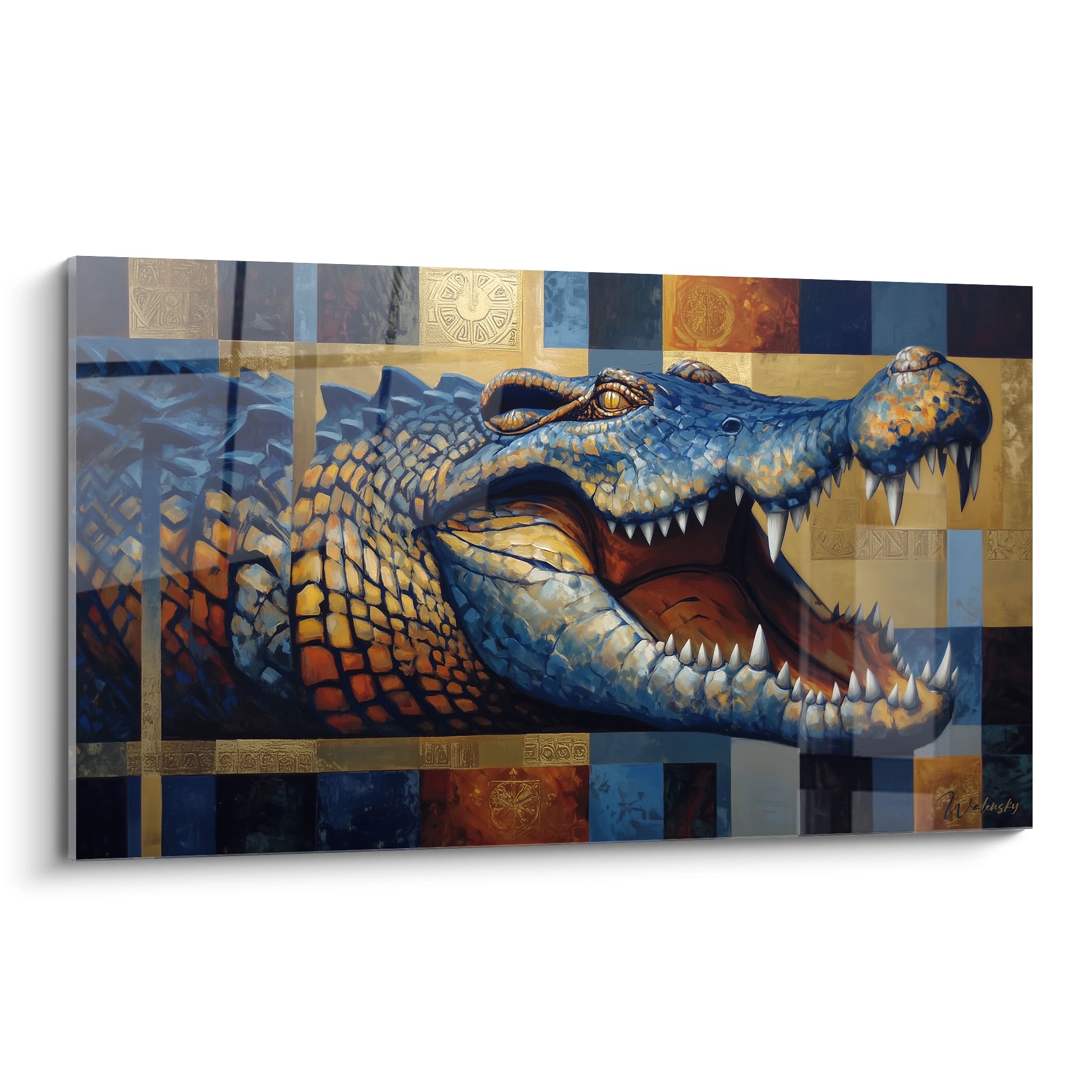
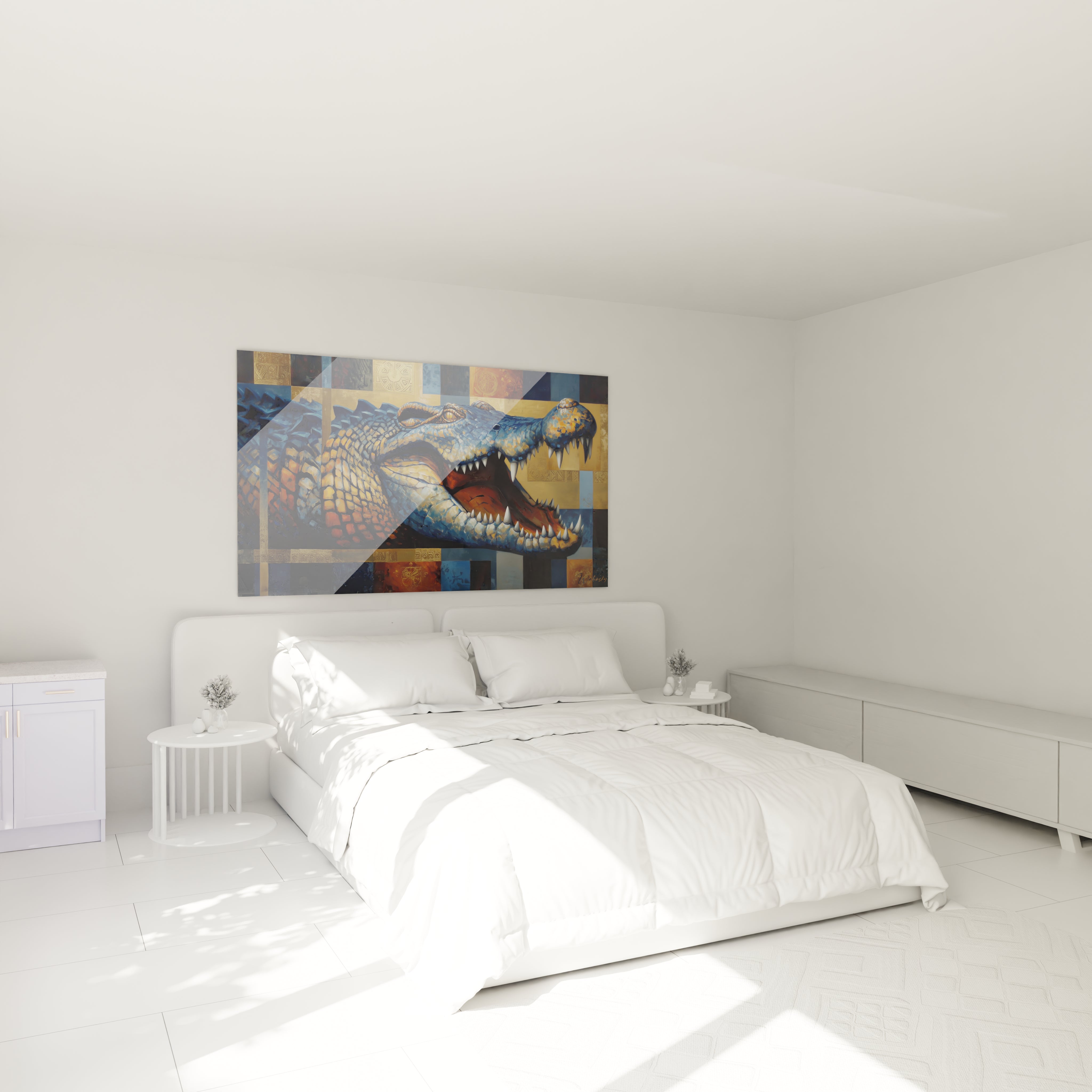
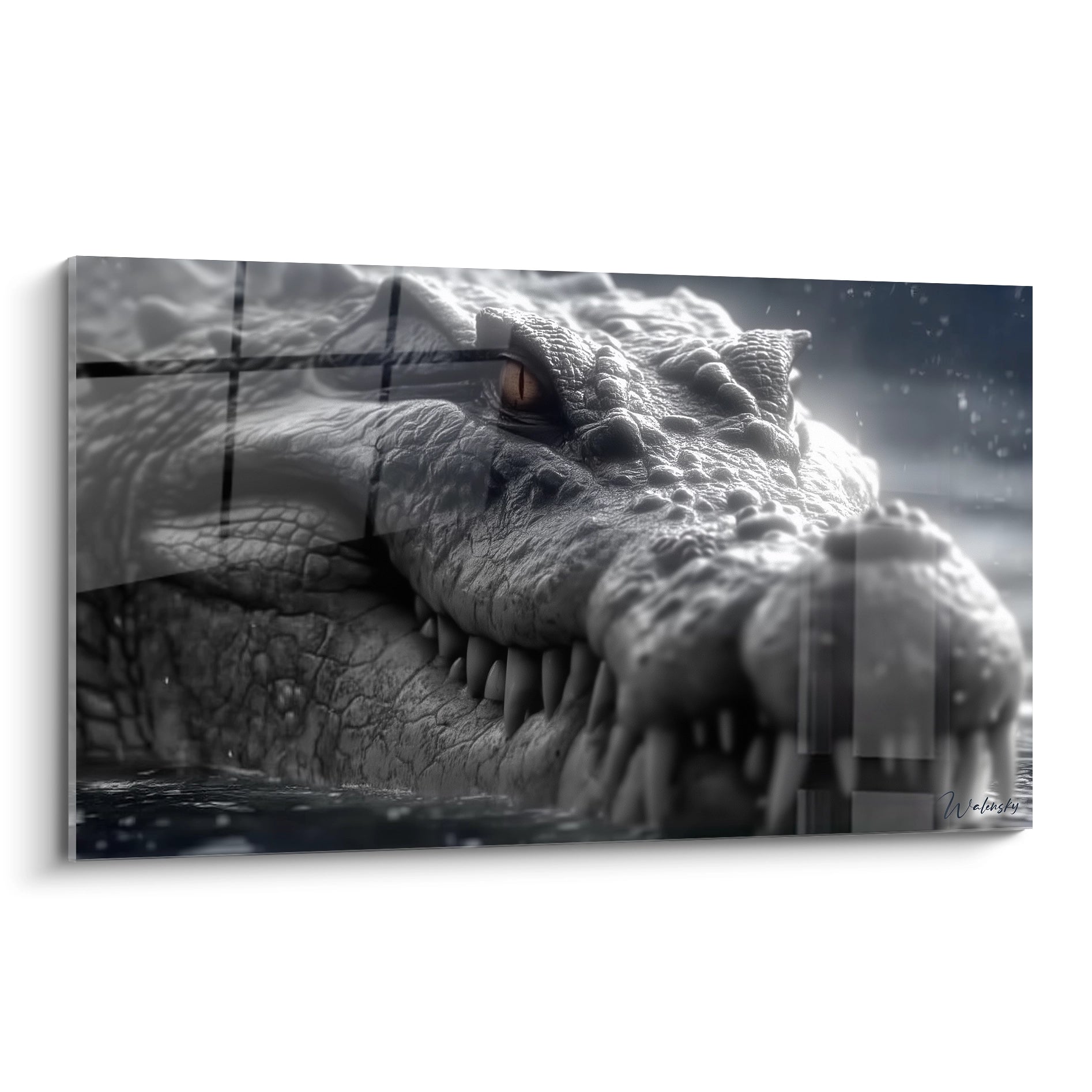
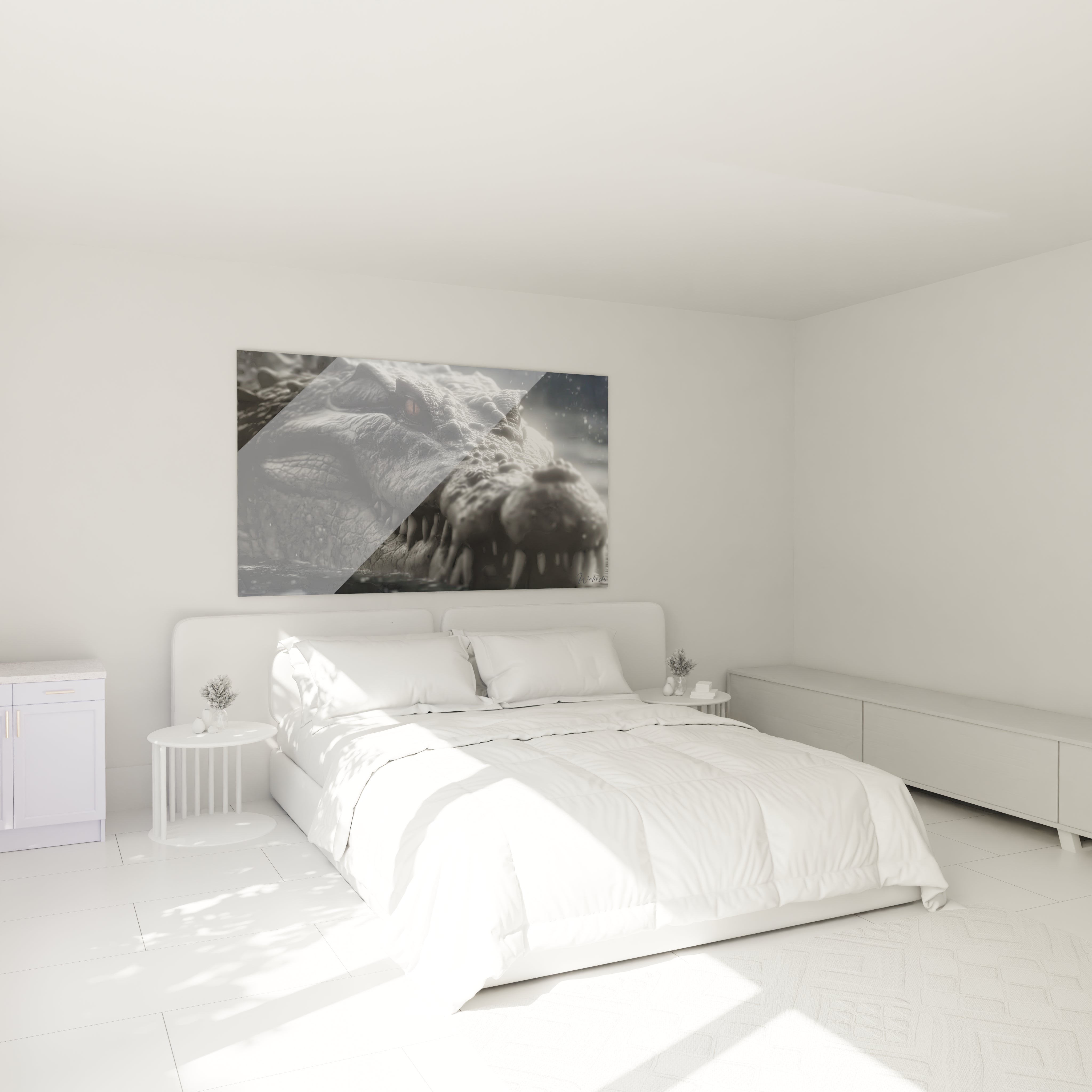
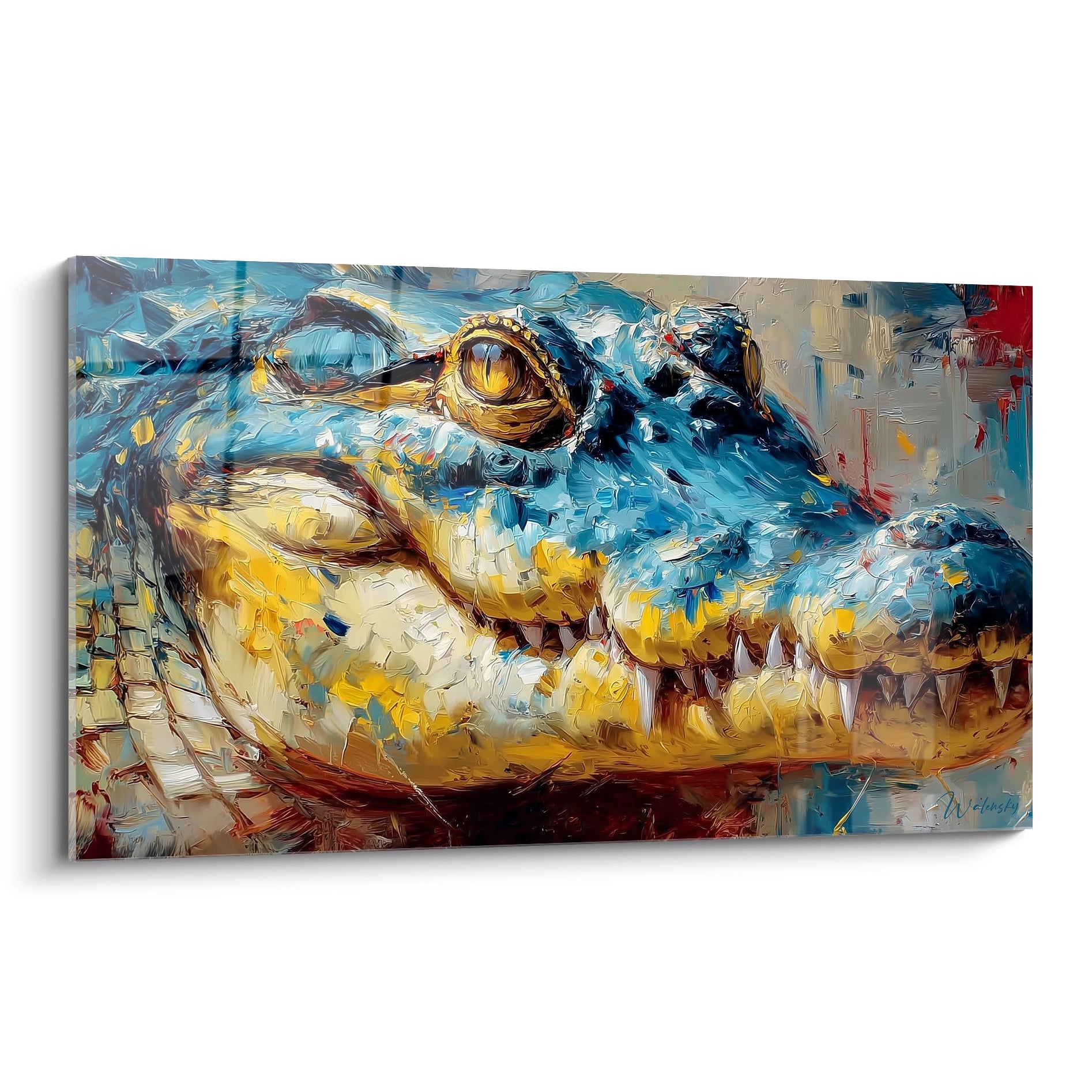
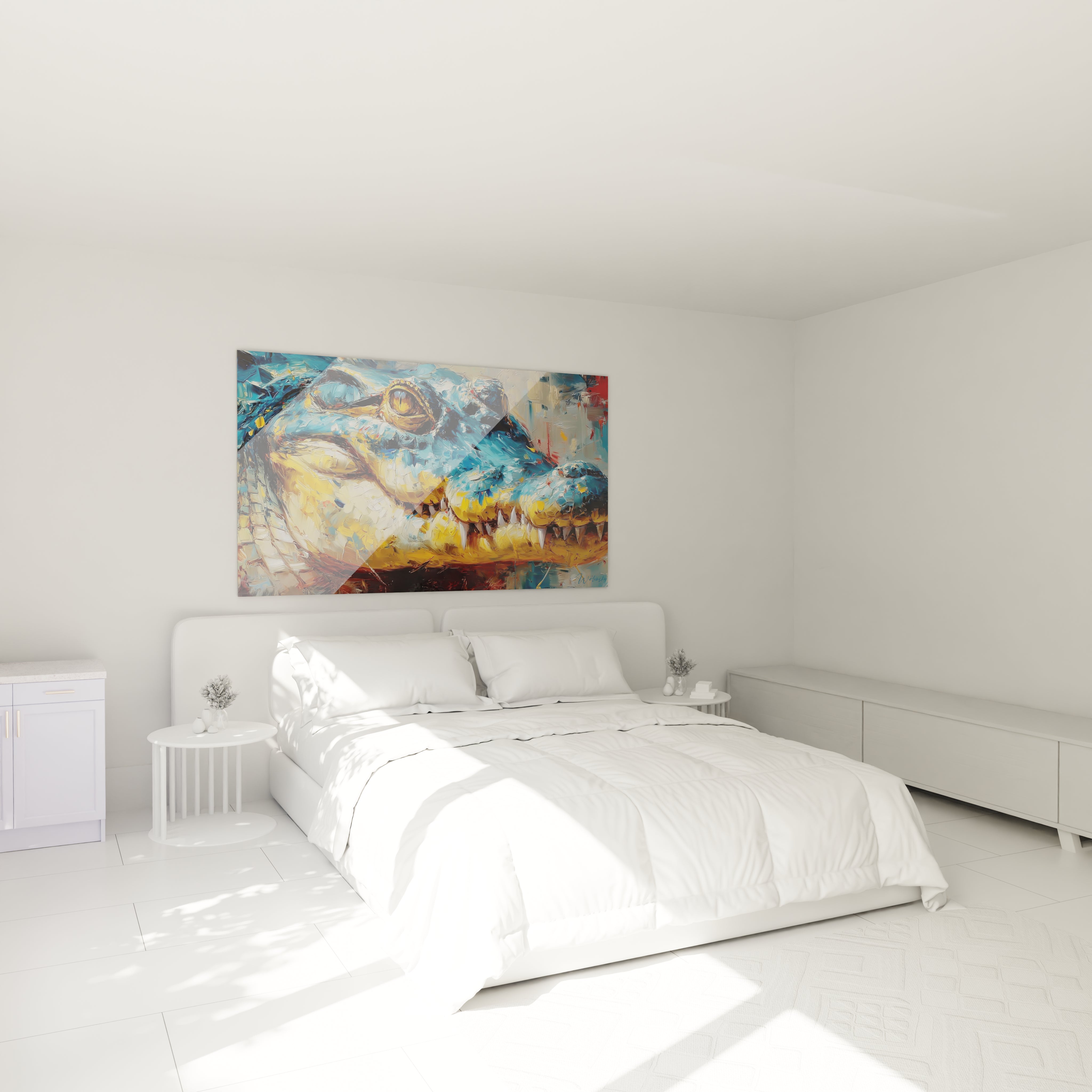
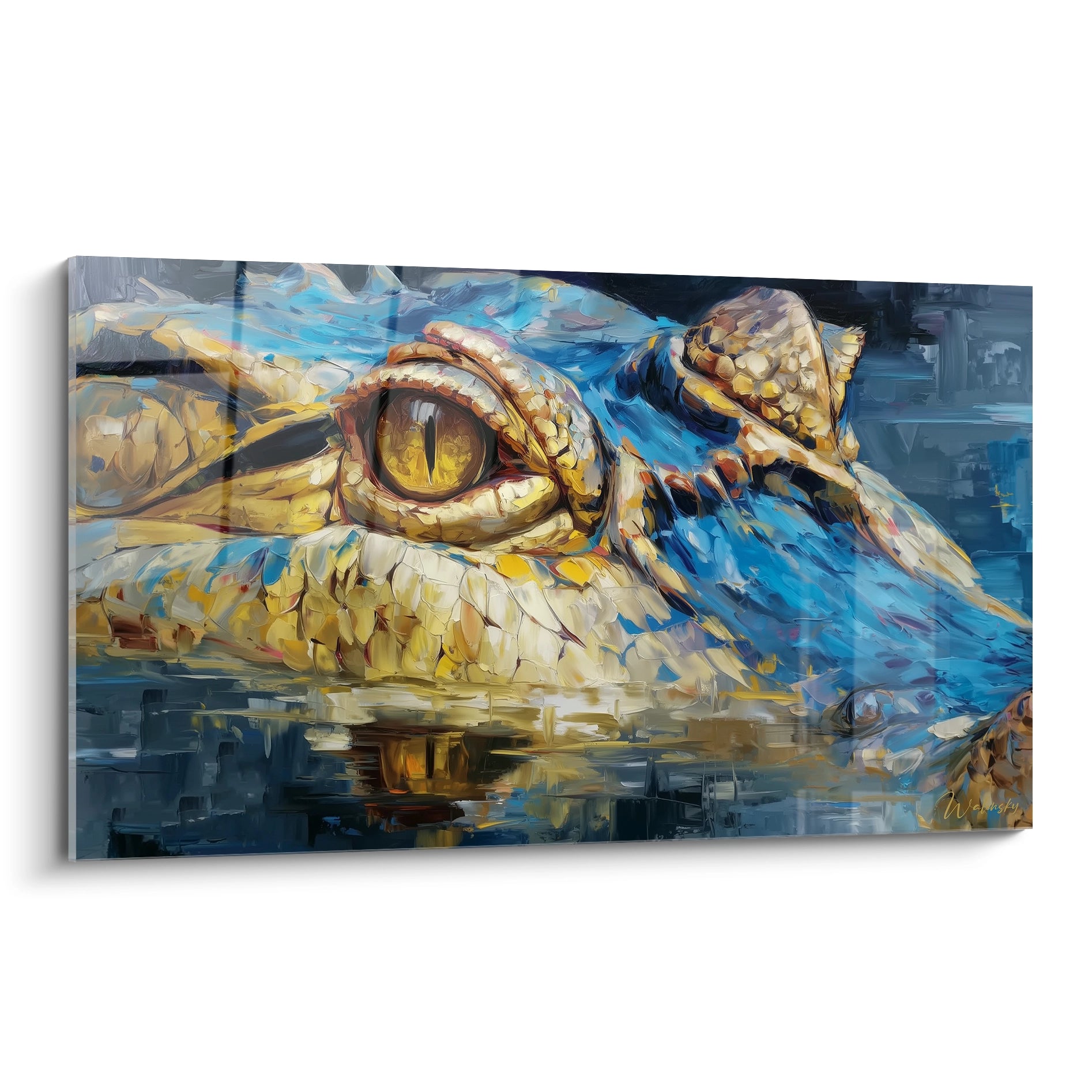
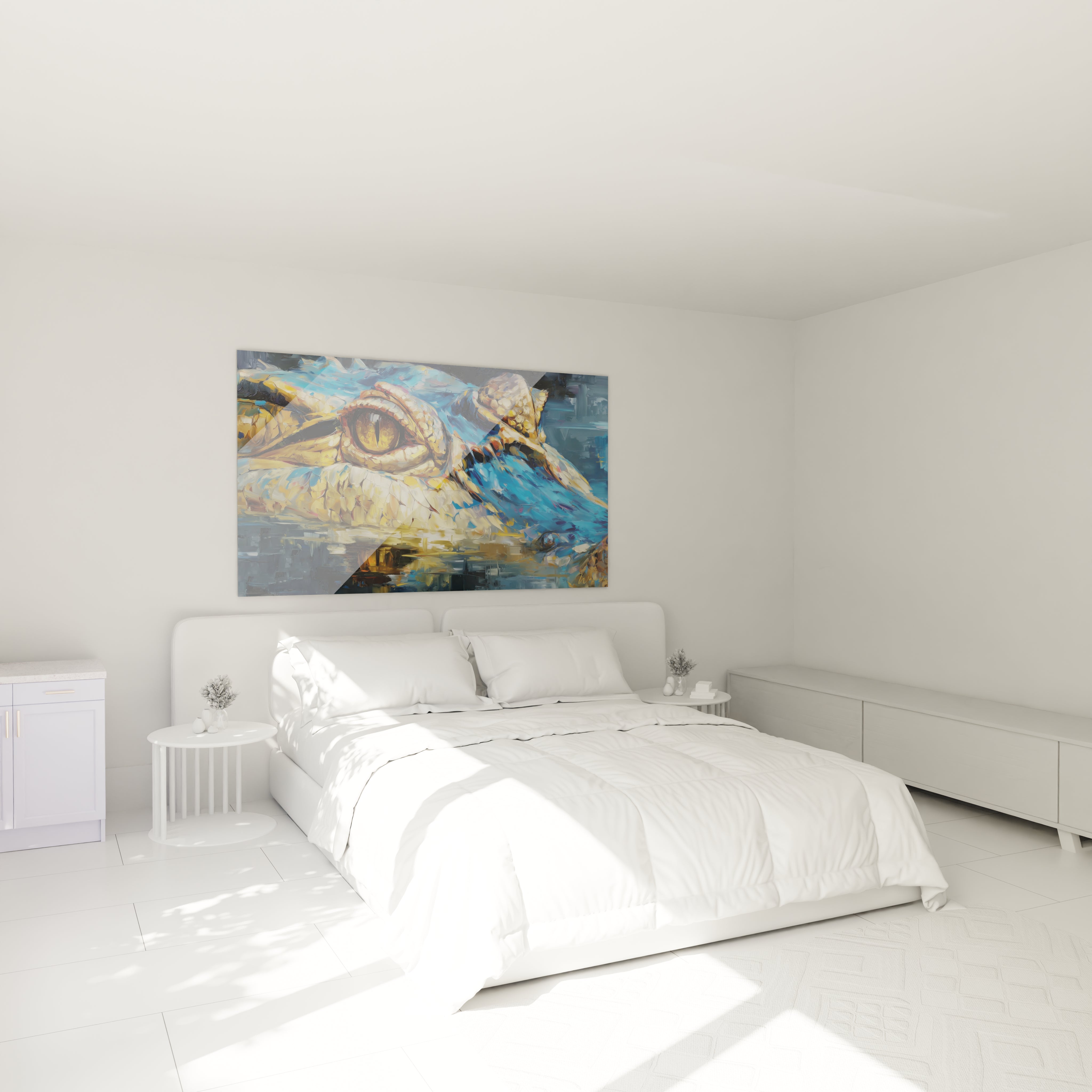
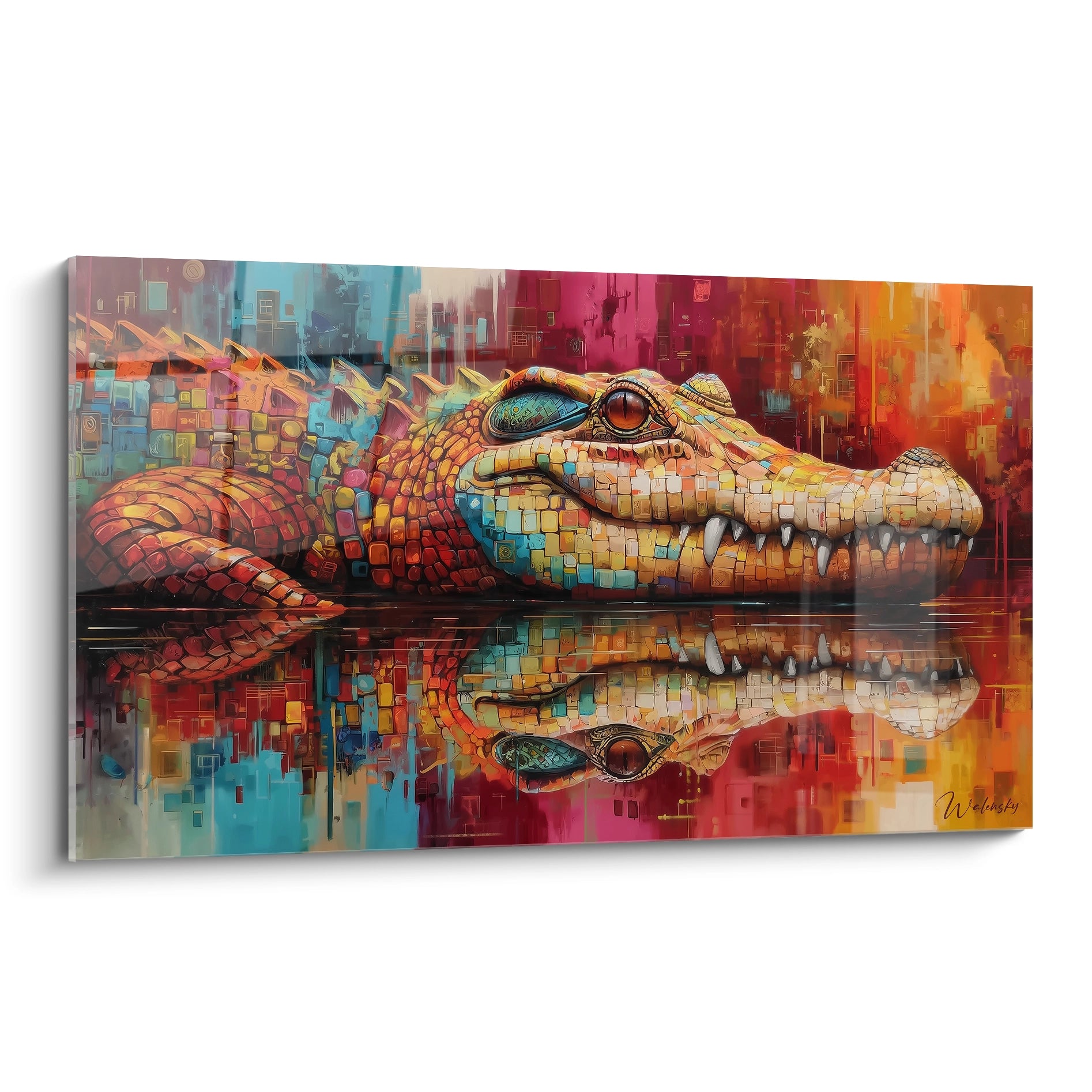
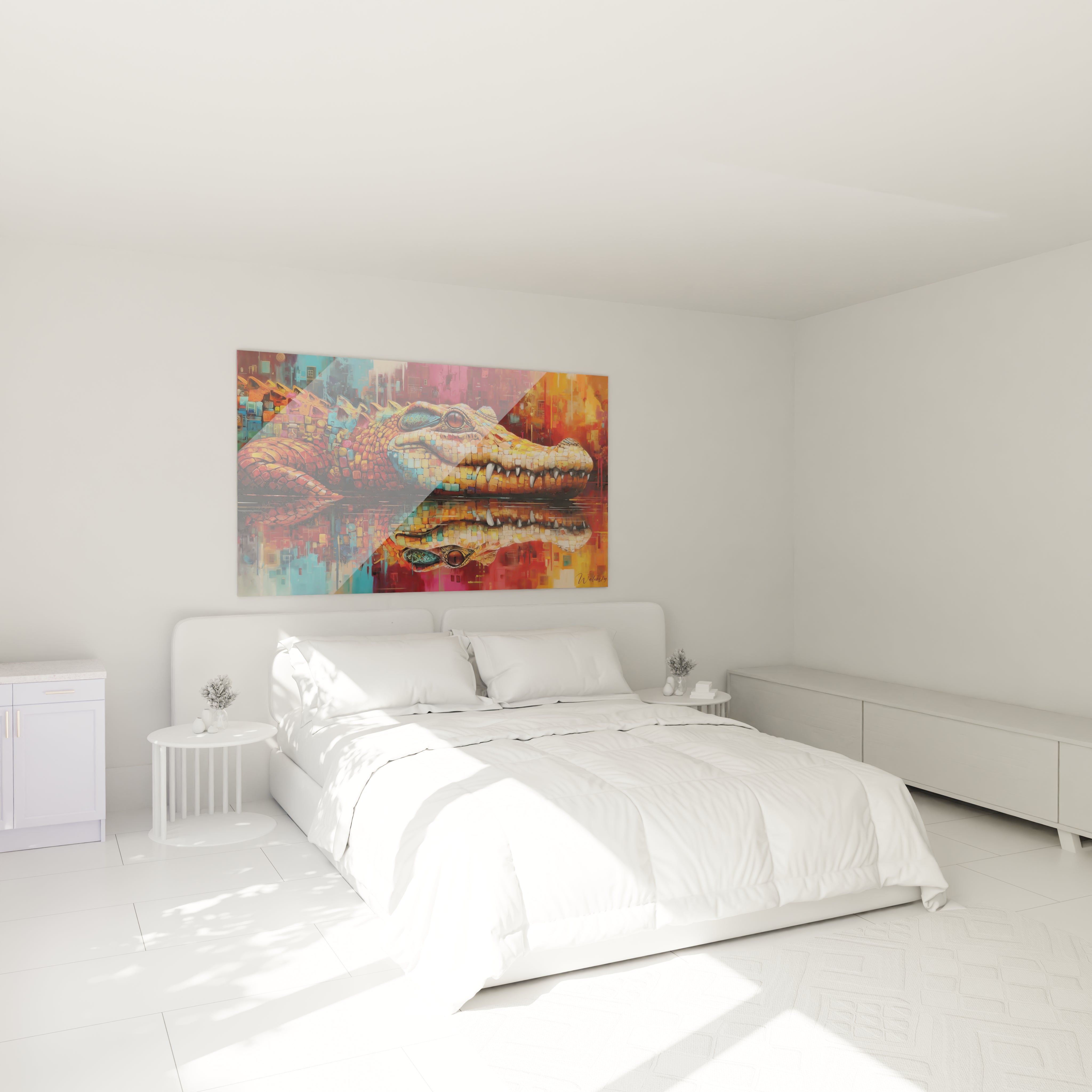
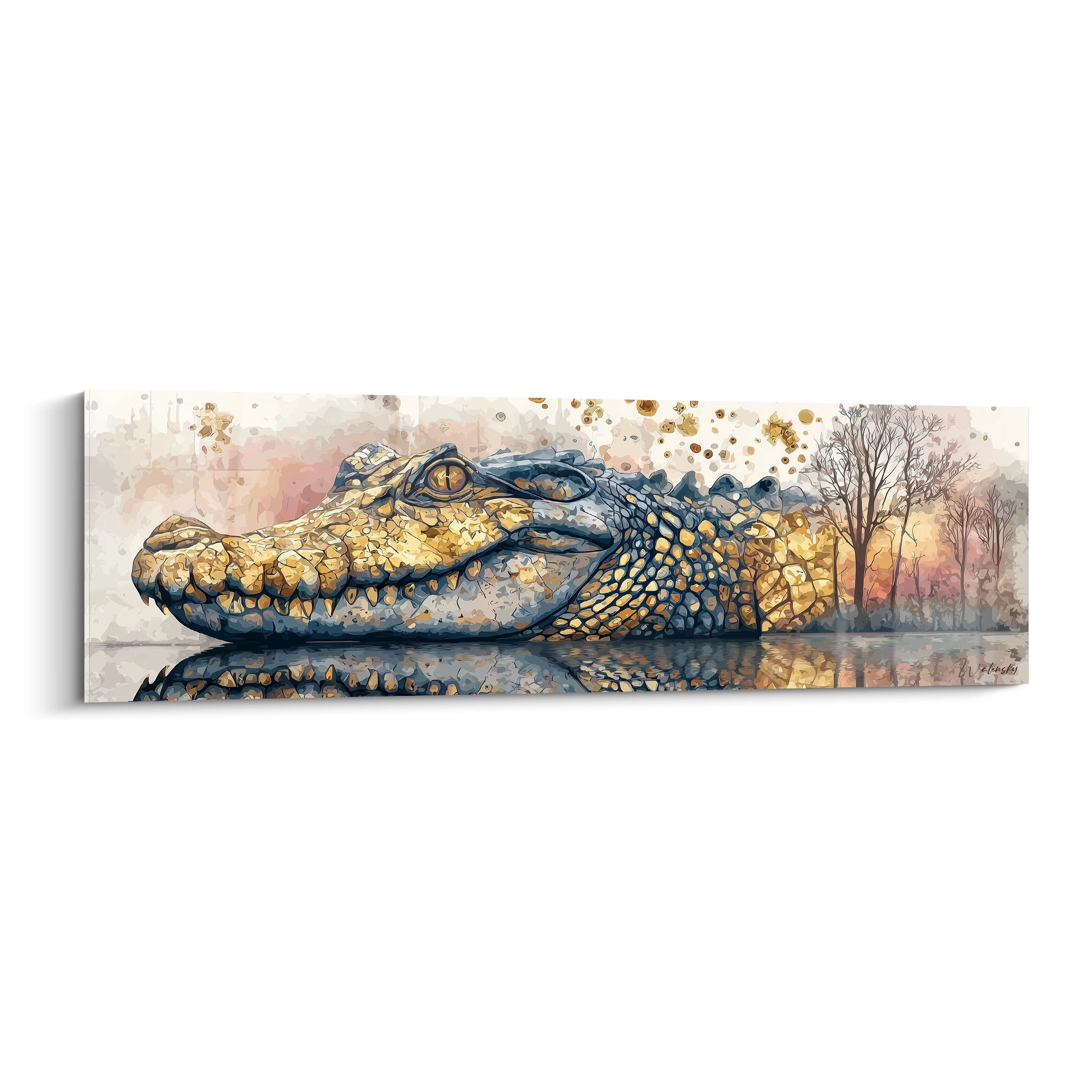
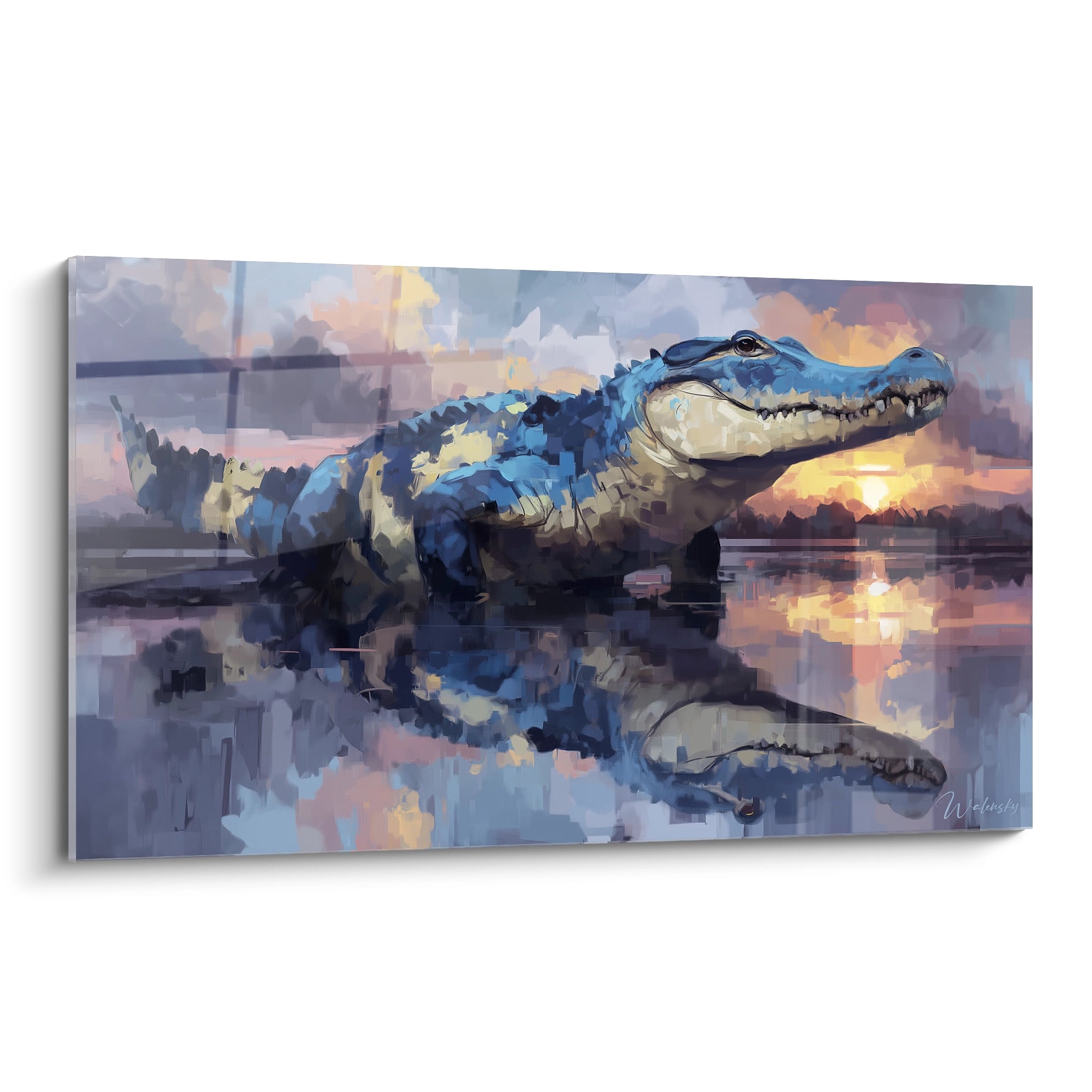
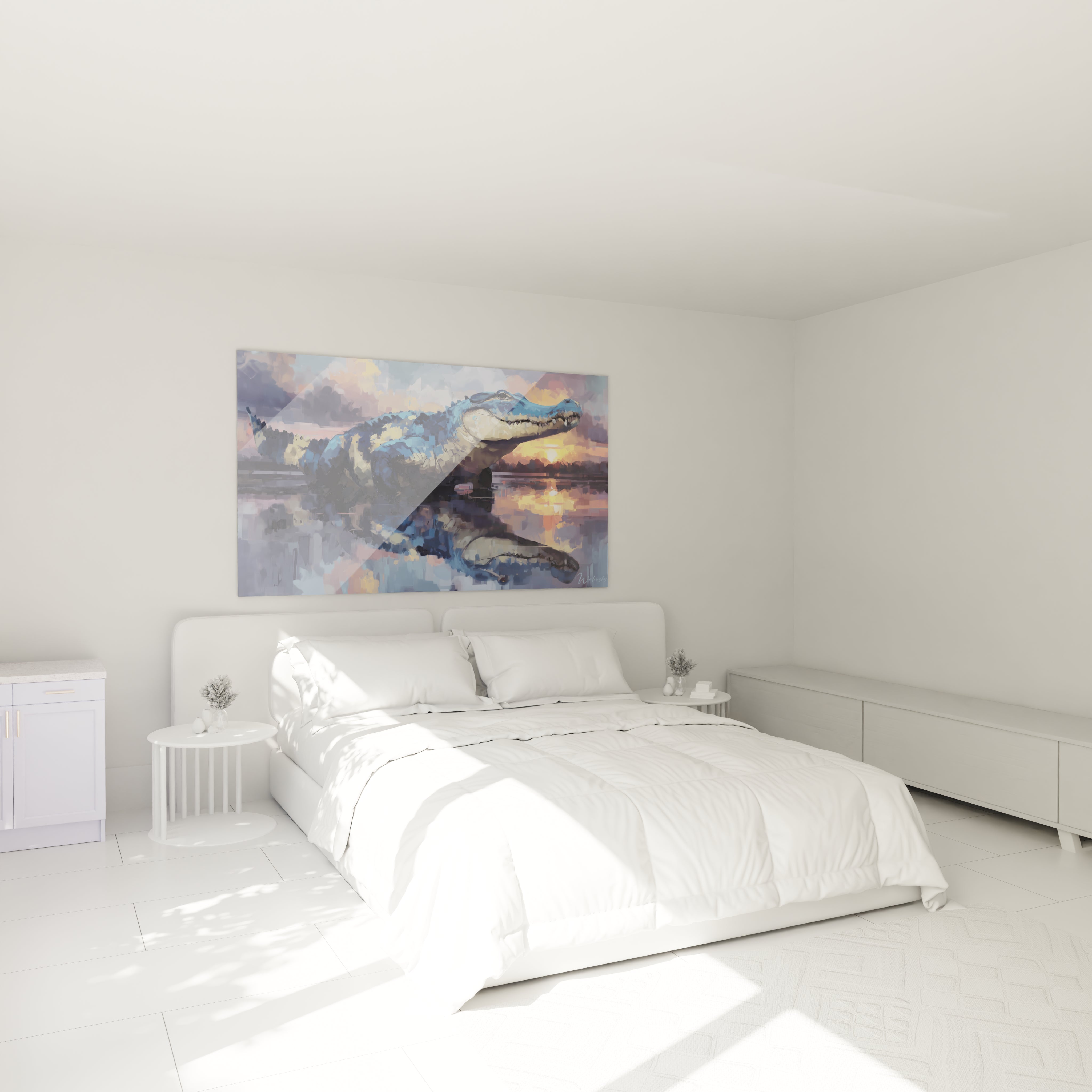
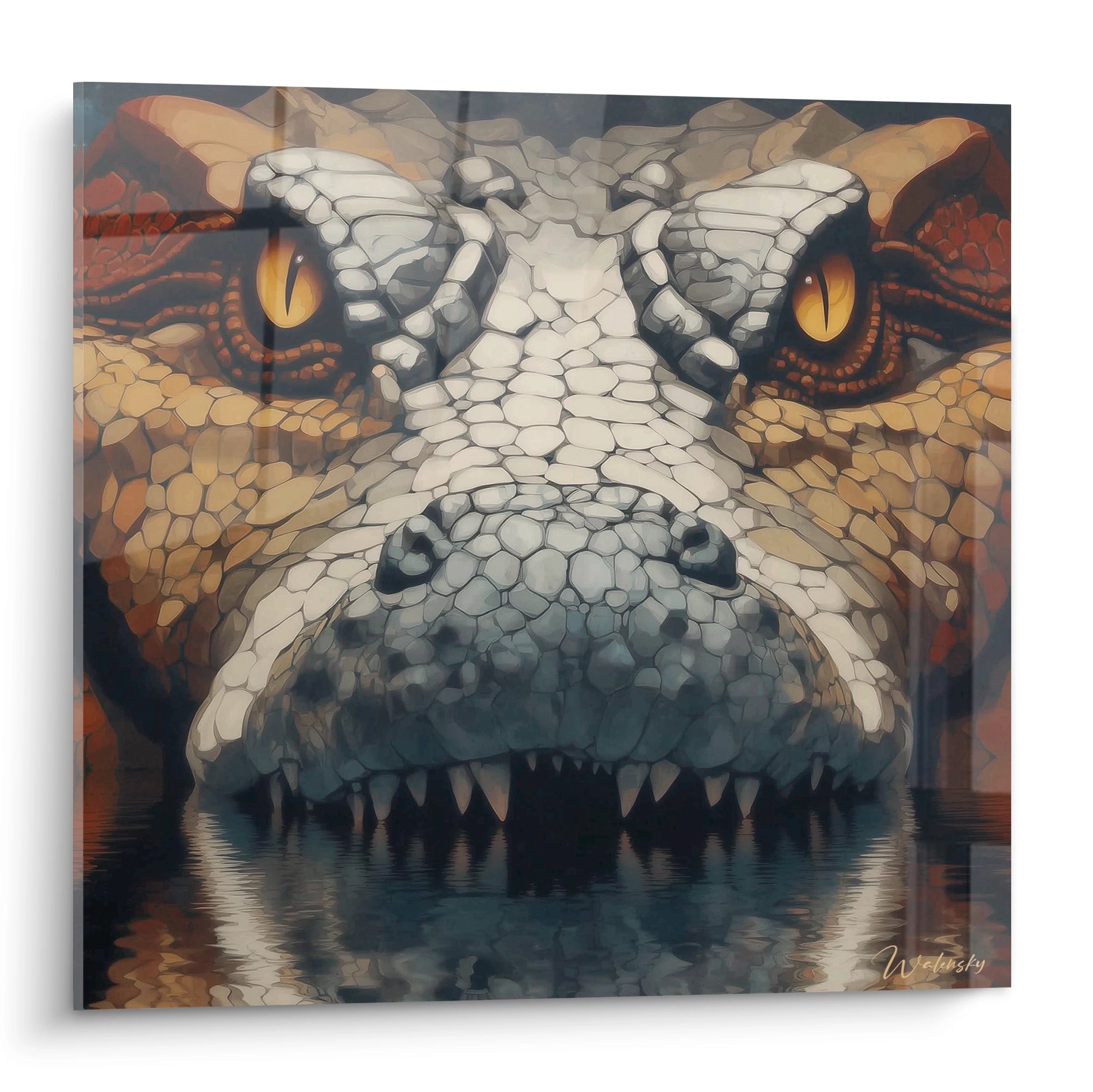
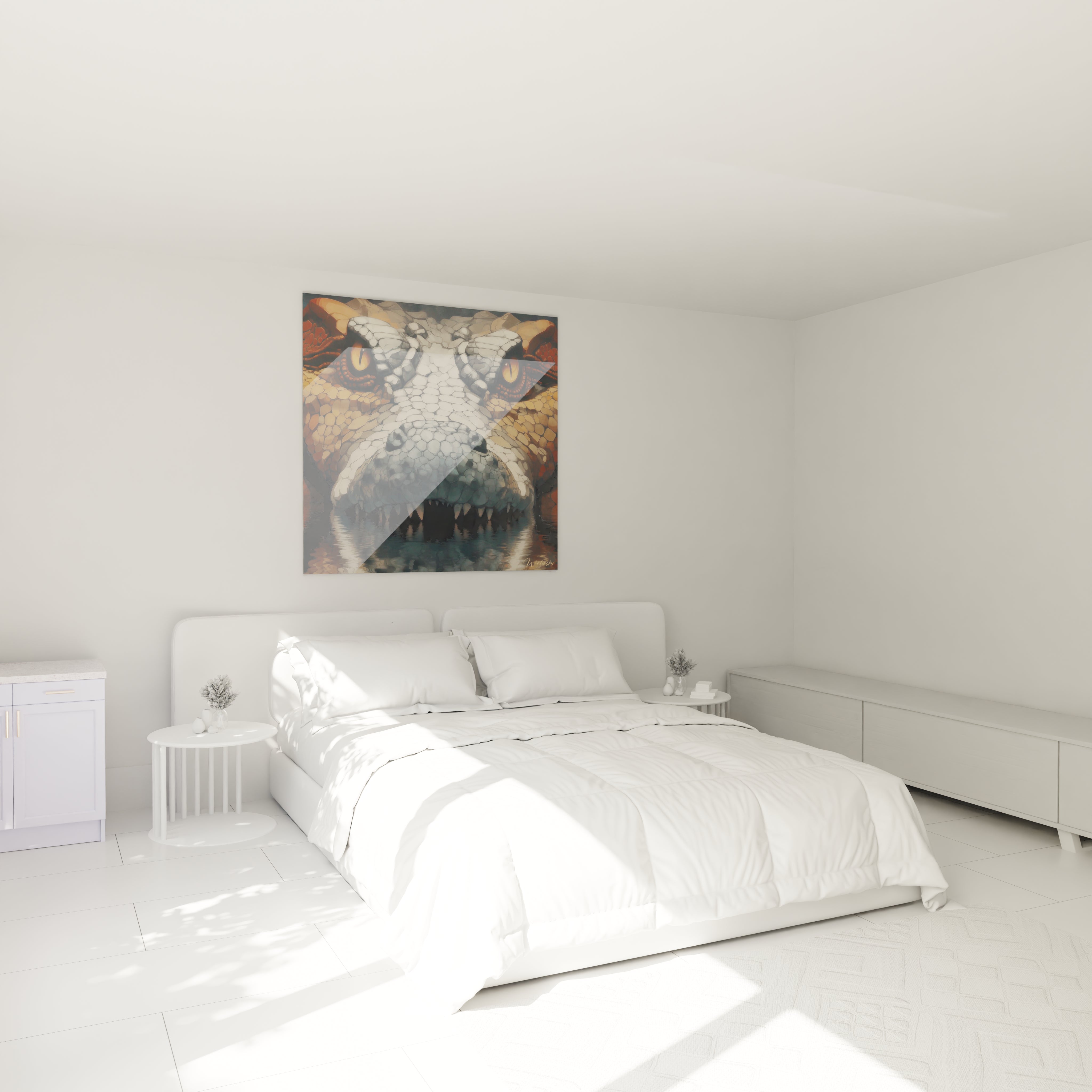
Discover our Kaprosuchus painting, a striking representation of one of the most fascinating prehistoric crocodilians from the Upper Cretaceous. This terrestrial predator, nicknamed "BoarCroc" in reference to its prominent tusks, offers a captivating alternative to classic dinosaur representations. Our large-format wall decoration captures the formidable essence of this reptile that roamed the Saharan expanses 95 million years ago. Perfect for paleontology enthusiasts and prehistoric art collectors, this visual transforms any space into a genuine cabinet of scientific curiosities. Also explore our complete collection on creatures of ancient lands to enrich your paleontological universe.
Kaprosuchus Painting: The Distinctive Anatomy of the Tusked Crocodilian
The Kaprosuchus painting highlights the exceptional anatomical features that distinguish this crocodilian from all its fossil relatives. Unlike typical representations of prehistoric aquatic crocodiles, this visual celebrates a predator adapted to terrestrial hunting, with a unique morphology in the evolutionary history of crocodilians.
Prominent Tusks: Morphological Signature of the BoarCroc
The most striking element of a Kaprosuchus wall representation lies in its three pairs of protruding tusks. These hypertrophied fangs, which earned it the nickname "boar-crocodile", project an immediately recognizable silhouette. Our large-format decoration accentuates these dental protrusions that extended well beyond its jaw, creating an unparalleled aggressive profile. These bony structures likely served to immobilize medium-sized prey, a hunting technique radically different from the crushing bites of modern crocodilians.
The specific arrangement of these tusks creates remarkable visual balance in our artistic compositions. The two anterior maxillary tusks framed the snout, while the lower mandibular fangs interlocked with those above when the jaws closed. This specialized dentition generates ideal graphic dynamics for spaces requiring strong decorative presence without falling into Tyrannosaurus or Velociraptor clichés.
Massive Skull and Powerful Musculature: Predator Biomechanics
Scientifically informed representations of Kaprosuchus reveal a skull disproportionate to its body, measuring approximately 50 centimeters in length. This morphological characteristic translates considerable bite force, adapted to perforation rather than crushing. Our large-format mural art captures this cranial robustness that testifies to specialization toward active predation on terrestrial vertebrates.
The hypertrophied temporal musculature, visible through enlarged cranial windows, constituted the biomechanical motor of this formidable jaw. Quality paleoartistic illustrations incorporate these anatomical details to faithfully restore the impression of brute force this animal exuded. The prominent muscle attachment zones on the fossil skull allow artists to reconstruct with precision the imposing silhouette of this Cretaceous predator.
Elongated Limbs and Semi-Erect Posture: The Crocodilian Exception
Unlike amphibious crocodilians with short limbs adapted for swimming, Kaprosuchus possessed proportionally long legs suggesting efficient terrestrial locomotion. This anatomical particularity offers unique compositional possibilities for wall decoration. Dynamic representations showing this reptile in full terrestrial pursuit contrast radically with the static postures of modern crocodiles.
The pelvic structure and articulation orientation indicate capacity to maintain the body elevated above ground for extended periods. This semi-erect posture, unusual among crocodilians, visually brings Kaprosuchus closer to large theropods while retaining its distinct reptilian identity. For spaces dedicated to comparative paleontology, these representations perfectly illustrate the morphological diversity of Mesozoic archosaurs.
What body dimensions characterized adult Kaprosuchus?
Fossil specimens suggest total length of approximately 6 meters for mature individuals, with estimated mass between 300 and 500 kilograms. These intermediate proportions between modern large crocodilians and medium-sized theropods create a visual scale particularly suited to imposing mural compositions. Our large-scale format faithfully restores these proportions for maximum visual impact.
Teguments and Scaling: Dermic Texture of the Cretaceous
Although skin impressions are absent from Kaprosuchus fossils, scientific reconstructions rely on tegumentary evidence from other fossil crocodilians. Quality artistic representations incorporate robust scaling, with dorsal osteoderms forming protective armor. This complex dermic texture adds a tactile visual dimension to mural compositions.
Hypothetical coloration varies according to paleoartistic artists, oscillating between terrestrial tones adapted to Saharan camouflage and contrast patterns evoking an apex predator. Color palettes dominated by ochres, deep browns and blacks create an authentic prehistoric atmosphere, particularly effective in contemporary interiors seeking temporal exoticism.
Morphological Comparison with Aquatic Giants
Visually placing Kaprosuchus alongside its gigantic cousins such as Sarcosuchus (12 meters) or Deinosuchus (10 meters) puts its ecological specialization in perspective. Where these aquatic titans crushed their prey through sheer hydraulic force, the BoarCroc perforated and tore through its tusks. This functional differentiation translates into complementary visual aesthetics in a thematic collection.
- Unique protruding tusks among fossil crocodilians
- Massive skull adapted to perforation of terrestrial prey
- Elongated limbs for active terrestrial locomotion
- Intermediate body proportions ideal for mural compositions
- Robust dermic texture with osteodermic armor
Paleontological Context and Discovery of Kaprosuchus Saharicus
Understanding the scientific context considerably enriches appreciation of a wall decoration representing Kaprosuchus. This fossil crocodilian embodies a pivotal period in reptile evolution, offering a visual window into a Saharan ecosystem radically different from today's desert.
The Echkar Formation: Cretaceous Sahara and Paleoenvironment
The Kaprosuchus painting implicitly evokes the Sahara of the Upper Cretaceous, approximately 95 million years ago, when this region constituted a lush fluvial environment. The Echkar geological formation in Niger, where fossils were discovered, testifies to fluvial systems bordered by gallery forests, populated by extraordinarily diverse fauna. Contextualized artistic representations incorporate this lush vegetation contrasting with current aridity.
This paleoenvironmental reconstruction transforms the mural visual into a genuine time-travel machine. Geology enthusiasts particularly appreciate these representations that combine paleontological precision with evocation of a lost world. The vegetation background typical of the Cretaceous, with its tree ferns and primitive conifers, immediately situates Kaprosuchus in its original biotope.
Paul Sereno and the 2009 Expedition: Scientific Revelation
The formal discovery of Kaprosuchus saharicus by paleontologist Paul Sereno's team constitutes a landmark moment in 21st-century paleontology. Published in 2009 in ZooKeys journal, this scientific description revolutionized our understanding of Mesozoic crocodilian diversity. For paleontological decoration collectors, owning a representation of this relatively recently described species guarantees originality and scientific relevance.
The holotype, preserved at the National Museum of Niger, comprises only a partial skull and a few postcranial elements, leaving interpretive margin for paleoartists. This fossil incompleteness explains stylistic variations between different artistic representations, each proposing a slightly different reconstruction hypothesis. This interpretive diversity paradoxically enriches collector interest.
What was Kaprosuchus's phylogenetic position in the evolutionary tree?
Kaprosuchus belongs to the Mahajangasuchidae clade, a group of terrestrial Gondwanan crocodilians. This systematic position reveals evolutionary links with other terrestrial forms from Africa and Madagascar, illustrating the adaptive radiation of crocodilians during the Mesozoic. Understanding this phylogeny adds scientific depth to educational wall decorations.
Faunal Coexistence: Cretaceous Niger Ecosystem
Kaprosuchus shared its environment with remarkable megafauna, including the apex predator Suchomimus (piscivorous spinosaur), the sauropod Nigersaurus with rake-like teeth, and the giant crocodilian Sarcosuchus. This faunal diversity offers opportunities for panoramic mural compositions reconstructing the complete ecosystem. Paleoecology enthusiasts appreciate these contextualized representations showing predator-prey interactions.
The ecological stratification between terrestrial crocodilians (Kaprosuchus), semi-aquatic and giant aquatic forms illustrates trophic complexity rarely seen in modern faunas. Sophisticated artistic representations exploit this richness to create engaging narrative scenes. Unlike generic dinosaur reconstructions, these specialized ecosystems offer more nuanced paleontological interpretation.
Extinction and Disappearance of Terrestrial Crocodilians
The lineage of terrestrial crocodilians such as Kaprosuchus became extinct at the end of the Cretaceous, victims of the K-Pg extinction event. This definitive disappearance grants wall representations a melancholic dimension, evoking evolutionary forms without modern descendants. For spaces dedicated to reflection on lost biodiversity, these visuals carry an implicit message about the fragility of adaptive radiations.
The absence of terrestrial crocodilians in current fauna makes Kaprosuchus all the more exotic and fascinating. Unlike contemporary crocodiles and alligators perpetuating an ancestral aquatic body plan, the BoarCroc represents an interrupted evolutionary experiment. This historical uniqueness fully justifies its integration into a demanding paleontological decoration collection.
Scientific Precision versus Artistic License
The best Kaprosuchus wall representations balance paleontological rigor and aesthetic impact. Musculo-skeletal reconstructions based on comparative anatomy guarantee scientific credibility, while chromatic and compositional choices serve decorative effectiveness. Educated enthusiasts privilege artists who document their reconstructive choices.
- Lush Cretaceous Saharan environment contrasting with current aridity
- Recent discovery (2009) guaranteeing scientific originality
- Coexistence with Cretaceous African megafauna
- Extinct evolutionary lineage without modern descendants
- Balance between paleontological rigor and visual impact
Decorative Impact and Integration of Kaprosuchus Painting into Contemporary Space
Beyond its paleontological interest, the Kaprosuchus painting constitutes a powerful decorative element capable of radically transforming a space's atmosphere. Its visual singularity and narrative charge make it a privileged choice for spaces seeking strong and memorable identity.
Modern Cabinet of Curiosities: Resurgence of Naturalist Aesthetics
Contemporary enthusiasm for scientific cabinets of curiosities finds in Kaprosuchus representation an ideal subject. This prehistoric crocodilian immediately evokes the golden age of naturalist exploration and early 19th-century paleontological discoveries. Our large-format wall decoration perfectly fits this neo-Victorian trend valuing temporal and geographical exoticism.
Interiors adopting this aesthetic typically juxtapose vintage furniture, antique scientific instruments and naturalized or represented specimens. Kaprosuchus, with its appearance simultaneously reptilian and mammalian due to its tusks, generates the visual tension characteristic of naturalist curiosities. The imposing formats we propose create an immediate focal point, structuring the entire arrangement around this showpiece.
Educational and Institutional Spaces: Pedagogy Through Image
Educational establishments, natural history museums and scientific centers find in our Kaprosuchus representations exceptional pedagogical support. Large-format visualization facilitates understanding of complex paleontological concepts, particularly morphological diversity of Mesozoic crocodilians and evolutionary adaptation to terrestrial niches.
Unlike fossilized skeletons requiring expertise for interpretation, artistic reconstructions offer immediate accessibility. Visitors instantly understand the predatory function of tusks and the unusual terrestrial posture. This communicational clarity justifies investment in high-quality visuals for institutions targeting maximum educational impact.
How does Kaprosuchus distinguish itself from other prehistoric reptiles in decoration?
Its unique combination of crocodilian traits and terrestrial specializations creates a visual identity impossible to confuse with Tyrannosaurus, raptors or other overexploited prehistoric icons. This originality guarantees distinctive decoration avoiding genre clichés.
Libraries and Reflection Spaces: Contemplative Atmosphere
Environments dedicated to reading, study or reflection particularly benefit from Kaprosuchus visual presence. The primitive animality and deep temporality evoked by this Cretaceous predator induce philosophical perspective on human existence's ephemeral nature. This conceptual depth far exceeds superficial decorative function.
Private libraries housing naturalist collections, paleontology volumes or scientific literature find in this representation coherent visual complement. Association between bookish knowledge and paleontological iconography creates intellectual synergy valorizing cognitive approach. Dominant earthy tones facilitate integration with woodwork and antique leather book bindings.
Professional Spaces and Offices: Identity Affirmation
Professional cabinets of geologists, paleontologists, evolutionary biologists or simply entrepreneurs passionate about natural sciences use wall decoration as expression of intellectual identity. Kaprosuchus, a species relatively unknown to the general public, signals expertise and curiosity exceeding superficial knowledge.
This cultural selectivity functions as subtle social marker, distinguishing the owner from conventional decoration enthusiasts. Educated visitors immediately recognize the paleontological reference, creating terrain for intellectual exchange. This social function of scientific decoration should not be underestimated in competitive professional environments.
Chromatic Integration and Contemporary Harmonies
Color palettes of Kaprosuchus representations, dominated by browns, ochres, olive greens and blacks, naturally integrate into contemporary interiors privileging natural materials. This chromatic compatibility facilitates arrangement without requiring complete decorative overhaul. The large formats we propose maximize visual impact while maintaining this colorimetric harmony.
Contemporary industrial interiors, characterized by exposed concrete, raw steel and recycled wood, find in these earth tones an organic counterpoint balancing mineral coldness. The visual texture suggested by reptilian scaling dialogues with rough material surfaces of industrial materials, creating tactile richness even through two-dimensional representation.
Thematic Collection: Personal Paleontological Curation
Discerning collectors build coherent thematic ensembles, and Kaprosuchus occupies a strategic position in a collection dedicated to prehistoric crocodilians or Cretaceous Gondwanan fauna. Its relative rarity makes it a distinctive piece avoiding redundancy with more common Sarcosuchus or Deinosuchus representations.
- Powerful focal point for modern cabinet of curiosities aesthetic
- Exceptional pedagogical support for educational institutions
- Contemplative atmosphere suited to private libraries
- Intellectual identity marker for professional spaces
- Natural chromatic integration with contemporary interiors
FAQ: Frequently Asked Questions About Kaprosuchus Painting
Why choose a Kaprosuchus painting rather than Tyrannosaurus or Velociraptor?
Kaprosuchus offers unequaled scientific and visual originality, avoiding clichés of over-publicized dinosaurs. Its recent discovery and unique morphology guarantee distinctive decoration not found in every interior. Authentic paleontology enthusiasts appreciate this relative rarity testifying to thorough knowledge rather than superficial enthusiasm for Mesozoic giants.
Is a Kaprosuchus painting suited to all interior styles?
While particularly adapted to naturalist, industrial or contemporary aesthetics, Kaprosuchus possesses surprising versatility. Its earth tones harmonize with varied interiors, from urban loft to classical library. The essential element lies in appropriate scale and surrounding decorative context that should valorize rather than compete with this showpiece.
What educational value does a Kaprosuchus painting bring to a family space?
This visual stimulates young minds' scientific curiosity by presenting an alternative to omnipresent dinosaurs in popular culture. It introduces complex evolutionary concepts such as adaptive radiation, ecological specialization and extinction of lineages. Family discussions around this representation develop critical thinking and interest in natural sciences, far exceeding superficial decorative function.
Do Kaprosuchus representations respect paleontological rigor?
Serious artistic reconstructions rely on scientific publications and comparative anatomy to guarantee maximum plausibility. However, fossil incompleteness leaves certain areas of uncertainty that artists interpret according to their expertise. The best representations document their reconstructive choices, allowing educated buyers to assess scientific rigor. Our selection systematically privileges artists collaborating with professional paleontologists.