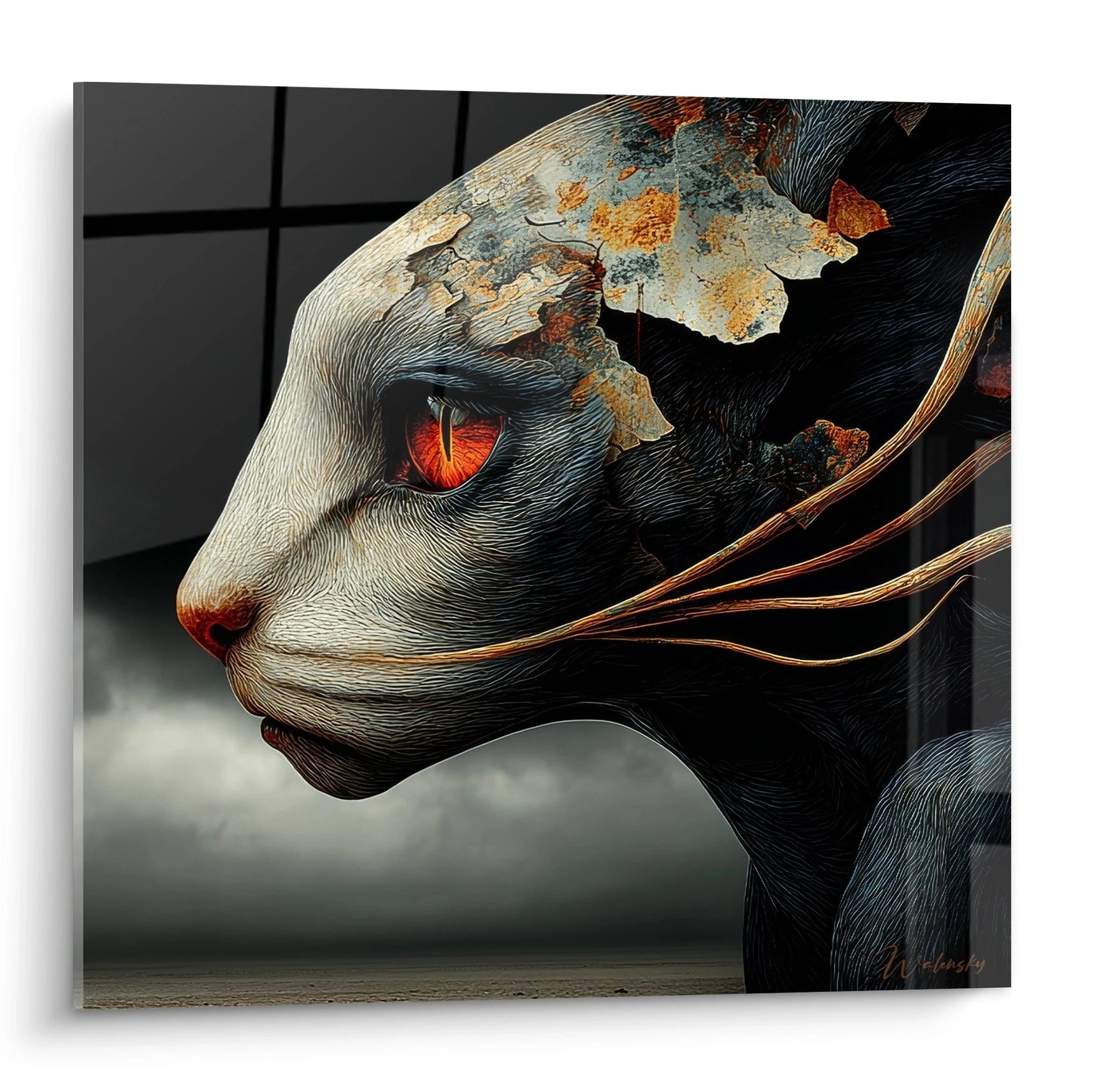
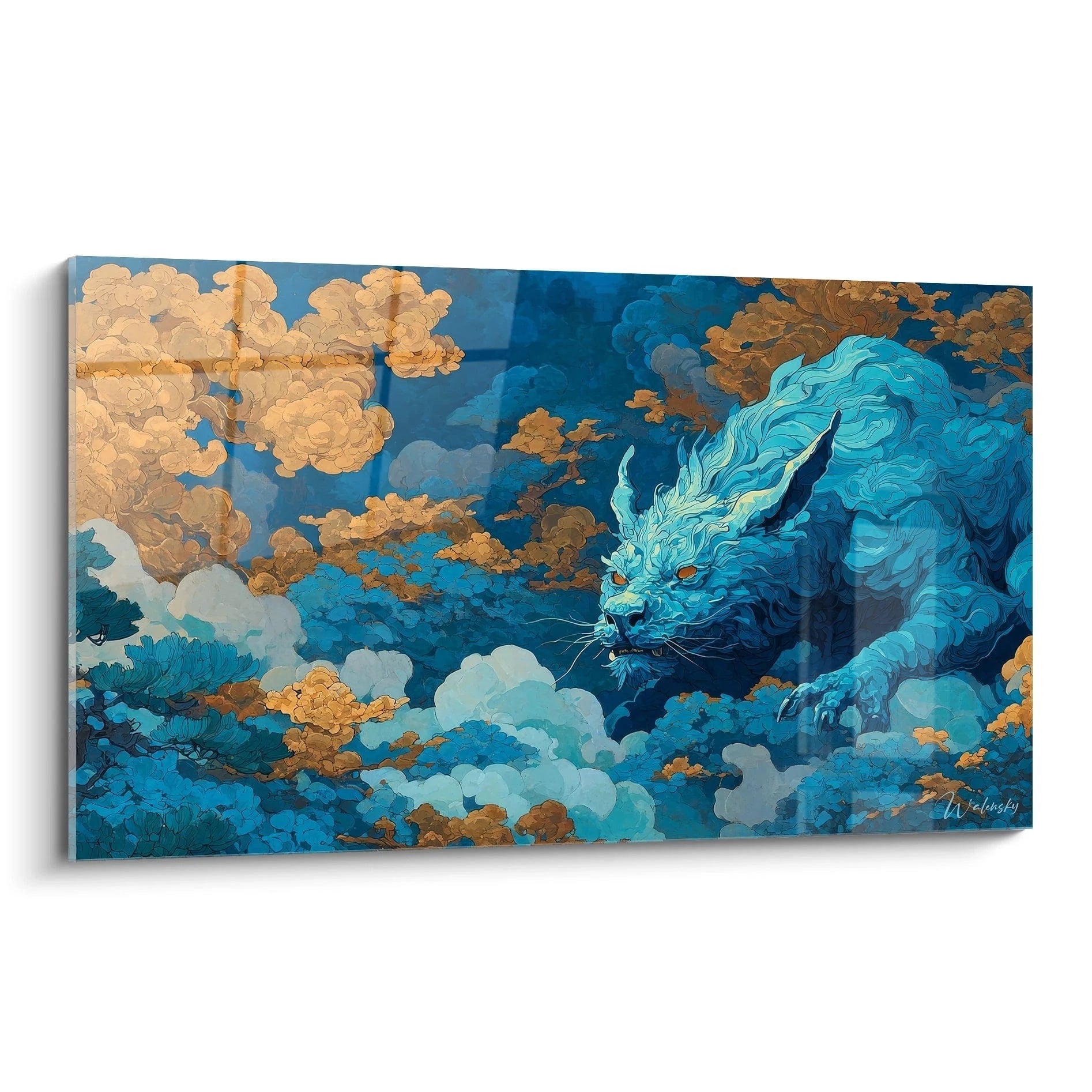
A Chupacabra wall art represents one of the most fascinating cryptozoological creatures in Latin American culture. This mural artwork captures the mysterious essence of this legendary predator, originating from Puerto Rican eyewitness accounts in the 1990s, before spreading throughout the American continent. Acquiring a large-format representation of this emblematic creature radically transforms the atmosphere of a space, creating a focal point that engages contemporary collective imagination and narratives passed down through generations.
The Psychological Impact of Monumental Cryptozoological Representations
Installing a Chupacabra wall art in a residential or professional environment generates a visual dynamic radically different from that produced by other decorative artworks. This legendary creature, described as a nocturnal predator with blended reptilian and mammalian characteristics, provokes an instinctive response in observers that activates brain regions linked to ancestral vigilance.
How does a legendary creature wall art influence spatial perception?
The imposing dimensions of a Chupacabra mural representation create what environmental psychologists call "mythological spatial anchoring". Unlike representations of purely imaginative fantastic creatures, the Chupacabra benefits from documented contemporary eyewitness accounts, conferring on its image a troubling ambiguity between reality and folklore. This cognitive gray area generates lasting fascination that maintains visual attention far beyond initial observations.
Testimonies about this creature, concentrated primarily between Puerto Rico, Mexico, and the southern United States, consistently describe bulging luminescent eyes, a spine bristling with prominent dorsal spines, and a characteristic bipedal posture. When these distinctive anatomical elements are magnified in a substantial mural format, they establish a presence that dialogues with our archaic fears while satisfying our curiosity about unexplained phenomena.
Cognitive stimulation through cryptid iconography
A myth and legend wall art centered on the Chupacabra specifically activates neural circuits associated with processing contradictory information. This creature, whose existence oscillates between marginal zoology and modern urban legend, forces the brain to simultaneously maintain multiple possible interpretations. This cognitive process enriches daily experience of the space by creating recurring intellectual stimulation.
Creative professional environments, particularly in audiovisual production, conceptual design, or speculative writing, benefit especially from this visual stimulation. The monumental presence of a controversial cryptid encourages lateral thinking and questioning of established certainties, two fundamental skills in innovation processes.
The "conversation starter" effect of paranormal visual phenomena
Unlike conventional decorative subjects, a large-format representation of the Chupacabra systematically generates in-depth discussions. Visitors invariably share their personal knowledge about the legend, their own explanatory theories, or their experiences with other cryptozoological phenomena. This social dynamic transforms the artwork into a catalyst for meaningful interactions.
Spaces dedicated to social gatherings—spacious living areas, coworking spaces, themed bars, or conceptual restaurants—particularly exploit this dialogical potential. The creature acts as a narrative trigger allowing individuals to reveal their positions on the rationality-belief spectrum, creating authentic exchanges that transcend usual superficial conversations.
Why do cryptid representations generate superior memorability?
Research in visual neuroscience demonstrates that ambiguous images, impossible to categorize definitively, are encoded more deeply in long-term memory. A wall art depicting the Chupacabra benefits from this cognitive property: each observation reactivates the initial questioning without ever completely resolving it, thereby reinforcing the mnemonic imprint.
This characteristic proves valuable in commercial contexts where visual identity must durably mark visitors. Specialty bookstores focused on fantastic literature, themed escape games, or podcasts centered on unsolved mysteries create thus an immediately recognizable and memorable atmospheric coherence.
Optimal dimensions for maximizing cryptozoological visual impact
Monumental formats exponentially amplify the effect of the cryptid's presence. A representation exceeding standard human proportions suggests face-to-face encounter with the creature, activating a visceral feeling impossible to obtain with reduced dimensions. This scale imposes a visual confrontation that simulates the experience of original eyewitnesses.
- Spaces with generous ceiling heights (exceeding 2.80 meters) allow dramatic vertical installations exploiting the creature's characteristic bipedal posture
- Extended walls without architectural interruption authorize horizontal compositions showing the Chupacabra in its supposed nocturnal environment, creating a narrative window into its mythical habitat
- Multiple viewing angles in open spaces transform the representation into a three-dimensional presence that seems to survey the space from different perspectives
Contemporary Symbolism and Cultural Resonance of Decorative Chupacabra
Integrating a Chupacabra wall art into a domestic or professional environment never constitutes a purely aesthetic choice. This creature embodies specific cultural anxieties that emerged in the 1990s, a period of profound socioeconomic transformations in Latin America and North American Hispanic communities. Its visual representation functions as a complex identity marker.
The Chupacabra as expression of modern Latin American identity
Unlike millennial-old European or Asian mythological creatures, the Chupacabra represents a contemporary cryptozoological phenomenon anchored in recent Latin American experience. This temporal and geographic specificity confers on its representation a dimension of cultural affirmation particularly pertinent in multicultural urban spaces.
Households wishing to celebrate their Puerto Rican, Mexican, or more broadly Latin American heritage find in this iconography an alternative to traditional folkloric symbols sometimes perceived as dated. The cryptid modernizes identity expression by connecting it to globalized popular culture while maintaining its distinctive geographic roots. This duality addresses the needs of diaspora generations navigating between ancestral traditions and urban contemporaneity.
What sociological reading does a modern vampire creature wall art enable?
Anthropologists interpret the emergence of the Chupacabra myth as a narrative response to economic upheaval and rapid modernization of traditionally agrarian societies. The creature, specifically attacking livestock, symbolizes invisible threats weighing on rural lifestyles. A large-format mural representation captures this tension between tradition and modernity.
Professional environments in the sectors of cultural anthropology, investigative journalism, or Latin American studies frequently use this iconography as a visual anchor for their research problematiques. The monumental presence of the cryptid constantly reminds of the necessity to examine popular narratives as expressions of legitimate social concerns rather than as mere superstitions.
The transgenerational appeal of the cryptozoological phenomenon
A remarkable particularity of Chupacabra wall art resides in its capacity to captivate multiple generations simultaneously. Adults who lived through the media emergence of the phenomenon in the 1990s recognize in it a nostalgic marker of their adolescence or youth. More recent generations discover the creature through reinterpretations in video games, contemporary horror films, and podcasts about unexplained mysteries.
This generational versatility proves valuable in family spaces where different age groups cohabit. The cryptid acts as a cultural bridge enabling intergenerational discussions about beliefs, rational skepticism, and evolution of mass media. Grandparents share original narratives, parents provide historical context, and children bring current digital reinterpretations.
How to integrate the humorous dimension of modern folklore?
Despite its threatening appearance, the Chupacabra has also generated significant humorous and self-deprecating cultural production, particularly in communities that witnessed its emergence. Internet memes, musical parodies, and kitsch merchandise created a secondary amused reading of the phenomenon, coexisting with serious interpretations.
This tonal ambivalence allows sophisticated decorative installations playing on multiple emotional registers simultaneously. A reception space can thus project both an intriguing mysterious atmosphere and cultural self-irony that disarms visitors. This emotional complexity considerably enriches spatial experience compared to univocal interpretations.
- Latin American fusion restaurants brilliantly exploit this tonal duality by creating simultaneously authentic and playful environments
- Creative workspaces in the entertainment industry use the iconography as a reminder that the most impactful cultural productions often emerge from the margins
- Private collections of Latin American popular culture position the cryptid as a historical milestone in the evolution of urban legends in the media age
The unexpected ecological dimension of the vampire myth
A lesser-known but fascinating interpretation of the Chupacabra phenomenon connects it to emerging environmental concerns. Several amateur cryptozoologists have suggested that observations might correspond to known animals suffering from severe parasitic diseases, transformed by environmental degradation. This ecological reading adds a pertinent contemporary layer.
Environmental organizations, education centers focused on conservation, and spaces dedicated to ecological awareness can exploit this metaphorical dimension. The wall art becomes thus a support for discussion about visible and invisible consequences of natural habitat destruction, mutations induced by pollution, and our collective responsibility toward biodiversity.
Aesthetics of Folkloric Terror and Cryptid Visual Composition
Acquiring a Chupacabra wall art involves aesthetic considerations radically distinct from those applicable to other decorative genres. This creature occupies a unique visual space between contemporary cinematic horror and medieval bestiary iconography, creating a hybrid aesthetic requiring a specific compositional approach to maximize its impact.
Distinctive anatomical characteristics and their representation
Consensual descriptions of the Chupacabra converge toward several recurring anatomical traits which, when magnified in a substantial mural format, create a striking visual presence. Oversized eyes, often described as luminescent or reflective like nocturnal predators, constitute the primary focal point of any successful composition.
The spine bristling with bony or cutaneous appendages creates an immediately recognizable silhouette that stands out in any environment. This morphological characteristic, absent from traditional European or Asian cryptids, allows instantaneous identification even in peripheral vision. Installations in hallways, stairwells, or frequently traversed passages particularly exploit this subliminal recognition effect.
Why do nocturnal representations amplify perceived authenticity?
Nearly all historical testimonies situate Chupacabra observations in twilight or nocturnal contexts. A mural representation respecting this environmental chronology gains considerably in atmospheric credibility. Color palettes dominated by deep blues, desaturated purples, and rich blacks create narrative coherence with original accounts.
This nocturnal dominance also generates sophisticated light interactions with ambient illumination. Spaces benefiting from natural light variations throughout the day progressively reveal different composition details. Real twilight resonates with depicted twilight, creating striking moments of synchronization between real environment and pictorial universe.
The tension between anatomical realism and mythological stylization
Artists representing the Chupacabra constantly navigate between two contradictory yet complementary aesthetic approaches. The hyperrealistic approach, inspired by taxidermy and scientific zoological illustration, suggests the creature might actually exist according to known biological laws. This anatomical credibility amplifies unease by maintaining the observer in ontological uncertainty.
Conversely, stylized interpretations borrowing from traditions of Pre-Columbian art, expressionist printmaking, or contemporary street art anchor the creature in the symbolic and cultural domain. This approach privileges emotional and mythological resonance over zoological plausibility, creating artworks functioning as contemporary totems rather than cryptozoological documents.
How do rural versus urban environments influence visual interpretation?
A fascinating dimension rarely explored concerns the contextual adaptation of Chupacabra representations depending on installation environment. Rural or periurban spaces, where original testimonies concentrated, allow compositions integrating authentic landscape elements: dense tropical vegetation, nocturnal agricultural terrain, abandoned agrarian structures.
Contemporary urban environments generate instead audacious reinterpretations positioning the cryptid in improbable urban contexts. These transpositions create productive visual dissonances questioning boundaries between wild and domestic, between rural periphery and metropolitan center. Industrial lofts, minimalist apartments, or trendy commercial spaces brilliantly exploit this anachronistic tension.
- Compositions showing the creature observing civilization from a liminal position create a gaze reversal placing humans in the position of observed rather than observer
- Stripped backgrounds concentrate attention on cryptid anatomy, transforming the representation into quasi-scientific study dialoguing with traditions of naturalist plates
- Environments crowded with narrative elements create complex scenes where the Chupacabra becomes actor in an extended visual narrative requiring repeated observation to extract all details
The stylistic evolution of the cryptid through the decades
Between early 1990s Puerto Rican descriptions and contemporary reinterpretations, the Chupacabra's supposed appearance has evolved considerably. Initial representations evoked more a bipedal reptile with extraterrestrial proportions, while recent versions often integrate emaciated canid elements, influenced by rational explanations suggesting certain observations concerned coyotes with severe mange.
This diachronic evolution offers stratified decorative possibilities. Informed collectors can juxtapose different interpretative epochs, creating a visual chronology of the myth itself. This metadecorative approach transforms the space into a living archive documenting the evolution of a contemporary legend, adding intellectual and historical dimension to simple aesthetic presence.
What contextual elements reinforce cryptozoological atmosphere?
Beyond the central creature representation, peripheral compositional choices largely determine overall atmospheric effectiveness. The inclusion of animal victims, suggested rather than explicitly shown, adds an unsettling narrative dimension without descending into gratuitous gore. This aesthetic restraint maintains the artwork in the psychological suspense register rather than visceral horror.
Rural Latin American architectural elements—rusted metal fencing, decrepit agricultural structures, encroaching tropical vegetation—geographically and culturally anchor the representation. These environmental details transform the wall art into a window to a specific place rather than a simple creature portrait, considerably enriching narrative depth and visual immersion.
FAQ: Frequently Asked Questions about Chupacabra Wall Art
Is Chupacabra wall art suitable for family spaces with young children?
Relevance depends on the representation style chosen and individual children's sensitivity. Stylized versions borrowing from comic book or cartoon aesthetics work excellently as a playful introduction to cryptozoological legends, stimulating imagination without generating anxiety. Hyperrealistic representations better suit adolescents and adults appreciating ambiguity between zoological documentation and speculative fiction.
What decorative complementarity works with a Latin American cryptid representation?
Association with other regional folklore elements creates enriching thematic coherence: La Llorona representations, Día de los Muertos iconography, or references to other Pre-Hispanic legends. This approach transforms the space into celebration of Latin American narrative heritage rather than simple exhibition of cryptozoological curiosity. Alternatively, juxtaposition with cryptids from other cultures—Himalayan Yeti, American Mothman, or Australian Bunyip—creates a global cartography of contemporary myths.
Do large-format Chupacabra wall art pieces require special conservation conditions?
Professional quality artworks intended to endure benefit from the same precautions as any ambitious pictorial representation: avoid prolonged direct exposure to ultraviolet rays that gradually degrade pigments, maintain stable humidity to preserve structural integrity, and position the artwork away from intense heat sources. Monumental formats also impose considerations of robust wall fixation, particularly crucial for dynamic representations suggesting movement that generate substantial visual load.
What psychological significance attaches to displaying a cryptozoological predator?
Environmental psychologists observe that voluntary integration of predatory imagery in habitat often reflects desire for symbolic reappropriation of anxieties. Rather than passively suffering existential uncertainties, the individual materializes and confronts them daily, transforming diffuse apprehension into controlled aesthetic object. This dynamic resembles cathartive functions attributed to horror narratives, allowing secure exploration of threatening emotional territories through artistic mediation.