


Mosaic Wall Art
Immerse yourself in the elegance of our Mosaic wall art collection, a true celebration of ancient art revisited in a contemporary style. Each mosaic wall art piece plays with shapes and colors, creating captivating and harmonious compositions. These artworks add a unique artistic dimension to your space, evoking both tradition and innovation through the world of modern mosaic art.
 Song of Tiles Artwork - Mosaic Street Art Edition273,90 €
 Ceramic Flow Canvas - Mosaic Edition273,90 €
 The Mark of Sin Painting - Mosaic Street Art Edition273,90 €
 The Colors of the Pavement Painting - Mosaic Street Art Edition273,90 €
 The Traces of the Past Wall Art - Mosaic Street Art Edition273,90 €
 Wall of Secrets - Mosaic Street Art Edition273,90 €
 Reverie Floral Wall Art - Mosaic Street Art Edition273,90 €
 Urban Throne Painting - Mosaic Street Art Edition273,90 €
 Resilience Face Painting - Mosaic Street Art Edition273,90 €
 Stone Traveler Painting - Mosaic Street Art Edition273,90 €
Explore further
In Mosaic Wall Art

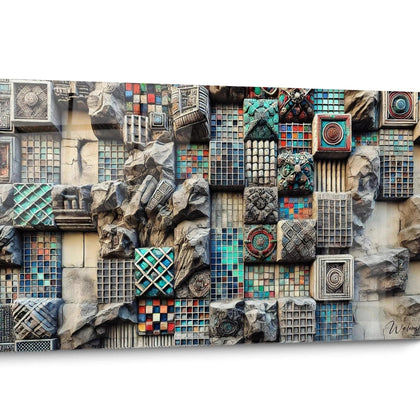
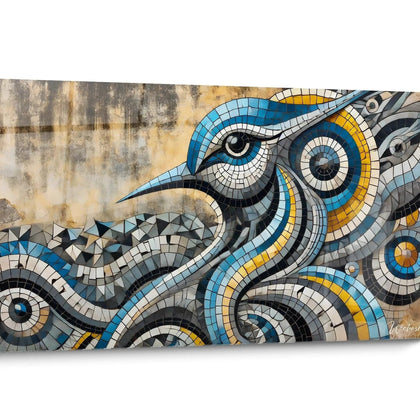


All about Mosaic Wall Art
- Mosaic Wall Art Presentation
- Mosaic Wall Art Contemporary Art
- Mosaic Wall Art XXL Wall Decor
- Mosaic Wall Art Visual Effects
Mosaic wall art represents a distinct form of artistic expression that transforms any interior space through its fragmented composition and striking visual effects. Unlike traditional artworks, these contemporary creations assemble multiple visual fragments to form a complete image, creating a unique visual experience that changes according to viewing angle and ambient lighting. Ideal for large wall spaces, these street art wall pieces bring depth and dimension, instantly transforming a room's atmosphere. Perfect for contemporary art collectors and interior design enthusiasts seeking statement pieces, mosaic wall art combines the visual impact of fragmented compositions with the artistic sophistication of modern artworks.
Mosaic Wall Art - The Fragmented Art That Transforms Your Spaces
Mosaic wall art represents an aesthetic revolution in the world of contemporary mural art. These multi-faceted works do more than adorn your walls, they transform them into genuine interactive artistic installations that dialogue with your space and perception.
What makes mosaic wall art unique in contemporary art?
Unlike classical paintings that present a uniform surface, mosaic wall art stands out for its fragmented composition that creates a dialogue between unity and multiplicity. Each fragment constitutes a micro-universe which, assembled with others, reveals a global image while preserving its own identity. This visual duality offers an ever-renewed contemplative experience, where the gaze oscillates between details and the whole, discovering new nuances and connections with each observation.
The unique kaleidoscopic effect of mosaic wall art stems from the meticulous juxtaposition of fragments with varied colors and textures. This composition creates fascinating interplays of light that animate the surface and transform the work depending on the viewing angle and ambient lighting. This characteristic makes mosaic wall art living works that evolve throughout the day, offering a dynamic visual experience impossible to reproduce with other forms of mural art.
How do mosaic wall artworks transform a room's acoustics?
An often overlooked but fascinating aspect of mosaic wall art concerns its acoustic properties. The textured and multi-faceted surface of these works contributes to sound diffusion in the space, reducing reverberation and creating more balanced sound. In large spaces with high ceilings, such as lofts or spacious living areas, installing a mosaic wall art piece of large dimensions can significantly improve acoustic comfort while adding major artistic dimension.
Contemporary art collectors particularly appreciate the complex narrative dimension offered by mosaic wall art. Each fragment tells its own story while participating in a larger visual narrative. This narrative stratification allows for exploring complex contemporary themes such as identity fragmentation, information overload or multiple perspectives, making these works relevant witnesses of our digital and fragmented era.
Evolutive chromatic adaptation represents another major advantage of mosaic wall art. Thanks to their multi-fragment composition, these works naturally integrate an extended palette that harmonizes with seasonal changes in your decor. While other works might seem discordant when you modify your interior colors, mosaic wall art simply reveals new chromatic facets that accord with your new palette, ensuring permanent harmonious integration.
- Immediate visual impact through orchestrated fragmentation effect
- Evolving perceptual experience depending on viewing distance
- Unique light modulation that animates the space throughout the day
For digital art and contemporary photography enthusiasts, mosaic wall art offers a fascinating bridge between traditional artistic techniques and digital aesthetics. The pixelated aspect recalls digital imagery while maintaining an imposing physical presence, thus creating an interesting dialogue between materiality and virtuality that resonates particularly with our hyper-connected era.
Spatial adaptability constitutes a considerable advantage of mosaic wall art in complex architectural configurations. Their modular structure allows elegantly working around spatial constraints such as asymmetrical angles, columns or niches. In contemporary spaces with unconventional geometries, a mosaic wall art piece can perfectly fit architectural particularities while creating visual continuity that unifies the space.
Are mosaic wall artworks durable artistic investments?
The investment dimension should not be overlooked when considering acquiring a mosaic wall art piece. These contemporary works experience steady appreciation in today's art market, particularly those exploring urban or societal themes. Discerning collectors recognize the growing value of these pieces that combine technical innovation, thematic relevance and exceptional visual impact, making them strategic acquisitions for diversifying their collection.
Beyond their aesthetic dimension, mosaic wall art fits perfectly into the current trend of well-being through visual environment. Their structured yet organic compositions promote visual balance that helps reduce perceived stress in living or working spaces. This characteristic makes mosaic wall art preferred choices for high-end professional environments and residences where visual harmony actively contributes to daily quality of life.
XXL Mosaic Wall Art - Metamorphose Your Large Spaces
XXL mosaic wall art represents a revolutionary artistic solution for contemporary spaces with generous dimensions. These monumental works do more than occupy a wall, they completely redefine a room's spatial and architectural dynamics, creating a monumental focal point that immediately captures attention and structures the entire environment.
Why is mosaic wall art ideal for high-ceiling spaces?
In lofts and contemporary spaces with elevated ceilings, XXL mosaic wall art brilliantly solves the challenge of vertical balance. Their fragmented composition naturally draws the gaze upward, creating a sensation of elevation that valorizes architectural height while humanizing it. Unlike uniform works that might appear lost on a large wall surface, the multi-fragment structure of a mosaic wall art piece establishes visual connection that unites floor to ceiling, preventing the spatial disconnection effect often felt in large volumes.
The chromotherapeutic impact of XXL mosaic wall art constitutes a considerable asset in large spaces often perceived as cold or impersonal. The diversity of colored fragments creates zones of variable intensity that subtly influence mood and space perception. Interior designers exploit this characteristic to establish different ambiance zones in the same open space, using the painting's chromatic variations to visually signal functional transitions without resorting to physical separations.
The optimized light reflexivity of XXL mosaic wall art radically transforms natural and artificial lighting of large spaces. Each fragment captures, absorbs or reflects light differently, creating a multiplier effect that amplifies ambient luminosity. In spaces limited in natural light sources, this characteristic allows optimizing every ray, illuminating areas that would otherwise remain in shadow and creating a more lively and dynamic atmosphere.
- Visual activation of underexploited monumental spaces
- Creation of micro-areas of visual interest at different distances
- Thematic unification of open multi-functional spaces
How do XXL mosaic wall artworks address the acoustic challenges of large spaces?
Acoustic attenuation represents a major functional benefit of XXL mosaic wall art, particularly relevant in contemporary spaces with hard and reflective surfaces. The complex topography created by fragment assembly interrupts the linear propagation of sound waves, significantly reducing excessive reverberation. This characteristic transforms the overall sensory experience of the space, creating a more intimate and controlled sound environment despite imposing dimensions, without requiring additional acoustic interventions that could compromise minimalist aesthetics.
The perspectival versatility of XXL mosaic wall art offers a unique visual experience to owners of generous spaces. Unlike traditional works that reveal themselves entirely at first glance, these fragmented compositions unveil different interpretations depending on observation distance. From afar, the global image emerges majestically, while closer approach progressively reveals micro-details and interactions between fragments. This stratification of visual experience encourages physical space exploration, inviting occupants and visitors to vary their positions to discover all facets of the work.
The transformative architectural dimension of XXL mosaic wall art transcends their status as artwork to elevate them to structuring elements of space. Their composition can strategically accent or attenuate certain architectural characteristics, visually correcting disproportions or irregularities without costly structural intervention. In spaces with atypical configurations, such as inclined walls or asymmetrical areas, an XXL mosaic wall art piece can visually recalibrate spatial balance, creating perceived harmony that transcends the physical constraints of the building.
Seasonal adaptability represents a considerable economic advantage of XXL mosaic wall art for owners of spacious areas. Their composition naturally integrating an extended chromatic palette allows harmonizing the work with different seasonal decorative configurations. Rather than investing in multiple voluminous artistic pieces to vary ambiance throughout the year, a single well-chosen XXL mosaic wall art piece can accord with changes in textiles, accessories and lighting, offering a sensation of renewal without replacement of the main artistic element.
The superior environmental resistance of XXL mosaic wall art ensures their longevity in spaces with variable conditions. Their compartmentalized structure naturally limits the impact of humidity and temperature fluctuations that often affect large artworks. This characteristic makes them particularly suited to spaces difficult to climatize uniformly such as large halls, atriums or rooms with expansive bay windows, where traditional works often suffer from premature deterioration due to fluctuating environmental constraints.
Mosaic Wall Art - Light Interplay and Transformed Perception
Mosaic wall art represents a singular artistic category that transcends mere wall ornament to become an immersive visual experience. Their particularity lies in their capacity to constantly metamorphose spatial perception through orchestrated fragmentation and complex light interactions they generate.
How do mosaic wall artworks transform spatial perception?
Perceptual spatial dilation constitutes one of the most remarkable effects of mosaic wall art in contemporary interiors. Their fragmented structure creates visual depth that virtually pushes back the physical boundaries of the wall, generating a sensation of spatial expansion. This characteristic makes them particularly valuable in spaces with restricted dimensions or constraining architectural configurations, where they create visual openness that transcends the physical limitations of the built environment.
Passive kinetic effect represents a fascinating specificity of mosaic wall art that radically distinguishes them from traditional static works. Without any mobile mechanism, these creations generate an impression of perpetual movement through meticulous juxtaposition of fragments with variable reflectivity. Simple movement of the observer or natural light fluctuations suffice to animate the work, creating an ever-evolving visual spectacle that maintains interest and perceptual engagement over time.
Environmental chromatic modulation of mosaic wall art reveals sophisticated interaction with surrounding space. The multiple colored facets do more than reflect light, they subtly project colored halos that tint adjacent surfaces, creating a chromatic irradiation effect that extends the influence of the work well beyond its physical boundaries. This phenomenon transforms the artwork into a secondary light source that actively participates in the space's overall chromatic ambiance.
- Multi-directional light interaction that animates surrounding surfaces
- Perceptual transformation of space depending on lighting conditions
- Stratified depth effect impossible to reproduce with other techniques
What are the unique psychological effects of mosaic wall art?
The neurocognitive impact of mosaic wall art on observers represents a fascinating field of study at the intersection of art and neuroscience. The structured visual complexity of these works simultaneously stimulates different brain regions, engaging both analytical and synthetic perception processes. This enriched cognitive activation creates a deeper and more memorable contemplative experience than that generated by visually more uniform works, explaining the lasting attraction these creations exercise on observers.
Circadian rhythm management through strategic integration of mosaic wall art in contemporary living spaces testifies to their function far beyond aesthetics. Their ability to capture and redistribute light differently throughout the day can contribute to maintaining a visually stimulating environment that supports natural biological cycles. In professional spaces notably, a judiciously positioned mosaic wall art piece can create subtle ambiance variations that accompany work rhythm, promoting concentration or creativity according to moment's needs.
Visual Zeigarnik effect constitutes a particularly interesting psychological characteristic of mosaic wall art. Named after the psychologist who demonstrated that unfinished tasks remain more present in memory, this effect manifests in how our brain constantly seeks to "complete" the fragmented image. This subtle but persistent cognitive tension maintains visual engagement with the work, creating a dynamic relationship between observer and artwork that resists perceptual habituation that generally affects our attention to static decorative elements.
Mnemonic spatial resonance of mosaic wall art explains their capacity to become powerful identity anchors for the spaces they occupy. Their distinctive visual complexity creates a strong memorial imprint that durably associates with place perception. For commercial or reception spaces, this characteristic represents a considerable strategic asset, transforming a simple decorative element into a memorable visual signature that reinforces spatial identity and promotes immediate place recognition.
Why are mosaic wall artworks particularly suited to transition spaces?
The transitional dimension of mosaic wall art makes them particularly relevant in circulation and passage spaces. Their composition, which naturally guides the gaze through different visual zones, harmoniously accompanies physical movement through space. In hallways, entry halls or landings, a judiciously positioned mosaic wall art piece can facilitate spatial transitions, creating visual progression that subtly prepares for the next space's experience, thus promoting fluid perceptual continuity between different functional zones.
What are ideal lighting conditions for mosaic wall art?
Optimal lighting conditions for mosaic wall art differ considerably from standard recommendations for mural art. Multi-source lighting is generally preferable to a single spotlight, allowing simultaneous revelation of different work facets. A combination of ambient and directional lighting creates the richest visual experience, progressively revealing the work's different dimensions throughout hours and seasons.
How do I choose ideal dimensions for a mosaic wall art piece for my space?
Optimal sizing of a mosaic wall art piece depends not only on available space but also on the perceptual effect sought. To maximize transformative spatial impact, favor a piece whose dimensions allow occupying at least 60% of wall height. The ideal minimum viewing distance generally corresponds to 1.5 times the work's width, thus ensuring simultaneous perception of details and whole.
Do mosaic wall artworks require particular maintenance?
Maintenance of mosaic wall art requires different attention from traditional works. Their textured surface benefits from regular dusting using an electrostatic duster or low-pressure compressed air. Absolutely avoid liquid cleaners that could seep between fragments and compromise the work's structural integrity. To preserve color brilliance, protection against direct UV exposure is recommended.
Can one integrate mosaic wall art into a minimalist interior?
Contrary to common beliefs, mosaic wall art integrates remarkably well into contemporary minimalist aesthetics. Their visual complexity can serve as deliberate focal counterpoint in an otherwise refined space, creating dynamic balance between surrounding simplicity and concentrated visual richness. For harmonious integration, favor a chromatic palette coherent with the space's dominant tones, allowing the artwork to subtly dialogue with its environment rather than confront it.
Further reading
Our articles on this topic
- Geometric mosaic painting: the decor trend redefining our interiors
- Mediterranean mosaic painting for dining room: the complete guide
- How to pair a mosaic painting with other decor elements
- Mosaic Wall Art: The Painting Alternative to the Mural Fresco
- Earthy mosaic painting with an animal motif: integrate it room by room into a bohemian decor
- Ochre and terracotta mosaic painting with prehistoric motifs for an adult bedroom with character
L'art qui suscite l'envie
Maison belge d'art mural grand format
14 jourspour changer d'avis*
Protection Walenskyincluse
Fabriquéen Italie
FormatXXL
Kit de fixationtoujours fourni
* Hors tableaux personnalisés et tailles personnalisées


