

Asian pagoda painting: its unique characteristics
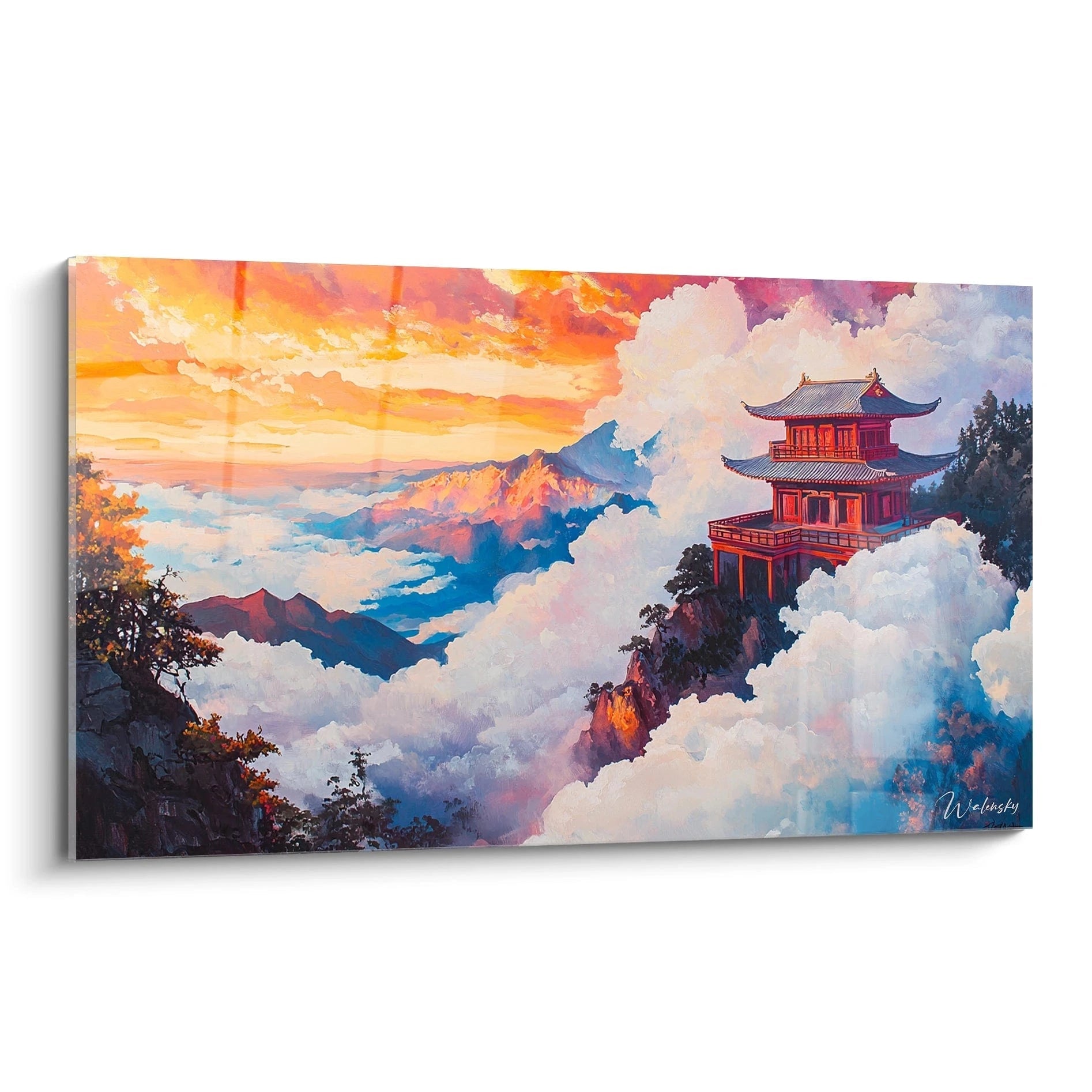
The work captivates immediately through its striking representation of an Asian temple floating above a sea of clouds. This asian pagoda painting distinguishes itself through its interplay of contrasts between the warm hues of a blazing sky and the cool nuances of white and blue clouds enveloping the mountainous panorama. The traditional red structure seems suspended between sky and earth, creating an impression of an inaccessible celestial sanctuary. The perfect balance between precise architectural elements and vaporous natural elements gives this painting an immediately recognizable mystical aura.
How this celestial Japanese pagoda painting is structured
The composition of this celestial japanese pagoda painting revolves around a perfectly mastered balance. The traditional red pagoda, located in the right third of the image, constitutes the main focal point while being harmoniously integrated into its natural environment. Invisible directional lines lead the viewer's gaze from the lower left corner, through successive layers of mountains and clouds, to the temple illuminated by golden light.
The aerial perspective creates vertiginous depth, suggesting a view from an elevated contemplation point. The perfectly calculated proportions between the architectural structure and the immensity of the cloudy landscape reinforce the impression of human smallness faced with nature's grandeur, while highlighting the technical prowess of constructing such an edifice in so improbable an environment.
The colors of the Asian pagoda painting and their harmony
The chromatic palette of this asian pagoda painting revolves around a striking contrast between warm and cool colors that generates captivating visual tension. Detailed analysis reveals:
- Incandescent oranges and golden yellows that set the sky ablaze, creating an almost mystical atmosphere
- Deep blues and turquoise that bring freshness and mystery to the cloudy valleys
- Pure whites and slightly nacreous clouds that create a sensation of weightlessness
- The vibrant vermillion red of the temple that contrasts with its surroundings and asserts its presence
- Dark greens and earth shadows of trees that anchor the composition
This chromatic harmony relies on the complementary opposition between oranges and blues, softened by the white nuances of clouds that serve as transition between these extremes. The effect obtained evokes simultaneously warmth and coolness, creating an immersive and balanced visual experience.
Textures and technical details of the oriental celestial pagoda painting
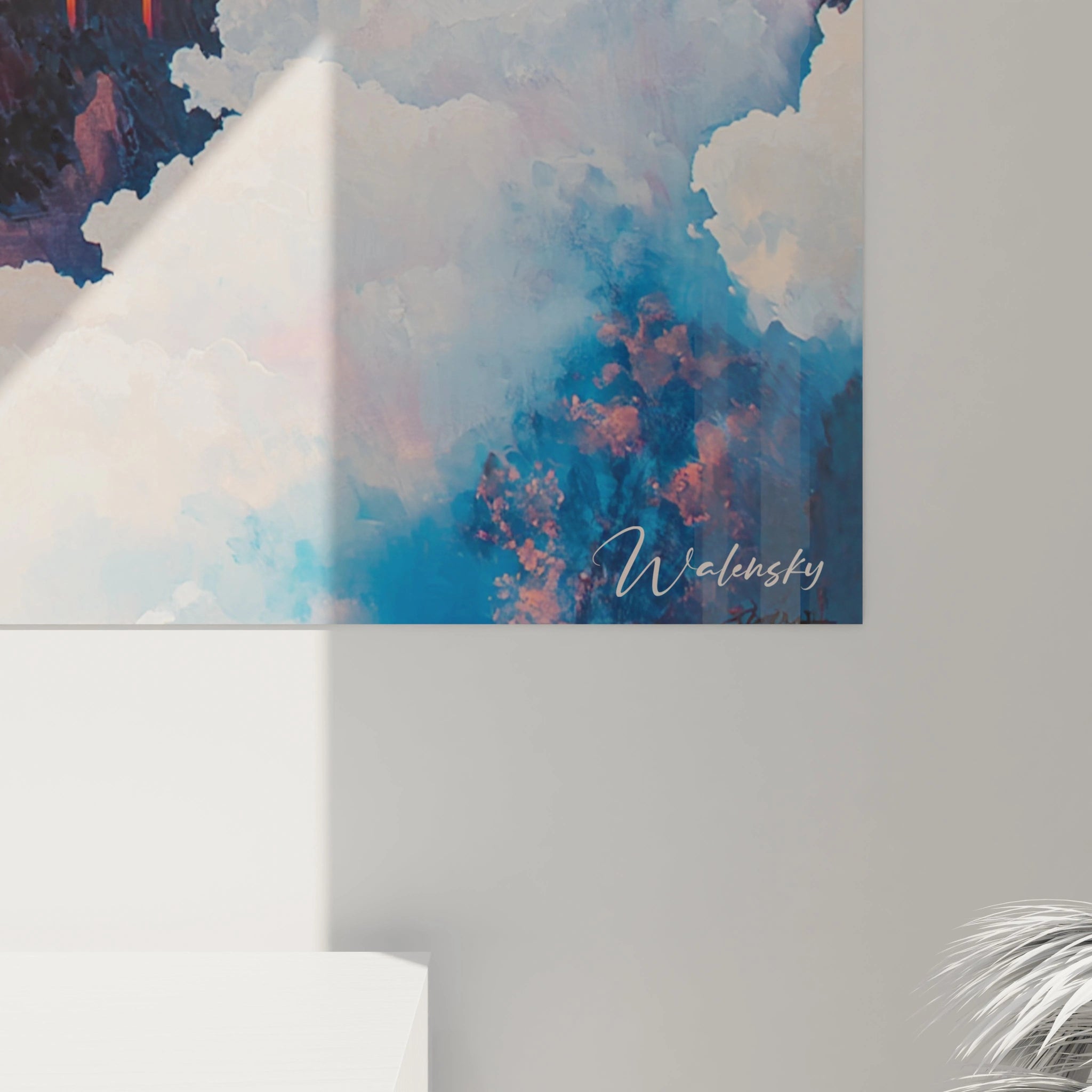
This oriental celestial pagoda painting presents remarkable richness of textures that contribute to its atmospheric realism. The clouds are rendered with subtle impasto technique that gives them both volume and lightness simultaneously. One can distinguish variations in paint thickness that create tactile relief particularly visible in the densest cloud formations.
The light treatment reveals exceptional technical mastery, with golden rays that seem to truly illuminate the scene from within. The shadows cast on the architectural structure are rendered with precision that enhances the three-dimensionality of the edifice. The glazing technique is identifiable in the sky rendering, where translucent layers of paint superimpose to create luminous depth that gives the impression the work emits its own light.
What makes this mountain pagoda mist painting unique
The uniqueness of this mountain pagoda mist painting lies in its ability to fuse architectural realism and dreamlike atmosphere. Unlike conventional representations of Asian pagodas, this work transcends mere architectural documentation to create a quasi-surreal vision where the edifice seems to float in a celestial ocean. The perfectly executed juxtaposition between the temple's precise geometric structure and the organic, fluid forms of clouds creates visual tension impossible to reproduce.
The distinctive quality of this oriental wall decoration is also manifested in its ability to evoke simultaneously several moments of the day—the nascent dawn with its golden tones and the dusk with its deep blues—creating thus an ambiguous temporality that transcends the frozen instant typically captured in painting. This temporal ambivalence gives the work unique meditative dimension that invites prolonged contemplation.
Depth and details of the pagoda painting
The visual experience of this work transforms radically depending on observation distance. From afar, this pagoda painting impresses through its overall composition and the emotional impact of its chromatic contrasts. The temple's distinctive silhouette stands out clearly against the cloudy background, creating an emblematic image immediately recognizable and memorable.
Upon approaching, a universe of minute details progressively reveals itself. The pagoda's architectural elements disclose their specific ornaments—roof with curved and upturned extremities, finely worked balustrades, traditional proportions respected with precision. Within the clouds, one discovers countless variations of hues and textures that create the perfect illusion of vaporous masses in constant motion. This contemplative asian wall art rewards careful observation with a richness of details that sustains visual interest even after numerous contemplations.
Where and how to showcase your Japanese pagoda sunset painting
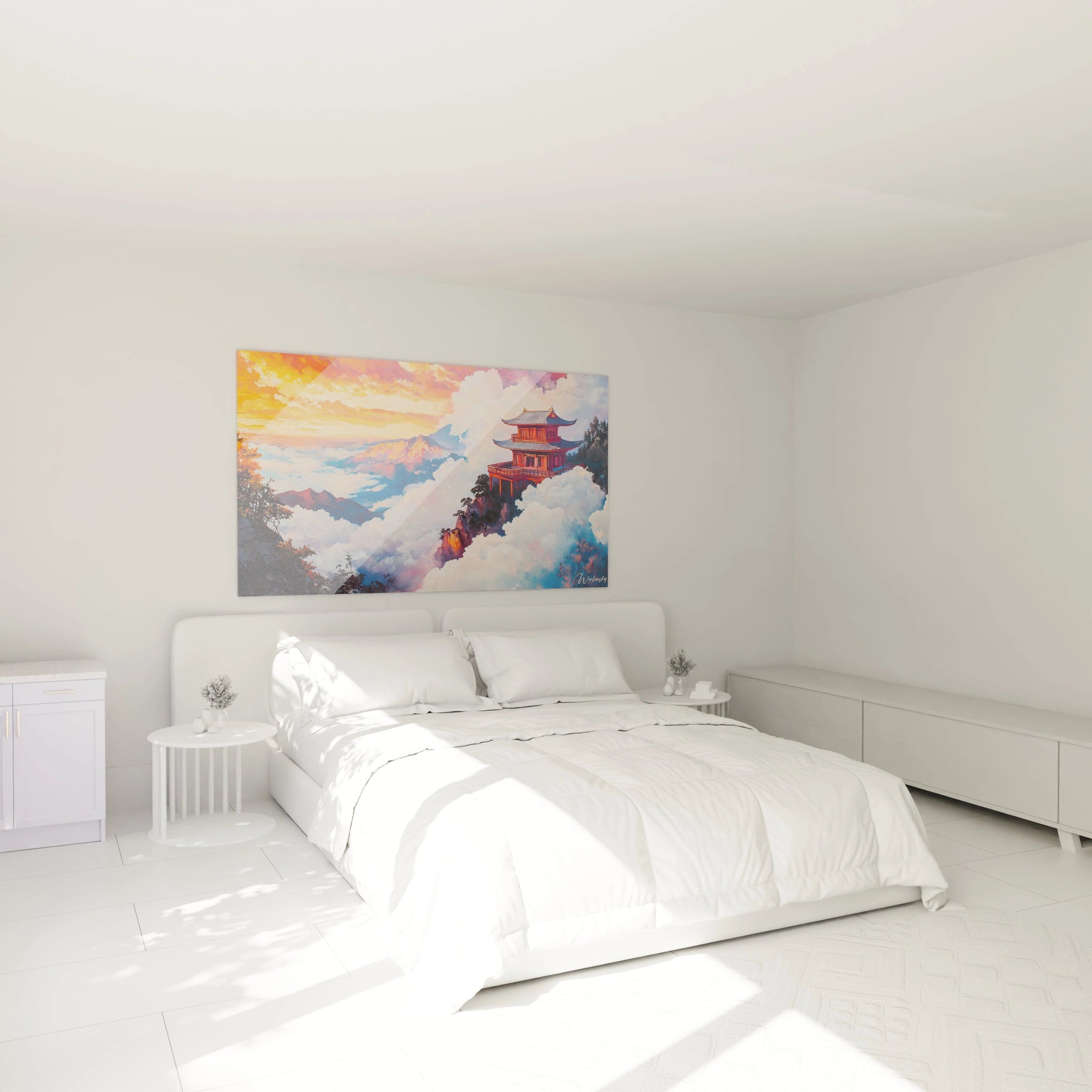
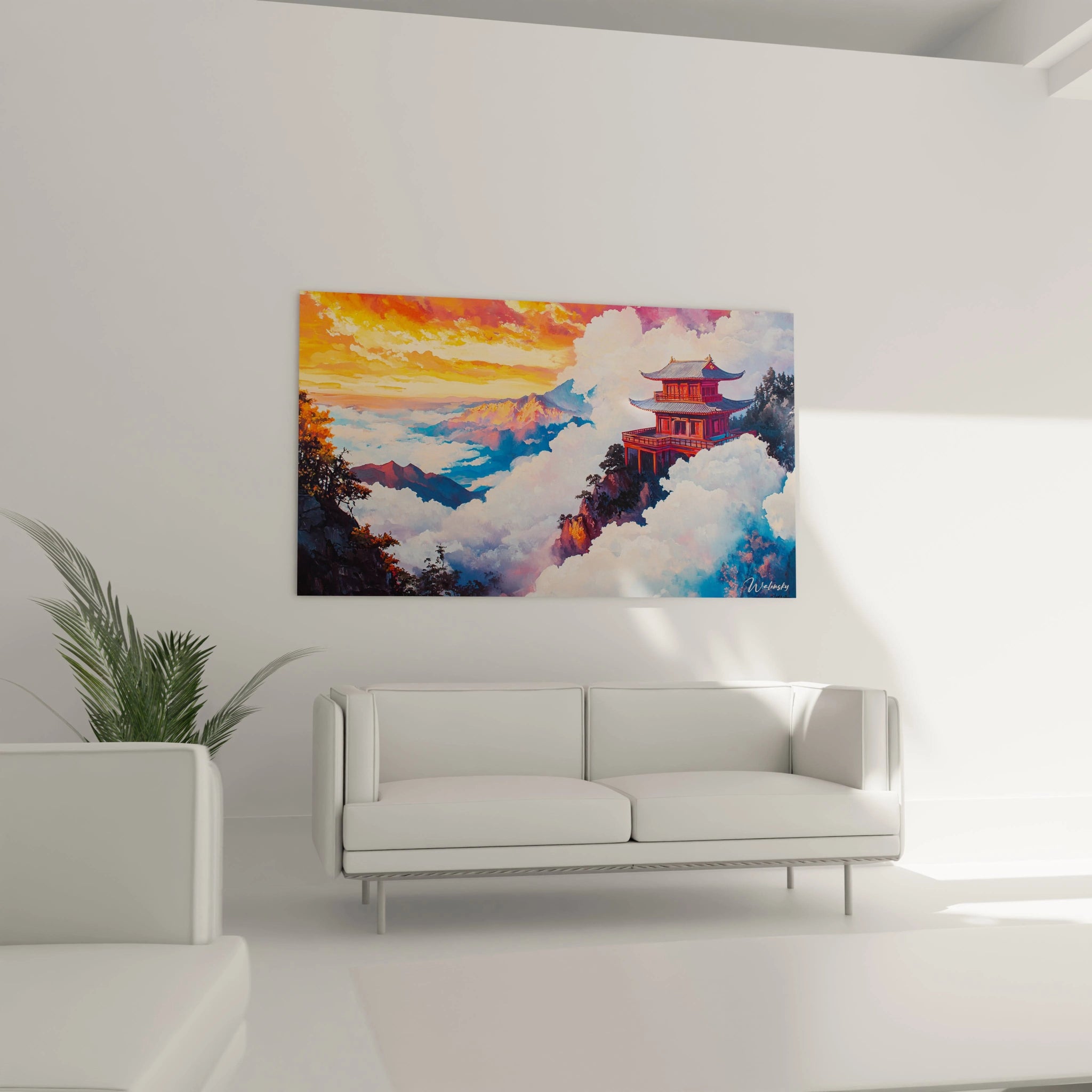
To fully valorize the visual impact of this japanese pagoda sunset painting, indirect lighting is strongly recommended. A warm color temperature LED spot (around 3000K) directed toward the work will bring out the golden nuances of the sky and the vibrant reds of the temple without creating bothersome reflections on the surface. In contemporary interiors with light walls, this work will create a striking focal point and bring depth and dimension to the space.
Ideal environments for this pagoda wall decoration include main living spaces benefiting from moderate natural light, such as a living room or dining room where the work can be admired daily. Interiors adopting a neutral color palette—whites, grays, beiges—will provide a perfect setting that allows the vibrant colors of the painting to express themselves fully. For complete chromatic harmony, incorporate a few deep blue and orange accents into your surrounding décor—cushions, vases, or decorative objects—that will echo the dominant tones of the work without creating visual competition.