Santorini painting: its unique characteristics
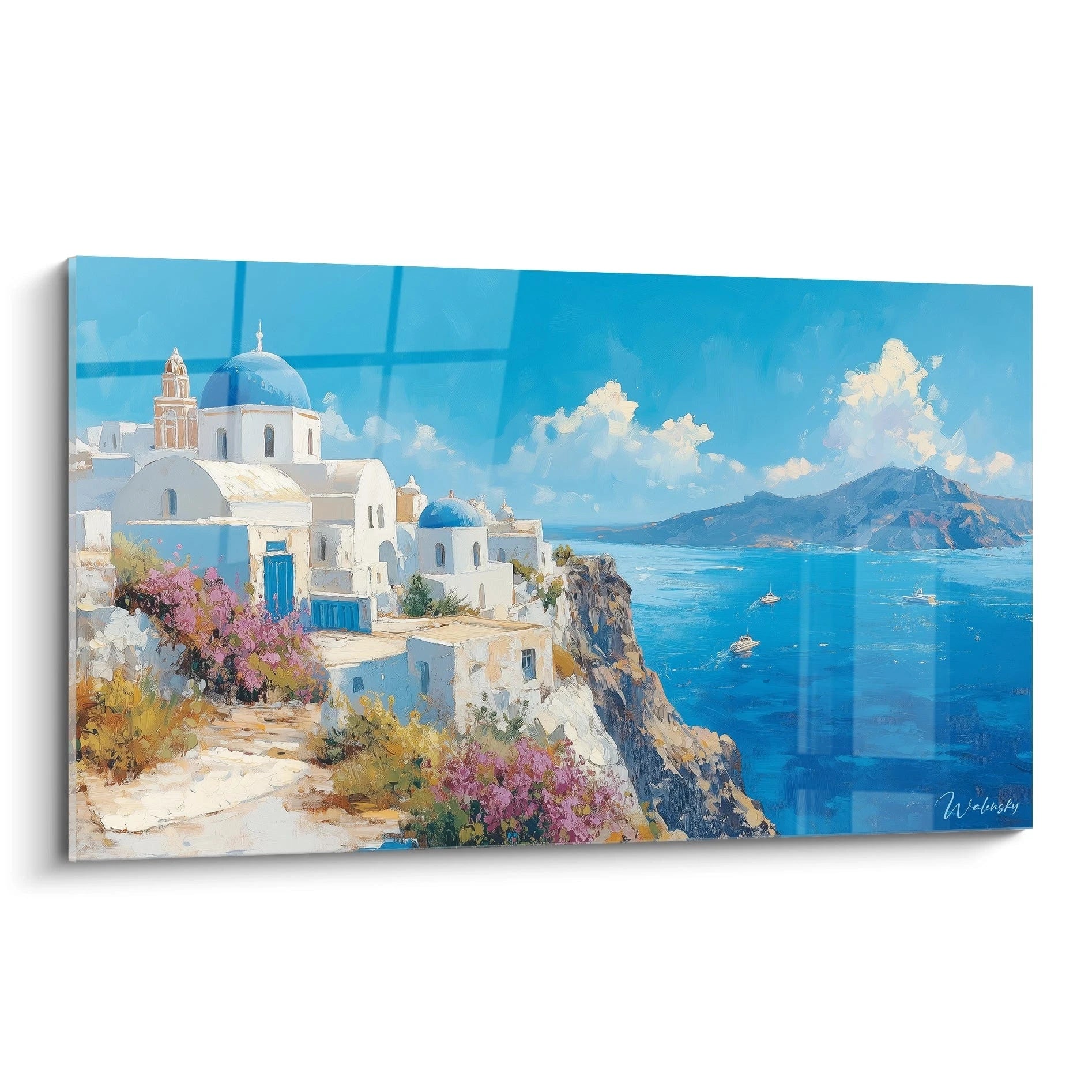
This Santorini painting captures the emblematic essence of the Greek Cyclades with remarkable finesse. The work presents a striking panoramic view of the characteristic white village of Santorini, perched on steep cliffs overlooking the Aegean Sea's deep blue. The first visual impression is dominated by the striking contrast between cubical constructions of brilliant white and the intense blue of sky and sea. This Mediterranean Santorini painting immediately distinguishes itself through its cobalt blue domes harmoniously punctuating Cycladic architecture.
How this sea-view Santorini painting is structured
This sea-view Santorini painting's composition is masterfully balanced, with the white village occupying the work's left third, creating a powerful focal point. The artist used diagonal directional lines that naturally guide the viewer's eye from whitewashed houses to the horizon where distant islands emerge. The perspective is slightly downward-looking, offering partial aerial view that amplifies the cliff's height sensation.
Space is skillfully distributed between three main components: village architecture with geometric forms, the vast maritime expanse occupying nearly half the canvas, and luminous sky dotted with delicate clouds that harmoniously complement this architectural Santorini painting.
The colors of the Santorini painting and their harmony
The chromatic palette of this Santorini painting is dominated by an exquisite range of blues ranging from sky cerulean blue to church domes' cobalt blue, to the sea's deep ultramarine. These hues are enhanced by the brilliant white of dwellings that intensely reflects Mediterranean light. Subtle touches of pink and mauve appear in bougainvillea adorning the constructions, adding a note of softness to the ensemble.
The contrast between cool and warm colors is particularly successful in this blue-sky Santorini painting, with earthy and golden tones warming the cliffs and certain architectural details. This chromatic harmony creates simultaneously soothing and vibrant visual impact. The three primary colors are:
- The dominant azure blue of sky and sea
- The pure white of Cycladic constructions
- The touches of pink from bougainvillea flowers
Textures and technical details of the white-village Santorini painting
This white-village Santorini painting reveals a wealth of textures that amplify its realism and depth. Building façades present subtle impasto recreating traditional lime's appearance, with delicate shadow and light variations. Cliffs are rendered with rougher texture, evoking the volcanic rock characteristic of the island, while vegetation is treated through impressionist touches suggesting the light breeze's gentle movement.
The pictorial technique used for this white-village Santorini painting alternates between smooth applications for sky and more expressive touches for architectural elements. Light is treated with particular mastery, creating glowing zones on white surfaces and scintillating reflections on water that animate the entire composition.
What makes this Greece Santorini painting unique
This Greece Santorini painting's uniqueness lies in its ability to capture the light atmosphere so particular to the island, that almost unreal quality of Mediterranean light bathing the entire scene. The representation of emblematic blue domes is particularly successful, with reflections suggesting their characteristic enameled surface. The way the artist captured the contrast between human geometric constructions and surrounding nature's organic forms creates a fascinating visual tension.
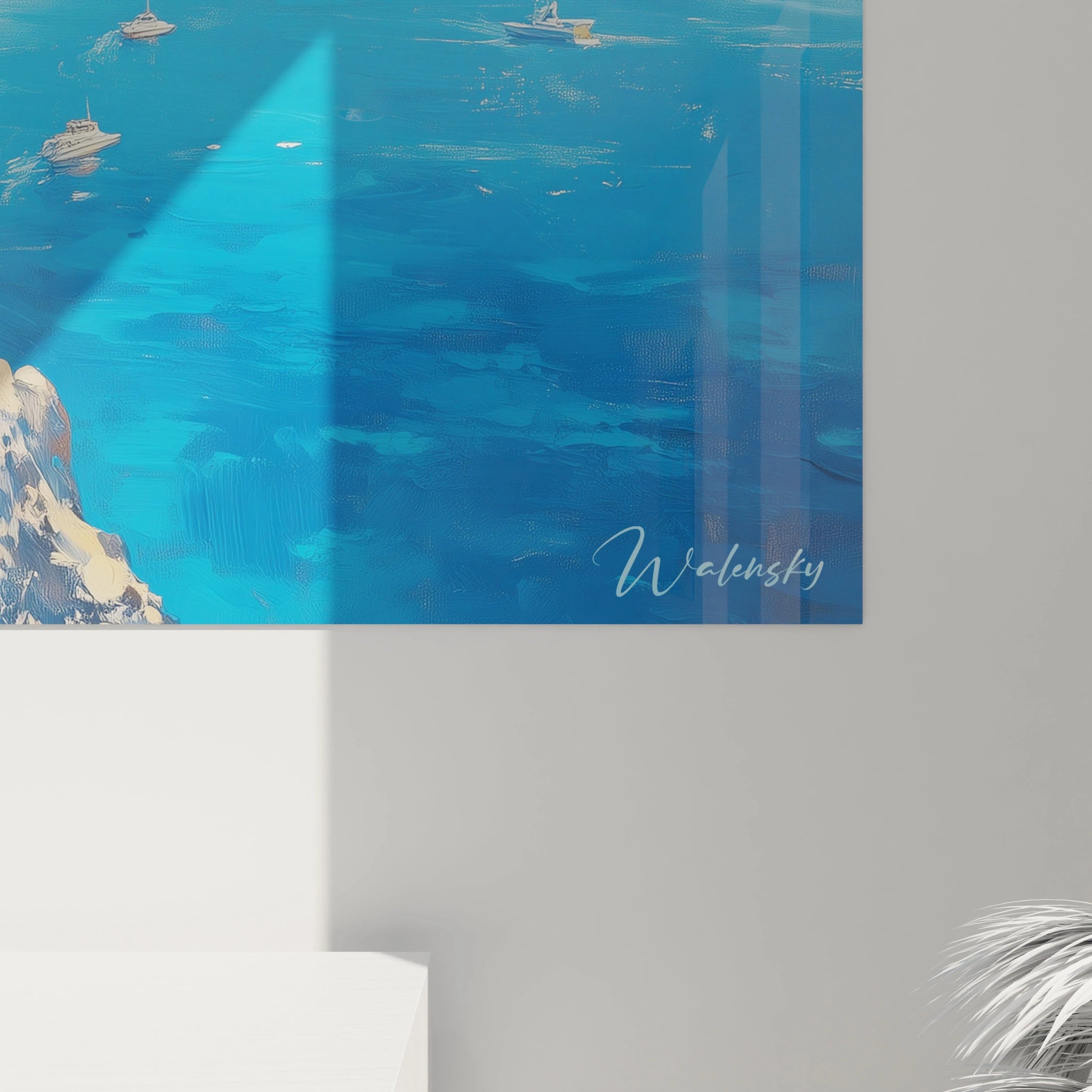
This Greece Santorini painting also distinguishes itself through the finesse with which small boats navigating the azure sea are represented, adding a touch of life and scale to this impressive Mediterranean wall decoration. Attention paid to typical Cycladic architectural details - blue doors and windows, slender bell towers, winding stairs - testifies to meticulous observation of the place.
Depth and details of the Santorini painting
From a distance, this Santorini painting offers a striking overall impression of luminosity and chromatic harmony. The eye is immediately attracted by the contrast between dwelling white and the sea and sky's intense blue. Approaching, one progressively discovers subtle details: small windows of houses, nuances in projected shadows, texture variations in walls, delicate-toned bougainvillea cascading down façades.
A closer examination also reveals fascinating details such as small boats navigating the sea, changing reflections on the water surface, and subtle nuances in cloud treatment bringing additional dimension to this panoramic Santorini sea view painting. The artist created a work that renews with each glance, progressively revealing its richness and complexity.
Where and how to showcase your Aegean-sea Santorini painting
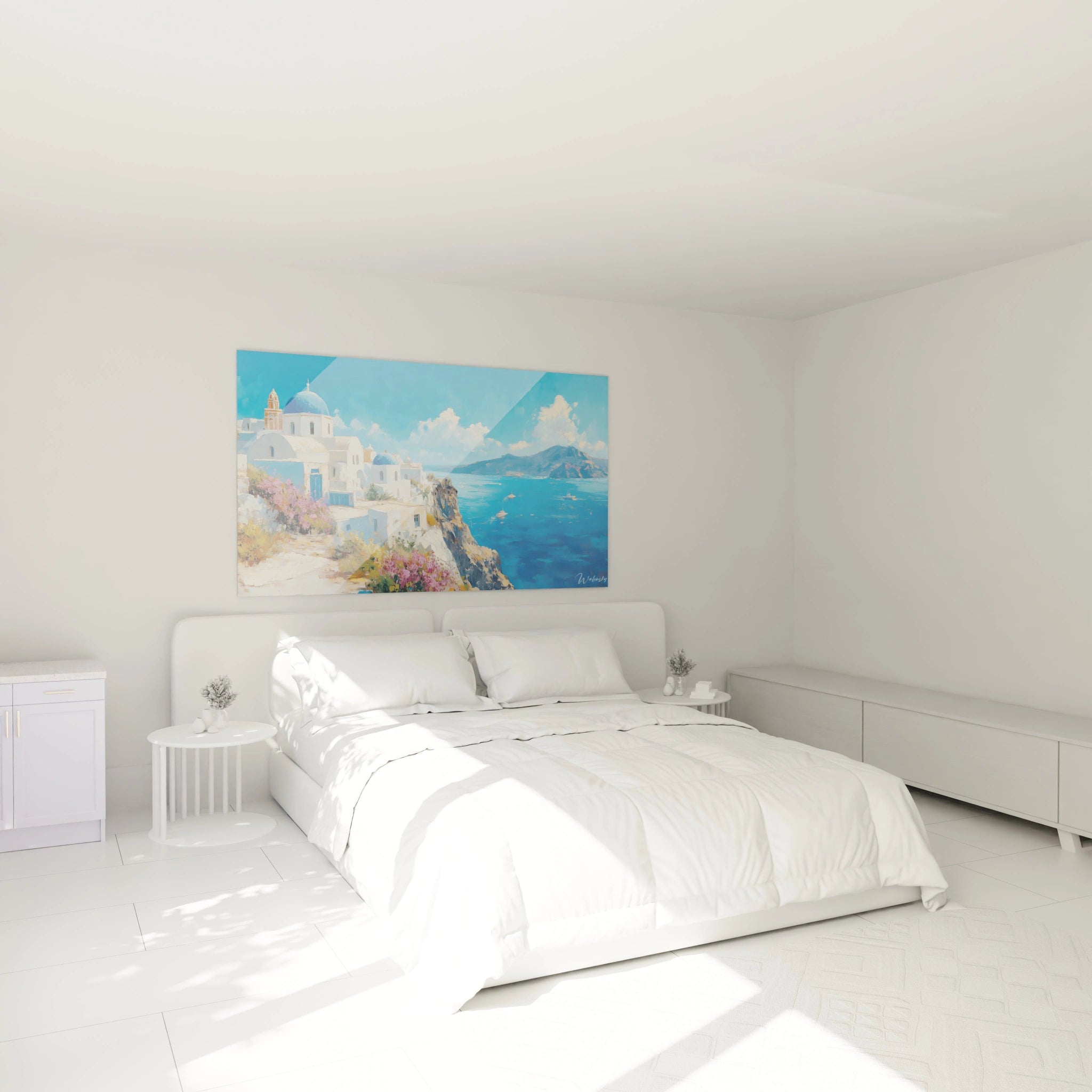
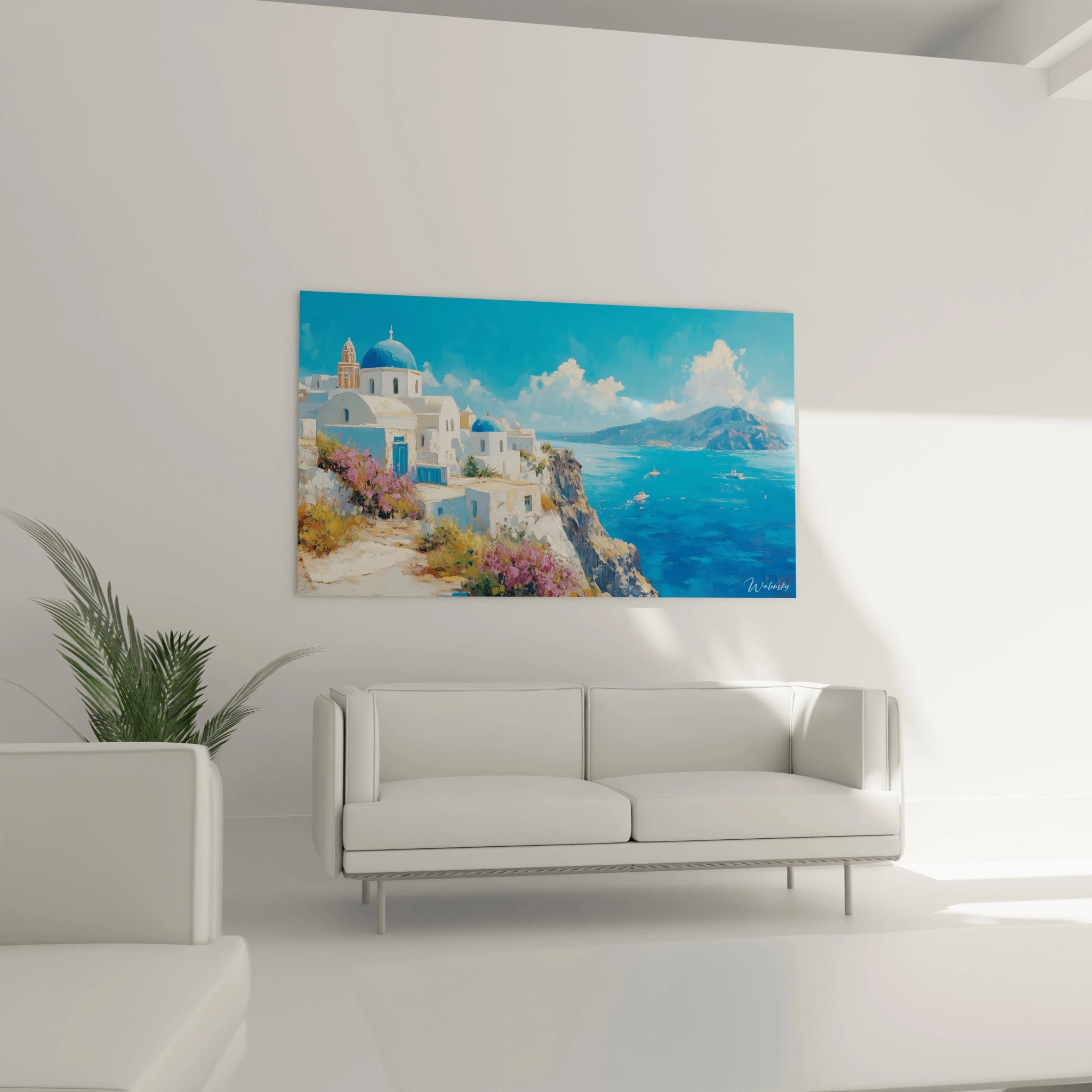
This Aegean-sea Santorini painting will find its ideal place in a luminous space with neutral tones allowing its vibrant colors to express themselves fully. A living room or dining room with white or cream walls constitutes a perfect setting for this Mediterranean work. Lighting is crucial to reveal all its nuances: favor indirect natural light or soft artificial lighting that does not cause annoying screen glare.
To create a harmonious decorative ensemble around this Aegean-sea Santorini painting, choose furniture with refined lines in neutral tones - light wood, white, beige - echoing represented Cycladic architecture. A few decorative accessories in blue can be judiciously placed in the room to create chromatic dialogue with the work without overloading the space. This Mediterranean wall art will bring a sensation of escape and serenity to any interior.