Japan painting: its unique characteristics
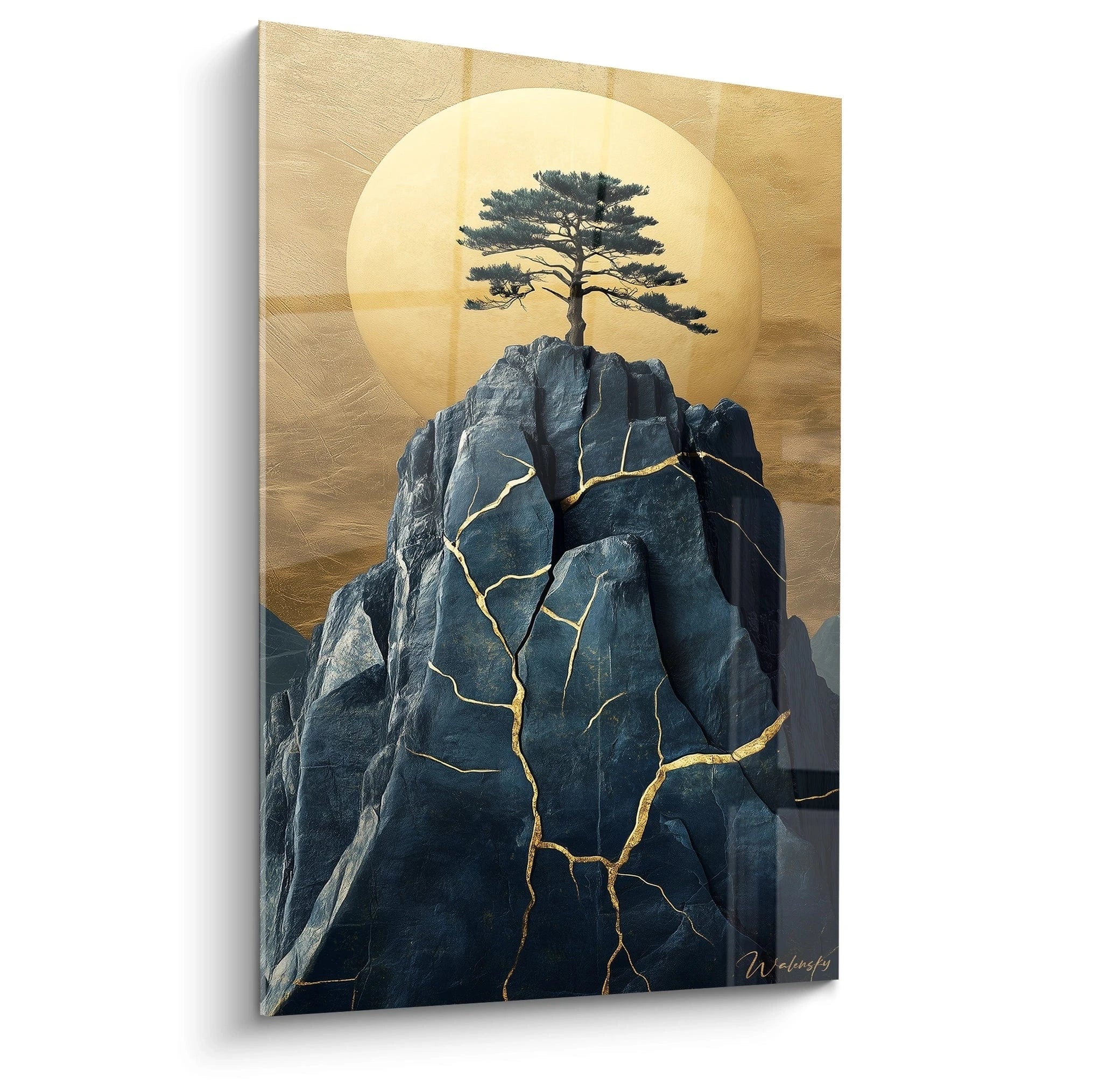
This Japan painting immediately captivates with its powerful and symbolic composition. The work presents a majestic Japanese pine perched at the summit of a deep blue rock formation, set against a golden circle evoking the country's emblematic rising sun. The first impression is one of perfect balance between strength and delicacy, characteristic of traditional Japanese aesthetics.
The Japan painting sublimes the art of kintsugi with its golden veins running through the blue rock, transforming cracks into precious elements. This striking visual representation instantly evokes Japanese mountain landscapes and their century-old pines, while adding profound symbolic dimension that transcends simple naturalistic representation.
How this minimalist zen Japan painting is structured
The composition of this minimalist zen Japan painting is based on perfect balance between three main elements organized vertically. In the foreground, the deep blue mountain occupies two-thirds of the lower work, creating a solid and imposing base. Its angular structure naturally directs the gaze toward the summit where the solitary pine stands.
The tree, central element of the minimalist zen Japan painting, is strategically positioned at the composition's focal point. Its delicate silhouette contrasts with the rock mass, creating visual tension that symbolizes resilience. In the background, the perfect golden circle occupies the entire upper space, framing the tree and visually balancing the rock mass through its pure geometric form and intense luminosity.
The colors of the Japan painting and their harmony
The color palette of this Japan painting articulates around three main tones creating striking and harmonious contrast:
- Dominant gold: present in the large solar circle and the veins running through the rock, it brings luminosity, warmth and nobility to the whole. Its brilliant texture creates changing reflections depending on viewing angle.
- Deep blue: used for the rock formation, it evokes both the ocean surrounding Japan and sacred mountains. This cool tone contrasts magnificently with gold's warmth.
- Dark green: visible in the pine foliage, it brings a touch of life and nature that perfectly completes the mineral whole.
This chromatic triad of the Japan painting creates perfectly balanced visual harmony between warmth and coolness, lightness and density, recalling the traditional Japanese aesthetic principles of balance and complementarity.
Textures and technical details of the kintsugi style Japan painting
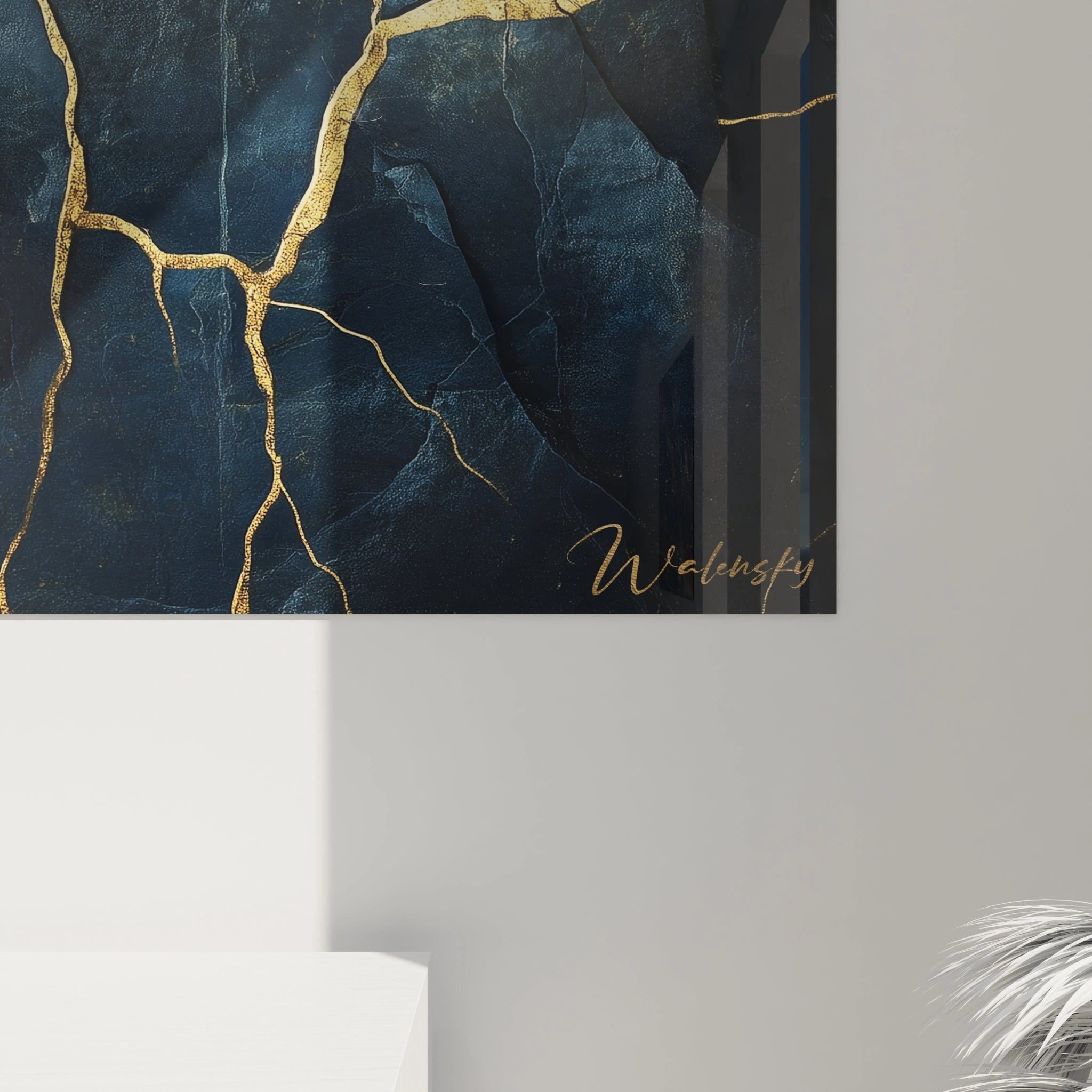
This kintsugi style Japan painting presents remarkable texture wealth that contributes to its visual and emotional depth. The golden circle's surface exhibits micro-textures recalling traditional gold leaf, with subtle brightness variations that animate its apparently uniform surface.
The blue rock reveals a rough and stratified texture, meticulously rendered to evoke natural stone. The golden veins traversing it present slightly raised relief, creating three-dimensional effect recalling authentic kintsugi technique. The pine, central element of the kintsugi style Japan painting, is represented with remarkable attention to detail in its tortuous branches and textured foliage, testifying to technical mastery allowing simultaneous suggestion of both strength and fragility.
What makes this solitary pine Japan painting unique
The uniqueness of this solitary pine Japan painting lies in its ability to merge traditional symbolism with contemporary aesthetics. The work distinguishes itself through its representation of the Japanese concept of « wabi-sabi » - the beauty of imperfection and acceptance of the transitory - embodied by the tortuous pine surviving in a hostile environment.
The distinctive technique of golden veins traversing the blue rock confers the solitary pine Japan painting unique narrative dimension, telling the story of wounds transformed into beauty. The bold use of intense chromatic contrasts between luminous gold and deep blue creates captivating visual tension that maintains viewer attention. This contemporary Japanese wall decoration thus transcends simple representation to become visual meditation on resilience and beauty emerging from trials.
Depth and details of the Japan painting
This Japan painting reveals different dimensions depending on observation distance. From afar, the composition strikes through its apparent simplicity and immediate visual impact: the dark pine silhouette standing against the golden disc creates a powerful iconic image capturing Japanese aesthetics' essence.
Approaching, the Japan painting unveils fascinating complexity. The golden veins reveal microscopic details in their tracery, some thicker, others finer, creating organic network recalling rivers seen from above. Close observation also allows appreciation of subtle blue variations in the rock, ranging from blue-gray to almost black deep blue. This kintsugi-inspired Japan painting thus transforms visual experience into contemplative journey inviting exploration and meditation.
Where and how to display your solitary tree Japan painting
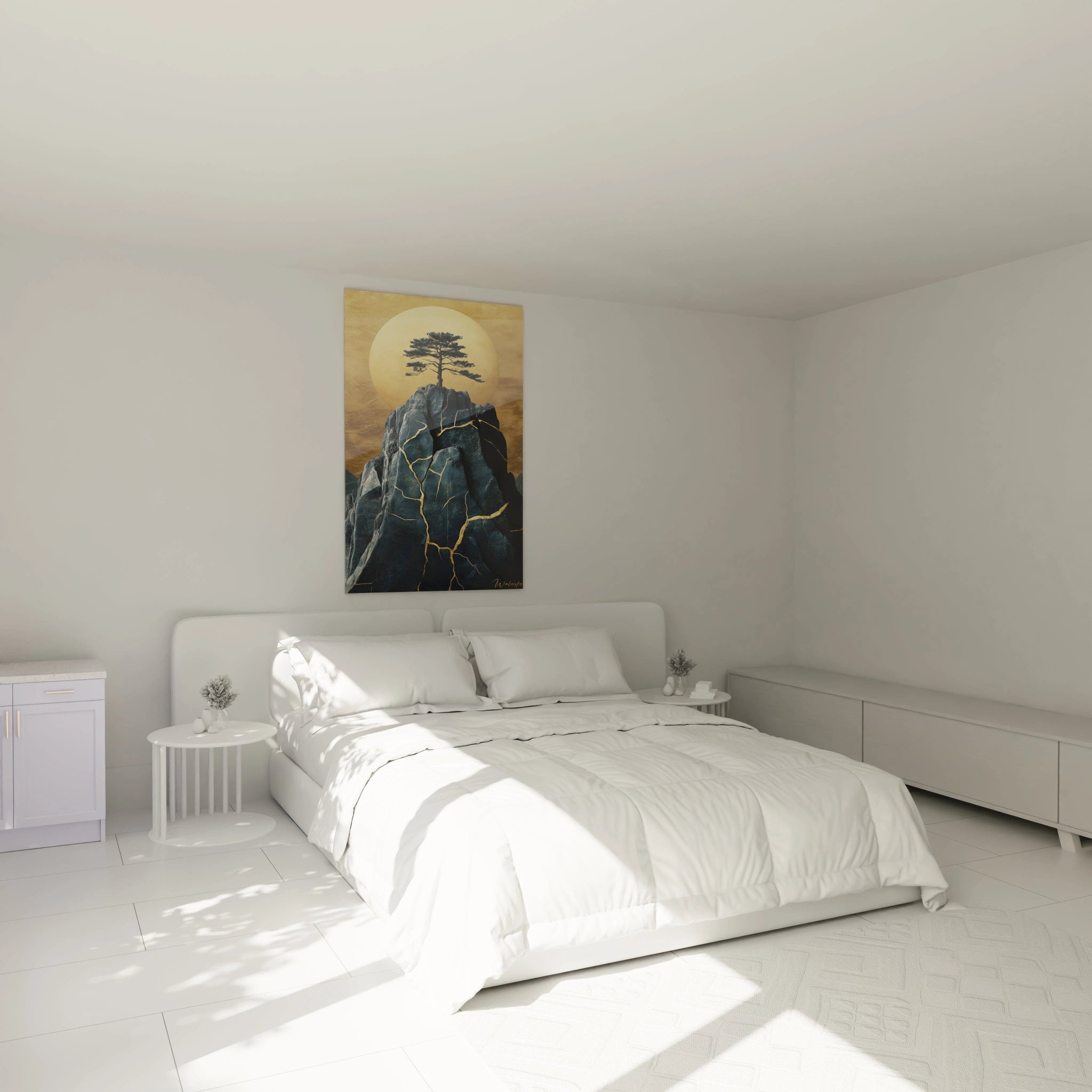
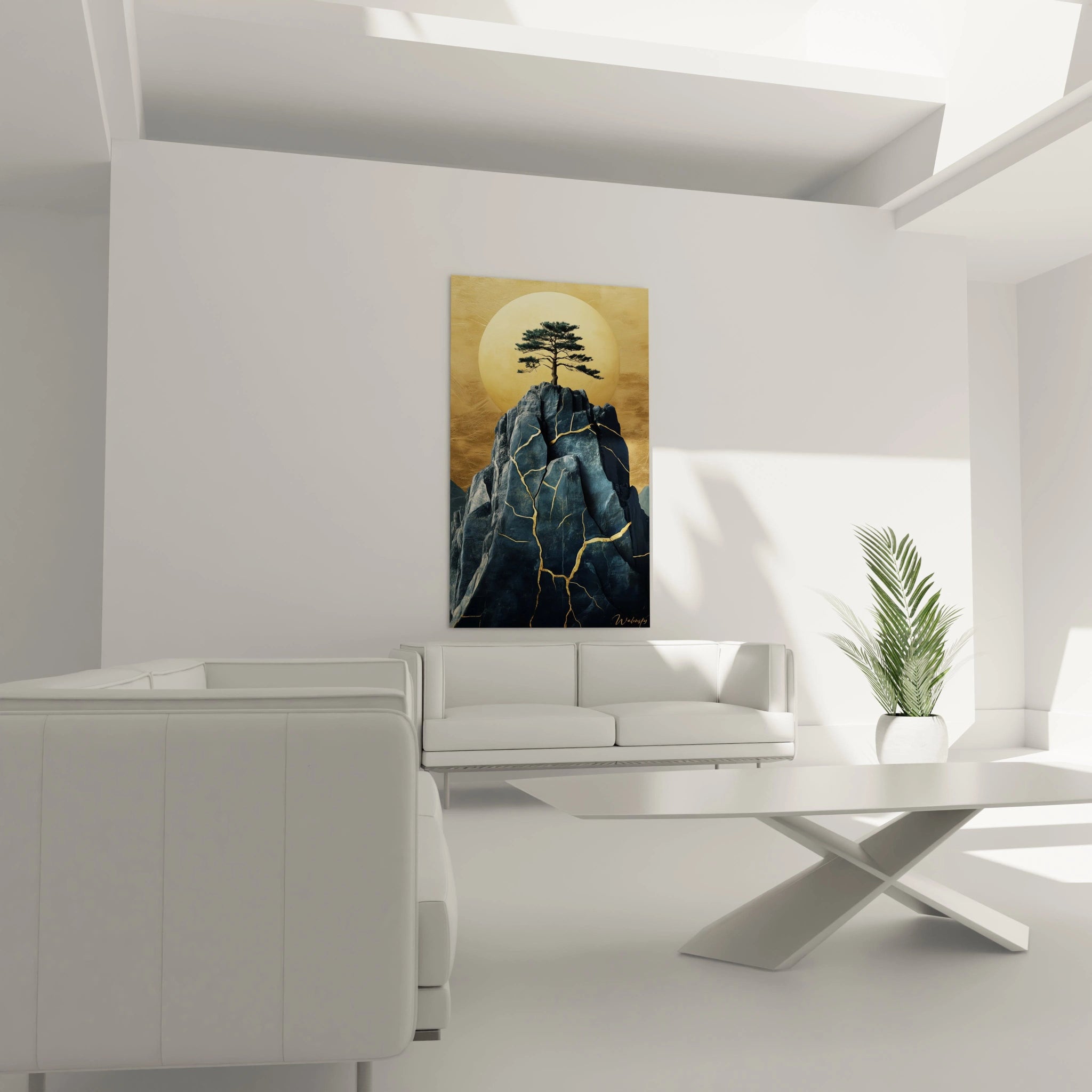
To enhance your solitary tree Japan painting, favor a neutral color wall - white, light gray or beige - that will allow the work's intense colors to fully express themselves. Directional soft lighting, ideally with warm color temperature bulb (2700-3000K), will highlight golden reflections and create shadow and light plays that will animate the work's texture.
This solitary tree Japan painting will integrate perfectly into a refined interior, whether contemporary minimalist or Japanese-inspired style. Associate it with natural materials like dark wood, stone or bamboo to reinforce its organic dimension. Avoid overcrowding surrounding space with other strong visual elements that would compete with this striking Japanese wall art. This masterpiece deserves to be your space's focal point.