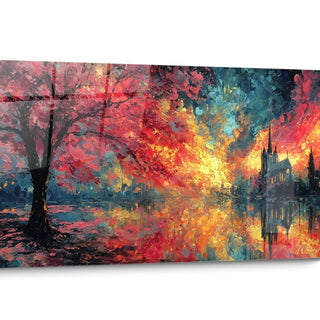
- Overview Pointillism Wall Art
- Pointillism wall art: Visual impact and decorative effect
- Pointillism wall art: Artistic value and prestige
- Pointillism wall art: Modernity and contemporary integration
A pointillism wall art represents the culmination of the post-impressionist revolution, transforming your space through an exceptional artistic technique. This pictorial approach, characterized by the meticulous application of distinct colored dots, creates wall artworks of remarkable sophistication. Modern pointillist representations combine the legacy of divisionist masters with contemporary aesthetic requirements, offering visually striking compositions.
Pointillist art distinguishes itself through its unique ability to generate fascinating optical effects, where colors blend in the observer's eye rather than on the painted surface. This technical particularity gives divisionist creations incomparable luminosity and chromatic vibrancy, particularly valued in large-scale wall formats.
Contemporary neo-impressionist works perpetuate the scientific tradition of color initiated by Georges Seurat and Paul Signac, while adapting to current decorative sensibilities. These pointillist wall creations constitute lasting aesthetic investments, combining artistic movements with decorative modernity.
The Unique Visual Impact of Pointillism Wall Art in Decor
A pointillism wall art radically transforms spatial perception through its revolutionary approach to color and light. This divisionist technique generates visual effects impossible to reproduce with other pictorial methods, creating a chromatic dynamism that evolves depending on viewing angle and surrounding light intensity.
How does the pointillist technique create unique optical effects?
The magic of pointillism lies in the **meticulous juxtaposition** of pure colored dots, allowing optical blending that surpasses the intensity of physical pigment mixing. This scientific approach to color, inherited from divisionism, produces particularly striking chromatic vibrations in large wall formats.
Modern pointillist representations exploit this optical property to create **evolving luminous atmospheres**. Depending on natural or artificial lighting, the nuances transform subtly, offering a renewed visual experience throughout the day. This unique characteristic fundamentally distinguishes divisionist works from other mural artistic techniques.
The adaptation of viewing distance for wall formats
Contemporary pointillist creations intelligently exploit the **optical recession phenomenon** inherent to this technique. In impressive wall format, the work progressively reveals its secrets: pointillist details visible up close give way to **overall chromatic harmony** when observed from appropriate distance.
This perceptual duality gives pointillist paintings exceptional decorative richness. The observer alternately discovers the **technical virtuosity** of detailed work and the **overall aesthetic impact**, creating permanent visual dialogue between proximity and distance.
- Effect of **chromatic shimmering** through optical vibration of colored dots
- **Light modulation** according to variations in ambient lighting
- **Visual depth** generated by the superposition of pointillist layers
- **Decorative dynamism** through the apparent movement of divisionist compositions
The influence of lighting on pointillist wall artworks
Pointillist paintings reveal their full decorative potential under **optimized lighting conditions**. The divisionist technique amplifies light variations, transforming each intensity modification into a new chromatic revelation. This particular sensitivity to light makes pointillist works evolving and living decorative elements.
The interaction between colored dots and light creates **selective reflection phenomena** that continuously enrich the visual experience. This unique property of divisionist creations allows **harmonious integration** into spaces with varying lighting, naturally adapting to daily and seasonal rhythms.
The Artistic Value and Cultural Prestige of Pointillism Wall Art
Acquiring a pointillism wall art means appropriating the legacy of a revolutionary artistic movement that transformed the perception of color in Western art. This technique, developed by post-impressionist masters, represents a scientific and methodical approach to pictorial creation, conferring on contemporary works **indisputable artistic legitimacy**.
What is the historical importance of the pointillist movement?
Pointillism, also called **divisionism** or **neo-impressionism**, constitutes a major aesthetic revolution of the late 19th century. Georges Seurat and Paul Signac theorized this approach based on contemporary scientific discoveries concerning color perception, creating a unique bridge between art and science.
This **intellectual dimension** of pointillism fundamentally distinguishes this movement from other artistic currents. Contemporary pointillist works inherit this **conceptual sophistication**, offering collectors creations that combine visual beauty with theoretical depth.
The modern evolution of divisionist technique
Contemporary creators revisit the **traditional pointillist method** by adapting it to current sensibilities while preserving its fundamental principles. This modern approach to divisionism allows creating works that respect historical legacy while meeting contemporary aesthetic requirements.
The **current reinterpretation** of pointillism integrates new subjects, enriched color palettes and formats adapted to modern living spaces. This respectful evolution preserves **technical authenticity** while renewing the decorative impact of divisionist creations.
- **Direct heritage** from masters Seurat, Signac and Cross
- **Scientific method** of chromatic composition
- **International museum recognition** of the movement
- **Heritage value** of post-impressionist techniques
- **Intellectual sophistication** of the divisionist approach
Contemporary recognition of neo-impressionism
The pointillist movement benefits from **constant institutional recognition** in the world's most prestigious museums. This permanent legitimation gives contemporary works inspired by divisionism **artistic credibility** that transcends temporary decorative trends.
Discerning collectors particularly appreciate this **heritage dimension** of pointillist creations, which represent a lasting aesthetic investment. The **timelessness** of this artistic approach guarantees decorative relevance that resists stylistic evolution, making pointillist paintings strategic acquisitions for refined interior design.
The technical expertise required for divisionist works
Creating authentic pointillist works requires **exceptional technical mastery** and deep understanding of post-impressionist color theories. This requirement for excellence guarantees the **superior quality** of contemporary creations that faithfully perpetuate the divisionist tradition.
The **considerable time investment** necessary for developing a pointillist work - each dot being applied individually according to rigorous methodology - gives divisionist paintings an **artisanal value** that distinguishes these creations from conventional artistic productions.
Contemporary Integration and Modernity of Pointillism Wall Art
A contemporary pointillism wall art achieves the perfect synthesis between historical artistic tradition and current decorative sensibilities. This capacity for adaptation makes modern divisionist works elements of choice for sophisticated interiors seeking balance between cultural heritage and aesthetic modernity.
How to harmoniously integrate a pointillist wall art into modern decor?
The **contemporary minimalist approach** finds in pointillism an unexpected but perfectly compatible aesthetic partner. The **organized structure** of divisionist technique, with its methodical distribution of colored dots, resonates with the principles of **geometric rigor** that characterize current design.
Modern pointillist creations exploit this compatibility by proposing **refined compositions** that respect traditional technique while adapting to contemporary visual codes. This intelligent adaptation allows **natural integration** into spaces with clean lines and controlled color palettes.
The evolution of pointillist subjects for current interiors
The themes of contemporary pointillist paintings evolve to meet modern decorative aspirations while preserving the **technical authenticity** of the movement. Current creators develop **renewed iconographies** that combine the sophistication of the divisionist method with subjects resonating with current sensibilities.
This **thematic modernization** allows pointillist works to free themselves from exclusively historical references to propose **contemporary visions** that enrich current interiors without creating stylistic dissonance.
- **Compatibility** with contemporary architecture
- **Adaptation** to current color palettes
- **Thematic evolution** respectful of tradition
- **Harmonious dialogue** with modern furniture
- **Decorative versatility** across different interior styles
The technological dimension of modern pointillist creation
Contemporary creators enrich the **traditional pointillist method** by integrating tools and approaches that amplify the precision and visual impact of divisionist works. This **controlled technical evolution** preserves the essence of the technique while optimizing its decorative potential.
The use of **extended color palettes** and **supports adapted** to contemporary requirements allows creating pointillist paintings that combine **historical fidelity** and **optimized decorative performance** for current living spaces.
Pointillism as a lasting decorative investment
The **aesthetic permanence** of the pointillist movement, demonstrated by over a century of continuous recognition, makes contemporary divisionist works particularly **judicious decorative investments**. This artistic stability contrasts with the volatility of many current decorative trends.
The acquisition of a pointillist painting thus represents a strategic choice for art lovers concerned with building a **timeless decorative collection**. The **heritage value** of this technique guarantees aesthetic relevance that transcends temporary stylistic evolution.
Which spaces best showcase pointillism wall art?
Pointillist works reveal their full potential in **bright spaces** where lighting variations can amplify the optical effects characteristic of this technique. Contemporary **living rooms**, **prestigious offices** and **reception spaces** constitute privileged environments for these divisionist creations.
How to choose the ideal size for pointillism wall art?
**Generous formats** allow **optimal appreciation** of the pointillist technique, with divisionist details requiring sufficient surface to reveal their sophistication. Large wall dimensions amplify the **decorative impact** while preserving the **technical readability** characteristic of the movement.
Does pointillism wall art suit all decorative styles?
The **aesthetic versatility** of pointillism allows remarkable adaptation to different **decorative universes**, from **classical elegance** to **ultra-contemporary design**. This stylistic flexibility makes divisionist works particularly **versatile** and **timeless** decorative elements.
What is the durability of contemporary pointillist artworks?
**Modern creation and conservation techniques** guarantee **exceptional permanence** to contemporary pointillist paintings. The use of **stabilized materials** and **proven methods** ensures **optimal preservation** of chromatic intensity and technical integrity over the long term.


 Woman Face Painting Vibrant Palette - Pointillism Edition233,90 €
 Landscape Painting Colorful Vibrations - pointillism edition233,90 €
 Landscape Painting Winding Path - pointillism edition233,90 €
 Mediterranean Landscape Painting Granulated Emotion - pointillism edition233,90 €
 Female Portrait Painting Decomposed Beauty - pointillism edition233,90 €
 Explosion Primordial Breath Painting - pointillism edition233,90 €
 River Landscape Painting Solitary Boat - pointillism edition233,90 €
 Garden Secret Refuge Painting - Pointillism Edition233,90 €
 Flower Poetic Emergence Painting - Pointillism Edition233,90 €
 Flower Blooming Vibrant Painting - Pointillism Edition233,90 €
 Cathedral Eternity Dotted Painting - Pointillism Edition233,90 €
 Flower Metamorphosis Light Painting - Pointillism Edition233,90 €
 Natural Pixels Landscape Painting - Pointillism Edition233,90 €
 Landscape Tree Contemplation Painting - Pointillism Edition233,90 €
 Female Face Magnetic Iris Painting - Pointillism Edition233,90 €
 Autumn Landscape with Impressionist Touches - Pointillism Edition233,90 €
 Sea Colored Dance Painting - Pointillism Edition233,90 €
 Wave Energy Marine Painting - Pointillism Edition233,90 €
 Impressionist Landscape Painting Reverie - Pointillism Edition233,90 €
 Twilight Landscape Painting Brilliant - Pointillism Edition233,90 €
 Lacustrine Landscape Painting Floral Mirror - Pointillism Edition233,90 €
 Autumn Landscape Painting Warm Emotion - Pointillism Edition233,90 €
 Forest Landscape Painting Scarlet Flowers - Pointillism Edition233,90 €
 Autumn Landscape Painting Colorist Reverie - Pointillism Edition233,90 €