


Saber-Toothed Tiger Wall Art
The Smilodon, famous saber-toothed tiger, stands out in our collection as the ultimate prehistoric predator. Its oversized fangs and powerful musculature make it a fascinating artistic subject that captures the essence of ancestral predation. Each artwork reveals the ferocity and elegance of this prehistoric feline that dominated North and South America. These wall creations bring a wild and primitive touch to your décor, evoking the era when these fearsome hunters ruled their territory with unmatched brute force.
 Smilodon Roaring in the Mist Painting - Legendary Predator - Saber-Toothed Tiger Edition233,90 €
 Smilodon with Prominent Fangs Painting - Prehistoric Predator - Saber-Toothed Tiger Edition233,90 €
 Roaring Saber-Toothed Tiger Painting - Fury of the Ancients - Saber-Toothed Tiger Edition233,90 €
 Smilodon in Action Painting - Prehistoric Predator - Saber-Toothed Tiger Edition233,90 €
 Saber-Toothed Tiger Oil Painting - Prehistoric Majesty - Saber-Toothed Tiger Edition233,90 €
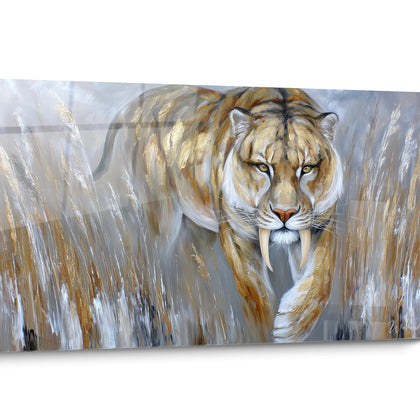
 Smilodon Painting in Tall Grass - Prehistoric Predator - Saber-Toothed Tiger Edition233,90 €
 Mystical Smilodon in the Clouds Wall Art - Ethereal Vision - Saber-Toothed Tiger Edition233,90 €
 Luminescent Saber-Toothed Tiger Wall Art - Prehistoric Majesty - Saber-Toothed Tiger Edition233,90 €
 Roaring Smilodon Wall Art - Wild Expression - Saber-Toothed Tiger Edition233,90 €
 Roaring Smilodon Wall Art - Prehistoric Majesty - Saber-Toothed Tiger Edition233,90 €
 Majestic Smilodon Wall Art - Intense Gaze of the Predator - Saber-Toothed Tiger Edition213,90 €
Explore further
In Saber-Toothed Tiger Wall Art



In the same family
Also explore the theme Primordial Lands
-
 View all150
artworks
View all150
artworks
-
 Andrewsarchus6
artworks
Andrewsarchus6
artworks
-
 Argentavis9
artworks
Argentavis9
artworks
-
 Basilosaurus10
artworks
Basilosaurus10
artworks
-
 Dinosaur31
artworks
Dinosaur31
artworks
-
 Dunkleosteus5
artworks
Dunkleosteus5
artworks
-
 Prehistoric Frescoes8
artworks
Prehistoric Frescoes8
artworks
-
 Glyptodon8
artworks
Glyptodon8
artworks
-
 Indricotherium2
artworks
Indricotherium2
artworks
-
 Kaprosuchus12
artworks
Kaprosuchus12
artworks
-
 Woolly Mammoth22
artworks
Woolly Mammoth22
artworks
-
 Megaloceros
-
 Megalodon9
artworks
Megalodon9
artworks
-
 Quetzalcoatlus8
artworks
Quetzalcoatlus8
artworks
-
 Scutosaurus9
artworks
Scutosaurus9
artworks


All about Saber-Toothed Tiger Wall Art
- Presentation Saber-Toothed Tiger Wall Art
- Saber-Toothed Tiger Wall Art: Paleontological Authenticity
- Saber-Toothed Tiger Wall Art: Power of the Prehistoric Predator
- Saber-Toothed Tiger Wall Art: Modern Prehistoric Atmosphere
Immerse yourself in the fascinating world of prehistory with a saber-toothed tiger wall art, a mural masterpiece that captures the very essence of Pleistocene megafauna. This legendary feline, also known by its scientific name Smilodon, represents one of the most emblematic predators ever to roam our planet. Extinct approximately 10,000 years ago, this apex predator continues to captivate with its massive canines reaching up to 28 centimeters and its evocative power. Wall decoration featuring this prehistoric hunter brings a unique dimension to your interior, blending contemporary aesthetics with a passion for paleontology.
Scientific Representation and Paleontological Fidelity of the Smilodon
Acquiring a saber-toothed tiger wall art requires particular attention to paleontological accuracy of representation. Unlike modern felines, the Smilodon displayed distinctive morphology that only the finest artistic reproductions capture with precision. Large format dimensions allow for appreciation of these crucial anatomical details that make all the difference between a simple illustration and genuine scientific reconstruction.
What are the authentic anatomical characteristics of the Smilodon?
Paleontology enthusiasts seek representations faithful to fossil discoveries. The massive skull with enlarged zygomatic arches, saber-shaped upper canines measuring up to 28 centimeters, and hypertrophied cervical musculature constitute essential distinctive elements. The Smilodon's jaw could open to 120 degrees, an exceptional biomechanical capacity absent in contemporary large felines. A premium prehistoric mural tiger of superior quality restores these specific proportions, notably the stocky and muscular body, particularly developed forelimbs, as well as the relatively short tail compared to modern felines.
Scientific reconstruction versus artistic interpretation
The boundary between scientific rigor and artistic freedom defines the value of a Smilodon mural decoration. Recent paleontological discoveries about prehistoric creatures have refined our understanding of this predator's true appearance. Isotopic analyses of fossils reveal, for example, that certain specimens likely displayed spotted or striped pelage, similar to modern felines inhabiting semi-open environments. The most recent reconstructions incorporate this data, offering a more nuanced vision than before.
Large-scale mural artworks allow incorporation of these subtleties: chromatic variations in coat, realistic fur texture, reflections in the eye conveying predatory intelligence. Some representations favor the documentary approach, depicting the Smilodon within its Pleistocene environment with vegetation characteristic of the glacial epoch. Others adopt a more dramatic aesthetic, concentrating attention on the feline's facial expression and threatening posture during an attack.
The importance of paleo-environmental context
An authentic saber-toothed tiger wall art often situates the animal in its original biotope. During the upper Pleistocene, Smilodon fatalis primarily occupied regions of North and South America, evolving in landscapes oscillating between open prairies and scattered forests. Contextualized representations frequently include elements of glacial flora, potential prey such as ancient bison or giant ground sloths, even other contemporary predators such as dire wolves.
This environmental contextualization considerably enriches the educational dimension of mural decoration. For demanding collectors, the presence of these paleo-ecological details transforms a simple decorative image into a genuine temporal window toward the Pleistocene. Imposing formats valorize these complex compositions, allowing integration of multiple layers of visual information without saturation.
The three Smilodon species and their morphological differences
The Smilodon family comprised three distinct species whose morphological differences merit recognition. Smilodon gracilis, the smallest and oldest, measured approximately 1.80 meters in length. Smilodon fatalis, the most widespread and best documented thanks to La Brea fossils, reached 2.10 meters. Finally, Smilodon populator, a true South American giant, exceeded 2.60 meters and possessed the most imposing canines.
Each species presented specific adaptations to its environment. Large-scale mural representations can highlight these subtle yet significant variations: slightly different skull proportions, variable limb length, skeletal robustness. For the discerning enthusiast, these distinctions add further depth to artwork appreciation. Some collectors specifically seek representations of Smilodon populator for its impressive stature, while others prefer the more streamlined silhouette of gracilis.
La Brea fossils and their influence on modern representations
The bitumen deposits of Rancho La Brea in California have yielded thousands of Smilodon fatalis fossils, providing scientists exceptional documentation of this species. This abundance of fossil material enabled reconstructions of unequaled precision. Artists specialized in paleo-illustration directly rely on this data to create faithful representations.
A mural artwork inspired by La Brea discoveries benefits from this scientific rigor. Bone details visible on certain fossils, such as dental pathologies or combat traces, can be integrated into artistic compositions to reinforce authenticity. For natural history enthusiasts, these direct references to fossil archives confer scientific legitimacy to mural decoration, transforming it into an object that is both educational and aesthetic.
Coat coloration and texture: current scientific hypotheses
The exact pelage coloration of the Smilodon remains speculative, as soft tissues rarely fossilize. Nevertheless, paleontologists formulate hypotheses based on biogeography and behavioral ecology. Ambush predators evolving in semi-open environments generally display camouflage patterns: vertical stripes, irregular spots, or uniform beige-fawn coloration.
Contemporary artistic representations explore these various possibilities. Some favor uniform fawn pelage with light underside, similar to modern lions. Others opt for spotted patterns reminiscent of leopards, particularly suited to forest environments. Large-scale mural formats allow subtle play with these chromatic variations, creating striking visual effects while respecting plausible scientific hypotheses. This controlled uncertainty paradoxically offers more creative richness than definitive knowledge.
Predatory Symbolism and Visual Impact of the Extinct Super-Hunter
The appeal of a saber-toothed tiger wall art extends far beyond pure paleontological interest. This prehistoric predator embodies universal concepts of power, domination, and survival that resonate deeply in our collective imagination. Its disappearance ten millennia ago confers an additional dimension of mystery and nostalgia for an era when apex predators reigned unchallenged over ecosystems.
Why does the Smilodon fascinate our modern era so?
The saber-toothed tiger occupies a unique place in our pantheon of emblematic animals. Unlike current predators, it represents an extinct evolutionary lineage, a branch definitively cut from the tree of life. This total extinction generates melancholic fascination: we can never observe a living Smilodon, which amplifies its mythic status. Its extreme morphology, notably these massive canines protruding beyond the lower jaw, makes it an almost fantastical creature despite its documented historical existence.
A mural decoration representing this prehistoric hunter captures this ambivalence between scientific reality and legend. Imposing formats magnify the animal's intimidating presence, creating a powerful focal point in any space. The eye is immediately drawn to these impressive fangs, symbols of absolute lethality. For enthusiasts of powerful visual sensations, few animals rival the graphic impact of the Smilodon.
Evolutionary comparison with contemporary large felines
Although often called a "tiger," the Smilodon bears no direct phylogenetic relationship with modern tigers. This distinct feline lineage evolved independently, developing radically different hunting strategies. Large-scale mural formats allow visual exploration of these fascinating evolutionary differences. While modern Pantherinae favor throat bites, the Smilodon used its sabers to lacerate vulnerable zones of large prey.
This extreme specialization testifies to evolutionary adaptation pushed to its paroxysm. Artistic representations can stage this distinctive hunting technique, showing the animal in full action, jaw wide open, sabers positioned for the final thrust. These dynamic compositions generate striking visual tension, transforming mural decoration into a dramatic narrative frozen in time. The great feline enthusiast finds in the Smilodon a unique alternative to the ubiquitous representations of lions or tigers.
The mystery of extinction: philosophical dimension
The Smilodon's extinction coincides with the disappearance of Pleistocene megafauna, a major event occurring during the transition to the Holocene. The exact causes remain debated: rapid climate change, over-hunting by prehistoric humans, or combination of multiple factors. This uncertainty adds an additional layer of reflection to the decorative artwork.
A prehistoric mural tiger becomes a support for meditation on species fragility, even the most powerful. The Smilodon, despite dominating its ecosystem for hundreds of thousands of years, did not survive the environmental upheavals of the early Holocene. This lesson in humility resonates particularly in our era of biodiversity crisis. Large formats allow integration of this contemplative dimension, the animal fixing the viewer with intensity that transcends millennia.
Intimidating presence and character affirmation in space
Installing a Smilodon mural representation constitutes an audacious decorative choice that speaks volumes about the acquirer's personality. This is not discreet or consensus decoration. The apex predator's presence imposes itself immediately, creating an atmosphere of primitive power and territorial affirmation. Visitors cannot ignore this artwork that inexorably captures the gaze.
This visual intensity suits spaces requiring strong identity particularly well: personal office, reception area, main living space. Generous dimensions amplify this presence effect. The Smilodon appears to surge from the wall, threatening fangs, fixed and determined gaze. For enthusiasts of characterful decors refusing blandness, this decorative option imposes itself naturally. It simultaneously expresses a taste for natural history and an asserted personality, little inclined toward aesthetic compromises.
Artistic representations: realism versus stylization
The market for Smilodon mural decorations offers a very broad stylistic spectrum. At one extreme, photorealistic hyperrealism reproduces every anatomical detail with quasi-photographic precision. At the other end, graphic stylizations reduce the animal to its essential elements: recognizable silhouette, emphasis on canines, expressionist chromatic treatment.
Large formats lend themselves remarkably well to both approaches. Realism benefits from available space to deploy the richness of detail: fur texture, pupil reflections, muscular tension visible beneath the coat. Stylization exploits the generous surface to create audacious compositions playing on contrasts, color planes, and form geometricization. Each approach generates distinct yet equally powerful visual impact, allowing each person to find artistic expression corresponding to their personal aesthetic sensitivity.
Symbolic association: strength, determination and transcendence
Beyond pure paleontological interest, the saber-toothed tiger conveys strong symbolic values. Its specialized morphology testifies to evolution determined toward predatory excellence. Hypertrophied canines, while limiting certain capacities, conferred decisive advantage in dispatching large prey. This extreme specialization illustrates the concept of transcendence and total commitment toward an objective.
These symbolic connotations transform mural decoration into a source of daily inspiration. For entrepreneurs, athletes, or anyone pursuing ambitious objectives, the Smilodon's presence reminds that excellence and determination overcome obstacles. The animal becomes visual metaphor for perseverance and evolutionary adaptation. Large dimensions reinforce this symbolic charge, the image imposing itself as visual manifesto of values upheld by the space's occupant.
Decorative Integration and Contemporary Prehistoric Atmosphere Creation
Installing a saber-toothed tiger wall art in a modern interior creates a fascinating aesthetic tension between distant past and present. This temporal juxtaposition generates a unique atmosphere, simultaneously evoking the glacial epoch and our technological era. Large format dimensions allow the artwork to genuinely structure the space, becoming the central element around which all surrounding decoration articulates.
What chromatic palette to associate with prehistoric decoration?
Successful integration of a Smilodon representation requires reflection on chromatic environment. Earthy tones evoking Pleistocene landscapes constitute a natural foundation: ochres, deep browns, stone grays, sandy beiges. These hues recall glacial steppes, arid soils, and rock formations of the epoch. An accent wall in these tonalities creates an ideal setting for the mural artwork.
However, a bolder approach involves exploiting contrast between prehistoric representation and resolutely modern surroundings. Immaculate white walls or anthracite gray make the image's details emerge spectacularly, creating dynamic visual tension. Cool shades—slate blue, steel gray—subtly evoke the glacial era while maintaining contemporary aesthetics. Spaces benefiting from abundant natural light allow exploration of darker combinations, the Smilodon emerging dramatically from a profound background.
Complementary decorative elements and paleontological thematic coherence
For enthusiasts wishing to deepen prehistoric atmosphere, numerous complementary decorative elements present themselves. Fossil reproductions, whether skull casts or bone fragments, add three-dimensional dimension and reinforce scientific credibility of the whole. Shelving accommodating these pieces can be strategically positioned around the main artwork.
Raw natural textures harmonize perfectly with the theme: driftwood recalling remains of Pleistocene-era trees, rough stones evoking ancient geological formations, leathers and furs for a primitive touch. Imposing mural formats dialogue effectively with these textured elements, creating a multi-sensory composition where visual and tactile respond to each other. Lighting plays a crucial role too: indirect light sources create dramatic shadows reinforcing the predator's presence.
Suitable spaces and architectural valorization
Not all spaces equally accommodate large-scale Smilodon mural decoration. Spacious rooms with sufficient visual distance allow full appreciation of the artwork's details. A generous living room, executive office, personal library, or even a wide corridor constitute ideal locations. Ceiling height also influences impact: substantial volumes magnify the imposing presence of the prehistoric predator.
The orientation of the representation merits reflection. A profile Smilodon exhibiting characteristic canines creates directional dynamism, the animal's gaze naturally guiding circulation through the space. A frontal view generates direct confrontation with the viewer, intensifying emotional impact. Bird's-eye or worm's-eye perspectives, though less frequent, offer spectacular views valorized by large formats. Vision angle conditions the emotional experience provided by the artwork.
How to associate modern architecture and prehistoric imagery?
Coexistence between ultra-contemporary aesthetics and prehistoric imagery generates particularly stimulating creative tension. Ultra-minimalist interiors with clean lines, design furniture and integrated technologies seem a priori antagonistic with prehistoric creature representation. Yet this opposition creates precisely the interest of the association. The Smilodon becomes organic focal point in a geometric environment, introducing natural and historical dimension into contemporary artifice.
Modern materials—glass, brushed steel, polished concrete—do not necessarily oppose paleontological themes. On the contrary, their technical neutrality valorizes the organic and wild character of the prehistoric animal. Large-scale formats allow the artwork to hold its own against architecture, creating dialogue as equals between contemporary human construction and ancestral natural power. This dialectic considerably enriches the spatial experience of the environment.
Thematic collection and coherent prehistoric series
Passionate collectors may consider complementing their saber-toothed tiger wall art with other Pleistocene megafauna representations, thereby creating a coherent thematic gallery. The woolly mammoth, megaceros with gigantic antlers, cave lion, or giant ground sloth constitute excellent visual companions for the Smilodon. Strategically positioned in different rooms or grouped in generous space, these elements construct a true personal museum dedicated to the glacial era.
This serial approach amplifies individual artwork impact. The Smilodon finds its place in a reconstructed ecosystem, visually interacting with its extinct contemporaries. For natural history enthusiasts, this collection becomes narrative support allowing evocation of ecological relationships, predator-prey dynamics, and biological richness of this bygone epoch. Large dimensions facilitate this approach by enabling sufficiently detailed and expressive representations to function both individually and as coherent ensemble.
Educational dimension for young paleontology enthusiasts
A mural decoration representing a Smilodon constitutes a formidable pedagogical tool for awakening younger people's curiosity toward paleontology and natural sciences. Unlike contemporary animals omnipresent in children's imagery, this prehistoric predator opens a window toward a vanished world, stimulating questions and reflections on evolution, adaptation, and extinction.
Large format dimensions naturally capture children's attention, transforming the space into immersive environment. The feline's impressive character, far from frightening, generally fascinates and sparks desire to learn more. This daily presence of a prehistoric creature can become scientific vocation trigger, encouraging reading, museum visits, and paleontological knowledge exploration. The decorative artwork thereby transcends its aesthetic function to become learning catalyst and wonder spark.
FAQ - Frequently asked questions about tiger wall art saber-toothed
Does a saber-toothed tiger wall art suit all interior styles?
Although primarily associated with natural ambiances or interiors of paleontology enthusiasts, a saber-toothed tiger wall art integrates surprisingly well in varied decors. Industrial interiors with exposed brick and metal beams create interesting dialogue between the prehistoric animal and raw urban aesthetics. Minimalist contemporary ambiances benefit from the feline's organic presence as counterpoint to rigorous geometry. Even certain classic interiors can welcome this artwork by creating bold contrast between traditional decorative approach and unexpected prehistoric subject.
What distinguishes a saber-toothed tiger wall art from other feline representations?
Beyond the visually distinctive appearance of massive canines, a saber-toothed tiger wall art conveys radically different symbolic charge than contemporary felines. Where current lions and tigers evoke majesty and present natural power, the Smilodon introduces temporal dimensions of extinction, paleontological mystery, and reflection on species fragility. Its extreme morphology also makes it visually more spectacular and memorable than conventional felines, offering a distinctive alternative for enthusiasts of characterful decoration seeking originality.
Are large formats preferable for this type of representation?
Generous dimensions present decisive advantages for valorizing saber-toothed tiger wall art. The Smilodon's distinctive morphology, notably its characteristic canines and powerful musculature, gains considerably in visual impact when represented at important scale. Essential anatomical details for paleontological authenticity—fur texture, facial expression, specific proportions—fully appreciate on extended surfaces. Moreover, the prehistoric predator's intimidating presence expresses itself better in large format, creating the dramatic focal point sought by enthusiasts of asserted decoration.
Can one combine a saber-toothed tiger wall art with other prehistoric elements?
Association with other Pleistocene megafauna representations creates particularly successful thematic coherence. Mammoths, woolly rhinoceros, cave lions, or ancient bison can accompany the Smilodon to visually reconstitute the glacial ecosystem. Complementary decorative elements such as fossil reproductions, prehistoric vegetation representations, or glacial epoch landscape evocations enrich the atmosphere. This approach transforms the space into genuine temporal immersion, particularly appreciated by paleontology enthusiasts wishing to create coherent environment celebrating this fascinating period of Earth's history.


