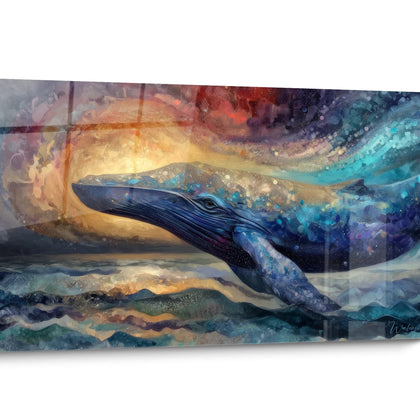
- Presentation Basilosaurus Wall Art
- Visual Impact and Presence
- Paleontological Dimension
- Ancestral Oceanic Decoration
The Basilosaurus wall art celebrates one of the most fascinating marine giants of prehistoric times. This primitive whale, which dominated the oceans of the Paleocene 40 million years ago, offers today a majestic artistic representation that instantly transforms the atmosphere of any space. With its serpentine body reaching 18 meters in length, the Basilosaurus embodies the power of ancestral marine predators and immediately captivates the eye. This large-format wall representation naturally finds its place in environments where one wishes to create a deep connection with marine natural history.
Basilosaurus Wall Art: A Monumental Presence That Redefines Space
Why does the Basilosaurus instantly capture attention?
The unique anatomy of the Basilosaurus, with its elongated 15 to 18-meter body and sea serpent silhouette, creates
exceptional visual dynamism on walls. Unlike representations of modern marine mammals, this primitive cetacean presents unusual proportions that generate natural visual tension. Its serpentine morphology guides the eye horizontally, creating a fluidity in spatial perception that visually expands rooms. The large dimensions available for this type of representation allow you to capture every anatomical detail that distinguished this predator: its powerful jaws equipped with differentiated teeth, its vestigial front limbs testifying to its evolution, and this paddle-shaped tail that propelled its imposing mass through the warm waters of the Tethys.
The color palette associated with Basilosaurus representations favors
primitive ocean tones: deep blues evoking the Eocene seas, emerald greens recalling the tropical coastal waters of that era, and amber touches suggesting the filtered luminosity of ancient oceans. These warm hues contrast with representations of contemporary marine environments, bringing chromatic richness that integrates particularly well in spaces with natural and woody tones. The association with materials such as dark wood, aged leather or natural stone reinforces this temporal connection with past geological eras.
How to optimize the visual impact of a primitive whale representation?
The natural horizontal orientation of the Basilosaurus dictates a different strategic placement than other marine representations. Long, expansive walls constitute the ideal location, particularly in wide corridors, extended conference rooms or reception areas where circulation runs parallel to the wall. This configuration allows observers to grasp the impressive length of the animal while moving, creating a progressive discovery effect that amplifies the sensation of majesty.
Professional offices, specialized practices and consultation spaces benefit particularly from a
large-scale Basilosaurus representation. In a paleontology, geology or oceanography office, this type of wall art immediately establishes the credibility and expertise of the place. Waiting rooms in medical or dental centers frequently use these prehistoric representations to create a soothing focal point that diverts attention from potential anxiety. The implicit educational dimension naturally engages curiosity, offering a subject of contemplation that facilitates patience.
Lateral directional lighting particularly enhances
the anatomical details of the ancestral marine predator. Light coming from the front casts subtle shadows that accentuate body volume, powerful musculature and head contours. This technique creates three-dimensional depth that literally makes the Basilosaurus "pop" from the wall, amplifying its physical presence in space. Variable temperature lighting allows you to modulate the ambiance: warm light at 3000K evokes the tropical waters of the Eocene, while cooler temperature at 4500K suggests mysterious depths.
Which spaces best showcase a primitive cetacean representation?
Libraries and reading spaces find in the
Basilosaurus wall art an ideal companion. The contemplative nature of this animal extinct for millions of years inspires deep reflection on time, evolution and the transformation of ecosystems. Collections of scientific books, natural history works or literature on marine exploration create a natural thematic dialogue with this representation. The concentration required for reading harmonizes with the calm yet imposing presence of this ancient ocean giant.
Training spaces and conference rooms in scientific, environmental or educational fields frequently adopt
representations of extinct marine megafauna. The Basilosaurus serves as a visual bridge between presentations on evolution, climate change, species adaptation or marine conservation. Its presence stimulates discussions on major ecological transformations, extinctions and the resilience of marine life. For organizations working in oceanographic research or protection of modern cetaceans, this connection with prehistoric ancestors reinforces the message of evolutionary continuity.
Residential spaces such as lofts or high-ceiling apartments perfectly accommodate the
large dimensions of these representations. Paleontology enthusiasts, fossil collectors or natural history passionate individuals often create thematic spaces where the Basilosaurus wall art becomes the centerpiece of a larger collection including ammonite replicas, marine skull reconstructions or ancient geological maps. The
collections of wall art representing creatures of Ancient Lands offer coherence and complementarity to develop a truly immersive ambiance.
Association with other primitive oceanic decoration elements
Creating a coherent visual ecosystem around the
Basilosaurus amplifies its impact. The integration of representations of other Eocene marine species - Otodus sharks, Archelon turtles, or primitive seabirds - reconstitutes the complete environment in which this predator evolved. This narrative approach transforms a simple wall into a time window toward a bygone era, creating an immersive experience that transcends simple decoration.
Raw natural textures ideally complement this representation: authentic driftwood, fossiliferous limestone, natural slate or raw concrete evoke marine sediments that preserved Basilosaurus fossils. Patinated metal elements, recalling archaeological tools or ancient navigation instruments, reinforce the exploratory and scientific dimension. The addition of large-leaf tropical plants - monstera, tree ferns, palms - reconstitutes the atmosphere of Eocene coastlines, creating a living contrast with the extinct creature.
The temporal dimension and historical depth
Unlike representations of contemporary animals, a
primitive whale wall art generates reflection on the depth of geological time. The 40 million years separating us from the Basilosaurus exceeds the scale of ordinary human understanding, creating a form of temporal sublime. This temporal distance grants the representation a particularly meditative quality: the animal is not simply geographically absent, it belongs to a completely bygone world, whose very oceans have changed configuration.
Spaces dedicated to reflection - meditation rooms, reading corners, personal offices - use this quality to deepen introspection. The contemplation of a species extinct for so long naturally relativizes daily preoccupations, offering a broader perspective on our own ephemeral existence. Psychology, coaching or philosophy professionals frequently integrate these prehistoric representations to facilitate discussions on change, impermanence and adaptation.
The Scientific and Educational Dimension of Basilosaurus Wall Art
The Basilosaurus as a pedagogical tool for understanding cetacean evolution
The Basilosaurus wall art constitutes an exceptional visual support for understanding the evolutionary transition of land mammals toward marine environments. This species represents a fascinating intermediate stage where ancestral terrestrial characteristics still coexist with aquatic adaptations. The vestigial hind limbs, though too small for locomotion, testify to the terrestrial origin of cetaceans and concretely illustrate the concept of vestigial organs in evolution. This pedagogical dimension transforms the wall representation into a genuine anatomy lesson accessible to all ages.
Educational institutions - schools, universities, science centers - particularly exploit this teaching value of primitive marine mammals representations. In the corridors of biology, geology or paleontology departments, these large-format wall artworks serve as permanent visual references. Students passing daily progressively assimilate distinctive anatomical characteristics: heterodont dentition with differentiated incisors, canines and molars (unlike the homogeneous teeth of modern cetaceans), extreme vertebral elongation creating this unique serpentine body, and the massive skull adapted to hunting large fish and other marine mammals.
Why does the Basilosaurus fascinate paleontology enthusiasts so much?
The initial discovery of Basilosaurus fossils in the 19th century initially deceived scientists who believed they had found a giant marine reptile, hence its name meaning "king-lizard". This historical error, quickly corrected when mammalian characteristics were identified, adds a captivating narrative dimension to the species. A wall art representing this archaic cetacean therefore also evokes the history of paleontology itself, the explorations of science and the importance of rigorous analysis. For fossil collectors and natural history enthusiasts, this connection with the discipline's beginnings reinforces the symbolic value of the representation.
The exceptional fossil sites where Basilosaurus remains have been discovered - notably the Wadi Al-Hitan (Valley of the Whales) in Egypt, now a UNESCO World Heritage site - add specific geographical and geological dimension. These desert zones were once shallow tropical seas where extraordinary marine biodiversity flourished. The wall representation of the Basilosaurus thus also evokes major geological upheavals, continental drift and climatic transformations that metamorphosed oceans into deserts. This contextual depth considerably enriches the contemplative experience.
Contemporary curiosity cabinets and private collection spaces frequently integrate representations of extinct marine predators as masterpieces. The Basilosaurus, with its status as apex predator of Eocene seas, occupied the top of the marine food chain of its era. This particular ecological position distinguishes it from modern marine mammals that, with the exception of the orca, are generally not apex predators. Understanding this absolute ecological dominance grants the representation an aura of power that resonates with collectors seeking artworks evoking strength and natural supremacy.
How does Basilosaurus wall art stimulate scientific conversations?
Scientific coworking spaces, research laboratories and break rooms of academic institutions use these representations of extinct marine megafauna as catalysts for interdisciplinary discussions. A marine biologist, a geologist and a climatologist can all find matter for exchange before a Basilosaurus representation: the former interested in anatomical and behavioral adaptations, the latter in fossilization conditions and depositional environments, the last in the implications of climate changes that followed species extinction. This thematic transversality makes the wall art a genuine tool for scientific mediation.
The impressive size of the Basilosaurus - up to 18 meters for the largest specimens - poses fascinating questions about the physiology of giant marine mammals. How did an animal of this size regulate its temperature in Eocene tropical waters? How much food did it need to consume daily to maintain its metabolism? These questions, naturally sparked by contemplating large-dimension representation, engage observers in reflection on the biomechanical and metabolic constraints of extreme-sized organisms. Spaces dedicated to scientific popularization exploit this spontaneous curiosity.
The importance of Basilosaurus in understanding ancient marine ecosystems
A high-quality Basilosaurus wall art generally represents the animal in its reconstituted environment, including contemporary species that shared its habitat: massive-toothed Otodus sharks, primitive dugongs Protosiren, giant sawfish and archaic sea turtles. This ecological contextualization transforms the representation into a window on a complete extinct ecosystem. Natural history museums indeed use this approach in their reconstructions, and private space owners increasingly seek to reproduce this narrative richness in their decorative choices.
The predator-prey interactions of the Basilosaurus with primitive dugongs constitute a particularly edifying example of parallel evolution between predators and prey. The characteristic bite marks found on certain fossils of Dorudon (a small cetacean) show that the Basilosaurus probably practiced active predation even on other marine mammals. This dimension of versatile apex predator, capable of attacking varied prey thanks to its specialized dentition, offers rich angles of discussion for professional spaces related to evolutionary biology or behavioral ecology.
Anatomical variations among different Basilosaurid species - the family including Basilosaurus - allow addressing concepts of adaptive radiation and speciation. Some species were more coastal, others more pelagic; some more massive, others more slender. A wall art specifically representing Basilosaurus cetoides, the most studied type species, enables these precise taxonomic discussions that captivate informed enthusiasts. The scientific accuracy of the representation becomes an additional appreciation criterion, beyond simple aesthetic quality.Creating a Primitive Oceanic Ambiance with Basilosaurus Wall Art
How does the Basilosaurus evoke temporal marine depths?
Integrating Basilosaurus wall art into a space transcends simple wall decoration to create a genuine atmosphere of exploring immemorial times. The Eocene oceans, 40 million years ago, presented characteristics radically different from current seas: globally higher temperatures, distinct continental configuration, marine biodiversity in full evolutionary radiation post-dinosaur extinction. The representation of this primitive cetacean thus becomes the anchor point of an ambiance that celebrates these vanished aquatic worlds, creating a profound emotional connection with bygone geological epochs.
Themed restaurants focused on seafood and marine gastronomy frequently adopt representations of prehistoric marine creatures to create a unique visual narrative. Unlike establishments using contemporary species representations, those choosing the Basilosaurus position themselves on a more exclusive register, evoking ancientness and authenticity of marine resources. The visual association between an ancestral marine predator and contemporary gastronomic excellence creates an intriguing temporal paradox that stimulates customer curiosity and generates memorable conversations around evolution, sustainability and respect for marine ecosystems.
Which color palettes complement a primitive whale representation?
Creating a coherent environment around Basilosaurus wall art requires specific chromatic reflection on Eocene seas. Warm tones - ochres, ambers, sandy beiges - evoke limestone sediments and shallow coastal waters where these animals hunted. These hues contrast with the cool blues typical of contemporary marine décor, creating a distinctive visual identity that immediately signals the prehistoric dimension. The use of olive greens and deep browns recalls primitive algae and tropical seafloors, enriching the palette beyond usual oceanic clichés.
Raw natural materials - limestone, fossiliferous shale, petrified wood - reinforce this connection with geological strata that preserved Basilosaurus fossils. Surfaces with textures evoking natural erosion, ancient patinas and traces of time create a visual dialogue with the creature represented, whose existence we know only through fossilization processes. Spa spaces and wellness centers particularly exploit this mineral and timeless aesthetic, using the archaic marine mammal wall art as a central element of a soothing ambiance that invites temporal disconnection.
Association of Basilosaurus with other paleontological marine representations
Building a coherent thematic collection around prehistoric oceans considerably amplifies decorative impact. The association of Basilosaurus wall art with representations of other contemporary species - giant Carcharocles sharks, Cretaceous mosasaurs, Jurassic ichthyosaurs - creates a timeline narrating the history of marine life through geological eras. This narrative approach transforms a simple wall into a genuine personal museum, particularly appreciated in private libraries, educational playrooms for prehistory-passionate children, or reception areas of natural science professionals.
Medical offices specialized in osteopathy, chiropractic or physiotherapy find particular relevance in primitive cetacean representations. The exceptionally elongated spine of the Basilosaurus, with its individual vertebrae adapted to undulatory locomotion, offers a fascinating visual parallel with human anatomy. Discussions on biomechanics, structural adaptation and flexibility become naturally more engaging in the presence of such a spectacular example of axial skeleton evolution. The pedagogical dimension thus harmoniously marries with the aesthetics of the place.
How to create an immersive space around the ancient oceans theme?
Ambient lighting plays a crucial role in evoking Eocene marine depths. Diffuse light sources imitating filtered luminosity underwater, combined with intensity variations suggesting surface wave movements, transform space into a stylized subaquatic environment. Programmable LED technologies enable creating light cycles evoking different hours of the day underwater, from deep blue of night hours to brilliant turquoise of tropical middays. This theatrical lighting makes the Basilosaurus wall art the protagonist of a constantly evolving scene.
Sound elements complement sensory immersion: distant wave sounds, crackles evoking sediment movements, or musical compositions using low frequencies imitating communications of great cetaceans. These soundscapes, used sparingly in relaxation spaces, waiting rooms or rest areas, create a multisensory experience that engages visitors beyond simple visual contemplation. The imposing presence of the Basilosaurus on the wall becomes then the visual center of a complete immersive experience.
Interior architecture and thematic space design professionals increasingly integrate representations of extinct marine megafauna in their large-scale projects. Building halls in maritime, oceanographic or environmental sectors, reception areas of aquariums and marine science centers, or lobbies of hotels situated in coastal areas exploit the evocative power of the Basilosaurus to create a memorable visual identity. The large dimensions available for these representations allow treating significant architectural volumes while maintaining necessary visual impact.
The added value of precise anatomical details in representation
A high-quality Basilosaurus wall art distinguishes itself through scientific accuracy of its anatomical representation. Knowledgeable enthusiasts particularly appreciate faithful details: the specific shape of the skull with its elongated rostrum, the position of nostrils still partially in dorsal position (unlike blowholes located atop modern cetacean heads), the characteristic musculature adapted to undulatory swimming, and even correct proportions between different body sections. This scientific rigor transforms the representation into a legitimate reference rather than a fanciful artistic interpretation.
Demanding collectors seek artworks respecting the most recent paleontological discoveries, avoiding obsolete reconstructions based on outdated hypotheses. Ongoing research on Basilosaurids regularly brings new information about their appearance, behavior and ecology. A wall art accurately representing the Basilosaurus according to current knowledge demonstrates the creator's seriousness and commitment to accuracy, a quality particularly valued in scientific or educational professional environments where credibility is essential.
FAQ: Frequently Asked Questions about Basilosaurus Wall Art
What is the ideal size for Basilosaurus wall art in a residential space?
To respect the characteristic elongated proportions of the Basilosaurus and create authentic visual impact, favor wide horizontal formats. Recommended minimum dimensions are around 120 cm in width to capture the distinctive serpentine silhouette. In spaces with sufficiently long walls - spacious living rooms, wide corridors, open living areas - formats reaching 200 cm or more allow fully appreciating the majesty of this ancestral marine predator and distinguishing anatomical details that render it unique among primitive marine mammals.
Is Basilosaurus wall art suitable for children's rooms passionate about prehistory?
Absolutely, this representation constitutes an excellent choice for young paleontology enthusiasts and extinct animal lovers. Unlike dinosaurs omnipresent in children's rooms, the Basilosaurus offers a distinctive marine alternative that stimulates curiosity about prehistoric aquatic environments. Its less aggressive appearance than contemporary marine reptiles like mosasaurs, combined with its evolutionary connection to modern whales children know, creates a natural pedagogical bridge. The educational dimension enriches space while maintaining captivating aesthetics that evolves with the child's age.
How to maintain and preserve wall art representing prehistoric marine creatures?
Large-dimension wall representations require minimal but regular maintenance to preserve their brilliance. Avoid direct sunlight exposure that could alter pigments, particularly blues and greens evoking Eocene waters. Gentle monthly dusting with a dry microfiber cloth generally suffices. For high-humidity spaces - themed bathrooms, spa areas - ensure adequate ventilation to prevent degradation. Environmental stability preserves longevity: avoid abrupt thermal variations and maintain relative humidity between 40 and 60%.
Can one combine Basilosaurus wall art with contemporary minimalist décor?
This combination actually creates a particularly successful and increasingly sought-after contrast in contemporary interior design. The evocative power of a creature extinct for 34 million years is magnified by the sobriety of a refined environment. In a space with pure lines, neutral colors and minimalist furniture, the Basilosaurus wall art naturally becomes the absolute focal point, capturing attention without visual competition. This "statement piece" approach - a powerful artwork in a sober environment - perfectly corresponds to current trends valuing quality over quantity and intentional decorative choices laden with meaning.


 Cosmic Whale Painting - Celestial Voyage - Basilosaurus Edition233,90 €
 Colored Whale Painting - Aquatic Expressionism - Basilosaurus Edition233,90 €
 Abstract Whale Painting - Breath of Fire - Basilosaurus Edition233,90 €
 Basilosaurus Whale Painting - Abyssal Odyssey - Basilosaurus Edition233,90 €
 Prehistoric Whale Wall Art - Basilosaurus Aquatic Renaissance - Basilosaurus Edition233,90 €
 Whale Floral Skull Wall Art - Memento Mori Renaissance - Basilosaurus Edition233,90 €
 Prehistoric Basilosaurus Wall Art - Giant of Ancient Abysses - Basilosaurus Edition233,90 €
 Basilosaurus in the Ocean Depths Wall Art - Abyssal Majesty - Basilosaurus Edition232,90 €
 Colorful Whale Wall Art - Majesty of the Abyss - Basilosaurus Edition233,90 €
 Majestic Whale Wall Art - Mystic Ocean - Basilosaurus Edition232,90 €