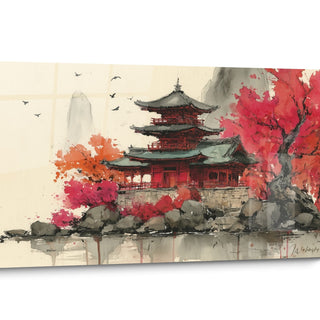
A Buddhist temple painting transforms your interior into a sanctuary of peace, evoking the majesty of Himalayan monasteries and the tranquility of Asian pagodas. These monumental representations capture the architectural essence of Buddhist places of worship, with their characteristic curved roofs, gilded stupas, and meditative gardens. Perfectly sized for large spaces, this type of wall decoration appeals to Buddhist practitioners seeking to sacralize their meditation space, to admirers of Oriental architecture fascinated by Asian religious constructions, and to collectors of spiritual art wishing to anchor a lasting contemplative atmosphere. Each visual faithfully reproduces the ornamental details of Tibetan, Burmese, Thai, or Japanese temples, creating a focal point conducive to daily contemplation.
The Spiritual Energy of Buddhist Sanctuaries in Your Home
Acquiring a Buddhist temple painting responds to a profound quest for spiritual connection within your own habitat. Unlike abstract or botanical representations, these works reproduce sacred structures charged with centuries of meditative practices and monastic prayers. Temples such as Borobudur in Indonesia, Todaiji in Japan, or Taktsang monastery in Bhutan carry a particular energetic imprint that artists strive to convey through their visual creations.
How does a Buddhist temple painting amplify your daily meditative practice?
In a domestic meditation space, this type of wall decoration functions as a visual concentration support (kasina in the theravada tradition). The gaze naturally settles on the architectural lines of the represented temple, facilitating entry into a meditative state. Practitioners of zen meditation painting recognize that temple visuals create a more powerful mental anchor than traditional mandalas, because they evoke a physical place of collective practice. The generous dimensions allow for total visual immersion, transforming an ordinary wall into a window opening onto a Himalayan sanctuary.
Representations of historical temples versus contemporary creations
The market offers two distinct categories: photographic reproductions of authentic Buddhist temples and modern artistic interpretations. The former capture iconic locations such as the Golden Pavilion of Kinkaku-ji in Kyoto or the Angkor Wat complex, offering documentary fidelity prized by spiritual travelers and ethnologists. The latter blend traditional architectural elements with contemporary minimalist aesthetics, appealing to decorators seeking a fusion between Buddhist heritage and current design.
The influence of different Buddhist traditions on architectural representations
A Tibetan Buddhist temple painting is radically distinct from a Japanese Zen representation. Himalayan monasteries display vibrant colors (ochre red, immaculate white, gleaming gold) and fortified architecture adapted to mountains, while Zen temples prioritize chromatic sobriety, refined lines, and harmonious integration into stone gardens. This differentiation allows buyers to choose according to their spiritual lineage: vajrayana, mahayana, or theravada traditions directly influence the aesthetics of the represented temple and therefore the atmosphere created in the domestic space.
Architectural Symbolism and Sacred Geometry of Buddhist Structures
Each architectural element of a Buddhist temple painting conveys precise cosmological significance, transforming your wall into a silent teaching of the dharma. Multi-tiered roofs represent the stages of the path to enlightenment, with each level symbolizing a degree of spiritual realization. Stupas, hemispherical structures often gilded, embody Mount Meru, the central axis of the Buddhist universe. Understanding this symbolism considerably enriches the contemplative experience offered by these monumental wall decorations.
What are the essential architectural elements to identify on a temple painting?
Connoisseurs seek representations including authentic architectural characteristics: Tibetan chortens with their thirteen rings symbolizing thirteen spiritual lands, monumental gateways guarded by stone lions, ritual bells suspended from eaves, and multicolored prayer flags. A large-format Buddhist temple painting allows appreciation of these ornamental details that testify to the artistic mastery of Asian builders. Knowledgeable buyers examine the precision of these elements to evaluate the documentary and spiritual quality of the work.
The significance of colors in Buddhist temple architecture
The red dominant in Tibetan temples is not aesthetic but symbolic: it represents spiritual power and transformation. The gold of stupas evokes enlightenment and the absolute purity of the Buddha. Japanese Zen temples prioritize natural tones (raw wood, gray stone, green moss) embodying impermanence and harmony with nature. When selecting a Buddhist temple painting, this chromatic palette should align with the spiritual intention of your space: energization (red), luminous contemplation (gold), or silent introspection (natural tones).
Geographic orientation and the implantation of temples in the landscape
Buddhist traditions prescribe precise rules for temple implantation according to feng shui and geomancy principles. Himalayan monasteries are often perched on cliffs, symbolizing spiritual elevation and proximity to the sky. Japanese temples integrate harmoniously into bamboo forests or beside ponds, illustrating non-duality between constructed and natural elements. A painting representing these specific landscape contexts brings an additional dimension: it shows not merely a building but a complete spiritual ecosystem, reinforcing the immersive effect in your living space.
Creating a Domestic Sanctuary with a Buddhist Temple Painting
Installing a Buddhist temple painting in your interior radically transforms the function of a room, evolving it from a simple resting space into a true domestic sanctuary. Contemporary Buddhist practitioners seek this sacralization of their habitat, creating zones dedicated to daily dharma practice without requiring a separate room. The visual presence of a majestic temple immediately establishes an atmosphere of contemplation, signaling to the mind that it is entering a space differentiated from mundane daily life.
Why choose a monumental format for your Buddhist temple painting?
Generous dimensions prove essential to reproduce the immersion effect felt when physically visiting a temple. A small format cannot convey architectural majesty nor create the sensation of being physically transported to a Himalayan sanctuary or Burmese pagoda. Monumental formats (beyond 120 cm width) allow architectural details to be fully appreciated: ornamental sculptures, geometric patterns of balustrades, expressions of stone guardians. This monumental scale justifies the investment for collectors of spiritual art seeking a meditative masterpiece rather than a simple decorative accessory.
The association of the Buddhist temple painting with other Buddhist ritual elements
In an optimal configuration, the Buddhist temple painting integrates into a domestic altar comprising Buddha statues, offering bowls, incense burner, and sacred textures. Positioned above or behind the altar, it creates visual depth suggesting that ritual objects are arranged before an actual temple. This stratified staging amplifies the spiritual experience: the gaze penetrates physical objects to reach the represented sacred space, creating a connection between domestic ritual and thousand-year-old monastic tradition.
Moments of contemplation favored by the representation of a temple
Unlike Buddha images that invite direct devotion, a Buddhist temple painting facilitates more architectural and philosophical contemplation. The practitioner may meditate on impermanence by observing an ancient Cambodian temple overgrown with vegetation, on perseverance by contemplating a Tibetan monastery resisting Himalayan rigors, or on simplicity by focusing on the purity of a Zen pavilion. This contemplative versatility explains why Buddhist teachers recommend these representations for spaces of collective practice, where each participant can project their own spiritual reflection onto the represented sacred architecture.
Is a Buddhist temple painting suitable only for Buddhist practitioners?
Absolutely not. While Buddhist practitioners find direct spiritual support in it, admirers of Asian architecture, travelers who have visited these iconic locations, and people simply seeking a peaceful atmosphere also benefit from these representations. The universality of the quest for inner peace transcends specific religious affiliations.
How to distinguish an authentic Buddhist temple painting from a generic reproduction?
Authentic reproductions precisely identify the represented temple (name, location, construction period) and respect actual architectural proportions. Generic creations blend elements from different traditions without historical coherence. Check the precision of ornamental details and the presence of culturally consistent elements: an authentic Tibetan temple will never feature Japanese torii gates, for example.
What is the durability of a large-format Buddhist temple painting?
Monumental formats require resistant materials and advanced printing techniques to guarantee longevity. Prioritize prints on rigid supports with anti-UV treatment to preserve vibrant colors (particularly important for Tibetan temples with brilliant tones) and protect against fading caused by natural light, essential in a bright meditation space.


 Buddhist Pagodas in Golden Mist - Sunrise Wall Art - Mystical Serenity232,90 €
 Buddhist Temple Landscape Wall Art - Sunset with Orange and Purple Sky - Bagan Serenity232,90 €
 Stone Faces Painting Carved in Ochre and Golden Tones - Millennial Serenity - Buddhist Temple Edition233,90 €
 Buddhist Temple Painting Scarlet Red in Millennial Cedar Forest - Ancestral Serenity - Buddhist Temple Edition233,90 €
 Buddhist Temple Painting at Twilight with Golden Reflections on Lotus Pond - Golden Serenity - Buddhist Temple Edition233,90 €
 Sacred Portico in Golden Mists and Verdant Mountains - Spiritual Harmony - Buddhist Temple Edition233,90 €
 Red and Blue Tunnel Architectural Perspective - Mystical Passage - Buddhist Temple Edition233,90 €
 Black and White Stone Lantern Wall Art - Zen Serenity - Buddhist Temple Edition233,90 €
 Perched Temple Wall Art with Pagodas and Misty Mountains - Summit Serenity - Buddhist Temple Edition233,90 €
 Golden Parasol Wall Art with Ornamental Motifs in Traditional Architecture - Spiritual Serenity - Buddhist Temple Edition233,90 €
 Buddhist Temple Wall Art Golden Mist Sunrise - Mystical Serenity - Buddhist Temple Edition233,90 €
 Golden Traditional Bells and Asian Roof Watercolor Canvas - Spiritual Serenity - Buddhist Temple Edition233,90 €
 Golden Temples in Purple Haze at Twilight Canvas - Sacred Mystique - Buddhist Temple Edition233,90 €
 Sacred Architecture Black Silhouette Textural Blue Sky Painting - Zen Spirituality - Buddhist Temple Edition233,90 €
 Golden Pagoda Painting Black Silhouette on Gold Background - Golden Serenity - Buddhist Temple Edition233,90 €
 Buddhist Temple on Misty Mountain Painting Ochre and Blue Tones - Celestial Sanctuary - Buddhist Temple Edition213,90 €
 Buddhist Architecture with Copper Roofs and Perfect Water Reflections - Mirror Harmony - Buddhist Temple Edition213,90 €