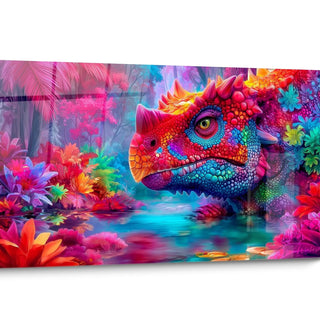
Discover our exclusive collection of woolly mammoth wall art depicting this magnificent Ice Age creature, a mural decoration that transports your interior to the fascinating epoch of the glacial era. These artistic representations of prehistoric megafauna bring unique educational and aesthetic dimensions to your living spaces. Each large-format visual captures the majesty of this disappeared Pleistocene giant, transforming your walls into genuine windows on the past. Explore our range dedicated to creatures from ancient lands to enrich your decor with authentic paleontological touches.
The Woolly Mammoth: A Powerful Prehistoric Presence in Your Modern Decor
A woolly mammoth wall art piece radically transforms the perception of an interior space by introducing a temporal dimension that transcends human understanding. This artistic representation of Mammuthus primigenius is far more than a simple mural decoration—it is a genuine gateway to the glacial steppes of the Upper Pleistocene. The visual impact of this prehistoric giant on a contemporary wall creates a fascinating juxtaposition between the modernity of our homes and the deep antiquity of natural history.
Why choose a woolly mammoth representation for your interior?
Prehistoric mural art answers a quest for connection with the origins of our planet. Paleontological art collectors seek large-format visuals that capture the essence of extinct megafauna, and the woolly mammoth perfectly embodies this nostalgia for a vanished world. Its massive silhouette covered in thick reddish fur immediately evokes the climatic rigors of the Ice Age, a period when average temperatures reached up to 10 degrees Celsius lower than today.
Integrating a representation of this giant proboscidean into a living room, office, or library instantly creates a compelling focal point. Visitors are invariably drawn to the presence of this animal that could reach 3.5 meters at the shoulder and weigh up to 6 tons. This imposing presence on your wall generates an atmosphere of respect for ancient biodiversity and sparks reflections on evolution, adaptation, and ecosystem fragility.
The symbolism of the mammoth in ancestral and contemporary cultures
The woolly mammoth occupies a special place in collective human imagination since our Cro-Magnon ancestors shared the same territories with these giants. Rock paintings found in European caves testify to this cohabitation and the fascination this animal already exerted on humanity's first artists. Today, choosing mural decoration representing this prehistoric animal perpetuates this millennia-old tradition of celebrating wild nature.
Within thoughtful interior design, the woolly mammoth representation conveys values of resilience and adaptability. This animal survived for nearly 300,000 years in extreme environmental conditions before going extinct approximately 4,000 years ago on Wrangel Island. This exceptional longevity inspires individuals going through periods of change or seeking symbols of perseverance for their work environment or personal space.
What atmospheres can you create with a woolly mammoth visual in different spaces?
Installing a large-format representation of the woolly mammoth in professional reception spaces immediately communicates values of grounding and solidity. Law offices, executive suites, or waiting areas for independent professionals benefit from the natural aura of authority emanating from prehistoric megafauna. The quiet power of the mammoth reflects expertise built over long time periods and an ability to face challenges with serenity.
For residential spaces, particularly personal libraries or home offices, this mural decoration integrates particularly well with collections of scientific works, paleontology treatises, or exploration narratives. It naturally dialogues with shelves containing fossil replicas, minerals, or antique scientific instruments. The chromatic tonality of glacial landscapes associated with the mammoth—dominated by whites, grays, and deep blues—calms the mind and promotes the concentration necessary for intellectual activities.
The psychological impact of prehistoric megafauna in modern habitats
Environmental psychology research demonstrates that representations of powerful and majestic animals in our immediate environment positively influence our perception of our own capabilities. A woolly mammoth wall art piece acts as a daily reminder of the strength that exists in nature and, by extension, within ourselves. This constant visual presence of an Ice Age survivor unconsciously stimulates our determination when facing obstacles.
The dominant colors in woolly mammoth representations—the earthy browns of fur, the pristine whites of ivory tusks, the grayish tones of tundra landscapes—create a soothing palette that reduces visual stress. Unlike tropical or exotic decors that can over-stimulate, the glacial aesthetic associated with the mammoth induces a state of contemplative calm. This atmosphere suits particularly well spaces where serenity is sought: bedrooms, zen living rooms, meditation spaces.
Pairing with other paleontological decorative elements
Decorative coherence reaches its pinnacle when the woolly mammoth representation fits into a broader thematic ensemble. Natural history enthusiasts can create a genuine prehistoric gallery by combining different Pleistocene megafauna species: the woolly rhinoceros, the saber-toothed tiger, the megaceros (Irish giant deer), or the cave bear. Each creature brings its own symbolism and enriches the visual narrative of your space.
Natural materials amplify the authenticity of this paleontological decoration. A raw untreated wood frame, furniture in reconstituted stone, carpets with textures recalling animal hides, or fixtures in aged metal create harmonious dialogue with prehistoric imagery. Robust plants like ferns, which already existed during the mammoth era, reinforce this connection with a distant past while bringing contemporary botanical touches.
Evolution of woolly mammoth perception in decorative art
The aesthetics of mammoth representations have evolved considerably since the first scientific reconstitutions of the 19th century. Contemporary artists offer varied interpretations: from ultra-detailed photographic realism to minimalist stylized versions, passing through surrealist approaches placing the mammoth in anachronistic contexts. This stylistic diversity allows every enthusiast to find a representation that resonates with their personal aesthetic sensibility.
Extra-large panoramic formats enjoy particular success for woolly mammoth representations, as they allow capturing the vastness of the glacial landscapes in which this animal evolved. A visual 150 to 200 centimeters wide transforms an entire wall into a window onto the Pleistocene, creating total immersion. This monumental scale is particularly suitable for large open living spaces, lofts, or rooms with high ceilings where the artwork can deploy its full evocative power.
Creating an Immersive Paleontological Atmosphere with Woolly Mammoth Wall Art
Installing a woolly mammoth wall art piece transcends simple decoration to become a genuine thematic design project. Educational spaces, learning-focused game rooms, or scientific discovery zones find in this prehistoric representation a central element around which to build an immersive learning experience. The visual presence of the mammoth stimulates natural curiosity and opens conversations about evolution, paleontology, and climate change.
Integration into spaces dedicated to scientific learning
Classrooms, educational reading corners, or training spaces benefit extraordinarily from adding a large-format woolly mammoth representation. This prehistoric animal serves as a gateway to multiple disciplines: evolutionary biology, Quaternary geology, prehistoric archaeology, cold-climate ecosystem ecology, and even mathematics through the study of carbon-14 dating. A single mural visual becomes thus a versatile educational tool enriching the learning environment.
Strategic placement of this mural decoration in an educational space requires reflection on traffic flows and attention zones. Placing the mammoth facing the main entrance creates an immediate effect of surprise and wonder, while a lateral position allows progressive discovery maintaining interest over time. Vertical formats accentuate the imposing stature of the animal, reinforcing the impression of standing before a true three-meter-tall giant.
How does woolly mammoth representation enrich natural history collections?
Passionate natural history collectors accumulating fossils, minerals, ancient shells, or herbaria find in woolly mammoth representation a masterpiece unifying their collection. This large-format visual naturally dialogues with display cases containing megalodon shark teeth, fossilized ammonites, or dinosaur bone fragments. Thematic coherence establishes itself around the notion of deep time and extinct biodiversity.
Arranging a modern "cabinet of wonders"—heir to Renaissance curiosity cabinets—reaches its full potential when the mammoth occupies the main wall. Around this central piece, you can arrange wall shelves welcoming naturalized specimens, casts of prehistoric animal skulls, opened geodes revealing their crystals, or antique scientific instruments like brass microscopes or navigation compasses. This scenography transforms a simple living space into a genuine personal museum.
Which color palette to adopt to accompany prehistoric decoration?
Recreating coherent glacial ambiance around the woolly mammoth wall art passes through thoughtful color choices. Cool tones dominate naturally: deep glacier blue, anthracite gray evoking Ice Age overcast skies, off-white recalling eternal snows. These base colors create a soothing backdrop enhancing the characteristic reddish fur of the mammoth without creating visual cacophony.
Color accents should be used sparingly to maintain paleontological authenticity. Touches of rust, ochre, or burnt sienna recall pigments used in prehistoric parietal art and create subtle connection with the first human artists. Aged metals—oxidized iron, patinated copper, ancient bronze—bring additional temporal dimension reinforcing the sense of antiquity. These metal elements can take the form of decorative sculptures, frames, or functional accessories.
Creating a visual chronology of proboscidian evolution
Evolutionary biology enthusiasts can develop a fascinating decorative concept by tracing the evolutionary lineage of elephants and mammoths. The woolly mammoth becomes then the culmination of a series of representations showing its ancestors: Primelephas from the Miocene, Mammuthus meridionalis, the steppe mammoth, up to current African and Asian elephants. This evolutionary frieze transforms an entire wall into educational support visually demonstrating natural selection mechanisms and environmental adaptation.
The comparative scale between these different species reveals fascinating information on evolutionary pressures. The woolly mammoth, with its thick fur and reduced ears, shows clear adaptations to glacial climate, unlike its African elephant cousins with large ears serving thermoregulation in warm savannas. This visual juxtaposition strikingly illustrates how the same animal group can diverge depending on colonized environments.
The educational contribution of the mammoth in family spaces
Families with curious children find in the woolly mammoth wall art a tremendous catalyst for discussions about science, Earth's history, and nature protection. Children's natural fascination with giant animals—whether dinosaurs or prehistoric mammals—makes this mural decoration a durable educational investment. Unlike fleeting trends, interest in paleontology crosses generations and grows with the child.
The ideal location for such a piece in a family context often lies in common spaces: main living room, educational play area, or hallway leading to bedrooms. This daily visibility progressively anchors scientific knowledge in young observers' minds. Parents regularly report that the presence of such a visual triggers spontaneous questions leading to encyclopedic exploration, visits to natural history museums, or in-depth school projects.
Thematic associations with prehistoric literature
Personal libraries devoted to prehistory—comprising Jean M. Auel's works, Stephen Baxter novels about mammoths, or comics like "Vo'Hounâ"—find their perfect visual complement in a large-format woolly mammoth representation. This convergence between literature and mural decoration creates thematic coherence enriching the reading experience. Settling comfortably with a novel on the Ice Age while having before your eyes the creature inhabiting these narratives intensifies narrative immersion.
Reading clubs specialized in prehistoric fiction or circles of archaeology enthusiasts can transform their meeting space into a genuine Pleistocene sanctuary. The mammoth on the main wall immediately establishes the location's visual identity and creates an atmosphere conducive to exchanges on latest paleontological discoveries, theories concerning megafauna extinction, or controversial de-extinction projects through genetic manipulation.
Woolly Mammoth Wall Art in Contemporary Scientific Decoration
Modern scientific aesthetics has profoundly transformed our relationship with interior decoration by legitimizing educational imagery as a decorative element in its own right. A woolly mammoth wall art piece perfectly embodies this trend where visual beauty marries informative value. Natural science professionals, researchers, teachers, and enlightened enthusiasts seek representations combining scientific accuracy with exceptional artistic quality.
Paleoartistic accuracy in mural representations
The quality of a woolly mammoth representation is first measured by its fidelity to the most recent scientific discoveries. Exceptionally preserved specimens in Siberian permafrost—like the baby mammoth "Lyuba" discovered in 2007—revolutionized our understanding of these animals' precise anatomy. Contemporary artistic representations rely on these discoveries to accurately restore fur density, the exact curve of tusks, the particular shape of the dorsal hump consisting of fat reserves.
Discerning collectors favor creations by recognized paleoartists collaborating directly with paleontologists. These specialized artists integrate the most recent data on skin pigmentation, animal posture, reconstructed social behavior from fossil site studies, and even parasites infesting its fur. This scientific rigor does not hinder the artwork's beauty but rather enriches it with an authenticity fascinating to knowledgeable observers.
How to recognize museum-quality woolly mammoth representation?
Several criteria distinguish amateur representation from work worthy of the finest scientific institutions. Anatomical proportionality constitutes the first indicator: the characteristic domed skull, spiraled tusks curving inward and potentially reaching 4.5 meters in length in adult males, massive legs ending in elastic foot pads. Secondary details also reveal the artist's seriousness: presence of short hairy tail, miniaturized ears limiting heat loss, anal valve protected by a cutaneous flap.
The environment in which the mammoth is represented equally testifies to documentary rigor. Mammoth steppe landscapes—vast grassy prairies dotted with dwarf willows and stunted birches—differed radically from current Arctic tundra. A scientifically informed representation will show this specific vegetation, as well as other contemporary species like wild horse, steppe bison, or reindeer. Lighting should evoke long Arctic summer days or conversely winter darkness, depending on the season represented.
Integration into scientific professionals' offices
Geologists' practices, environmental research offices, scientific laboratories, or science documentation centers find in the woolly mammoth wall art decoration immediately communicating their field of expertise. This prehistoric imagery establishes visual credibility and signals to visitors they enter a space valuing science and natural history. For a geologist specializing in the Quaternary, this representation almost constitutes a professional emblem.
Associating the mammoth with other scientific visual elements creates coherent identity. Paleogeographic maps showing maximum glacier extension during the Last Glacial Maximum, stratigraphic diagrams illustrating Pleistocene deposits, or graphs presenting temperature variations over the past 50,000 years naturally complement the mammoth's presence. This multi-support approach transforms the professional space into a genuine educational showcase.
What message does woolly mammoth art convey in environmental awareness context?
The woolly mammoth's extinction, occurring approximately 10,000 years ago on the continent and only 4,000 years ago on isolated islands, raises troubling questions about species vulnerability facing rapid environmental change. Scientific debates continue determining the respective weight of post-glacial warming and human hunting in this disappearance. This historical uncertainty powerfully resonates with current environmental concerns regarding the ongoing sixth mass extinction.
Environmental organizations, ecology education centers, or spaces dedicated to sustainable development use mammoth imagery as an alert symbol. This animal that survived two previous glaciations before succumbing during the last warming period demonstrates that even the most robust and adapted species can disappear when changes accelerate. The mammoth becomes thus a powerful visual metaphor for biodiversity conservation discussions and climate urgency.
Dialogue between past extinction and present conservation
Woolly mammoth representation in a contemporary setting creates fertile temporal tension. This animal that roamed glacial steppes alongside our direct ancestors has today completely disappeared, leaving only frozen bones and memories in parietal art. This relatively recent extinction at geological scale—less than 5,000 years—makes extinction terribly tangible and concrete. It reminds us that biodiversity is never assured and ecosystems can shift rapidly.
Natural history museums and interpretation centers strategically use woolly mammoth representations to establish parallels with current elephants, themselves threatened by poaching and habitat destruction. This evolutionary continuity between extinct and endangered species creates an emotionally powerful narrative actively mobilizing the public. A woolly mammoth wall art piece in such context doesn't merely decorate, it actively educates and raises awareness.
De-extinction projects and their impact on collective imagination
Scientific research conducted by teams like geneticist George Church's at Harvard, working on possibilities of recreating an elephant-mammoth hybrid through genetic manipulation, has revitalized public interest in these disappeared animals. The concept of "de-extinction" or "species resurrection" fascinates and simultaneously divides the scientific community and public. This scientific actuality strengthens a woolly mammoth wall art relevance, which no longer appears as a frozen relic of the past but as a possible future.
Spaces dedicated to biotechnologies, genetics laboratories, or bioethics centers find in mammoth imagery the perfect visual support launching discussions on modern science's limits and opportunities. Should extinct species be resurrected? For what ecological purpose? With what consequences for current ecosystems? These complex questions find immediate visual anchoring in the imposing mammoth presence on the wall, making abstract debates suddenly concrete and accessible.
FAQ - Woolly Mammoth Wall Art
Why is woolly mammoth wall art particularly suited to large spaces?
Monumental format representations of the woolly mammoth leverage this animal's natural proportions reaching 3.5 meters height. In voluminous spaces like lofts, spacious entrance halls, or cathedral living rooms, this imposing scale allows filling visual space without saturation. The mammoth's massive presence creates a natural focal point structuring space perception and guiding furniture arrangement around it.
Can woolly mammoth wall art integrate into minimalist contemporary interiors?
Absolutely. The contrast between prehistoric imagery and clean-lined modern environments generates particularly successful aesthetic tension. The mammoth brings organic touches and historical depth warming minimalist interiors sometimes perceived as cold. Natural fur tones—browns, russets, grays—harmonize with typical contemporary design neutral palettes. This temporal juxtaposition between the Pleistocene and modernity creates sophisticated visual dialogue.
What are the educational advantages of displaying woolly mammoth wall art in family environments?
This prehistoric representation's daily presence naturally stimulates children's and adolescents' scientific curiosity. It opens doors to multiple domains: paleontology, climatology, biological evolution, ecology, but also parietal art and human prehistory. Learning psychology studies demonstrate permanent visual elements in family environments durably influence interests and educational trajectories. The mammoth becomes a silent companion accompanying intellectual development.
How does woolly mammoth wall art distinguish itself from other animal mural decorations?
Unlike representations of current exotic animals or mythological creatures, the mammoth occupies a unique status: it genuinely existed, our ancestors encountered it, yet it completely disappeared. This combination of historical reality and present absence creates particular emotional resonance. The temporal dimension—reaching beyond 10,000 years—brings philosophical depth absent from conventional animal decor. The mammoth simultaneously embodies nature's power and its fragility facing climate upheaval, offering multiple reading levels impossible with other animal themes.


 Woolly Mammoth Multicolor Painting - Creative Explosion - Woolly Mammoth Edition233,90 €
 Woolly Mammoth in Floral Garden Painting - Blue Dreamlike Vision - Woolly Mammoth Edition233,90 €
 Luminous Woolly Mammoth Painting - Electrifying Prehistoric Creature - Woolly Mammoth Edition233,90 €
 Mosaic Abstract Woolly Mammoth Painting - Fragmented Prehistoric Giant - Woolly Mammoth Edition233,90 €
 Cosmic Woolly Mammoth Painting - Prehistoric Creature in Space - Woolly Mammoth Edition233,90 €
 Colorful Woolly Mammoth Painting - Expressionist Prehistoric Giant - Woolly Mammoth Edition233,90 €
 Woolly Mammoth Painting with White Tusks - Prehistoric Majesty - Woolly Mammoth Edition233,90 €
 Woolly Mammoth Patchwork Canvas - Colorful Geometric Art - Woolly Mammoth Edition233,90 €
 Neon Effect Woolly Mammoth Canvas - Prehistoric Majesty - Woolly Mammoth Edition233,90 €
 Stylized Woolly Mammoth Canvas - Prehistoric Majesty - Woolly Mammoth Edition233,90 €
 Woolly Mammoth Canvas - Prehistoric Majesty - Woolly Mammoth Edition233,90 €
 Golden Woolly Mammoth Canvas - Prehistoric Majesty - Woolly Mammoth Edition233,90 €
 Woolly Mammoth Geometric Canvas - Prehistoric Mosaic - Woolly Mammoth Edition233,90 €
 Colorful Abstract Woolly Mammoth Painting - Prehistoric Heritage - Woolly Mammoth Edition233,90 €
 Black and White Woolly Mammoth Painting - Prehistoric Majesty - Woolly Mammoth Edition233,90 €
 Mammoth Painting with Curved Tusks - Giant of the Ice Age - Woolly Mammoth Edition213,90 €
 Woolly Mammoth Painting in Water Under Stormy Sky - Prehistoric Majesty - Woolly Mammoth Edition233,90 €
 Woolly Mammoth Painting - Van Gogh Style - Woolly Mammoth Edition213,90 €
 Woolly Mammoth Painting with Curved Tusks - Prehistoric Majesty - Woolly Mammoth Edition233,90 €
 Psychedelic Woolly Mammoth Painting - Cosmic Whirlwinds - Woolly Mammoth Edition233,90 €
 Golden Woolly Mammoth Painting - Floral Decorative Art - Woolly Mammoth Edition232,90 €
 Blue Woolly Mammoth Painting in the Mist - Mystical Glacial Giant - Woolly Mammoth Edition213,90 €