


Japanese Wall Art
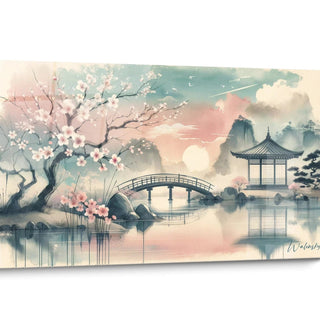
Discover the serenity and beauty of our Japanese City Wall Art collection. Inspired by Japanese landscapes and traditions, each Japanese City Wall Art piece showcases serene temple scenes, blooming cherry blossoms, and vibrant alleyways. This collection combines harmony and aestheticism, bringing a zen and refined atmosphere to your space. A perfect choice for Japanese culture enthusiasts and elegant interior design lovers.
 Lanterns Midnight Glow Wall Art - Japan Edition273,90 €
 Yoshiwara Path of Souls Painting - Japan Edition273,90 €
 Pink Mirror City Painting - Japan Edition228,90 €
 Japanese Artwork No. 3 - Japan Around the World Edition273,90 €
 Japanese Painting No.2 - Japan Edition Around the World273,90 €
 Japanese Painting No.1 - Japan Edition Around the World273,90 €
 Hokusai Painting No. 1 - Japan Around the World Edition273,90 €
 Japanese Cherry Blossom Wall Art No. 1 - Japan Around the World Edition273,90 €
 Japanese Calligraphy Painting No. 1 - Japan Around the World Edition273,90 €
 Japanese Wave Wall Art No. 6 - Japan Around the World Edition273,90 €
 Japanese Wave Painting No. 5 - Japan Around the World Edition273,90 €
 Japanese Wave Painting No. 4 - Japan Around the World Edition273,90 €
 Japanese Wave Wall Art No. 3 - Japan Around the World Edition273,90 €
 Japanese Wave Canvas No.2 - Japan Around the World Edition273,90 €
 Japanese Wave Wall Art No. 1 - Japan Around the World Edition273,90 €
 Japanese Landscape Wall Art No.1 - Japan Around the World Edition273,90 €
 Zen Japanese Painting No.1 - World Around Japan Edition273,90 €
 Japanese Painting No.10 - World Around Japan Edition273,90 €
 Japanese Wall Art N°9 - Japan Around the World Edition273,90 €
 Japanese Wall Art No. 8 - Japan Around the World Edition273,90 €
 Japanese Wall Art No. 7 - Japan Around the World Edition273,90 €
 Japanese Wall Art N°6 - Japan Around the World Edition273,90 €
 Japanese Painting No.5 - Japan Around the World Edition273,90 €
 Japanese Painting No.4 - Japan Around the World Edition273,90 €
In the same family
Also explore the theme Asia


All about Japanese Wall Art
- Presentation Japan Wall Art
- Japan Wall Art Traditional Art
- Wall Art Japan Landscape Iconic
- Japan Wall Art Interior Decoration
Japan wall art represents far more than a simple decorative piece: it is a genuine window into the soul of the Land of the Rising Sun. These mural works capture the very essence of Japanese culture, between timeless tradition and captivating modernity. Whether you are drawn to ukiyo-e prints, representations of Mount Fuji, cherry blossoms, or Tokyo's urban landscapes, a Japan wall art immediately brings a zen atmosphere and refined elegance to your interior.
Paintings inspired by Japan distinguish themselves through their perfect balance between minimalist aesthetics and symbolic richness. These mural works instantly transform your space's ambiance by creating a visual dialogue between East and your Western interior. To discover exceptional pieces that will enhance your decoration, explore our world wall art collection where Japanese art mingles with other international inspirations.
Beyond their visual beauty, Japan wall artworks tell stories, transmit a life philosophy, and create a fascinating cultural bridge. In the following tabs, we will explore the different facets of this unique mural art, guiding you through its distinctive characteristics, ancestral techniques, and integration into contemporary living spaces.
Traditional Japanese Art Transposed into Mural Artworks
The universe of Japan wall art is deeply rooted in centuries-old artistic traditions that have fascinated the Western world for generations. These contemporary mural works draw inspiration from a rich visual heritage dating back to the Edo period and beyond, offering a unique cultural bridge between past and present.
Why do ukiyo-e prints transform a room's atmosphere?
The famous ukiyo-e prints, literally "images of the floating world", constitute one of the major sources of inspiration for contemporary Japan wall art. These representations of everyday scenes, emblematic landscapes, and mythological figures are characterized by their refined lines and balanced compositions. A Japan wall art inspired by ukiyo-e immediately brings a narrative dimension to your space. Unlike Western abstract works, these artworks tell specific stories drawn from Japanese mythology and culture, transforming your wall into a portal to another world.
The particularity of ukiyo-e prints lies in their ability to capture moments suspended in time, a philosophy deeply rooted in Zen culture. By choosing Japan wall art inspired by these techniques, you subtly introduce this notion of impermanence and contemplation into your daily life. The eye is naturally drawn to these compositions where each element finds its rightful place, creating a soothing focal point in any room.
The unique chromatic codes of Japan wall art
One of the distinctive characteristics of Japan wall art is its specific color palette. Far from the bright and saturated hues of certain Western arts, these works often favor natural, delicate, and subtly contrasted tones. The vermillion red of Shinto temples, ancestral indigo blue, tender green of bamboo, or the ephemeral pink of cherry blossoms compose an immediately identifiable chromatic harmony.
This particular colorimetric approach stems from the traditional use of natural pigments in Japanese art. Artisans created their hues from minerals, plants, and other organic materials, resulting in soft yet profound nuances. Contemporary Japan wall art retains this visual signature, even when realized with modern printing techniques. This chromatic subtlety explains why these works integrate harmoniously into virtually all interiors, never appearing garish or discordant.
Japanese calligraphy as a mural decorative element
Calligraphy or "shodo" represents a fascinating aspect of Japan wall art that radically distinguishes it from other decorative works. This art of the stroke, where each brush movement expresses both literal meaning and emotion, transforms writing into pure artistic expression. A Japan wall art incorporating calligraphic elements is more than merely aesthetic - it carries a message, a philosophy, sometimes an entire poem.
Unlike Western typography which prioritizes legibility, Japanese calligraphy celebrates gesture, form balance, and ink dynamics on the support. On Japan wall art, these characters become graphic elements in their own right, appreciable even without understanding their meaning. Kanji ideograms, with their visual complexity, create natural focal points and give unique intellectual depth to your mural decoration.
Traditional printing techniques reinvented
Contemporary Japan wall art often reinterprets traditional printing techniques such as mokuhanga (woodblock printing). This ancestral method, which once required a different wood block for each color, produced works with incomparable textures. Modern reproductions successfully capture this tactile dimension so characteristic, where subtle inking variations and slight imperfections form an integral part of the aesthetic.
Japan wall art inspired by these techniques presents a visual texture impossible to find in other decorative styles. The apparent simplicity conceals remarkable technical complexity, where layer superposition creates fascinating visual depth. This particular quality explains why these works constantly attract the eye and progressively reveal their nuances over time, unlike flat and uniform images of other decorative styles.
The beauty of Japan wall art lies in its ability to transcend the simple decorative role to become a genuine object of contemplation and visual meditation. These mural works do not simply dress up a space - they fundamentally transform our relationship with it, inviting us to adopt a more attentive, patient, and conscious gaze toward the subtleties surrounding us.
Japan's Emblematic Landscapes Transcended into Mural Artworks
Japan wall art representing emblematic landscapes constitutes a particularly sought-after category, capable of instantly transforming an interior's atmosphere. These iconic representations capture the very essence of the Japanese archipelago, between majestic nature and perfect harmony, offering far more than simple mural decoration.
Mount Fuji: why does its silhouette fascinate collectors so much?
Mount Fuji's majestic silhouette represents undoubtedly the most recognizable element of landscape Japan wall art. This sacred mountain, with its perfectly symmetrical summit often crowned with snow, transcends its status as a geographic landmark to become a global cultural icon. Japan wall art featuring Fuji-san immediately brings a spiritual dimension to your space, evoking simultaneously natural power and contemplative serenity.
Unlike Western mountain representations that often prioritize dramatic realism, Mount Fuji in Japanese art is treated with characteristic stylization. Its perfect proportions, simplified yet immediately recognizable, create a unique visual balance explaining why these artworks function remarkably as focal points in any room. The mountain appears sometimes imposing in the foreground, sometimes as a distant yet omnipresent element on the horizon, reflecting the Japanese philosophy of ma - that meaningful space between elements.
Seasonal variations of Mount Fuji offer radically different atmospheres on Japan wall art. Cherry blossoms in the foreground evoke spring renewal, while winter representations create a contemplative meditative atmosphere. This versatility explains why these works adapt to different living spaces, from dynamic living rooms to soothing bedrooms.
Zen gardens as visual metaphors for inner balance
Representations of zen or karesansui gardens constitute another fundamental theme of Japan wall art. These minimal compositions, where carefully arranged rocks, raked gravel, and sparse vegetation create evocative abstract landscapes of remarkable power. Japan wall art featuring these philosophical gardens is more than aesthetically pleasing - it invites meditation and reflection.
Unlike Western garden representations that often celebrate floral abundance and complexity, the Japanese zen garden values restraint and suggestion. In Japan wall art, lines of raked gravel symbolize water or waves, while rocks evoke mountains or islands. This controlled abstraction creates a work functioning simultaneously as decoration and meditation support.
The particularity of Japan wall art representing a zen garden lies in its ability to visually calm the space where it is displayed. Environmental psychology research has demonstrated that simple contemplation of these ordered geometric patterns can significantly reduce stress and promote concentration. This explains why these works are particularly recommended for work spaces or bedrooms.
Seasonal influence in Japanese landscape wall artworks
Seasons occupy a preponderant place in Japanese culture, and this temporal sensitivity beautifully reflects in landscape Japan wall art. Unlike the Western approach which often represents nature in its permanence, Japanese art celebrates impermanence and seasonal transitions, creating mural works that resonate differently depending on the time of year.
Spring Japan wall art with cherry blossoms (sakura) symbolizes the ephemeral beauty of existence, recalling the philosophy of mono no aware - that gentle melancholy facing the impermanence of things. Autumn representations, with their flame-colored maple leaves, evoke the beauty of decline and the nobility of time's passage. This philosophical dimension gives Japan wall art a conceptual depth rarely present in other decorative styles.
Snow, a recurring element in winter Japan wall artworks, perfectly illustrates the yuki-mi aesthetic (snow contemplation). Far from being simply a climatic element, it becomes revealing of forms, transforming familiar landscapes into minimal elegant abstract compositions. Japan wall art representing a snow-covered temple or garden brings an immediate sensation of calm and visual silence, particularly welcome in our contemporary interiors often overloaded with stimulation.
Historic urban landscapes as cultural testimonies
Beyond natural landscapes, Japan wall art representing historic urban scenes - traditional villages, ancient Kyoto quarters, Edo period streets (old Tokyo) - offer a fascinating immersion into Japanese architectural history. These works capture atmospheres now obsolete or threatened by modernization, becoming precious cultural testimonies.
The particularity of these representations lies in their perspective treatment, fundamentally different from Western conventions. Traditional Japanese art often uses what is called "plunging perspective" or "bird's-eye view", where multiple viewpoints coexist harmoniously. This approach creates Japan wall art that simultaneously reveals different facets of the same place, offering an immersive visual experience impossible to achieve with classic linear perspective.
These urban Japan wall artworks also reveal the unique relationship between architecture and nature in Japanese culture. Unlike Western representations where buildings and nature often form distinct entities, Japanese art shows them in constant interaction - bridges spanning peaceful rivers, tea houses nestled beneath maples, temples subtly emerging from morning mist. This harmonious integration explains why these works bring both visual dynamism and sense of balance.
Integrating Japan Wall Art into Your Interior Decoration: Art and Harmony
Japan wall art represents far more than a simple decorative element; it is a masterpiece capable of radically transforming an interior's ambiance. Its singular aesthetic, between minimalism and symbolic depth, offers unique arrangement possibilities that transcend ephemeral decoration trends.
How does the Japanese "ma" concept influence ideal artwork positioning?
The Japanese concept of "ma" - that meaningful space between elements - constitutes a fundamental key to understanding optimal integration of Japan wall art into your interior. Unlike Western approaches that sometimes tend to saturate walls, Japanese aesthetics values negative spaces, considered not as voids to fill but as active elements of spatial composition.
Japan wall art gains visual impact when surrounded by breathing space. Ideally, it should be installed on a partially bare wall, where it can harmoniously dialogue with the emptiness surrounding it. This approach, radically different from dense gallery walls, allows the work to radiate fully and exercise its soothing influence throughout the room. This is precisely this interaction between presence and absence that creates the characteristic zen atmosphere of Japan-inspired interiors.
Large-format Japan wall artworks particularly benefit from this spatial approach. Unlike Western artworks that can sometimes seem overwhelming in large formats, Japanese compositions, with their intrinsic balance between fullness and emptiness, flourish in vast mural spaces. A monumental Japan wall art thus becomes a room's natural focal point without ever overloading it visually.
Element harmonization: which associations to prioritize with Japan wall art?
Successful integration of Japan wall art into your interior decoration rests on subtle harmonization with other elements of your space. Natural materials like light wood, bamboo, stone, or plant fibers naturally resonate with Japanese aesthetics. A sofa with refined lines, a raw wood coffee table, or washi paper luminaires constitute ideal companions for your artwork.
Unlike eclectic Western interiors that often juxtapose varied styles, the Japanese approach privileges coherence and harmony. Japan wall art particularly flourishes in environments with neutral tonalities - off-white, beige, soft gray - that allow the artwork's colors to express themselves fully without visual competition. This restrained chromatic palette creates an ideal backdrop where each element naturally finds its place.
Lighting also plays a crucial role in showcasing Japan wall art. Unlike direct and intense lighting often used in Western galleries, favor soft and indirect light that will subtly reveal the work's nuances and textures. Lateral light sources, inspired by traditional washi paper windows, create shadows and light variations that harmoniously dialogue with Japanese aesthetics.
Feng shui principles applied to Japanese-inspired wall artworks
Although feng shui originates in China, its energy harmonization principles find particular resonance with Japan wall art, creating fascinating decorative synergies. According to this philosophy, landscape representations exercise subtle yet profound influence on the energy circulating in our living spaces.
Japan wall art depicting water - peaceful waterfalls, rivers serpentining between mountains, calm ocean at Mount Fuji's base - will bring fluid and soothing energy, particularly beneficial in spaces dedicated to relaxation. Placed in a living room or bedroom, this theme favors harmonious communication and relationship depth, while calming accumulated daily tensions.
Conversely, Japan wall art representing more dynamic elements - bamboo forests, cherry blossom branches, dramatic waves Hokusai-style - will instill more vibrant energy, ideal for spaces where creativity and vitality are sought. These representations perfectly suit offices, studios, or reception spaces where stimulating exchanges and inspiration are desired.
Vertical space valorization: kakemono specificity in contemporary decoration
The vertical format of kakemonos (hanging scrolls) constitutes one of the most authentic expressions of Japan wall art. This configuration, radically different from the horizontal formats dominating Western art, offers unique decorative possibilities for contemporary spaces, often characterized by high ceilings and narrow walls.
Unlike horizontal artworks that establish a relationship with the horizon, the kakemono creates a visual connection between sky and earth, between top and bottom. This accentuated verticality naturally guides the viewer's gaze in ascending or descending movement, inducing a particular contemplative experience. In a narrow hallway, staircase, or transition space, this vertical format transforms an architectural constraint into a decorative opportunity.
The kakemono's visual lightness, often realized in silk or thin paper, contrasts with the massiveness of traditional Western frames. This ethereal quality allows vertical Japan wall art to integrate harmoniously even in small spaces, creating a sensation of openness and depth where a conventionally framed artwork might seem cumbersome.
FAQ: Everything you need to know about Japan wall art
What is the difference between an ukiyo-e and modern Japan wall art?
Ukiyo-e specifically designates traditional Japanese prints produced between the 17th and 19th centuries, realized by woodblock printing and characterized by daily life themes, particular perspectives, and multicolor printing techniques. Modern Japan wall art visually inspires from these traditions but generally uses contemporary printing or painting techniques, allowing better preservation and adaptation to current interiors. The aesthetic spirit remains similar, but materials and processes have evolved.
How to properly maintain Japan wall art to preserve its colors?
To preserve the vibrancy and subtlety of Japan wall art colors, avoid its direct exposure to sunlight which accelerates fading. Prioritize placement away from heat sources and excessive humidity. Regular dusting with a soft feather duster or dry microfiber cloth generally suffices for maintenance. For particularly precious or historic works, installing UV-protective glass can offer additional protection while preserving the visual experience.
What are the ideal dimensions for Japan wall art in a modern living room?
In a contemporary living room, large-format Japan wall art (120cm × 80cm minimum) creates maximum visual impact and allows full appreciation of the subtle details characteristic of this art. This substantial size allows the artwork to function as an architectural element in itself, transforming the room's overall ambiance. For more restricted spaces, prioritize vertical format (90cm × 60cm) which maximizes visual impact while occupying reduced mural surface. The essential point is for the artwork to be proportioned to your space without visually overwhelming it, thus respecting the Japanese principle of "ma".
Further reading


