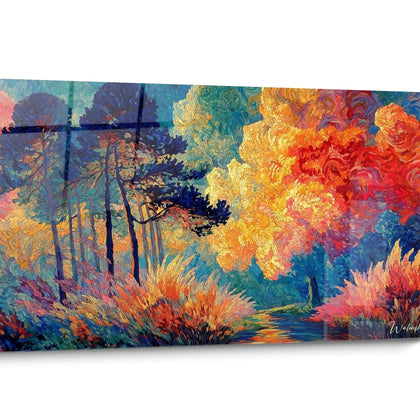
The pointillism landscape painting represents the culmination of divisionist technique applied to natural panoramas. This pictorial approach fragments the perception of vegetation, aquatic and celestial expanses into thousands of juxtaposed colored dots. Each composition transforms your space into a contemplative window where light seems to vibrate organically. The monumental formats we offer amplify this chromatic decomposition to create a captivating visual presence in contemporary volumes. The particularity of these works lies in their ability to modify the luminous ambiance of a room according to the angle of observation and ambient lighting. Unlike traditional representations, landscape pointillism generates an optical depth that constantly evolves under the viewer's gaze.
The optical vibration of divisionist horizons
A pointillism landscape painting transcends simple mimetic representation to generate a dynamic visual experience. The divisionist technique decomposes each natural element into pure chromatic particles that recompose in the observer's retina. This fragmentation creates an atmospheric luminosity impossible to reproduce with traditional pictorial techniques.
How does chromatic juxtaposition amplify spatial depth?
Pointillist masters applied the theory of simultaneous contrasts to construct their landscapes. Each orange dot placed near a blue dot mutually intensifies their saturation. In monumental compositions, this interaction multiplies exponentially, generating an atmospheric depth that seems to breathe. The successive planes of a pointillist meadow are layered by gradations of chromatic density rather than linear gradients.
The shimmering effect of divisionist aquatic expanses
Reflective surfaces constitute the terrain of excellence for landscape pointillism. A lake rendered by juxtaposed dots captures the complexity of changing reflections with remarkable analytical precision. Solar glimmers on water translate into concentrations of yellow-white dots surrounded by blue-violet halos. This optical mosaic restores the moving character of the liquid element with superior perceptual fidelity.
The atmospheric dissolution of distant views
In a large-scale pointillism landscape painting, mountainous or forested backgrounds benefit from particular treatment. The density of dots progressively decreases while unpainted interstices increase, mimicking the effect of atmospheric veil. This technique creates a sensation of measurable physical distance, as if the air itself became visible between the observer and the horizon. Tints gradually cool toward blues and purples, amplifying this aerial perspective.
Monumental pointillist landscape works also develop a unique relationship with the natural light of interiors. Depending on the time of day, certain chromatic zones activate differently, creating subtle variations in reading the composition. This living quality transforms each viewing into a renewed experience, far from the static nature of conventional reproductions.
Chromatic architecture of pointillist ecosystems
What specificities does vegetation treated by colored dots present?
The representation of foliage constitutes the ultimate test of landscape pointillism. A tree is constructed by accumulation of hundreds of green dots of different shades, interspersed with yellows, oranges and blues. This chromatic complexity reproduces the real optical effect of light filtering through vegetation strata. The monumental formats allow appreciation of this granularity down to microscopic detail, revealing unequaled textural richness.
Pointillist wildflower meadows offer a controlled explosion of colored particles where each plant species translates into a specific chromatic constellation. Poppies become red-orange nebulae punctuated with deep blacks, while cornflowers emerge through aggregations of cyan and ultramarine dots. This quasi-scientific organization of color paradoxically creates an impression of natural spontaneity.
The structuring of skies through chromatic stratification
A pointillism landscape painting often accords major importance to celestial treatment. Twilight skies are constructed through horizontal bands of dots gradually metamorphosed from golden yellow to deep violet. This chromatic progression obeys the physical laws of atmospheric light diffusion, conferring scientific credibility to the aesthetic effect. Clouds materialize through local densifications of white and gray dots, allowing the azure base to show through.
How are seasons expressed in the divisionist approach?
Autumn pointillist landscapes explode in orange and purple symphonies where each leaf becomes a pretext for chromatic variation. The technique allows juxtaposing warm and cool tones in a proximity that would defy traditional mixing. Pointillist winter plays with off-whites, pale blues and violet-grays to render the particular luminosity of snowy atmospheres. These winter compositions emanate a luminous coldness that effectively contrasts with warm interior ambiances.
Spring translates into a predominance of tender greens punctuated by floral pinks and whites, creating a sensation of vibrant renewal. This specific palette energizes living and working spaces. For those exploring the possibilities of pointillism beyond figurative representations, the abstract pointillism painting offers compositions where the divisionist technique liberates itself completely from mimetic constraint.
Monumental presence and spatial impact of divisionist landscapes
Why do large formats amplify the pointillist effect?
A pointillism landscape painting of imposing dimensions radically transforms the spatial perception of an environment. The multiplication of colored dots over an extended surface creates an immersive visual field where the gaze can travel between microscopic detail and overall vision. This perceptual duality generates lasting fascination, each observation revealing new chromatic interactions previously unnoticed.
Monumental compositions also allow appreciation of the technical prowess inherent to the divisionist method. The discipline required to maintain chromatic coherence over extended surfaces fully reveals itself in these ambitious formats. The observer becomes aware of the analytical work behind each zone, reinforcing the emotional impact of the work. This contemplative dimension is particularly suited to spaces dedicated to reflection or relaxation.
The architectural integration of pointillist panoramas
Contemporary spaces with generous volumes and streamlined lines find in the pointillism landscape painting an ideal organic counterpoint. The visual complexity of the divisionist technique softens minimalist rigor without breaking overall harmony. White or light gray walls constitute perfect neutral screens to reveal the subtlety of pointillist chromatic interactions. The abundant natural luminosity of modern architectures activates the optical properties of colored juxtaposition.
What visual experience do pointillist landscapes offer in daily life?
Unlike static works, a divisionist landscape evolves perceptively according to lighting conditions and observation distance. In the morning, raking light may privilege certain chromatic ranges, while afternoon reveals other harmonies. This variability transforms the work into a living element of the space, establishing renewed dialogue with its occupants. Visitors often discover previously unseen details with each viewing, maintaining aesthetic interest over the long term.
Large-scale pointillist formats also function as visual regulators in multifunctional spaces. Their complexity naturally captures attention without imposing directive narration, suiting both residential and professional environments. The thematic neutrality of landscape, combined with the technical richness of pointillism, creates a sophisticated and soothing decorative presence.
Is a pointillism landscape painting suitable for spaces with dominant artificial lighting?
Absolutely. Contemporary LED lighting with neutral color temperature reveals the chromatic subtleties of pointillism excellently. The essential factor resides in sufficient luminous intensity to activate simultaneous contrasts between adjacent colored dots.
How does the pointillism landscape painting influence the perceived acoustics of a space?
Although having no physical acoustic properties, the visual density of a pointillist composition psychologically creates an impression of absorption, contributing to a sensation of intimacy even in generous volumes. This perception softens the austerity of minimalist spaces.
What is the optimal observation distance for a monumental pointillism landscape painting?
The divisionist technique generates two distinct experiences: up close, the abstraction of individual dots will fascinate analytical observers; from afar, optical recomposition reveals landscape coherence. A distance equivalent to 1.5 times the diagonal of the work allows simultaneous appreciation of both dimensions.


 River Landscape Painting Solitary Boat - pointillism edition233,90 €
 Landscape Tree Contemplation Painting - Pointillism Edition233,90 €
 Autumn Landscape with Impressionist Touches - Pointillism Edition233,90 €
 Twilight Landscape Painting Brilliant - Pointillism Edition233,90 €
 Lacustrine Landscape Painting Floral Mirror - Pointillism Edition233,90 €
 Autumn Landscape Painting Warm Emotion - Pointillism Edition233,90 €
 Forest Landscape Painting Scarlet Flowers - Pointillism Edition233,90 €
 Autumn Landscape Painting Colorist Reverie - Pointillism Edition233,90 €
 Sunset Painting Fire Dots - Pointillism Edition233,90 €
 Golden Shimmer Landscape Painting - Pointillism Edition233,90 €
 Autumn Landscape Painting Turbulent Clouds - Pointillism Edition233,90 €
 Autumn Landscape Painting Colorist Magic - Pointillism Edition233,90 €
 Forest Enchanted Atmosphere Painting - Pointillism Edition233,90 €
 Vibrant Sunset Landscape Painting - Pointillism Edition233,90 €
 Urban Sunset Painting Flaming Pixels - pointillism edition233,90 €
 Maritime Landscape Painting Emerald Shimmer - pointillism edition233,90 €
 Landscape Painting Vegetation Harmony - pointillism edition233,90 €
 Landscape Painting Dancing Light - Pointillism Edition213,90 €
 Sunset Painting Undulating Reflections - Pointillism Edition213,90 €
 Lake Landscape Painting Autumn Mirror - Pointillism Edition213,90 €
 Marine Landscape Impressionist Emotion Painting - Pointillism Edition213,90 €
 Vibrant Horizon Landscape Painting - Pointillism Edition213,90 €
 Forest Starry Night Painting - Pointillism Edition233,90 €
 Mediterranean Landscape Painting Provence Warmth - Pointillism Edition233,90 €