


White Lady Painting
The White Lady, a recurring spectral figure in European folklore, glides through our collection across castles and isolated roads. This feminine spectral apparition dressed in white appears in numerous regional legends, often linked to romantic or family tragedies. Our artistic creations capture the melancholic elegance and mysterious aura of these phantom ladies. These wall artworks evoke the gothic atmosphere of European local legends, bringing a touch of romantic mystery and folkloric heritage to the oral traditions that have crossed centuries throughout Europe.
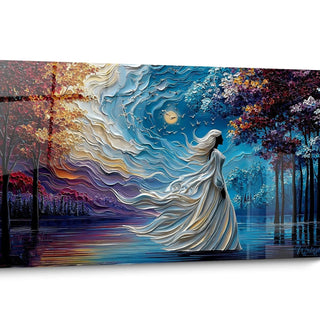
 Mystical White Lady Painting by the Lake - Ethereal Symphony - White Lady Edition273,90 €
 White Lady Painting by the Lake - Autumn Mystery - White Lady Edition273,90 €
In the same family
Also explore the theme Myth and Legends
-
 View all332
artworks
View all332
artworks
-
 Apollo2
artworks
Apollo2
artworks
-
 Other Myths and Legends14
artworks
Other Myths and Legends14
artworks
-
 Banshee2
artworks
Banshee2
artworks
-
 Bigfoot2
artworks
Bigfoot2
artworks
-
 Chupacabra2
artworks
Chupacabra2
artworks
-
 Dragon142
artworks
Dragon142
artworks
-
 Icarus1
artwork
Icarus1
artwork
-
 Kraken3
artworks
Kraken3
artworks
-
 Lilith1
artwork
Lilith1
artwork
-
 Mokele-Mbembe3
artworks
Mokele-Mbembe3
artworks
-
 Narcissus5
artworks
Narcissus5
artworks
-
 Pégase27
artworks
Pégase27
artworks
-
 Shiva62
artworks
Shiva62
artworks
-
 Ulysses1
artwork
Ulysses1
artwork
-
 Wendigo1
artwork
Wendigo1
artwork
-
 Yeti2
artworks
Yeti2
artworks
-
 Zeus1
artwork
Zeus1
artwork


All about White Lady Painting
- White Lady Painting White Lady
- Lady Painting White: Spectral Atmosphere
- White Lady Painting: Folkloric Legends
- White Lady Painting: Gothic Universe
A White Lady painting instantly transforms your interior by evoking one of the most mysterious figures in European folklore. This legendary apparition, anchored in medieval tales and ancestral gatherings, inspires today's monumental wall creations that captivate through their narrative dimension and enchanting aesthetic. Acquiring a mural representation of this spectral entity means inviting into your home a fragment of history, a piece of mystery that dialogues with our fascination for the unexplained and the supernatural.
The Spectral Atmosphere of a White Lady Painting in Your Space
A White Lady painting generates an enigmatic presence that transcends mere wall decoration. This phantasmagorical representation immediately establishes an atmosphere charged with contradictory emotions: fascination and apprehension, ethereal beauty and subtle unease. The imposing formats available today dramatically amplify this effect, allowing the vaporous silhouette to dominate the space and exert a tangible influence on the room's overall ambiance.
How does a White Lady representation modify the perception of a space?
The psychological impact of large-scale spectral imagery should never be underestimated. Unlike peaceful or abstract scenes, a White Lady painting establishes creative tension in the environment. The gaze is immediately captured by this diaphanous apparition, creating a focal point that commands attention while generating a subtle yet fascinating unease. This emotional duality transforms a living room or library into a place of intense contemplation, where visitors cannot help but seek details of the partially veiled face or the ghostly folds of draped fabric.
Spaces dedicated to personal reflection particularly benefit from this spectral presence. A studious office gains a meditative dimension when a white lady silhouette seems to watch from the wall. The atmosphere becomes conducive to writing, artistic creation, or philosophical reflection. This legendary entity, suspended between two worlds, paradoxically encourages deep concentration by establishing a symbolic boundary between trivial daily life and a preserved mental space.
The luminous contrast effects inherent to spectral representations
The particularity of a White Lady painting lies in its masterful use of chromatic contrasts. The evanescent figure typically stands out against dark or nocturnal backgrounds, creating a natural luminescence effect that seems to defy physical laws. This phantasmagorical brilliance attracts the eye even in dimness, conferring on the room an almost living dimension when ambient light decreases. Imposing formats amplify this visual phenomenon, transforming an entire wall into a portal to the strange and marvelous.
The interaction between natural lighting and a white lady representation evolves throughout the day. At dawn's first light, the silhouette seems to gradually vanish, as if the apparition returns to its shadowy realm. At dusk, it regains vigor, its presence asserting itself with increasing intensity. This daily cycle creates a dynamic decorative experience, where the artwork constantly dialogues with its luminous environment, never presenting exactly the same appearance.
Spatial arrangement around a phantasmagorical presence
Integrating a large-scale representation requires rethinking the organization of surrounding space. The zone directly facing a White Lady painting naturally becomes a place of slowed passage, where occupants mark an instinctive pause. This characteristic allows creation of spaces for mental transition between different functional zones in a home. A hallway leading to bedrooms, for example, becomes a symbolic threshold when a spectral apparition marks its entrance.
Adjacent furniture must respect the emotional intensity of the artwork. Elements too colorful or exuberant would conflict with the solemnity of the white lady. Instead, prioritize:
- Dark wood bookshelves laden with ancient volumes reinforcing the timeless atmosphere
- Deep velvet armchairs inviting prolonged contemplation facing the apparition
- Variable-intensity lighting allowing modulation of spectral presence according to moments
- Antique mirrors with patined frames subtly multiplying the phantasmagorical presence
Which spaces benefit most from a legendary presence?
Certain rooms naturally lend themselves to hosting representations of myths and legends. Personal libraries become sanctuaries of occult knowledge under the benevolent gaze of a spectral figure. Music rooms, where melancholic melodies resonate, perfectly accord with the ethereal presence of a white lady. Guest bedrooms meant for visitors appreciating particular atmosphere acquire memorable identity through this enigmatic presence.
Semi-private spaces like staircase landings or vestibules transform into mystery-laden places. The white lady, silent guardian of thresholds, seems to watch over passages between different life spaces. This symbolic function adds narrative depth to domestic architecture, creating an emotional geography within the very habitat. Each crossing becomes a micro-adventure, a conscious passage between different states of mind.
The immersive dimension of monumental formats
Today's large-scale representations enable total immersion in the legendary universe. When a phantasmagorical silhouette extends over several meters, it ceases being a simple decorative element to become a complete sensory experience. The viewer no longer looks at an image; they penetrate its narrative space, they temporarily share the apparition's realm. This monumental scale suits rooms with high volume particularly, where elevated ceilings allow the spectral figure to deploy its full disquieting verticality.
The presence effect intensifies considerably with dimensions. A white lady represented at human size or greater establishes an almost physical rapport with room occupants. One no longer passively contemplates a distant legend; one cohabits with it, feels its proximity. This daily cohabitation with the legendary gradually transforms perception of domestic space, becoming a place where the marvelous borders the everyday, where boundaries between real and imaginary fade delightfully.
The Legendary Narratives Evoked by a White Lady Painting
Each White Lady painting is far more than simple visual representation: it is a narrative condensate that instantly reactivates centuries of European oral tradition and folklore. These spectral apparitions have populated gatherings since the Middle Ages, transmitted generation to generation with their regional variants and local interpretations. Hanging such a representation means inscribing yourself in this uninterrupted chain of storytellers and listeners fascinated by the mysteries of the beyond.
Why do white lady legends traverse the centuries?
The permanence of these narratives is explained by their capacity to crystallize universal anxieties while offering melancholic beauty. The white lady simultaneously embodies loss, unfinished grief, unrendered justice, and eternal love. These themes resonate across epochs, adapting to contemporary preoccupations without losing their original essence. A painting representing this legendary figure keeps this narrative tradition alive while inscribing it in a modern domestic context.
Regional variants offer exceptional narrative richness. The white lady of French châteaux subtly differs from that of Scottish manors or Germanic fortresses. Some are messengers of imminent misfortune; others are benevolent guardians watching over ancestral lineages. Owning a large-scale artistic representation allows visual exploration of these nuances, with each compositional detail referring to a specific tradition, a particular narrative anchored in precise legendary geography.
Haunted châteaux and ancestral manors as narrative setting
A White Lady painting immediately evokes the centuries-old dwellings where these apparitions are traditionally reported. Gothic architecture, deserted corridors with faded tapestries, stone staircases worn by centuries of passage form the natural setting for these manifestations. Integrating such an artwork into contemporary interiors creates a fascinating temporal bridge, as if a medieval history fragment invited itself into the present.
This association with history-laden places confers particular depth to modern spaces. An urban loft or contemporary home suddenly acquires artificial memory, fictional yet emotionally powerful temporal thickness. Owners become temporary keepers of a legend, depositaries of a narrative that surpasses them. This narrative dimension considerably enriches daily habitat experience, transforming each glance toward the artwork into a reminder of mythic permanence beyond ephemeral fashions.
How does a spectral representation nourish personal imagination?
Living daily with a white lady figuration powerfully stimulates narrative creativity. Unlike fixed scenes or abstractions, this legendary presence invites personal story elaboration. Who was she in life? What tragedy condemned her to eternal wandering? What message does she seek to transmit? These questions naturally arise, encouraging intimate storytelling where each person weaves their own legend version.
Imposing available formats considerably reinforce this narrative engagement. A monumental representation cannot be ignored; it demands mental interaction. Details become clues: the partially visible face expression, spectral gaze orientation, diaphanous hand position. Each element can be interpreted, integrated into personal narrative threads that evolve over time. The artwork becomes thus a creative meditation support, a permanent story generator.
Fantastical literature incarnated on your walls
Devotees of gothic and fantastical literature find in a White Lady painting the visual incarnation of their favorite readings. Atmospheres cultivated by Ann Radcliffe, Edgar Allan Poe, or Sheridan Le Fanu take tangible form. The spectral presence instantly evokes most memorable scenes: nocturnal apparitions, supernatural revelations, ancestral secrets emerging from the past to haunt the present.
This literary connection considerably enriches the location's cultural experience. A personal library rich in gothic novels naturally dialogues with mural representation. Fantastical devotees immediately recognize the homage to this literary genre and can engage in in-depth conversations about different literary incarnations of white ladies. The space thus becomes a place of shared culture, where common references create bonds between admirers of the strange and marvelous.
Contemporary gatherings and modernized oral transmission
Owning a White Lady painting of great dimension paradoxically reactivates ancestral oral transmission tradition. Evening gatherings among friends become occasions to share legend regional variants, each bringing their local or family version. The artwork serves as conversational catalyst, naturally inviting tales of strange manifestations, unexplained experiences, troubling coincidences. These exchanges recreate, in modern context, the atmosphere of ancestral gatherings where storytellers captivated their audiences.
Children and adolescents present during these gatherings develop particular sensitivity to legendary narratives. The permanent visual presence of the white lady anchors these cultural transmission moments in their memory. Unlike ephemeral stories, the mural artwork persists, daily reminding that legends form an integral part of our collective heritage. This informal education in the marvelous and legendary constitutes precious counterbalance to excessive contemporary rationalization.
- Direct evocation of medieval and renaissance oral traditions
- Stimulation of narrative imagination and personal storytelling
- Tangible connection with classic fantastical and gothic literature
- Support for intergenerational transmission of legendary narratives
Integrating a White Lady Painting into a Gothic-Romantic Decorative Universe
A White Lady painting constitutes the ideal centerpiece for a gothic-romantic decorative environment. This aesthetic, far from being a mere passing trend, represents profound cultural sensibility valuing melancholic beauty, attraction to mystery, and serene acceptance of human finitude. Available imposing formats allow structuring an entire space around this spectral presence, creating remarkable visual and emotional coherence.
Which decorative elements harmoniously accompany a spectral apparition?
The environment surrounding a white lady representation must respect its emotional intensity without competing. Textures play a primary role: deep velvets, antique laces, time-patined wood create tactile dialogue with spectral figure evanescence. The contrast between material furniture solidity and apparition immateriality paradoxically reinforces each element's presence.
Antique object collections naturally find their place in this universe. Pendulum clocks whose regular tick-tock punctuates silence, tin or blackened silver candelabras, bevel-edged mirrors with slightly distorted reflections: each piece contributes to thickening temporal atmosphere. These history-bearing objects dialogue with the legendary figure, suggesting each potentially possesses its own phantasmagoric narrative, its buried secrets. Measured accumulation of these elements progressively transforms space into personalized curiosity cabinet.
The chromatic palette of an elegant haunted interior
A White Lady painting naturally imposes chromatic restriction that swiftly becomes major aesthetic asset. Gray nuances, from palest to deepest, constitute this palette's backbone. Ivory white touches recall spectral luminescence, while ebony blacks create necessary contrasts. This chromatic sobriety is hardly austere; it reveals instead rare sophistication, timeless elegance surviving contemporary decorative trend caprices.
Color accents, when introduced, must be chosen discerningly. Deep burgundy, dark forest green, midnight blue, or plum violet integrate harmoniously without breaking atmospheric unity. These saturated hues, used sparingly in textiles or accessories, enrich the palette without ever dominating. They function as earthly reminders facing the ethereal apparition, anchoring space in material reality while maintaining its opening toward the unreal.
Lighting as narrative element in spectral environment
The light management of a space housing a white lady representation demands sophisticated creative approach. Multiple, modifiable light sources allow radical atmosphere transformation according to daily moments and activities. Variable-intensity wall sconces create shadow zones conducive to mystery, while directional accent lamps generate theatrical contrasts.
Indirect lighting deserves particular attention. Concealed sources behind furniture or in corners project diffuse luminosity seeming to emanate from space itself rather than specific points. This approach amplifies white lady presence by creating ambient coherent with her evanescent nature. The entire room then participates in the spectral experience, every corner potentially inhabited by suggestive shadows, every reflecting surface subtly multiplying presences.
How do thematic collections strengthen the legendary universe?
Gothic culture and medieval history enthusiasts find in a White Lady painting the ideal focal point for organizing their collections. Ancient fantastical literature volumes, medieval engraving reproductions, Victorian macabre art objects: these elements naturally converge around the spectral presence. Spatial organization then becomes visual narration where each object enriches the global narrative.
Available monumental formats allow establishing clear visual hierarchy. The white lady naturally dominates the space, while secondary collections deploy in echo, creating satellite thematic constellations. This organization avoids visual confusion while maintaining detail richness for attentive gazes. Visitors progressively discover creation's narrative strata, each observation revealing new elements, new connections between different collection pieces.
Textiles and their textures in gothic-romantic atmosphere
Textile materials play fundamental role in creating atmosphere coherent with a White Lady painting. Thick velvets absorb sound and light, creating muffled acoustics conducive to contemplation and recollection. Antique laces with complex patterns evoking spectral veils establish direct dialogue with the legendary figure. Dark brocades with stylized vegetative motifs recall tapestries adorning haunted châteaux in tradition.
Textile layering creates remarkable visual and tactile depth. Heavy curtains with generous folds, multiple pillows with varied textures, rugs with complex patterns: these successive strata build enveloping, nearly protective environment facing fascinating unease generated by spectral presence. This material richness intentionally contrasts with apparition immateriality, underlining through opposition her ethereal nature.
What is the best way to balance modern comfort and gothic aesthetic?
Integrating gothic-romantic universe into contemporary habitat requires reconciling atmospheric authenticity with modern functionality. Current technologies easily hide behind antique façades: invisible integrated audio systems diffusing romantic compositions, connected lighting reproducing candleflame dance, silent thermal regulation maintaining optimal comfort. This technological discretion preserves ambient integrity without sacrificing contemporary advantages.
Furniture can similarly merge epochs and functionalities. Neo-gothic design armchairs integrating modern ergonomic seating, medieval-lined bookshelves equipped with discrete LED lighting, tables with patined tops concealing charging ports: these successful hybridizations allow fully living in aesthetically coherent universe without renouncing comfort. The objective consists of creating space where the legendary presence of the painting naturally cohabits with modern daily life.
Does a White Lady painting suit formal reception spaces?
Absolutely. Large-scale spectral representation confers memorable and distinguished identity to reception rooms. Guests long remember the unique atmosphere created by this legendary presence, instantly elevating conversations toward deeper, culturally richer subjects.
What minimum area to recommend for harmoniously integrating a monumental representation?
Imposing formats require consequent volumes for fully deploying their impact. Count ideally 25 to 30 square meters minimum for very large representation to breathe without crushing space. Elevated ceilings (minimum 2.80 meters) considerably amplify spectral presence effect.
How to prevent a gothic universe from becoming oppressive daily?
Balance lies in light modulation and visual breathing. Preserve chromatic breathing zones with clear surfaces, integrate plants with dark foliage (ferns, ivies) that lighten without breaking atmosphere, and prioritize variable lighting enabling intensity adaptation according to needs and moment mood.
Do white lady representations accord with other legendary themes?
Perfectly. The white lady harmoniously cohabits with other European folklore figures: fantastical creatures, mythological scenes, dark tale characters. This measured thematic accumulation creates coherent personal legendary universe, transforming habitat into narrative gallery where different folkloric traditions dialogue.
- Aesthetic coherence between gothic elements and monumental spectral presence
- Restricted chromatic palette valuing contrasts and subtle nuances
- Discreet modern technology integration preserving atmospheric authenticity
- Rich textiles creating tactile and visual depth dialoguing with the ethereal


