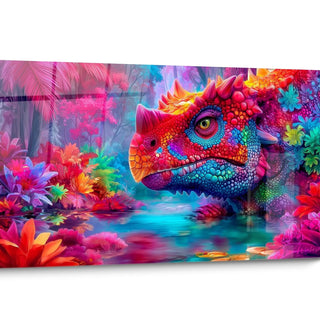
- Overview Quetzalcoatlus Wall Art
- Quetzalcoatlus Wall Art - Wingspan and Dimensions
- Quetzalcoatlus Wall Art - Paleontological Realism
- Quetzalcoatlus Wall Art - Cretaceous Atmosphere
Discover our Quetzalcoatlus wall art, a spectacular representation of the most imposing flying reptile ever to soar through the skies of the Late Cretaceous. This mural artwork captures the majesty of this giant pterosaur that dominated prehistoric landscapes 68 million years ago. With a wingspan exceeding that of a modern fighter jet, Quetzalcoatlus northropi fascinates paleontology enthusiasts and prehistoric animal art lovers alike. Our collection of decorations of ancient lands transports you into the extraordinary universe of extinct giants, transforming your interior into a true paleontological gallery.
The Monumentality of Quetzalcoatlus Wall Art: When Prehistoric Dimensions Meet Mural Art
Acquiring a Quetzalcoatlus wall art raises a fascinating question: how can we adequately represent on a wall the largest flying animal of all time? Unlike representations of mythological creatures whose proportions remain fictional, Quetzalcoatlus northropi possesses real dimensions verified by fossils discovered in Texas in the Javelina geological formation. This azhdarchid pterosaur reached a wingspan between 10 and 11 meters, equivalent to the width of a basketball court.
How Do the Giant Proportions of Quetzalcoatlus Transform Your Wall Space?
The mural representation of this flying reptile creates a unique perspective effect. When you install a large format depicting this azhdarchid in full flight, its deployed wings generate incomparable spatial dynamics. Visitors experience a sensation of vertigo proportional to this aerial predator whose silhouette evokes that of a winged giraffe. Panoramic formats become essential to faithfully restore the characteristic elongation of its enormous neck and streamlined beak devoid of teeth.
Paleo-art collectors specifically seek generous dimensions for these representations, as reducing the Quetzalcoatlus to a modest format would betray its very essence. A large format allows detailing of the veined wing membranes that stretched between its hypertrophied fingers and posterior limbs, an anatomical structure that radically differentiates it from current birds. This imposing scale dialogues with contemporary architecture, creating a striking temporal contrast between modernity and prehistory.
What Wall Display for a Cretaceous Giant?
The placement of a wall art depicting this giant pterosaur requires strategic consideration. Double-height walls or spaces with cathedral ceilings constitute ideal locations, allowing exploitation of the natural verticality of this creature during its hunting dives. In prehistoric mural decoration, the Quetzalcoatlus establishes itself as a masterpiece rather than a complement, its wingspan naturally monopolizing visual attention.
Professional spaces such as scientific offices, paleontologist waiting rooms or educational institutions favor these representations for their pedagogical value. The confrontation between visitor dimensions and those suggested by the artwork generates immediate awareness of the gigantic scale of Mesozoic ecosystems. This visual experience far exceeds that provided by representations of terrestrial dinosaurs, since the winged span occupies more perceptual space than an equivalent body length.
The Visual Impact of Ultra-Wide Formats for Azhdarchids
In-flight representations of the Quetzalcoatlus particularly benefit from ultra-wide formats. These horizontal compositions restore the characteristic gliding of this super-predator that exploited ascending thermal currents to conserve energy. Artists specializing in paleontological art favor lateral framings showing the full span, allowing appreciation of unusual proportions: a relatively compact body topped by an interminable neck and prolonged by oversized wings.
This horizontal configuration particularly adapts to longitudinal living spaces such as exhibition corridors, elongated lounges or walls positioned above scientific libraries. Quetzalcoatlus northropi also lends itself to overhead compositions, the perspective from which Cretaceous terrestrial observers would have perceived this intimidating silhouette gliding several dozen meters high, scrutinizing riverbanks in search of prey.
Which Architectural Elements Complement a Large-Format Quetzalcoatlus Wall Art?
Integration of a giant pterosaur representation in a contemporary interior creates unprecedented decorative opportunities. Exposed structures in metal or raw wood resonate with prehistoric aesthetics, evoking fossilized skeletons displayed in natural history museums. Directional lighting accentuates reliefs and cast shadows of wing membranes, generating an illusion of three-dimensional depth particularly spectacular at day's end.
Libraries filled with paleontological books, collections of fossil replicas or Mesozoic mineralogical specimens constitute coherent accompaniments. Some collectors associate their Quetzalcoatlus wall art with representations of contemporary dinosaurs such as Tyrannosaurus rex or Alamosaurus, thereby visually recreating the complete ecosystem of the Javelina formation where these giants coexisted. This museographic approach transforms residential space into a genuine cabinet of paleontological curiosities.
The Symbolism of Extreme Dimensions in Prehistoric Mural Art
Choosing a wall art representing the largest flying reptile constitutes an audacious decorative statement. Beyond aesthetic aspects, this artwork symbolizes human fascination with biological limits and natural records. Quetzalcoatlus embodies biomechanics pushed to its extreme: how could a living organism achieve such dimensions while maintaining active flight capability? This scientific interrogation fuels discussions and confers rare intellectual depth to the artwork.
Aviation enthusiasts recognize in this pterosaur a conceptual ancestor of modern gliders. Its proportions inspire aeronautical engineers and designers who study its anatomical adaptations to improve the energy efficiency of motorless aircraft. Displaying this creature in a living space testifies to curiosity about biomechanical challenges that nature solved millions of years before humanity's emergence, positioning the owner as an enlightened amateur of natural sciences and evolution.
Scientific Precision and Paleontological Realism in Quetzalcoatlus Wall Art
Paleontological authenticity radically distinguishes quality Quetzalcoatlus wall art from mere fanciful illustration. Since the discovery of the first fossils by Douglas A. Lawson in 1971 in Big Bend National Park, Texas, our understanding of this azhdarchid has continuously evolved. Contemporary artistic representations incorporate the latest scientific discoveries concerning its morphology, hunting behavior and even the probable texture of its wing membranes, crucial elements for collectors of scientifically rigorous paleo-art.
How to Identify an Anatomically Correct Quetzalcoatlus Representation?
Accuracy criteria radically transform the Quetzalcoatlus's appearance in mural art. Unlike obsolete interpretations showing it in a bat-like posture, modern reconstructions depict it as a terrestrial quadruped when not in flight, relying on its folded front limbs. Its elongated skull, devoid of the bony crest characteristic of other pterosaurs, stretches over 2.5 meters, a distinctive trait that specialized artists must scrupulously respect.
Wing membranes constitute another critical element. Histological studies of well-preserved fossils of other pterosaurs reveal a complex structure composed of muscle fibers, blood vessels and actinokerctin fibers conferring rigidity and flexibility. A faithful prehistoric flying reptile wall art displays these subtle structural details: visible veins, transparency variations according to membrane thickness, and muscular attachments visible at the level of the hypertrophied fourth finger that supported most of the wing surface.
Current Scientific Debates Influencing Quetzalcoatlus Art
The paleontological community continues debating several Quetzalcoatlus aspects, discussions that transpire in artistic choices of mural representations. The question of its takeoff technique divides researchers: some favor bipedal launch with momentum, others quadrupedal catapulting exploiting the power of its muscular front limbs. Wall arts reflecting these alternative hypotheses offer collectors different scientific perspectives on this enigmatic animal.
Skin pigmentation remains speculative, as fossils never preserve original colorations. Artists draw inspiration from current scavenging birds such as vultures to suggest dark hues with denuded head zones, or gliding raptors for ventral camouflage patterns. Some azhdarchid pterosaur representations propose bolder colorations inspired by modern iguanas or varanids, adding a contemporary aesthetic dimension while remaining biologically plausible.
What Late Cretaceous Environment Ideally Accompanies Quetzalcoatlus Wall Art?
Ecological context considerably enriches a painting's scientific value. Quetzalcoatlus northropi evolved in coastal plains and river deltas of what is today Texas, during the final millions of years of the Cretaceous. Rigorous reconstructions incorporate vegetation characteristic of this era: primitive palms, arborescent ferns, giant conifers and primitive angiosperms that were beginning to dominate landscapes.
Potential prey visible in the composition adds documented narrative dimension: young hadrosaur dinosaurs, small theropods, giant amphibians, freshwater fish or dinosaur carcasses from which this opportunistic scavenger probably fed. This contextualization transforms the prehistoric flying giant wall art into a veritable temporal window toward the Maastrichtian ecosystem, the final period of the Mesozoic before the mass extinction event that eliminated non-avian dinosaurs and all pterosaurs.
The Importance of Comparative Scales in Paleontological Compositions
The most pedagogical representations include elements allowing immediate comprehension of Quetzalcoatlus's extraordinary dimensions. Integration of a contemporary human, a modern vehicle or familiar current animals in the composition creates this crucial dimensional reference. Seeing this pterosaur beside a human silhouette reaching only mid-body height generates memorable visual impact, explaining why these didactic compositions particularly attract educational institutions.
Some artists favor comparisons with dinosaurs contemporary with Quetzalcoatlus of known size. Representing the pterosaur flying over a herd of Alamosaurus or perching near Tyrannosaurus rex allows establishing comprehensible relative proportions for paleontology enthusiasts. These Cretaceous fauna wall arts function as mural scientific reconstructions, true tools of cultural mediation between academic research and the general public passionate about prehistory.
The Artistic Signatures of Renowned Paleontological Illustrators
The paleo-art market clearly distinguishes generic creations from works signed by reputable scientific illustrators. These artists collaborate directly with paleontologists to guarantee anatomical rigor of their representations. A Quetzalcoatlus wall art from this collaborative approach typically carries references to consulted scientific publications, transforming the decorative piece into high-quality scientific communication.
Informed collectors seek these authenticity guarantees, knowing that paleontological knowledge constantly evolves with new fossil discoveries. A representation based on the most recent scientific consensus preserves its educational relevance and documentary value far superior to fanciful or obsolete illustrations. This rigor requirement positions the purchase as cultural investment as much as decoration, particularly for professionals in scientific education or natural history museum mediation.
Creating a Prehistoric Cretaceous Atmosphere with Quetzalcoatlus Wall Art
Installing a Quetzalcoatlus wall art transcends simple decoration to generate genuine temporal immersion ambiance. This flying reptile symbolizes the final moments of the reptile age, this pivotal Maastrichtian period when Mesozoic ecosystems reached their diversity apex before catastrophic extinction. Recreating this specific Late Cretaceous atmosphere in a contemporary interior requires a holistic approach combining chromatic choices, evocative lighting and decorative associations coherent with this 68-million-year-old temporal window.
How Do Twilight Hues Magnify a Giant Pterosaur Wall Art?
The finest Quetzalcoatlus representations exploit the grazing light characteristic of prehistoric late days. Cretaceous sunsets, observed through an atmosphere different from current conditions with variable carbon dioxide concentrations, probably offered particularly dramatic copper and orange tones. Artists specializing in Mesozoic atmospheres employ these warm palettes to silhouette the pterosaur in backlighting, creating compositions of remarkable visual intensity.
This chromatic approach also evokes the preferred hunting hours for this aerial super-predator. Comparative behavioral studies with current large waders and scavengers suggest that Quetzalcoatlus optimized activities during periods when ascending thermals facilitated effortless gliding flight. Capturing these day transition moments transforms the wall art into a frozen instant of documented natural behavior, adding narrative dimension to the decorative composition.
Which Décor Elements Strengthen Immersion in Ancient Lands?
Late Cretaceous atmosphere builds through accumulation of coherent details. Raw materials such as volcanic stone, petrified wood or slate slabs evoke geological substrates from this period. Passionate collectors associate their Quetzalcoatlus representation with authentic fossils from the same era: Tyrannosaurus rex teeth, dinosaur egg fragments, coprolites or fossilized resin specimens (amber) imprisoning insects contemporary with the pterosaur.
Interior plants can also contribute to this temporal coherence. Although current species differ from their Cretaceous ancestors, certain plant groups already existed: primitive ferns, cycads, archaic palms or araucarias. Integrating these "living fossils" around the wall art creates tangible botanical continuity between the represented Mesozoic and our era, materializing evolutionary lineages that traversed 68 million years without major modifications.
Scenographic Lighting to Dramatize Prehistoric Aerial Presence
Illuminating a Cretaceous flying reptile wall art requires a theatrical approach. Directional spotlights positioned in upward angles simulate the natural light a terrestrial observer would perceive looking upward toward this gliding giant. This technique highlights the translucent wing membranes, creating partial transparency effects where light filters through vascular tissue, exactly as it must have penetrated the living pterosaur's actual wings.
Programmable intensity variations allow simulation of Cretaceous diurnal cycles. Intense luminosity in mid-day evokes bright skies of an era when the atmosphere contained more oxygen than today, while dimmed evening lighting reproduces late-day ambiances when Quetzalcoatlus probably returned to its cliff roosts. These dynamic variations transform the static artwork into an evolving sensory experience throughout the day.
Why Does Quetzalcoatlus Perfectly Embody the Spirit of Ancient Lands?
This giant pterosaur crystallizes several characteristics defining the appeal of prehistoric lands-inspired decorations. First, its record-holder status: as the largest known flying animal, it embodies the exaggeration characteristic of the Mesozoic. Next, its anatomical strangeness defies our current references - no contemporary animal approaches its proportions or unique biomechanics. This radical otherness mentally transports the observer into a truly different world, where gravity's laws seemed to accommodate creatures today impossible.
Quetzalcoatlus also symbolizes the fragility of giant ecosystems. Witness to the final millions of years before the Cretaceous-Paleogene extinction event, it represents the apex and simultaneous end of an era. This melancholic dimension adds philosophical depth to its mural representation: contemplating this extinct giant invites reflection on biological dominance impermanence and evolution's contingency, universal themes transcending simple aesthetic appreciation.
Decorative Associations with Other Mesozoic Giants
Ambitious collectors create veritable chronological galleries by associating their Quetzalcoatlus wall art with other prehistoric megafauna representations. The classic trio combines giant pterosaurs, colossal terrestrial dinosaurs and massive marine reptiles such as mosasaurs. This "land-sea-air" trilogy recreates complete reptilian domination of the Mesozoic, offering global perspective on this era when mammals remained confined to modest ecological niches.
Spatial arrangement of these artworks can follow paleontological logic, recreating different biotopes of the Late Cretaceous American landscape. Quetzalcoatlus, dominating open spaces and coastal zones, naturally associates with Tyrannosaurus rex hunting reconstructions in plains, Alamosaurus browsing canopies or Mosasaurus patrolling the Western Interior Seaway that then divided North America. This museographic approach transforms the habitat into a permanent exhibition dedicated to Cretaceous extinct ecosystems.
Frequently Asked Questions About Quetzalcoatlus Wall Art
Where ideally position Quetzalcoatlus wall art in a living space?
Optimal placements exploit the verticality and span of this pterosaur. Primary lounge walls in spacious rooms, stairwells with clear views or double-height spaces allow full appreciation of the monumental dimensions suggested by the composition. Avoid corners or confined spaces that would compromise the aerial freedom impression characteristic of this flying giant.
How to integrate Quetzalcoatlus wall art into modern decoration without creating stylistic rupture?
The temporal contrast between contemporary furnishings and prehistoric fauna generates precisely the aesthetic dialogue being sought. Modern design's clean lines resonate with the pterosaur's biomechanical efficiency, while raw materials (concrete, steel, wood) evoke natural elements from its original environment. This juxtaposition creates creative tension enriching the space rather than fragmenting it.
Does wall art depicting this flying reptile suit spaces frequented by young children?
Absolutely, Quetzalcoatlus particularly fascinates paleontology-passionate children. Unlike terrestrial carnivorous dinosaurs often represented aggressively, this pterosaur is generally depicted in majestic flight, evoking wonder rather than concern. It stimulates scientific curiosity and family discussions about evolution, biomechanics and Earth's history.
Do Quetzalcoatlus representations retain relevance despite evolving paleontological knowledge?
Major discoveries concerning Quetzalcoatlus general anatomy are now stabilized since several decades. Revisions primarily concern details like fine musculature or specific behaviors. Wall art based on post-2000 scientific reconstructions therefore remains reliable and relevant. Favor recent works incorporating the latest consensus to maximize their informational durability.


 Quetzalcoatlus Painting in Flight - Golden Elegance - Quetzalcoatlus Edition233,90 €
 Geometric Quetzalcoatlus Painting - Abstract Reflections at Sunset - Quetzalcoatlus Edition233,90 €
 Abstract Bird Painting - Colorful Symphony - Quetzalcoatlus Edition233,90 €
 Quetzalcoatlus Painting - Majestic Flight - Quetzalcoatlus Edition233,90 €
 Quetzalcoatlus Painting - Majestic Flyer Above the Waters - Quetzalcoatlus Edition233,90 €
 Abstract Marine Bird Painting - Aquatic Flight - Quetzalcoatlus Edition233,90 €
 Kingfisher Wall Art - Azure Brilliance - Quetzalcoatlus Edition233,90 €
 Ornamental Heron Wall Art - Golden Elegance - Quetzalcoatlus Edition233,90 €