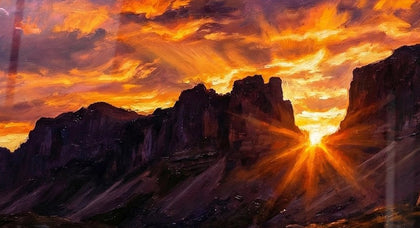
The panoramic mountain wall art transforms your living space into an open window onto majestic peaks. This type of wall decoration exploits elongated proportions to capture the characteristic amplitude of mountain ranges, creating an incomparable visual immersion. Perfectly suited to the large wall surfaces of contemporary spaces, it captures the expanse of alpine landscapes with remarkable fidelity. The horizontal orientation inherent to panoramic format naturally aligns with the horizon line of mountain massifs, offering an authentic perspective that respects the natural geometry of reliefs. Each composition reveals striking contrasts between deep valleys and snow-capped ridges, between raking morning light and evening shadows on rocky slopes.
Optimizing the Visual Impact of Panoramic Mountain Wall Art
Installing a panoramic mountain wall art requires strategic reflection on available wall architecture. The generous dimensions of these works necessitate clear walls of substantial length, ideally between 150 and 250 centimeters, to fully restore the continuity of mountain ranges. Spaces with high ceilings particularly enhance these horizontal compositions by creating balance between architectural verticality and landscape horizontality.
Which spaces are best suited for panoramic mountain wall art?
Open living areas with open-plan kitchens constitute the privileged environment for these monumental representations. The stretched format establishes a visual connection between different functional zones while preserving the aesthetic unity of the whole. Professional offices benefit from it as well, particularly in sectors related to mountain tourism, outdoor equipment, or alpine real estate, where mountain imagery reinforces brand identity.
Creating decorative coherence with alpine reliefs
The color palette of panoramic mountain wall art articulates around mineral and glacial tones: slate gray of rocky walls, immaculate white of snow fields, deep blue of high-altitude skies. For contemporary interiors with neutral dominants, these nuances integrate naturally while introducing emotional depth. Scandinavian or minimalist arrangements find in these panoramic compositions a focal point that maintains visual purity while infusing an organic dimension.
The influence of natural light on panoramic mountain landscapes
Luminous variations throughout the day interact differently depending on wall exposure. A panoramic mountain wall art positioned facing windows benefits from direct lighting that exalts contrasts between shadow areas and snowy surfaces. Conversely, placement perpendicular to openings produces preferable luminous stability for compositions with delicate details such as rocky edges or coniferous forests in mid-mountain.
Matching furniture to panoramic dimensions
The monumental scale of these alpine representations dialogues with furniture featuring extended horizontal lines: corner sofas, low consoles, longitudinal bookshelves. This repetition of elongated proportions creates a coherent decorative rhythm that amplifies the sensation of space. Raw materials such as solid wood, natural stone, or brushed metal establish tactile correspondences with the mineral universe of heights, reinforcing the authenticity of the whole.
The Psychological Benefits of Panoramic Mountain Wall Art
Daily exposure to panoramic mountain wall art generates cognitive and emotional benefits documented by research in environmental psychology. The representation of vast alpine expanses activates the same brain regions associated with relaxation and mental regeneration as direct observation of natural landscapes. This visual stimulation promotes cortical stress reduction and improves concentration capacity in professional environments.
How does panoramic format amplify spatial perception?
The stretched proportions characteristic of these compositions create a wall extension illusion particularly effective in width-constrained spaces. The brain interprets the horizontal continuity of mountain ranges as an extension of living space, generating a sensation of openness comparable to that produced by an actual window. This perceptual manipulation proves valuable in urban apartments where lack of natural perspective can induce a sense of confinement.
The emotional appeal of high-altitude panoramas
Representations of snow-capped massifs, glacial valleys, or summit ridges trigger profound emotional resonances linked to archetypes of grandeur, permanence, and transcendence. For mountain climbing, hiking, or skiing enthusiasts, panoramic mountain wall art constitutes a daily visual anchor of their values and aspirations. This personal connection transforms the work into much more than a simple decorative element: it becomes a support for identity projection.
Stimulate creativity through mountain imagery
Work environments enriched with alpine panoramic views show positive correlation with innovation and complex problem-solving. Passive contemplation of these landscapes during mental breaks facilitates the diffuse thinking phenomenon, essential to creative processes. Design agencies, architecture firms, and creative studios exploit this property by integrating panoramic mountain wall art in their reflection spaces.
Why do wide formats suit mountain scenes better?
The very morphology of mountain ranges – succession of peaks, passes, and valleys extending over kilometers – finds its optimal visual translation in panoramic compositions. A vertical format would artificially truncate this natural horizontal continuity, while a square would not restore the characteristic amplitude of alpine panoramas. The elongated ratio respects the geological and topographic logic of massifs, offering a representation faithful to the actual experience of the viewer facing a mountain landscape.
Selecting the Ideal Panoramic Mountain Wall Art
Choosing panoramic mountain wall art involves precise analysis of visual characteristics specific to each type of alpine landscape. Representations of snow-capped peaks under intense blue sky suit bright and refined interiors, while misty valley compositions at daybreak harmonize with muted atmospheres and soft color palettes. The represented season also influences atmosphere: winter panoramas with cool tones contrast with summer views where deep green of mountain pastures dominates.
Adapting mountain style to interior architecture
Industrial lofts with generous volumes and exposed structures advantageously accommodate panoramic wall art showcasing abrupt rocky walls or monumental glaciers, whose visual power balances architectural massiveness. Contemporary residences with pure lines often prefer minimalist compositions: a single mountain range standing out against a uniform sky, without detail overload. Mountain lodge or resort apartments benefit from identifiable local representations, creating continuity between interior decoration and external environment.
The importance of depth of field in alpine panoramas
Compositions with successive plans – foreground forests, intermediate valleys, background peaks – generate three-dimensionality that enriches visual space. This stratification promotes gaze immersion, inviting progressive visual exploration of landscape elements. Conversely, aerial views centered on crests and summit ridges produce a more abstract graphic effect, suited to design interiors where naturalistic representation yields to refined aesthetic approach.
What dimensions should be prioritized for optimal impact?
Large-scale models exceeding 180 centimeters in width truly transform the wall into a virtual panoramic window. These monumental formats suit reception spaces particularly well where visual effect must be immediate and memorable. For bedrooms or personal offices, more modest dimensions between 120 and 160 centimeters preserve space intimacy while offering sufficient contemplative escape. Standard height of 40 to 60 centimeters maintains characteristic panoramic proportions while adapting to varied ceiling heights.
Does panoramic mountain wall art suit spaces with classical furniture?
Absolutely. The chromatic neutrality of alpine landscapes and their timeless character allow harmonious integration even in traditional interiors. The stylistic contrast between classical furniture and contemporary representation of nature creates sophisticated decorative tension that avoids aesthetic monotony.
How to maintain large-format panoramic mountain wall art?
Monthly dusting with a dry microfiber cloth suffices for protected surfaces. Avoid direct sun exposure during peak radiation hours to preserve color saturation, particularly sky blues and snowy whites susceptible to yellowing. Annual fixture inspection ensures hanging safety for these substantial weight formats.
Can panoramic mountain wall art be installed in a spacious bathroom?
In bathrooms of generous dimensions with effective ventilation, it's feasible while respecting minimum distance of 150 centimeters from direct water sources. Representations of high-altitude lakes or mountain waterfalls create particularly successful thematic coherence in these spaces dedicated to aquatic relaxation.


 Tricolor Shepherd Dog on Misty Rock Wall Art - Guardian of the Heights - Collie Edition232,90 €
 Leonberg Dog on Rocky Promontory in Fjord Landscape - Guardian of Mountains - Leonberg Edition232,90 €
 White Dog on Rock Facing Misty Mountains Canvas - Contemplation of the Peaks - English Setter Edition232,90 €
 Majestic German Shepherd on Cliff - Guardian of the Heights - German Shepherd Canvas Edition232,90 €
 Pyrenean Sunset Painting - Golden Flames on Peaks - Pyrenees Edition232,90 €
 Wild Horses Painting - Galop of the Pyrenees - Pyrenees Edition232,90 €
 Alpinist Mont Blanc Painting - Summit of the Clouds - Mont Blanc Edition232,90 €
 Rowing Sunset Painting - Rower's Serenity - Rowing Edition232,90 €
 Perched Castle Valley Wall Art - Mountain Panorama - Countryside Edition232,90 €
 Solitary Tree and Mountains Painting - Natural Symphony - Mountain Edition232,90 €
 Sentinel Goat Wall Art Mountain Edition - Alpine Guardian232,90 €
 Wild Ascent Wall Art - mountain edition232,90 €