


Shiva Painting
Navy blue unfolds in swirls, red bursts forth like an offering, gold highlights a third eye that never quite closes: this collection of wall art Shiva captures the precise moment when destructive power merges with meditation. Each canvas of this Shiva collection works the divine face in washed ink, between trident, crescent moon and sacred adornment. A silent and inhabited presence, designed for a wall seeking something more than decoration.
 Painting Face purple and ivory with dark trident - River of golden foam - Shiva Edition273,90 €
 Painting Blue and White Face with Coiled Serpent - Miniature City in the Distance - Shiva Edition273,90 €
 Painting Face black and white with red splashes - Large circular ring in the ear - Shiva Edition273,90 €
 Painting Grey and Ochre Face with White Crescent Moon - Brown Pearl Necklace - Shiva Edition273,90 €
 Painting Pink and Turquoise Face with Joined Hands in Prayer - White Elephant Tusks - Shiva Edition273,90 €
 Painting Face purple and gold with vertical stripes - Granular gold splashes - Shiva Edition273,90 €
 Painting Divinity in Blue and Yellow Seated Among Lilies - Immense Lunar Crescent - Shiva Edition273,90 €
 Painting Meditating Divinity Red and Anthracite in Stripes - Vibrant Meditation - Shiva Edition273,90 €
 Painting Brown and White Divinity with Luminous Circle - Rosary of Brown Pearls - Shiva Edition273,90 €
 Painting Blue Divinity with Swirling Hair - Meditative Breath - Shiva Edition273,90 €
 Wall Art Face ochre and blue with distant trident - Arched white crescent - Shiva Edition273,90 €
 Painting Violet and Black Divinity with Golden Ink Swirls - Dark Trident Suspended - Shiva Edition273,90 €
 Painting Profile in Grey and Gold with Two Lunar Crescents - Large Earring Hoop - Shiva Edition273,90 €
 Painting Blue Face with Indigo Streaks and Floating City - Divine Dream - Shiva Edition273,90 €
 Painting Face terracotta and blue with tile mosaic - Spotted fur on the shoulder - Shiva Edition273,90 €
 Wall Art Brown and Red Face at Misty Lake - Foggy Shore with Pines - Shiva Edition273,90 €
 Painting White and Orange Face with Brown Pearl Necklace - Garland of Multicolored Flowers - Shiva Edition273,90 €
 Painting Flowered Divinity with Dark Trident - Floral Meditation - Shiva Edition273,90 €
 Painting Flaming Trident in Gray and Ocher Tones - Ancient City in the Background - Shiva Edition273,90 €
 Painting Divinity with Trident Walking Towards a Temple - Sacred March - Shiva Edition273,90 €
 Painting Blue and Yellow Face with Geometric Mandalas - White Crescent Moon - Shiva Edition273,90 €
 Golden Shiva Painting with Midnight Blue Tridents - Awakening of the Third Eye - Shiva Edition273,90 €
 Painting Divinity Sepia and Green with Intertwined Plant Volutes - Lotus Position - Shiva Edition273,90 €
 Shiva Purple and Turquoise Painting with Cosmic Cobras - Cosmic Trance - Shiva Edition273,90 €
In the same family
Also explore the theme Myth and Legends
-
 View all332
artworks
-
 Apollo2
artworks
-
 Other Myths and Legends14
artworks
-
 Banshee2
artworks
-
 Bigfoot2
artworks
-
 Chupacabra2
artworks
-
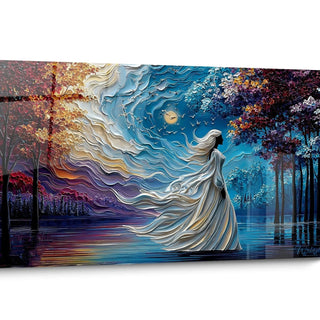
 White Lady2
artworks
-
 Dragon142
artworks
-
 Icarus1
artwork
-
 Kraken3
artworks
-
 Lilith1
artwork
-
 Mokele-Mbembe3
artworks
-
 Narcissus5
artworks
-
 Pegasus27
artworks
-
 Ulysses1
artwork
-
 Wendigo1
artwork
-
 Yeti2
artworks
-
 Zeus1
artwork


All about Shiva Painting
- Presentation of Shiva Painting
- The Red That Interrupts the Calm
- The Gesture of Washed Ink
- A Figure Between Two Worlds
This collection brings together Shiva paintings that share a common approach to the sacred: a face often in profile, the eyelids closed or lowered, captured in a suspended moment between power and contemplation. From one canvas to the next, the trident reappears, the crescent moon adorns the hair, the third eye marks the forehead—as many signs that anchor each Shiva painting within the same mythology without ever repeating in their pictorial treatment.
What unites these Shiva paintings is this constant dialogue between matter and void: broad ink brushstrokes, splashes of red or orange that burst forth on an almost hazy background, as if the color itself carried the energy of the divine gesture. We find deep anthracite blue, sometimes camaïeux of pink and mauve, sometimes a surge of terracotta—the palette changes, the tension between calm and vibration remains.
This collection is for those who want to install a presence rather than a simple decorative motif in their home: lovers of Eastern spirituality, curious about Indian mythology, or simply sensitive to the strength of a face painted with such economy of features. Hung in a living room, an entrance or a relaxation space, these Shiva paintings install an atmosphere of contemplation without ever falling into heavy symbolism.
Finally, this collection is distinguished by the diversity of its techniques: washed ink, fluid watercolor, gilded impasto, geometric patterns inspired by collage. Each Shiva painting offers a different reading of the same subject, allowing a coherent ensemble to be composed while avoiding any visual repetition on the same wall.
Where does this vermilion splash come from that runs through so many Shiva paintings?
Why does the red always appear near the trident?
On these Shiva paintings, the red never occupies the center: it splashes, it stains, it comes to break the serenity of the face with an almost uncontrolled gush. This chromatic rupture recalls an ancient symbolism where blood and fire signal the destructive part of the divinity, that which consumes to allow rebirth. Painted in broad projections rather than mastered flats, this red gives each canvas a tension between displayed peace and contained force—a voluntary imbalance that captures the eye long after the first glance.
Hung alone on a light wall, a Shiva painting dominated by this vivid stain acts as a focal point: the eye keeps returning to it, seeking to understand what could have happened just before the painted moment.
The tilak and the third eye: a detail that changes the whole painting
The vertical line painted between the eyebrows, often in saffron or deep black, is not a simple graphic ornament on these Shiva paintings: it designates the third eye, the one that sees beyond the visible and that, according to tradition, can reduce to ashes what it fixes. Its presence, minuscule on the scale of the canvas, nevertheless concentrates all the intensity of the composition. The artists who paint these faces play on this contrast of scale: a vast and calm forehead, crossed by a single line that carries all the power of the scene.
This detail allows a Shiva painting to function as much viewed from afar, as a soothing silhouette, as viewed up close, where the eye discovers this mark that completely changes the reading of the whole.
Why do some canvases associate red with glacial blue tones?
The deep blue that dominates the skin or hair on many of these Shiva paintings is not an arbitrary decorative choice: it refers to the legend according to which the divinity had absorbed a deadly poison, tinting its throat azure to protect the world. This glacial blue, often associated with a spot of red, visually recreates this moment of sacrifice contained in a posture of absolute calm. The coldness of the main hue and the burn of the red oppose each other without ever neutralizing each other.
This colorful temperature palette makes each Shiva painting capable of changing the ambiance of a room depending on the light: cooler and more mystical in natural light, more vibrant and lively under a warm evening lighting.
What does the painting technique used in these Shiva paintings tell us?
Why do these faces seem to dissolve into the background?
Many of these Shiva paintings borrow from the technique of diluted ink, its fundamental principle: color never stops clearly, it gradually dilutes until it merges into a broken white background, almost hazy. This voluntary dissolution of contours evokes the idea of a presence that belongs as much to the material world as to an immaterial, elusive dimension. The line remains firm only on the face and closed eyes, as if only inner consciousness deserved precision, the rest evaporating in movement.
This treatment gives each Shiva painting a rare visual lightness for a subject as symbolically charged: the canvas breathes, it never weighs down on the wall that welcomes it.
The frozen movement: how do these canvases capture the moment?
Loose strands, volutes of hair escaping towards the background, draperies treated in broad, expressive brushstrokes: everything in these Shiva paintings suggests a breath that has just crossed the scene and whose echo is still perceived. This capture of a movement barely completed transforms a normally static figure into an almost living image, as if surprised in the middle of a gesture rather than posed for eternity.
This choice of composition explains why a Shiva painting hanging in a passageway attracts more attention than a frozen image: there is always something that seems about to continue.
Why do some backgrounds resemble mandalas or patchwork quilts?
Some Shiva paintings structure their background into colored geometric blocks or repeated ornamental motifs, directly borrowing from the visual vocabulary of the traditional mandala. This construction in colored cells is not merely a decorative choice: it translates the idea of an underlying cosmic order to the divine figure, a structured universe that surrounds and supports it. The contrast between this geometric rigor of the background and the organic fluidity of the face creates a pictorial tension specific to this subject.
In a room with simple lines, this type of Shiva painting brings a point of visual complexity that rewards an attentive gaze without ever overloading the space.
Who are these Shiva paintings really talking to and why do they appeal to such a wide audience?
Why does a face with closed eyes soothe so much?
What first strikes in these Shiva paintings, even before recognizing the religious subject, is the universal posture of contemplation: closed eyelids, a slightly lowered chin, a stillness that is nothing like frozen but everything like chosen rest. This expression transcends cultures and beliefs, which explains that a visitor with no particular knowledge of Hinduism immediately perceives the calm of the scene, before even understanding its symbolic attributes.
It is this two-level reading - immediate soothing, then progressive discovery of symbols - that makes a Shiva painting relevant to both a connoisseur and someone who is discovering the figure for the first time.
In what way does this figure differ from other deities often represented in painting?
Unlike divine figures associated with abundance, gentleness or prosperity, the deity represented in these Shiva paintings carries within her a rare duality: she destroys as much as she protects, she meditates as much as she fights. This ambivalence is read directly in the composition, where a threatening trident borders a face of total serenity, where the red of sacrifice borders the white of purity. Few pictorial subjects allow such a coexistence of opposing forces in a single image.
It is precisely this tension that distinguishes a Shiva painting from a simple soothing image: it does not only invite calm, it also recalls the power that makes this calm necessary.
Why does this collection appeal so much to lovers of spirituality as well as aesthetics enthusiasts?
A Shiva painting can be chosen for two totally different reasons, and the collection embraces this double reading: some seek a specific spiritual resonance, linked to meditation, yoga practice, or a personal attachment to Indian culture; others are simply captivated by the graphic strength of the face, the material effects and the chromatic contrasts, without knowing the underlying mythology. Both audiences find their account in the same canvas.
This ability to function on two registers, sacred and aesthetic, explains the recurring presence of these works in both practice spaces and interiors that do not claim any particular religious dimension.
FAQ on shiva paintings
Why does the trident appear on almost all the Shiva paintings in this collection?
The trident, or trishula, symbolizes in tradition the three forces that the divinity embodies: creation, preservation and destruction. Its graphic presence, often standing in the background or crossing the composition, recalls that the serenity of the face always coexists with a latent power. It is this object that immediately distinguishes a Shiva painting from a simple meditative figure without attributes.
Does the crescent moon have a specific meaning in these representations?
Yes, this crescent placed on the hair evokes time and its cycle, a direct reference to the mythology where the moon adorns the divine headdress as a symbol of mastery over the passing time. On these Shiva paintings, it also provides a clear and bright graphic counterpoint to the dark tones of the hair, visually balancing the composition.
Are these paintings suitable for someone who doesn't know Indian culture?
Absolutely: the strength of these Shiva paintings lies in their double reading. The calm of the face, the fluidity of the line and the chromatic intensity are perceived without any prior knowledge of mythology. The symbolic dimension then adds, for those who wish to deepen it, without ever being a necessary condition for appreciating the work.
L'art qui suscite l'envie
Maison belge d'art mural grand format
14 jourspour changer d'avis*
Protection Walenskyincluse
Fabriquéen Italie
FormatXXL
Kit de fixationtoujours fourni
* Hors tableaux personnalisés et tailles personnalisées


