Transform your circulation space into a botanical gallery with a wall art for hallway tree that captures attention with every passage. These large-format creations bring remarkable visual depth to narrow, linear spaces, creating a natural escape where architecture imposes constraints. The verticality of arboreal motifs perfectly matches the elongated proportions of hallways, naturally guiding movement while visually structuring these transition zones often overlooked in interior design.
The Visual Impact of Arboreal Compositions in Circulation Spaces
A wall art for hallway tree intelligently exploits the specific architectural characteristics of transition spaces. The vertical branching of trees creates an upward dynamic that visually compensates for the typical narrowness of these zones, while horizontally deployed foliage generates an impression of lateral amplitude. This dual action literally shapes the perceived space, transforming a cramped corridor into an airy gallery.
How do plant motifs structure the perception of passage?
Large-format arboreal compositions function as visual markers that rhythm progression through the hallway. A majestic redwood in vertical format accentuates ceiling height, creating a cathedral-like sensation even in a 2.50-meter space. The spread branches of a century-old oak, presented in panoramic format, optically widen a narrow 90-centimeter passage, generating welcome visual breathing room.
Depth of field at the service of confined spaces
The hallway tree wall art incorporating forest perspectives creates precious depth illusion in constrained spaces. A poplar avenue receding toward a central vanishing point draws the eye beyond physical walls, mentally opening the space. This visual technique is particularly effective in windowless blind hallways, bringing a contemplative dimension that compensates for the absence of direct natural light.
Color balance between wood, foliage and surrounding architecture
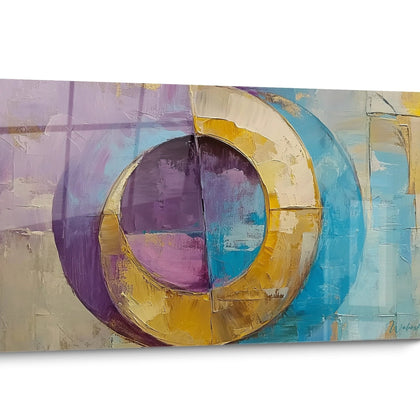
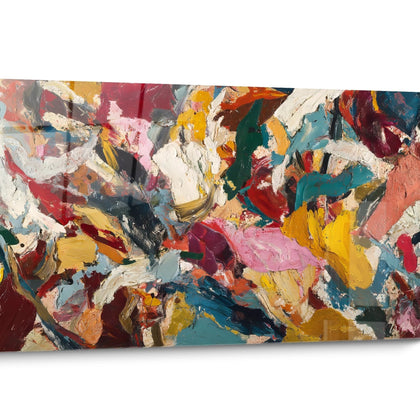
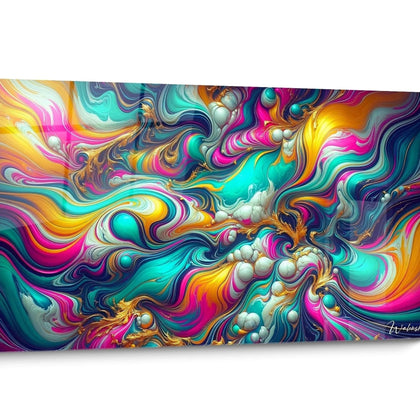
The plant palette of an arboreal painting naturally dialogues with passage materials: solid oak flooring, walnut baseboards, painted wooden doors. The earthy tones of trunks establish harmonious continuity with these architectural elements, while foliage greens introduce contrasting freshness. For contemporary interiors with light walls, a white-barked birch integrates with subtlety, while a wall art for hallway abstract would offer a more radical graphic alternative.
Represented seasonal variations also offer distinct decorative possibilities: an autumn tree with copper leaves visually warms a north-facing passage, while spring cherry blossoms bring light and airiness to a dark hallway.
The Symbolic and Psychological Dimension of Trees in Transition Zones
Why does arboreal iconography soothe circulation spaces?
A wall art for hallway depicting a tree activates profound psychological resonances during multiple daily passages. The tree as an archetype of rootedness and stability symbolically anchors the dwelling, transforming each repetitive journey into a micro-moment of reconnection with natural cycles. This recurring plant presence in the visual field acts as an emotional anchor point, particularly beneficial in urban apartments disconnected from nature.
Transition spaces often generate an impression of functional emptiness, perceived as simple utilitarian zones linking living areas. The integration of a large-format arboreal composition requalifies this status: the hallway becomes a contemplative destination rather than a mere obligatory passage. This perceptual transformation adds value to every square meter of the home.
Different essences and their specific evocations
The choice of depicted species orients the passage's atmosphere according to distinct emotional registers. A thousand-year-old olive evokes Mediterranean resilience, ideal for a hallway distributing family bedrooms. A weeping willow suggests melancholic contemplation, perfectly suited to a space leading toward an office or library. An African baobab introduces exotic monumentality that visually energizes a long rectilinear corridor.
Solitary tree versus forest composition
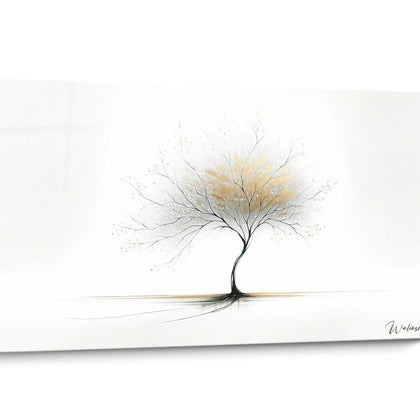
The representation of an isolated specimen concentrates attention on the singular plant, creating a powerful focal point in the circulation axis. This approach is particularly suitable for short hallways where the hallway tree wall art occupies the entire terminal wall, functioning as the visual culmination of the passage.
Conversely, a multi-arboreal forest scene generates an immersive atmosphere, inviting the eye to circulate between different plant planes. This compositional richness sustains visual interest along the entire length of an extended hallway, avoiding the monotony of long repeated journeys. Mysterious undergrowth, luminous clearings, trunk alignments create visual narratives that accompany movement.
Spatial Optimization and Installation in Hallway Configurations
Which arboreal configuration for which hallway morphology?
Hallways present varied geometries that guide the compositional choice of hallway tree wall art. An L-shaped passage benefits from installation on the wall perpendicular to the entrance, where deployed branches visually welcome before the turn. A through hallway connecting two living spaces gains coherence with a pair of arboreal compositions creating a botanical dialogue between both ends.
For hallways serving multiple doors, placement between two openings valorizes the wall interval while respecting access functionality. An elongated vertical format fits harmoniously into these residual spaces, transforming an architectural constraint into a decorative opportunity. Large panoramic formats find optimal expression on continuous wall sections exceeding 3 meters linear.
Management of natural and artificial light flows
The specific light exposure in hallways conditions the readability of the hallway tree wall art. Passages benefiting from lateral light through glass doors valorize compositions with moderate contrast, where foliage details and bark textures remain perceptible without glare. Windowless blind hallways require directional lighting enhancement: adjustable spots highlighting trunk verticality, LED strips creating uniform luminous saturation.
Complementarity with circulation furniture
Unlike richly furnished living spaces, hallways accommodate reduced functional furniture that directly dialogues with the wall composition. A narrow console positioned beneath arboreal wall art creates a coherent decorative ensemble, where natural objects displayed on the surface thematically extend plant presence: pebbles, dried branches, botanical arrangements.
Wall hooks, entry mirrors, and wall storage organize in compositional relationship with the painting. A large format occupying the full wall height naturally guides the implementation of functional elements on adjacent walls, thus structuring the entire corridor.
FAQ - Frequently Asked Questions About Hallway Tree Wall Art
Is hallway tree wall art suitable for passages narrower than one meter?
Absolutely, vertical arboreal compositions are particularly recommended for narrow hallways as their natural elongation visually compensates for low width. Favor formats not exceeding 60-70 cm wide to maintain fluid circulation while maximizing decorative impact without cluttering the passage space.
What visual depth to choose for a windowless blind hallway?
For a hallway without natural light, opt for an arboreal composition integrating deep perspective with luminous vanishing point: a forest clearing toward clear sky, a tree avenue opening onto an uncluttered horizon. This depth of field psychologically compensates for the absence of actual opening and brings essential visual breathing.
How to combine hallway tree wall art with solid wood flooring?
Combining wood flooring and tree wall art creates a particularly harmonious thematic continuity. To avoid saturation, favor a composition where foliage visually dominates the trunk, thus introducing greens, skies, or lights that pleasantly contrast with the woody tones of the flooring. This alternation between green plant matter and wood substance enriches the space without monotony.


 Night Tree Wall Art - Zen Life Tree Edition233,90 €
 Ancient Tree Wall Art - Life Tree Zen Edition233,90 €
 Fluid Golden Trees Abstract Painting - Abstract Edition233,90 €
 Stylized colorful tree painting - Mosaic of life - multicolor abstract edition233,90 €
 Tree Dance of the Seasons - Life Tree Edition Wall Art213,90 €
 Tree of Dreams Wall Art - Zen Tree of Life Edition233,90 €
 Eternal Tree of Life Wall Art - Zen Tree of Life Edition233,90 €
 Fire Tree Artwork - Abstract Colorful Edition233,90 €