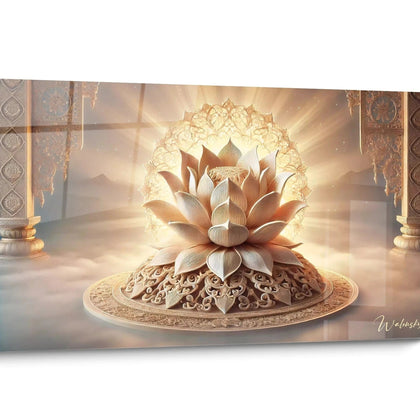
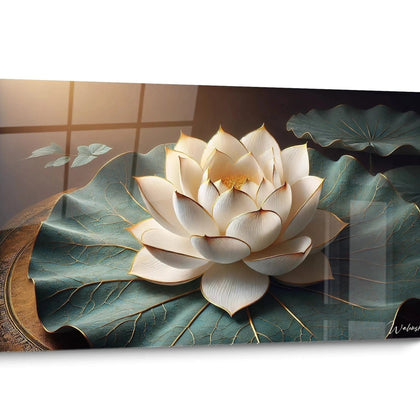
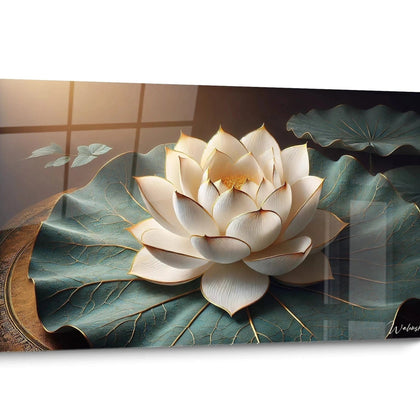
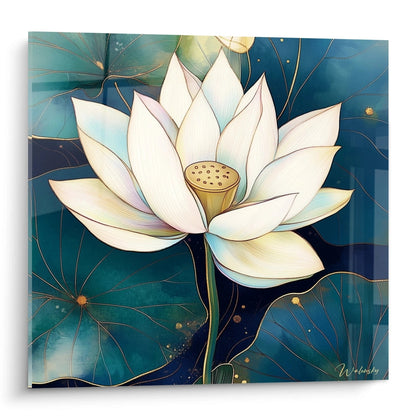
The lotus flower art deco wall art represents a remarkable fusion between oriental symbolism and the geometric elegance of the 1920s-1930s. This large-scale mural artwork celebrates the purity of the lotus through the lens of the Art Deco movement, characterized by its clean lines, stylized motifs, and sophisticated color palette. Unlike classical botanical representations, this artistic creation transposes the sacred lotus into a modern visual language where symmetry, architectural forms, and graphic ornamentation completely redefine traditional floral iconography.
The Alliance of Sacred Lotus and Art Deco Geometric Language
The lotus flower art deco wall art radically reinterprets the millennia-old symbol of the lotus by adopting the aesthetic codes of the Art Deco movement. This approach transforms organic petals into geometric compositions where natural curves become perfect arcs, concentric semi-circles, and angular segments that evoke the architecture of New York skyscrapers or Parisian palaces of the roaring twenties. The radial symmetry inherent to the lotus flower finds perfect resonance with the decorative obsession for balance and modular repetition.
How do geometric motifs transform the representation of the lotus?
In a large-scale mural artwork, the Art Deco stylization of the lotus favors flat color areas delimited by sharp, metallic contours. The veins of the petals become golden or silver rays that structurally organize the composition, creating a contemporary stained-glass effect. This geometrization allows the scale of the motif to be significantly enlarged without losing visual clarity, making the lotus flower art deco wall art particularly suited to vast mural surfaces in high-end residential or professional spaces. Subtle gradations between pastel tones and saturated hues create sophisticated depth.
The characteristic color palette of Art Deco floral creations
The lotus flower art deco wall art exploits a range of colors distinct from naturalistic approaches. Frequent bold combinations include powder pink with gold, emerald green with lacquered black, or petrol blue enhanced with silver. These chromatic combinations draw from the universe of 1930s luxury: the brilliance of precious stones, the shine of noble metals, the depth of oriental lacquers. For those preferring softer renderings, lotus flower watercolor wall art offers an alternative with fluid color transitions. Monumental formats allow these harmonies to unfold across several meters, creating striking focal points.
Stylized ornamentation as visual signature
Beyond the central lotus, the lotus flower art deco wall art often incorporates peripheral decorative elements typical of the movement: geometric friezes, chevron motifs, fan gradations, or zigzag compositions. These ornaments frame the sacred flower within a visual architecture that recalls the portals of Haussmann buildings or the illuminated signs of theaters of the era. This ornamental richness fully justifies the imposing format of the artwork, with each area of the composition contributing to the whole without creating visual saturation thanks to the rigorous organization characteristic of Art Deco.
Enhance Spaces with the Art Deco Aesthetic of the Lotus
Installing a lotus flower art deco wall art in a contemporary interior immediately creates a dialogue between decorative heritage and modernity. This large-scale mural piece works particularly well in spaces with high ceilings, where its vertical proportions accentuate the sensation of architectural grandeur. Spacious entrance halls, residential double heights, and professional reception areas constitute privileged locations where the monumental character of the artwork can fully express itself without spatial constraint.
Which architectural environments enhance Art Deco wall art?
The lotus flower art deco wall art reveals its full splendor in architectures already presenting marked geometric characteristics: linear moldings, pronounced right angles, axial symmetry of spaces. Renovated Haussmann apartments with contemporary spirit, industrial lofts with streamlined volumes, or modernist villas constitute ideal architectural settings. The presence of noble materials such as veined marble, lacquered wood, or brushed metals creates material correspondences with the Art Deco visual universe. In a minimalist living room with neutral tones, this mural artwork brings the touch of graphic opulence necessary without visually overwhelming the space.
Decorative associations to amplify visual impact
To maximize the presence of the lotus flower art deco wall art, the immediate decorative environment plays a determining role. Furniture with clean lines – leather club chairs, precious wood consoles, geometric coffee tables – establishes coherent stylistic continuity. Indirect lighting with concealed light sources recalls the interplay of shadows and light characteristic of 1930s interiors. Selected decorative accessories – cylindrical vases, abstract sculptures, luminaries with pleated shades – reinforce the atmosphere without competing with the visual centrality of the mural artwork. Textiles with luxurious textures (velvet, silk, mohair) in complementary tonalities create additional sensory depth.
Adapt the artwork to high-end professional spaces
In sophisticated corporate environments, the lotus flower art deco wall art conveys values of excellence, cultural refinement, and attention to detail. Boutique hotel lobbies, reception areas of prestigious firms, or private dining rooms of gastronomic restaurants find in this artwork a differentiating element that positively marks the client experience. The imposing format guarantees immediate visibility while offering visual complexity that rewards prolonged observation. The symbolic dimension of the lotus – purity, rebirth, spiritual elevation – aligns perfectly with the messages of transformation and excellence that many premium organizations wish to communicate.
Create a Sophisticated Atmosphere with Art Deco Lotus
The lotus flower art deco wall art generates a distinctive ambiance that transcends simple mural decoration to become a true atmosphere catalyst. This large-format artwork instantly establishes an aesthetic register where the glamorous nostalgia of the roaring twenties blends with contemporary streamlined sensibility. The balance between ornamental richness and compositional rigor creates stimulating visual tension that maintains interest without ever tipping into decorative excess.
What chromatic ambiance should be created around the artwork?
To fully enhance a lotus flower art deco wall art with dominant golden and powder pink tones, a wall palette in pearl gray, sand beige, or off-white allows the artwork to shine without chromatic competition. Conversely, with a composition in dark tones (black, midnight blue, forest green), walls in deep hues create a dramatic setting that magnifies metallic accents and luminous details. This tonal approach generates maximum sophistication while avoiding abrupt contrasts. The objective is to create refined visual continuity where the gaze naturally circulates between the artwork and its environment without brutal rupture.
How does the monumental format influence spatial perception?
A lotus flower art deco wall art of imposing dimensions (beyond 120 cm) substantially modifies the perception of the space that welcomes it. On a main living room wall, it creates a museum-gallery effect that instantly elevates the perceived standing of the entire room. This visual monumentality functions as an architectural anchor that structures the arrangement: furniture naturally organizes in relation to this strong presence, creating intuitive visual axes and circulation zones. In longitudinal spaces such as wide corridors or galleries, the artwork breaks linearity by offering a visual stopping point that enriches the spatial journey.
Usage scenarios for thematic interiors
The lotus flower art deco wall art integrates remarkably into several sophisticated decorative concepts. For an "East-West fusion" interior, it dialogues harmoniously with contemporary Asian elements while providing western formal structure. In "Hollywood Regency" decor, its geometric glamour reinforces the controlled opulence characteristic of this style. For "New Classic" enthusiasts, it represents the perfect bridge between decorative heritage and contemporary expression. Collectors developing a personal gallery will appreciate its ability to coexist with other artworks thanks to its intrinsic compositional coherence that does not depend on strict thematic context.
Is a lotus flower art deco wall art suited to minimalist interiors?
Absolutely, the lotus flower art deco wall art enriches minimalist spaces remarkably by introducing controlled visual complexity. The geometric rigor of the Art Deco movement shares with contemporary minimalism the same requirement for streamlining and formal precision. In a deliberately sober environment, this artwork becomes the signature piece that prevents coldness while preserving visual harmony. Its generous format allows it to adequately fill the vast mural surfaces characteristic of minimalist interiors without requiring decorative multiplication.
Can multiple mural artworks be combined with a lotus flower art deco wall art?
Associating other mural artworks with a large-format lotus flower art deco wall art requires rigorous compositional reflection. The most effective approach is to treat this piece as the dominant element of an asymmetrical gallery wall, accompanied by smaller artworks in similar frames arranged according to geometric logic. Prioritize complementary artworks by theme (stylized botanical, geometric abstract compositions) or color palette rather than by strict artistic style. Always respect sufficient visual breathing space around the main artwork to preserve its impact.
What advantages does a lotus flower art deco wall art offer compared to traditional floral motifs?
The lotus flower art deco wall art transcends the limitations of conventional floral representations by combining symbolic recognition with contemporary formal sophistication. Unlike realistic botanical motifs that can become dated or tiresome, the Art Deco geometric approach maintains timeless modernity through partial abstraction. Stylization also allows spectacular enlargement without loss of visual coherence, whereas photographic rendering at large scale would reveal every imperfection. Finally, this aesthetic simultaneously conveys cultural refinement, historical awareness, and decorative boldness – qualities particularly sought by discerning buyers.


 Lotus Flowers Painting - Golden Elegance - Art Deco Edition233,90 €
 Floral Motifs Wall Art Art Deco - Golden Lotus and Arabesques - Art Deco Edition233,90 €
 Egyptian Woman Painting - Goddess with Blue Lotus - Art Deco Edition233,90 €
 Lotus Wall Art Art Deco - Ornamental Floral Motifs - Art Deco Edition233,90 €
 Lotus Art Deco Wall Art - Oriental Serenity - Art Deco Edition233,90 €
 Woman with Blue Lotus Wall Art - Art Deco Elegance - Art Deco Edition233,90 €
 Golden Lotus Painting - Floral Elegance - Art Deco Edition233,90 €
 Lotus Art Deco Tableau - Golden Floral Elegance - Art Deco Edition213,90 €
 Art Deco Woman Wall Art - Oriental Elegance with Blue Lotus - Art Deco Edition213,90 €
 Lotus Flowers Wall Art - Aquatic Serenity - Art Deco Edition213,90 €
 Golden Lotus Wall Art - Art Deco Floral Elegance - Art Deco Edition213,90 €
 Lotus Flowers Painting - Aquatic Elegance - Art Deco Edition213,90 €