


Abstract Op Art Wall Art
Our Abstract Op Art collection celebrates kinetic art and captivating visual illusions. Dive into a universe of hypnotic geometric patterns where lines, curves and contrasts create striking movement effects. Each modern optical art transforms your interior into a contemporary gallery, bringing dynamism and sophistication. Explore these fascinating creations that play with perception and captivate the eye.
 Abstract Undulating Perspective Wall Art - Op Art Edition273,90 €
 Concentric Circles Pulsating Retinal Patterns - Op Art Edition Wall Art273,90 €
 Undulations Visual Distortion Painting - Op Art Edition273,90 €
 Undulating Abstract Painting Dynamic Illusion - Op Art Edition273,90 €
 Optical Waves Kinetic Energy Wall Art - Op Art Edition273,90 €
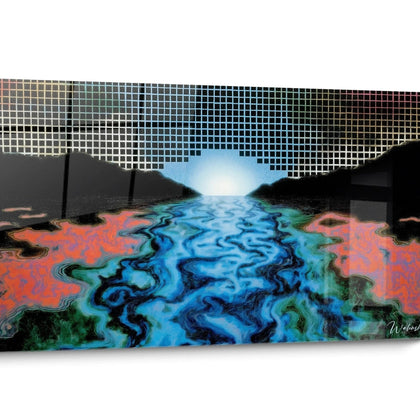
 Fragmented Spectrum Landscape Painting - Op Art Edition273,90 €
 Concentric Circles Magnetic Spiral Wall Art - Op Art Edition273,90 €
 Moiré Horizons Landscape Wall Art - Op Art Edition273,90 €
 Abstract Landscape Painting Hypnotic Waves - Op Art Edition228,90 €
 Grid Illusion Kinetic Wall Art - Op Art Edition228,90 €
Explore further
In Abstract Op Art Wall Art
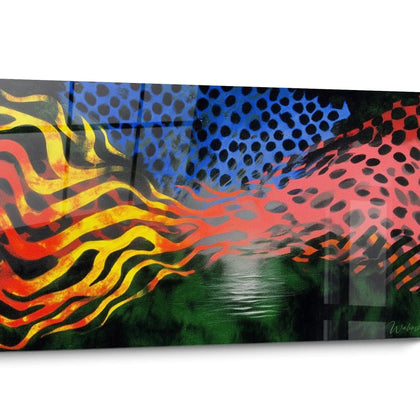
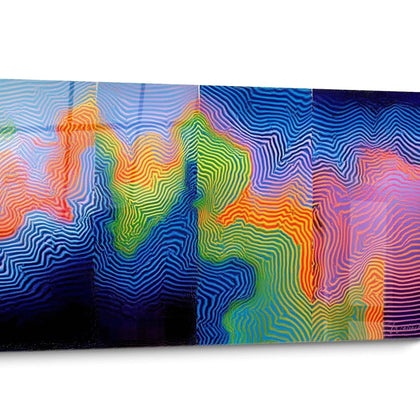
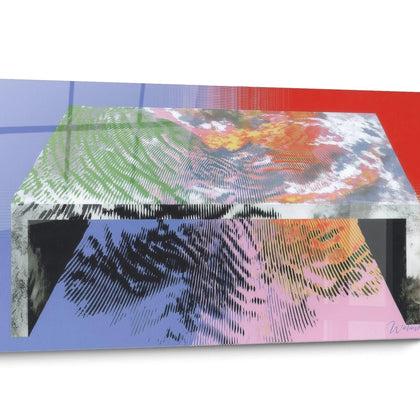
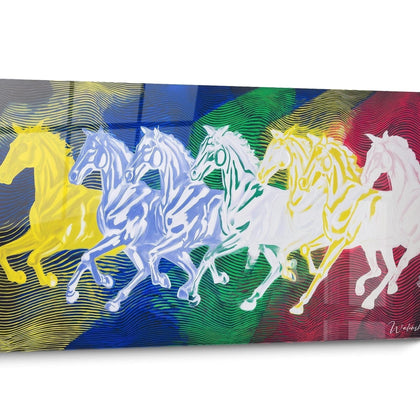
All about Abstract Op Art Wall Art
- Op Art Abstract Wall Art Presentation
- Perceptual Dynamics and Optical Vibrations
- Visual Architecture and Illusory Depth
- Decorative Impact and Spatial Presence
The op art abstract wall art embodies a fascinating encounter between optical illusion and geometric abstraction, creating mural compositions that radically transform the visual perception of a space. These large-scale mural creations exploit the neurological mechanisms of vision to generate effects of movement, depth and purely optical vibration, without any actually mobile elements. Abstract Op Art distinguishes itself through its capacity to actively engage the viewer's visual system, provoking sensations of controlled destabilization and perceptual oscillation that constantly renew the contemplative experience.
Optical Mechanisms and Retinal Stimulation of Op Art Abstract Wall Art
The acquisition of op art abstract wall art relies on understanding its specific neurophysiological properties. These compositions exploit maximum chromatic contrasts and rhythmic repetitions to temporarily saturate certain areas of the retina, generating residual images and flickering effects. Monumental formats considerably amplify these phenomena since the peripheral visual field fully participates in the creation of perceptual oscillations, unlike reduced formats which limit the effect to zones of foveal vision.
How do visual interferences amplify optical dynamics?
Pattern interferences constitute the technical foundation of large-scale op art abstract wall art. When repetitive linear structures overlap or are juxtaposed with minimal angular variations, moiré effects appear spontaneously, creating phantom undulations that seem to move according to the viewing angle. These interference phenomena are particularly powerful in circulation spaces where viewer movement continually modifies the perceptual configuration. The integration of geometric op art wall art exploiting these principles transforms a corridor or passage area into an evolving immersive experience.
Visual programming and contrast sequences
The programming of contrasted sequences differentiates sophisticated abstract op art compositions. Black-white alternations generate the most intense effects, but the introduction of gradual transitions or rhythmic breaks modulates visual fatigue. For contemporary professional environments requiring cognitive stimulation without sensory aggression, compositions integrating zones of visual rest between sectors of maximum activation offer optimal balance. The imposing dimensions permit this complex orchestration of distinct perceptual zones within a single composition.
Which spaces benefit from the kinetic properties of abstract Op Art?
Technology company reception halls, specialized medical waiting areas in neurology, and contemporary art galleries constitute privileged locations. The monumental dimension requires minimum ceiling heights of 2.80 meters to allow the necessary distance for full appreciation of the optical effects programmed in the composition.
Spatial Construction and Manipulation of Perceptual Depth
Large-format op art abstract wall art excels in generating illusory spatial architectures that seem to physically modify wall geometry. Unlike traditional perspective representations, these compositions create ambiguous and unstable depths, where planes seem to alternately advance and recede according to attentional fluctuations. This perceptual instability transforms the supporting wall into a breathing surface, visually multiplying the volume of rooms with constrained dimensions.
What are the spatial deformation techniques employed?
Progressive size gradients constitute the primary method: identical geometric elements gradually diminishing create an accelerated recession that surpasses the efficiency of classical perspectives. Curvilinear distortions applied to orthogonal grids generate effects of bulging or indentation that defy the actual flatness of the support. For minimalist interiors requiring visual complexity without physical encumbrance, a large-scale abstract op art wall piece produces spatial richness equivalent to a sculptural relief while preserving the entire living surface.
Spatial contradictions and impossible perceptual resolution
Impossible configurations represent the culmination of spatial exploration in abstract op art. These compositions program contradictory depth cues: certain zones suggest convexity while others simultaneously indicate concavity of the same sector. The brain continuously attempts to resolve these contradictions, generating sustained cognitive activation that maintains attentional engagement over prolonged durations. Monumental formats allow the coexistence of multiple distinct paradoxical zones, multiplying visual anchoring points.
Can abstract Op Art compensate for architectural defects?
Absolutely. A wall presenting subtle irregularities or unbalanced proportions strategically benefits from the installation of an abstract op art composition whose intentional distortions effectively mask structural imperfections. Optical vibrations divert attention from constructive defects toward programmed effects, transforming an architectural weakness into a valued support for a perceptually demanding work.
Peripheral zone activation and total immersion
The imposing dimensions of contemporary abstract op art wall art actively engage peripheral vision, a zone particularly sensitive to movements and contrasts. This global activation of the visual field generates perceptual immersion impossible with standard formats. In spaces dedicated to creative concentration such as design studios or architectural firms, this peripheral stimulation maintains optimal cognitive alertness without monopolizing the focal attention required for primary tasks.
Monumental Presence and Environmental Transformation
The installation of large-format op art abstract wall art constitutes a total environmental intervention that redefines complete spatial identity. Beyond simple wall decoration, these monumental compositions establish a dominant visual signature that orients all other aesthetic decisions in the space. Their perceptual intensity creates clear decorative hierarchy where the wall art incontestably becomes the focal point around which all furniture and secondary elements are organized.
How to manage visual intensity in residential spaces?
For industrial lofts and contemporary open volumes, monumental op art abstract wall art functions as a spatial delimiter without physical partitioning. Its visual power creates a zone of influence that implicitly defines a living or reception sector, structuring the open space without reducing its fluidity. Black and white compositions integrate particularly well with minimalist monochromatic palettes, while versions incorporating limited chromatic accents allow subtle programming of the overall furniture color harmonies.
Adaptation to light cycles and daytime variations
The optical properties of op art abstract wall art evolve radically according to ambient lighting conditions. Morning raking light accentuates contrasts and intensifies vibrations, while midday zenith lighting standardizes reading. This variability transforms the work into an evolving composition offering renewed experiences throughout the hours. For spaces exposed to significant light variations, this adaptability constitutes a major advantage, the work actively dialoguing with its natural luminous environment rather than passively undergoing its variations.
What viewing distance optimizes the programmed optical effects?
The critical distance generally situates itself between 2.5 and 4 meters for formats exceeding 120 centimeters. At this range, individual motifs remain discernible while permitting the emergence of overall interference effects. Spaces allowing circulation around this critical zone fully valorize the investment in monumental-dimension op art abstract wall art.
Heritage valorization and cultural positioning
The acquisition of large-scale op art abstract wall art signals precise cultural affiliation to avant-garde movements of the 1960s-1970s and their contemporary resurgence. For discerning collectors and institutional spaces, these pieces represent historical references at the intersection of art, perceptual science and formal innovation. Their presence testifies to sophisticated understanding of modern art history and valorization of active sensory experience rather than passive contemplation.
FAQ - Frequently asked questions about op art abstract wall art
Does op art abstract wall art suit demanding professional environments?
Perfectly. Innovative professional spaces such as technology startup headquarters, contemporary architecture firms or cognitive research centers strategically integrate these compositions to assert their avant-garde positioning. Controlled visual stimulation paradoxically favors concentration by maintaining background cognitive activation that prevents sensory monotony.
Do optical effects of op art abstract wall art cause excessive visual fatigue?
Fatigue depends essentially on direct observation duration. As a mural element present in the peripheral visual field rather than continuously fixed upon, these compositions generate intermittent stimulation perfectly tolerable. Models integrating zones of visual rest and modulated contrasts suit environments of prolonged presence.
How to integrate furniture and accessories around monumental op art abstract wall art?
Sobriety constitutes the optimal strategy. Clean lines, simple forms and a restricted color palette allow the wall art to dominate the space without visual competition. Scandinavian functionalist furniture or emblematic twentieth-century design pieces harmonize naturally with the rigorous aesthetic of abstract op art, creating coherent formal dialogues between complementary eras.
Further reading
Our articles on this topic
- Interactive abstract art: technologies and audience participation
- Decoding the Beauty of Abstract Artworks: A Journey into the Heart of the Abstract Acrylic Painting
- Abstract Art & Personal Interpretation: Unlocking Imagination
- Symbolism of abstract shapes: what your artwork communicates unconsciously
- Why Abstract Art Transforms Your Interior


