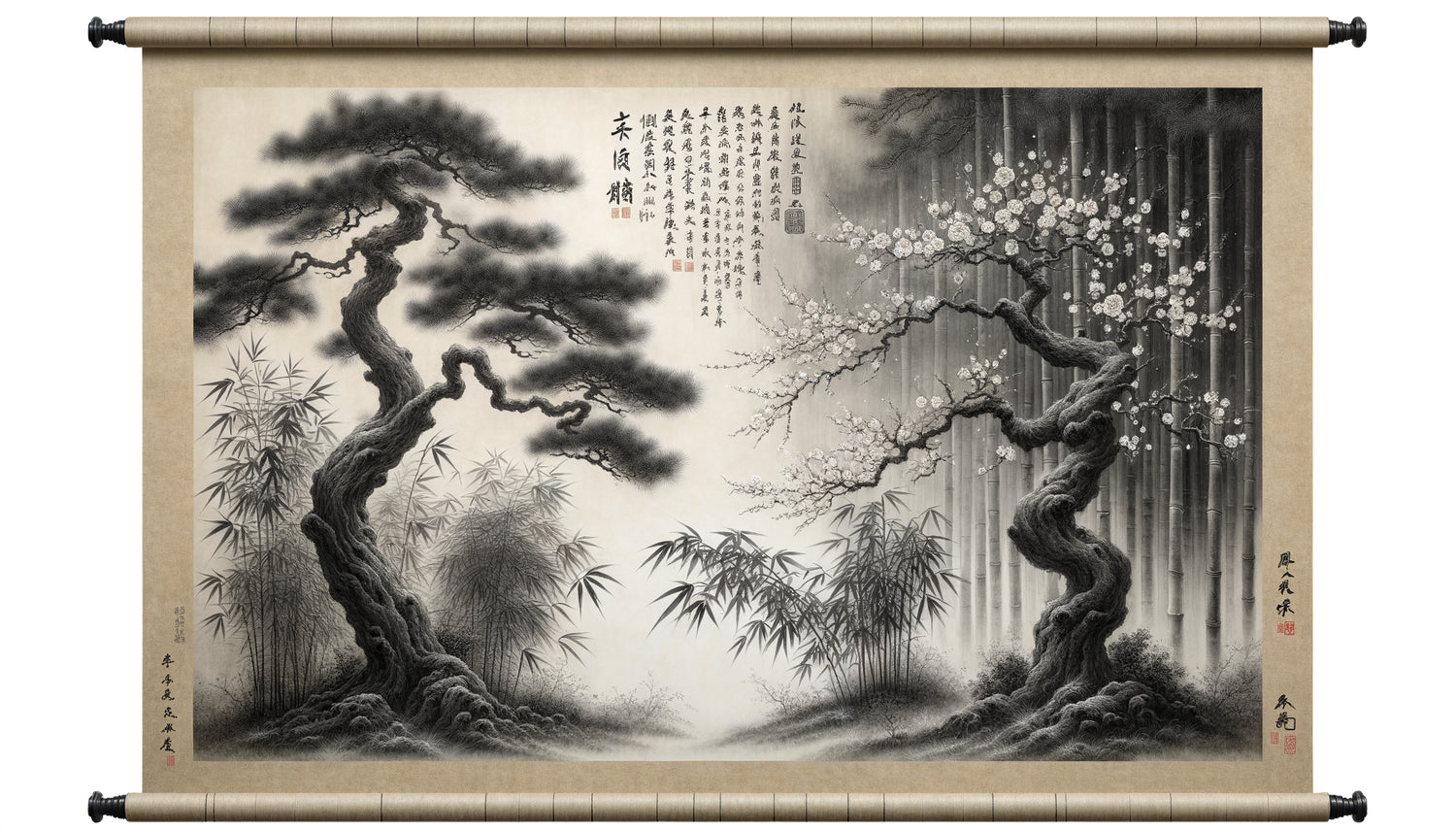
In the cozy living rooms of discerning collectors, a question often arises before these ink paintings where three plants coexist: why this gnarled pine, this slender bamboo, these plum blossoms? These Three Friends of Winter, or Suihan Sanyou in Chinese, are not simply decorative compositions. They embody a millennial philosophy, an ideal of resilience in the face of adversity that Chinese scholars celebrated in their monochrome paintings since the Song dynasty.
Here's what the motif of the Three Friends of Winter reveals in Chinese paintings: a celebration of perseverance in the face of trials, a poetic representation of moral integrity, and a codified visual vocabulary that transformed each work into a philosophical manifesto.
When you discover ancient Chinese art, you often feel lost before these mysterious symbols. Why precisely these three plants? What story do they tell together? How did artists use this motif to communicate their values?
Rest assured: behind the apparent complexity of these compositions lies a deeply human logic. Chinese monochrome painters created a universal language of resilience, accessible to anyone who agrees to slow down their gaze. In this article, I invite you to decode this fascinating trio of plants that continues to inspire contemporary interiors.
The sacred trio of winter resistance
The motif of the Three Friends of Winter brings together the pine, bamboo and plum for a very concrete reason: they are the only plants that defy the harshness of the cold season. While all nature strips itself bare and falls asleep, these three plants maintain their dignity.
The pine retains its needles all year round, symbolizing endurance and longevity. In Chinese monochrome paintings, it often appears twisted by the winds, clinging to a rocky cliff, testifying to a quiet strength that never yields. Artists depicted it with vigorous lines, gnarled branches that seemed sculpted by time.
The bamboo bends under the snow but never breaks, embodying flexibility and moral integrity. In Confucian tradition, bamboo symbolizes the virtuous scholar who can adapt to circumstances without compromising his principles. Monochrome painters loved to capture its vertical elegance, these segmented stems rising towards the sky with eloquent rectitude.
The plum produces its flowers even before the appearance of its leaves, sometimes on branches still covered in snow. This early flowering represents courage, purity and renewal. In ink compositions, plum blossoms appear as delicate, almost fragile touches, but with a fierce determination.
When nature becomes a philosophical manifesto
The scholar-painters of the Song dynasty and later periods were not mere botanical observers. Every brushstroke on rice paper was charged with intention. The motif of the Three Friends of Winter in their monochrome paintings constituted a true political and moral manifesto.
At a time when intellectuals sometimes had to navigate between compromise and principles, this trio of plants served as a personal metaphor. Representing the Three Friends was to assert: I will remain steadfast despite difficult circumstances. It was a code understood by all lettered men, a silent but eloquent declaration.
Chinese monochrome paintings favored black ink on white or silk paper, a reduced palette that paradoxically amplified symbolic richness. In this apparent minimalism, every element counted double. The Three Friends of Winter did not need bright color: their meaning unfolded in shades of gray, empty spaces, the gesture of the line.
Emptiness as a fifth dimension
In these compositions, empty space is never neutral. It represents the vital breath, the qi that circulates between the elements. The Three Friends of Winter often emerge from fog or mist, partially revealed, as if wisdom itself were only unveiled in fragments. This aesthetic of understatement, of suggestion rather than display, characterizes the most beautiful Chinese monochrome paintings.

Compositional variations of the sacred motif
While the symbolism of the Three Friends of Winter remains constant, Chinese artists have developed countless compositional variations over the centuries. Some placed the pine in a dominant position, others favored the flowering plum tree in the foreground.
In monochrome paintings of the Yuan dynasty, we often see a vertical composition where the three plants overlap like philosophical strata. Bamboo stands its stalks in the center, the pine twists on the side, and plum blossoms punctuate the whole with light touches.
During the Ming period, artists sometimes focused their attention on only one of the three friends, leaving the other two in discreet suggestion. A scroll might show a majestic bamboo with, in the poetic cartouche that accompanies it, a reference to the two other invisible but spiritually present companions.
Chinese monochrome paintings rarely functioned as isolated images. They were accompanied by calligraphy, seals, poems that enriched the reading of the motif of the Three Friends of Winter. A literate collector would slowly unroll the scroll, first reading the poem and then contemplating the image, creating a complete meditative experience.
The contemporary legacy of timeless symbolism
Today, the motif of the Three Friends of Winter continues to permeate contemporary Asian aesthetics and inspires interiors seeking symbolic authenticity. These monochrome compositions find their place in modern spaces where their message of resilience resonates with a troubling reality.
Enlightened decorators integrate these works into minimalist environments where their chromatic sobriety dialogues with natural materials: raw wood, stone, linen. The deep black of the ink on the white paper creates a contrast that structures the space without weighing it down.
What fascinates about these Chinese monochrome paintings, is their ability to transcend eras. A scroll painted in the 13th century still speaks today of perseverance, integrity, dignity in the face of adversity. In our contemporary interiors saturated with visual stimuli, the Three Friends of Winter offer a contemplative anchor point.
How to integrate this symbolism into your home
The spirit of the Three Friends of Winter invites itself into our spaces without requiring expensive antique works. Quality reproductions, contemporary interpretations or even black and white photographs of pines, bamboos and plum trees can evoke this millennial philosophy.
The essential thing is to understand the message: to create in your interior a visual reminder of resilience, an invitation to quiet strength. Placed in an office, such a composition encourages perseverance. In a living room, it inspires conversation and depth.

The essential masters of the genre
Several artists have brought the motif of the Three Friends of Winter to its peak in the history of Chinese monochrome paintings. Zhao Mengjian, a painter of the Song dynasty, excelled in representations of plum blossoms, often accompanied by his two plant companions. His economical and precise traits captured the essence of the subject rather than its superficial appearance.
Under the Yuan dynasty, Ni Zan developed an extremely refined style where the Three Friends of Winter appeared in stripped-down, almost abstract landscapes. His compositions breathe a aristocratic melancholy, the feeling of an ancient world that disappears but whose values remain.
In the Qing period, Zhu Da (also known as Bada Shanren) reinvented the motif with an explosive gesture. His Three Friends seem to burst from the paper in a furious vital surge, transforming resilience into a veritable cry of existence.
These masters shared a common belief: Chinese monochrome paintings should not only represent the visible world, but reveal the invisible forces that animate it. The pine, bamboo and plum tree then became actors in a cosmic theater where the great human questions were played out.
Let the wisdom of the East into your daily life
Discover our exclusive collection of black and white paintings that capture this timeless aesthetic of contrast and contemplation, perfect for creating a serene space inspired by the great Asian artistic traditions.
Living with the Three Friends of Winter
Integrating the motif of the Three Friends of Winter into your interior is not just an aesthetic decision. It's choosing to live daily with a visual reminder of what really matters: resilience in the face of difficulties, flexibility without compromising principles, the courage to bloom even in adversity.
These Chinese monochrome paintings act as visual mantras. Each time your gaze rests on them, you reconnect with these timeless values. In a world that often values immediate brilliance and ease, the Three Friends remind us of the beauty of endurance, the nobility of holding firm.
Imagine your space transformed by this discreet but powerful presence. A clean wall where a monochrome composition of pine, bamboo and plum tree reigns. There's no need to multiply decorative elements: this work alone is enough to create an atmosphere of contemplative depth. It becomes the visual anchor point of the room, the one towards which the gaze naturally returns seeking peace and inspiration.
The Three Friends of Winter are not a passing trend in Asian decoration. They represent a wisdom that transcends centuries because it touches on the human universal. We all need models of perseverance, examples that show us that it is possible to remain worthy and alive even when circumstances harden.
Start simply: look for a quality reproduction of a monochrome painting featuring this motif. Observe how the three plants dialogue in space, how emptiness structures the composition as much as the full. Let this image speak to you, and it will subtly transform your relationship with your interior, but also with your life.
Frequently Asked Questions about the Three Friends of Winter
Why precisely these three plants in Chinese paintings?
Pine, bamboo, and plum were chosen for their shared ability to defy winter, each in its own way. The pine retains its needles all year round, demonstrating constancy. Bamboo bends under the snow without breaking, illustrating flexibility with integrity. The plum blossoms early despite the cold, symbolizing courage and renewal. Together, these Three Friends of Winter form a complementary trio that embodies Confucian virtues of the noble man: endurance, adaptability, and determination. In Chinese monochrome paintings, this combination allowed educated artists to express a complete philosophical ideal in a single composition. It is therefore not an arbitrary choice, but a highly symbolic selection based on botanical observations and moral values deeply rooted in classical Chinese culture.
How to recognize an authentic Chinese monochrome painting of the Three Friends?
An authentic Chinese monochrome painting featuring the Three Friends of Winter can be recognized by several characteristics. First, the technique: Chinese ink applied to rice paper or silk, with subtle variations in black ranging from pale gray to deep black. Then, the balanced but asymmetrical composition, respecting the principles of Chinese aesthetics where emptiness counts as much as fullness. Authentic works generally feature red seals (marks of the painter and successive collectors) and often poetic calligraphy. The gesture of the stroke is also revealing: in true Chinese monochrome paintings, each brushstroke is definitive, executed with a mastery that allows for no repentance. Finally, the spirit of the work: authenticity can be felt in the economy of means, suggestion rather than exhaustive description, and this impression of meditative spontaneity that characterizes educated Chinese art.
Can this motif be integrated into a modern Western interior?
Absolutely, and it is even one of the great successes of contemporary decoration. The motif of the Three Friends of Winter integrates wonderfully into modern Western interiors, particularly those that favor minimalism, simplicity, and natural materials. Chinese monochrome paintings, with their restricted palette of black, white, and gray, dialogue perfectly with Scandinavian aesthetics, Japandi style, or even contemporary industrial architecture. To succeed in this integration, prioritize a location where the work can breathe, without decorative overload around it. A large white wall in a living room, the space above a sleek console, or even an office where the message of resilience of the Three Friends will resonate daily. The important thing is not to create an Asian-themed interior, but to let this millennial symbolism subtly enrich your living space. The universal beauty of these compositions transcends cultural boundaries and speaks to our common need for meaning and depth.