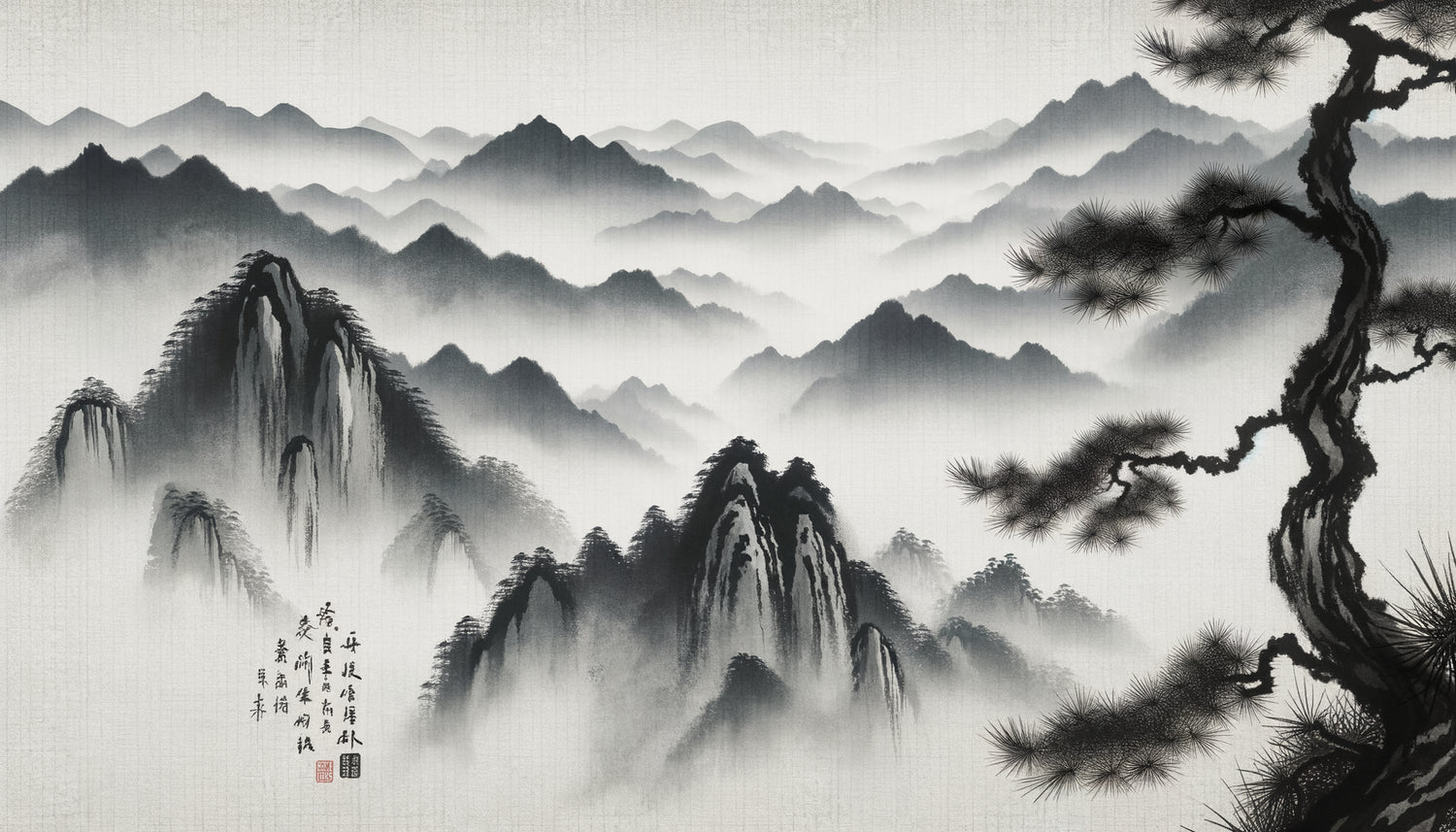
That morning, in Master Chen’s workshop, I observed something that shook my perception of wall art. With a fluid gesture, his brush loaded with black ink brushed against the rice paper. In seconds, a misty mountain appeared, vibrant with life despite the total absence of color. This scene reminded me why I left Paris twelve years ago to study traditional Chinese arts in Hangzhou.
Here’s what Chinese ink wash painting brings to your interior: visual serenity that instantly soothes, timeless sophistication that transcends trends, and a contemplative depth that transforms every glance into meditation. These monochrome works don't just decorate your walls; they create visual breaths in our spaces saturated with stimuli.
You may be tired of cluttered interiors, aggressive colors that fatigue the eye, this decorative frenzy that prevents you from relaxing at home. You aspire to that minimalist elegance seen in magazines, but fear that black and white alone might seem cold or austere.
Rest assured. Chinese ink wash painting has nothing of sad austerity. It is a subtle celebration of nuance, a universe of vibrant grays that reveal an unsuspected richness. Since I have integrated these principles into my interior design advice, my clients are discovering how sobriety becomes luxury.
Let me guide you through this millennial philosophy that is revolutionizing contemporary wall art today.
The foundations of ink wash: when emptiness becomes presence
Chinese ink wash painting, or shuǐmò huà, rests on a principle confusing to our Western minds: what is not painted counts as much as what is. In my workshop in Lyon where I advise collectors, I often explain that the white paper is not a background, but the mist, the light, the vital space that allows the mountain to exist.
This millennial technique exclusively uses diluted Chinese ink, creating an infinite palette of grays. Unlike oil painting where one can correct, ink wash requires total presence: each stroke is definitive. This technical constraint becomes a philosophy. The artist does not represent, he captures the essence.
I learned from Taoist masters that ink wash translates the concept of wú wéi, effortless action. The brush dances on the paper with meditative spontaneity, the fruit of thousands of hours of practice. This tension between absolute mastery and total letting-go creates works of rare contemplative intensity.
The five ink tones that contain the universe
Masters of ink wash distinguish five fundamental tones: dry ink, wet ink, saturated ink, light ink, and broken ink. These nuances are not mere technical variations. They embody the states of matter and spirit. Saturated ink sculpts rocks with authority. Light ink suggests suspended clouds. Broken ink, partially diluted, creates those vibrant textures where the paper breathes through the pigment.
When I help a client choose an ink wash artwork for their living room, I first invite them to observe these tonal subtleties. A composition dominated by light ink will bring brightness and lightness. A work with marked contrasts of saturated ink will create a dramatic focal point, a powerful visual anchor in a clean space.
Monochrome as a revealer of space
In our contemporary interiors, the monochrome of ink wash acts as a chemical revealer on our spatial perceptions. I have observed among my Parisian, Lyon and Geneva clients a recurring phenomenon: an ink wash artwork visually enlarges the room. Its lack of color avoids visual saturation, while its empty spaces create continuity with the wall.
This decorative magic rests on zen principles of spatial harmony. Ink wash Chinese does not shout, it whispers. It invites the eye to approach, to gradually discover the complexity of its nuances. In a living room where contemporary furniture and monochrome works coexist, this sobriety becomes the guiding thread that unifies the whole.
The art of ink wash dialogues particularly well with natural materials: raw wood, linen, stone, polished concrete. I recently completed the design of an industrial loft where three large ink wash compositions depicting bamboo in the rain transformed the austerity of the concrete into an urban sanctuary. Monochrome does not impoverish, it concentrates.
Pairing ink wash with contemporary palettes
Contrary to popular belief, Chinese ink wash is not limited to entirely monochrome interiors. Its sophisticated neutrality makes it a valuable ally for tempering colorful palettes. In a bedroom with navy textiles, an ink wash artwork depicting waves brings a luminous breath. Facing a terracotta sofa, misty mountains create a soothing contrast.
The key lies in the balance of proportions. A large ink wash composition requires sobriety in the rest of the decor: minimalist furniture, plain textiles, rare but meaningful accessories. Conversely, several framed small works create a sophisticated wall gallery that can support more decorative richness around it.

Iconic Subjects: Nature and Contemplation
The traditional repertoire of Chinese ink wash painting draws on four main motifs: mountain and water landscapes, bamboo, plum blossoms, and birds. These subjects are not chosen at random. They embody profound philosophical virtues rooted in Taoism and Chan Buddhism, the ancestor of Japanese Zen.
Hazy mountain landscapes symbolize permanence and transcendence. In my consulting experience, these compositions bring a majestic contemplative quality to main living spaces. Bamboo, flexible yet unwavering, represents resilience. Their elegant verticality is perfectly suited to narrow spaces or high walls that you want to enhance.
Plum blossoms, which bloom in the middle of winter, celebrate renewal and hope. Their delicacy works wonderfully in bedrooms or reading areas. Birds, often perched on bare branches, evoke freedom and lightness. These dynamic compositions create movement in very minimalist interiors.
Contemporary Compositions: When Tradition Meets Modernity
Contemporary artists who master Chinese ink wash painting are now creating fascinating bridges between millennia-old tradition and current aesthetics. I recently discovered works where the ancestral technique represents urban skylines, abstract portraits or geometric compositions. This respectful hybridization preserves the meditative essence of ink wash painting while engaging with our visual worlds.
These contemporary creations significantly expand decorative possibilities. A collector can integrate the Zen spirit of ink wash painting into a resolutely modern, Scandinavian, or even industrial interior without creating stylistic dissonance.
Integrating Ink Wash Painting: Practical Interior Design Tips
After twelve years advising Asian art enthusiasts, I have developed a proven methodology for harmoniously integrating Chinese ink wash painting into our Western interiors. The first rule: respect the breathing space around the artwork. An ink wash painting suffocates visually if it is surrounded by cluttered shelves or multiple frames.
The ideal location is on a clear wall, at eye level, with a minimum of 30 centimeters of free space on each side. Lighting deserves special attention: prioritize indirect natural light or neutral white LED lighting. Direct spotlights create reflections on the rice paper or silk that traditionally supports ink washes.
The frame plays a crucial role. Traditional Chinese mountings use brocades of silk framing the artwork, creating an elegant presentation that is part of the composition. For our contemporary interiors, a simple wooden natural or brushed aluminum frame works admirably, provided it remains discreet. The frame serves the work, never the other way around.
Create a monochrome gallery wall
A trend I particularly appreciate is composing a monochrome gallery wall blending Chinese ink washes, black and white photographs, and engravings. This approach creates a strong visual coherence while multiplying textures and techniques. The secret lies in varying the formats and generous spacing between frames.
In a long hallway, I recently installed a succession of five ink washes representing the different hours of the day on the same mountain. This visual narrative transforms a passageway into an invitation to contemplation. Monochrome avoids any cacophony, allowing the visitor to grasp the temporal and atmospheric progression.

Zen philosophy in decorative practice
Beyond aesthetics, integrating a Chinese ink wash into your interior is a philosophical choice. It's welcoming zen principles into daily life: simplicity, presence, acceptance of impermanence. Each tonal variation in the ink recalls that beauty arises from transitions, nuances, never absolutes.
I encourage my clients to consider their ink wash artwork as a support for visual meditation. A few minutes of attentive observation, in the morning with coffee or in the evening when returning home, creates a beneficial mental pause. The ink wash slows down time. In our accelerated lives, this quality becomes precious.
This zen approach also influences our overall design choices. We begin to question each object: does it bring joy and serenity, or does it clutter the space and mind? Chinese ink wash painting, with its calming presence, often becomes a catalyst for broader decorative simplification. My clients regularly testify to this gradual transformation towards more uncluttered, more breathable interiors.
Imperfection as Perfection
A central concept of Chinese ink wash painting overturns our Western standards: wabi-sabi, this Japanese appreciation of imperfection and impermanence inherited from Chinese zen philosophy. Ink bleeds, unintentional tonal variations, irregular edges are not defects but signatures of authenticity.
Accepting this aesthetic of imperfection is liberating. We stop searching for rigid perfection in our interior. We welcome patinas, natural asymmetries, authentic textures. This philosophy resonates particularly today, as a reaction to the standardization of our environments.
Transform your interior into a sanctuary of serenity
Discover our exclusive collection of black and white artworks that capture the spirit of ink wash painting and bring this monochrome sophistication into your daily life.
Your journey towards monochrome serenity begins now
Imagine yourself tomorrow morning, a steaming cup in hand, contemplating misty mountains hanging on your wall. This simple gaze instantly anchors you in the present moment. The frenzy of the day ahead subsides. You breathe deeper. That is the daily transformation that Chinese ink wash painting offers.
Start modestly if this monochrome still intimidates you. A small composition of bamboo in your entrance hall. Observe how it changes the energy of this transitional space. Notice how your gaze naturally rests on it, these micro-contemplative pauses that punctuate your passages. Then, gradually, let this zen philosophy infuse your interior.
The art of Chinese ink wash painting teaches us that by subtracting color, we reveal essence. By emptying the space, we create room for what is essential. In our saturated lives, this millennial lesson resonates with a contemporary urgency. Your white wall awaits only a misty mountain to become a window onto infinity.
Frequently Asked Questions about Chinese Ink Wash Painting
Does Chinese ink wash painting risk making my interior too austere?
It’s a legitimate concern I often hear, but completely unfounded once you actually experience it. Chinese ink wash painting possesses a stunning tonal richness that our eyes gradually discover. These endless variations of gray create a captivating visual depth, far from austerity. Think of a forest in the mist: monochrome, certainly, but vibrant with mystery and presence. The trick is to balance it with warm textures in your furniture and textiles: a wool blanket, linen cushions, a Berber rug. Ink wash painting then brings sophistication and breathability, never coldness. My most initially reluctant clients often become the most enthusiastic after a few weeks, discovering how this sobriety actually amplifies the feeling of space and serenity.
How to distinguish a genuine traditional ink wash painting from a reproduction?
This question reveals an important concern for any lover of authenticity. A genuine Chinese ink wash painting is first recognized by its support: rice paper or silk, never canvas. Approach and observe the tonal variations: they should present natural irregularities, areas where the ink has slightly bled or created grainy textures. This is the signature of aqueousness, this unpredictable interaction between water, ink and absorbent paper. Photographic or digital reproductions, even high quality ones, exhibit an overly perfect uniformity in flat areas. Also examine the edges of the work: an authentic wash painting often shows traces of traditional mounting or cutting irregularities. Finally, inquire about the artist and their background. True practitioners of ink wash painting have generally studied for years under recognized masters. Don't hesitate to ask for a certificate of authenticity.
Can Chinese ink wash painting and Western art be mixed in the same room?
Absolutely, and it’s even an approach I strongly encourage! Ink wash painting dialogues wonderfully with many Western artistic movements. I have created particularly successful associations with gestural abstraction, contemporary minimalism, and even some black and white architectural or nature photography. The key lies in the consistency of aesthetic values rather than cultural uniformity. If your Western works prioritize space, gesture, suggestion rather than exhaustive description, they will coexist harmoniously with an ink wash painting. Simply avoid overly brutal juxtapositions: detailed hyperrealism or saturated pop art would create a dissonance with the contemplative subtlety of the ink wash. In my own Lyon gallery, I regularly present ink wash paintings alongside works by Soulages or Rothko: the dialogue is fascinating, as these Western artists share with Chinese masters this quest for the essential and this celebration of emptiness as space of possibility.