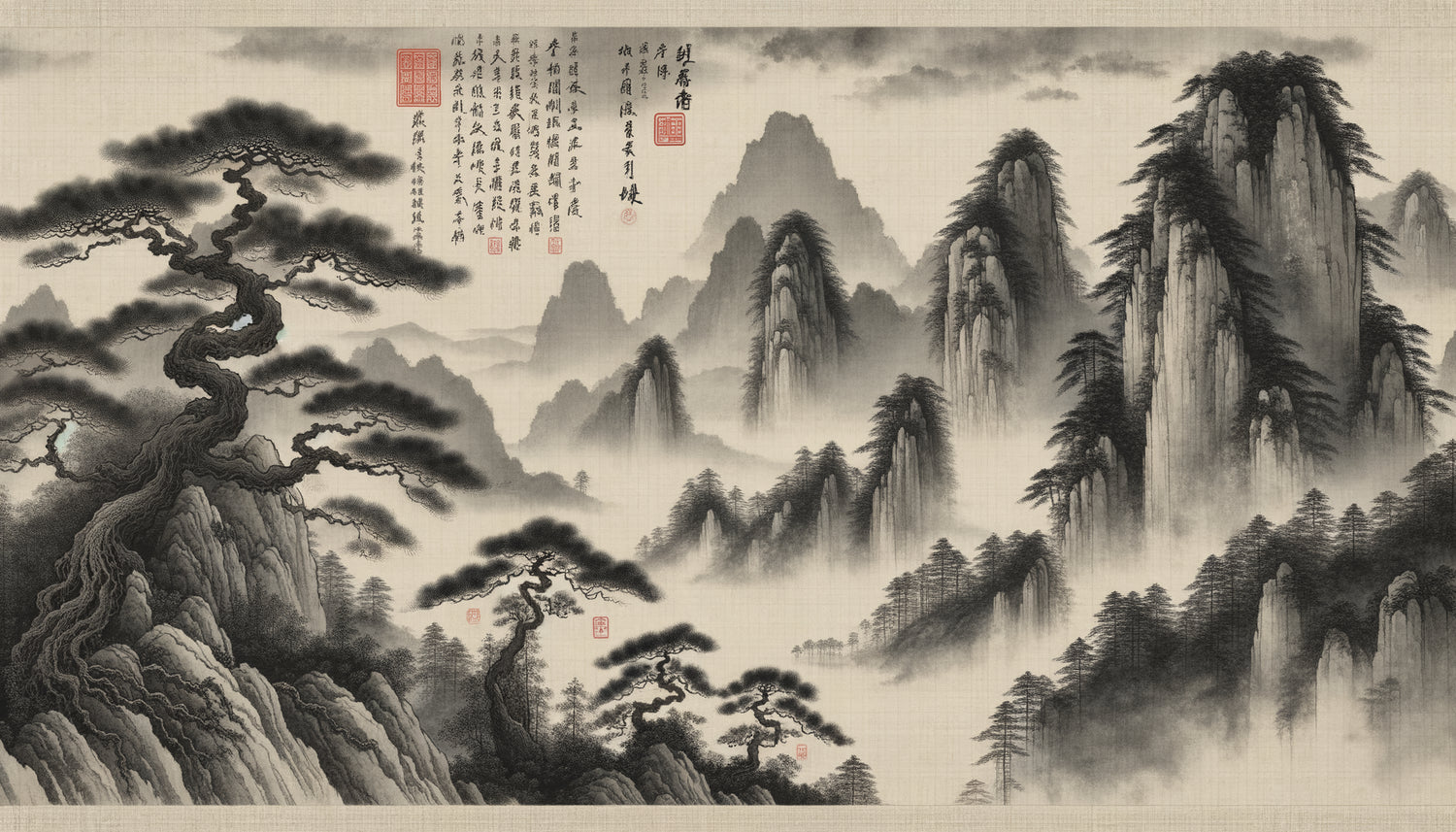
Imagine a roll of silk unfurled on a lacquered table. A misty mountain landscape stretches before your eyes, and in the empty spaces between the peaks, calligraphic characters tell the story of the traveler's emotion facing this immensity. It is not simply decoration: it is a conversation with three voices between the painter, the poet and the viewer, a millennial tradition where art becomes a total experience.
Here is what this ancestral practice reveals: the perfect union between visual contemplation, poetic meditation and emotional memory. Chinese literate travelers never separated what remains compartmentalized in the West: painting belongs to museums, poetry to books. In classical China, these arts merged to create something more powerful than their simple addition.
Today, faced with our interiors saturated with impersonal images and soulless decorations, we feel this void: where is the story? Where is authentic emotion? Our walls remain silent, our spaces lack narrative depth. Yet, this ancient Chinese wisdom offers a fascinating answer to our contemporary quest for meaning and authenticity.
Let me take you into the fascinating universe of Chinese landscape paintings, these works where each brushstroke dialogues with each calligraphic character. You will discover why this centuries-old tradition inspires our most daring decorative choices today.
When travel becomes a living work of art
The Chinese literate travelers of the Song, Ming and Qing dynasties were not simple tourists. Officials, philosophers, exiled poets, they traveled through China with brushes, ink and paper. Their approach was deeply contemplative: climbing a sacred mountain, navigating mythical rivers, isolating themselves in a forest hermitage.
But here is what distinguished them: they considered that painting alone could not capture the essence of a place. The visual landscape was only one facet of the experience. It lacked the sound of wind in the pines, the scent of rain on stone, the philosophical emotion facing the eternity of the mountains. That's where poetry came in.
Writing a poem directly on the painting was not a decorative addition. It was a spiritual necessity. The calligraphic characters complemented the image, adding a temporal and personal dimension. They told the precise moment: dawn when the fog lifted, the solitude felt at the summit, the nostalgia for a distant home. The poem anchored the experience in time and memory.
The three arts that are one: painting, poetry, calligraphy
In Chinese tradition, we speak of the three perfections (三絕, sānjué): painting, poetry and calligraphy. An accomplished scholar mastered these three disciplines, and landscape paintings became the ideal ground for unifying them.
Painting created space and atmosphere. Diluted ink suggested mists, distant mountains, trees twisted by the wind. But it also left voids, those white spaces so characteristic of Chinese art, which represent infinity, vital breath, the qi.
Calligraphy naturally occupied these spaces. Chinese characters are not mere signs: they are visual compositions, dances of the brush that possess their own plastic beauty. A quickly traced character expresses spontaneity; a slow and forceful stroke conveys gravity. Calligraphy therefore added a gestural and rhythmic dimension to the work.
Poetry, finally, brought intellectual and emotional depth. Often composed of just a few lines, these poems condensed powerful images: 'Clouds cling to millennial pines / My heart wanders in nameless valleys.' Each word resonated with the painted forms, creating sensory echoes.
A total composition for an immersive experience
The desired effect was a complete aesthetic experience. As one unrolled a painting (for these works were not permanently hung, but carefully preserved and contemplated at chosen moments), the viewer embarked on their own journey. Their eyes followed the path of the mountains, discovered hidden pavilions, then encountered poetic characters that enriched their understanding and deepened their emotion.
This practice transformed painting into a meditative object. One did not passively look: one read, deciphered, felt. Time stretched out. It was the opposite of our contemporary visual consumption, rapid and superficial.

The emotional memory engraved on silk
Why inscribe these poems directly onto the paintings rather than keeping them separate? The answer touches on the very nature of memory and lived experience.
Learned travelers knew that pure memory is volatile. A landscape seen once fades, details disappear. But by combining image and text, by making the visual and verbal dialogue, they created multiple mnemonic anchors. The poem recalled the emotional context of the painting; the painting gave form to the images evoked by the poem.
Imagine: an exiled official paints the mountains of his native province. He adds a melancholic poem about distance and the passage of time. Years later, contemplating this work, he does not simply see a landscape: he relives the very moment he created it, his emotions intact. The work becomes a personal temporal portal.
This intimate dimension also explains why other scholars added their own inscriptions to ancient landscape paintings. A collector, decades after the original creation, would inscribe his own poem, creating a conversation across time. The work became a palimpseste, an accumulation of voices and eras, a living object that grew with generations.
The landscape as a mirror of the soul
In Chinese philosophy, particularly influenced by Taoism and Chan (Zen) Buddhism, nature is not an external backdrop. It is a mirror of our inner state. Mountains represent stability and wisdom; water symbolizes fluidity and adaptability; clouds embody the ephemeral passage of time.
When a scholar inscribed a poem on a landscape painting, he explicitly established this correspondence. The poem revealed how the external landscape resonated with his internal landscape. 'The twisted pines on the cliff / resemble my stubborn heart.' Or else: 'The mist hides the paths / as uncertainty veils my future.'
This practice transformed art into an introspection tool. Contemplating such a work was not entertainment: it was a spiritual exercise. The viewer was invited to find their own resonances, to project their own emotions into the space created by the fusion of image and text.
A lesson in presence and slowness
This tradition teaches us something precious: the value of slow contemplation. At a time when we frantically scroll through thousands of images per day, the idea of spending an hour contemplating a single work, rereading a few verses, letting sensations deepen, seems almost subversive.
Yet, it is exactly what our contemporary interiors demand. Not walls covered with interchangeable images, but meaningful works that deserve our attention, that carry stories, that create spaces for mental breathing.

When tradition inspires our modern interiors
This ancient wisdom of Chinese landscape paintings finds an unexpected echo in our current decorative aspirations. We seek authenticity, emotional connection, narrative depth. We want our spaces to tell who we are, not just display a trendy style.
Integrating artworks inspired by this tradition into your interior invites this philosophy of contemplation into your home. A landscape painting with Asian influences, even contemporary, immediately brings a meditative dimension. Balanced compositions, assumed empty spaces, and a subtle palette of inks and natural tones create a valuable visual breath.
The absence of color saturation allows the gaze to settle. The clean lines of the mountains, suggestion rather than detailed description, invite the imagination to complete. You are not passively watching: you participate, you project, you feel. Your wall becomes an inner dialogue space.
Create Emotional Anchors
Learned travelers created memorial anchors with their poems inscribed. You can create your own anchors by choosing works that deeply resonate with your experiences. Does this mountain landscape remind you of a transformative hike? Does this aquatic scene evoke the serenity of a lake from your childhood?
Wall art should never be chosen solely to fill space or follow a trend. Each nature painting should carry an intention, tell something about your personal story or your aspirations. It is this emotional charge that transforms simple decoration into a living element of your daily life.
When you pass by each morning, the artwork should not disappear into the invisibility of habit. It should continue to offer moments of reconnection: a moment of calm before a busy day, a visual breath that refocuses your thoughts, a reminder of the values that guide you.
Transform your walls into spaces of contemplation
Discover our exclusive collection of nature paintings that capture the serenity of timeless landscapes and invite daily meditation.
The living heritage of a millennial tradition
What Chinese learned travelers understood centuries ago, we are rediscovering today: the most powerful art is not that which impresses at first glance, but that which reveals new depths with each contemplation.
By inscribing poems on landscape paintings, they were not simply decorating. They created meditation objects, emotional time capsules, invitations to slow down and feel deeply. They rejected the artificial separation between arts, understanding that true beauty is born of the fusion of senses and disciplines.
This lesson resonates powerfully in our fragmented contemporary lives. We need spaces that remind us of the essentials, that reconnect us to nature and our authentic emotions. Choosing a landscape painting for your interior is choosing depth over effect, contemplation over distraction, presence over agitation.
Imagine yourself tomorrow morning, with a cup of tea in hand, taking a few minutes to really look at this artwork hanging in your living room. The misty mountains appear different depending on your mood, depending on the daylight. You may not be reading a calligraphed poem, but you are composing one mentally, weaving your own words around the shapes and spaces. You become, in your own way, a modern literate traveler, transforming your everyday space into a territory of inner exploration.
This is what this tradition truly inherits: teaching us that art is not a superfluous luxury but an essential companion, a mirror that helps us better understand ourselves and consciously inhabit our lives.
Frequently Asked Questions
How to integrate the spirit of Chinese landscape paintings into a modern interior?
You don't need to transform your interior into an Asian museum to capture this essence. The spirit of Chinese landscape paintings rests on three simple principles: balance between empty and full, a subdued and natural palette, and a contemplative composition. Choose a work that breathes, that doesn't occupy all the space but dialogues with the blank areas of your wall. Favor shades inspired by nature: grays, deep greens, beiges, ink blacks. Place it in a spot where you can naturally stop for a few moments each day: facing the sofa, in a hallway where you pass in the morning, near your reading area. The important thing is not historical authenticity, but the creation of a visual anchor that invites pause and presence. A single well-chosen and well-placed painting transforms the energy of an entire room.
Is it really necessary to understand Chinese culture to appreciate these works?
Absolutely not, and even learned travelers would have approved of this idea. What makes these landscape paintings universal is that they speak directly to our emotions and our relationship with nature, which transcend cultures. You don't need to read Chinese characters to feel the melancholy of a misty landscape or the majesty of eternal mountains. The essential thing is your personal resonance with the work. Simply ask yourself these questions: Does this image soothe me? Do I discover new details with each look? Does it create a mental space of calm in my day? If the answer is yes, then you have understood the essence. Historical knowledge enriches appreciation, but sensory and emotional experience is accessible immediately, without cultural mediation. Trust your feelings above all.
Why choose a landscape painting over a nature photograph?
The difference lies in the poetic distance and the space left for your imagination. A nature photograph, however beautiful it may be, captures a specific moment with all its details. A landscape painting, especially in the tradition inspired by Chinese art, suggests more than it describes. Ink strokes evoke trees without detailing each leaf. Mists conceal as much as they reveal. This voluntary imprecision is an invitation: your mind naturally completes the image, projects your own experiences and emotions onto it. It is this active participation that creates meditative depth. Moreover, painted nature paintings possess a timelessness that photography struggles to achieve. They do not date, do not become outdated, because they have already crossed centuries in their aesthetic essence. They create a bridge between past and present, between exterior and interior, between wild nature and domesticated domestic space.