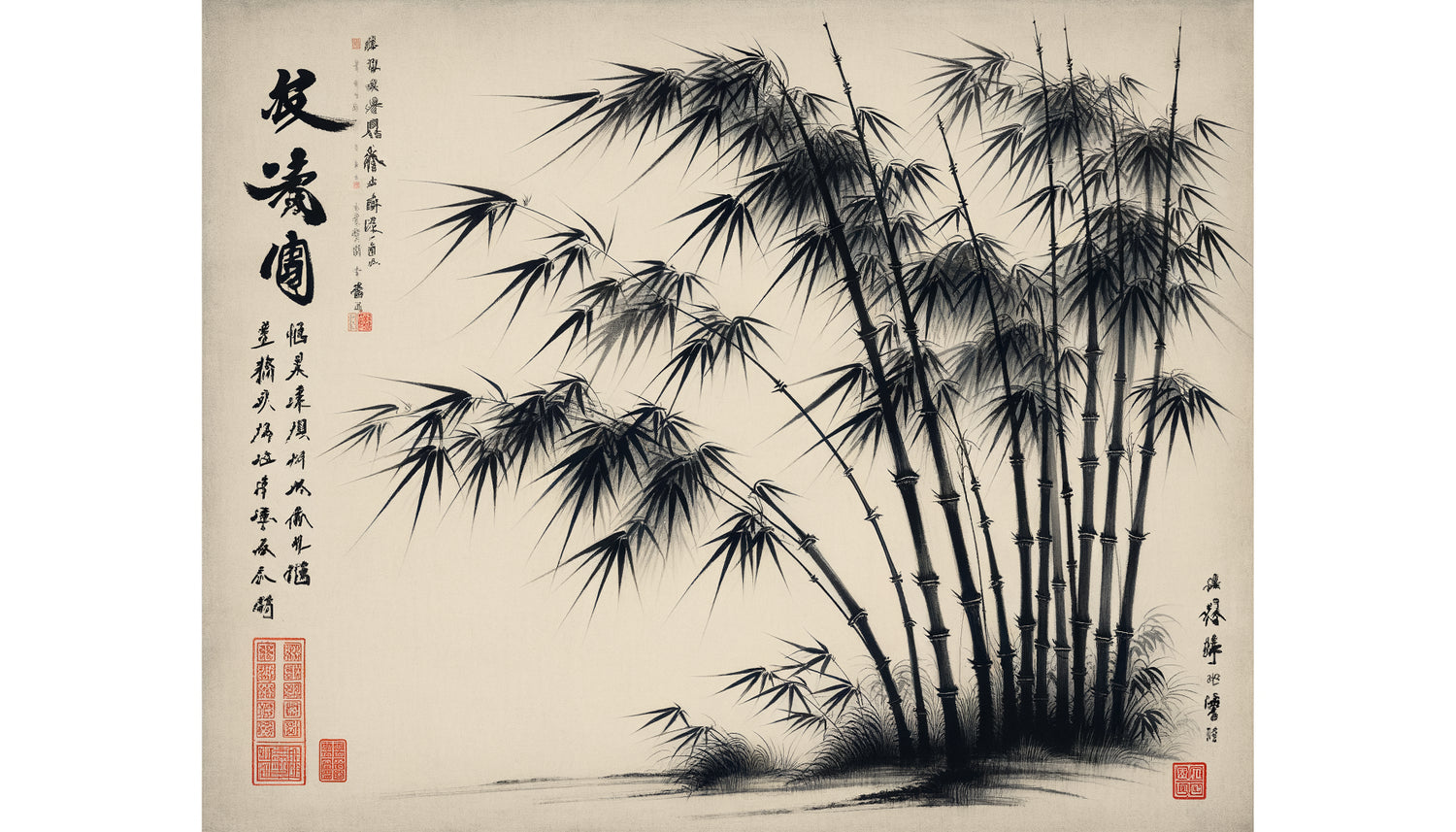
In the hushed workshop of a Parisian collector, a 14th-century Chinese painting unfolds slowly. Between mist and diluted ink, a forest of bamboo emerges from emptiness. No sumptuous decor, no exuberant details. Just a few slender stalks bending in an invisible breeze, their lanceolate leaves sketched in a few masterful brushstrokes. It's not simply a landscape: it's a moral self-portrait.
Here’s what bamboo reveals in Chinese literati art: a symbol of resilience in the face of adversity, the embodiment of the Confucian scholar’s integrity, and a living metaphor for flexibility without compromise. For Song to Ming dynasty official artists, painting bamboo was never a simple decorative exercise, but a silent philosophical statement.
Many admire these ancient Chinese paintings without grasping their coded language. They see minimalist elegance where a political manifesto is hidden. They appreciate the refined aesthetics without understanding that every curve of a stalk, every node, every leaf dancing carries a message as precise as a poem.
Yet, this understanding radically transforms our relationship with these works. It opens a door to the mental universe of Chinese scholars, those painter-poet-calligraphers who shaped Asian aesthetics for centuries.
Let's discover together why bamboo occupies such a unique place in literati landscapes, and how this humble plant has become the vehicle for an entire philosophy.
Bamboo, a portrait in negative of the ideal scholar
In the Confucian tradition that irrigates Chinese literati art, bamboo is never painted for itself. It's the vegetal mirror of the junzi, that “gentleman” whom every scholar aspires to become. This association dates back to classical texts: Confucius himself is said to have declared that he could not live without bamboo.
Why this profound identification? Bamboo possesses qualities that scholars considered the pillars of virtue. Its stems are straight but flexible: they bend in the storm without breaking, thus embodying moral adaptability without compromise. Its heart is hollow, symbolizing the humility and modesty of the sage who remains open to teachings. Its nodal sections evoke the segmented yet continuous integrity of moral character.
In Song dynasty landscape paintings, bamboo often appears isolated or in small groups, emerging from the mist. This solitude is not sadness, but spiritual autonomy. The scholar, like bamboo, remains faithful to his principles even when alone, even when imperial power becomes tyrannical. Many artists, having fallen into disgrace or chosen voluntary exile, painted bamboos as silent self-portraits of their moral resistance.
The art of bamboo as political language
Under the Yuan and Ming dynasties, when China was ruled by Mongol conquerors and then a sometimes oppressive centralized power, painting bamboo became an act of cultural resistance. Chinese scholars, excluded from power or refusing to serve masters they considered illegitimate, retreated to their gardens and studios. There, they painted bamboos stubbornly upright, indomitable.
The painter Zheng Xie (1693-1765), a genius calligrapher and poet, wrote: “When painting bamboo, I paint my heart.” His bamboos, traced with vigorous ink with calligraphic freedom, express a joyful defiance of the rigid social conventions of his time.
Four seasons, four virtues: bamboo in the temporal cycle
Chinese scholarly art often organizes the natural world according to the motif of the “Four Gentlemen” (四君子, si junzi): plum blossom, orchid, chrysanthemum and bamboo. Each represents a season and an aspect of the scholar's virtue. Bamboo, associated with summer, embodies vigor and uprightness in the fullness of life.
But bamboo has a remarkable peculiarity: it remains green all year round. Unlike deciduous trees that shed their leaves, bamboo maintains its verdure even under the snow. In winter landscapes of scholarly art, seeing stalks of bamboo emerge from a white blanket is a powerful image of moral constancy in the face of seasonal adversity.
This permanence symbolizes the scholar's fidelity to his principles, whatever the political seasons. Paintings of bamboo in the snow, particularly prized, show stems bent under the weight of white but never broken. It is the very image of resilience: bending temporarily to better straighten up again, rather than resisting rigidly and fracturing.
Technique reveals philosophy
The way of painting bamboo in scholarly art is as significant as the subject itself. Bamboo is always painted freely (写意, xieyi), without preliminary sketch, in a few decisive strokes of ink on silk or paper. This controlled spontaneity requires years of training.
The painter must “have bamboo in his heart” before lifting the brush, according to the established expression. This means visualizing the entire composition internally, then executing it in a single vital breath (气, qi). Each stroke is irrevocable: one cannot correct, overload or hesitate. This technique embodies the natural spontaneity of the Taoist sage combined with Confucian discipline – a typical paradox of classical Chinese thought.

The solitary or clustered bamboo: chosen solitude versus community
In landscape compositions, the number of painted bamboo stalks is never arbitrary. A solitary bamboo evokes the recluse scholar withdrawn from the world, cultivating his virtue in voluntary isolation. This is the Taoist hermit who prefers noble poverty to the compromises of imperial court.
A grove of bamboos, on the other hand, suggests the community of virtuous scholars who support each other. The stalks almost touch, bow together in the wind, but each remains distinct with its own roots. This is the Confucian ideal of harmonious society: morally autonomous individuals who coexist in mutual respect without undifferentiated fusion.
This dialectic between solitude and community runs through all Chinese landscape painting. Bamboo allows it to be expressed with remarkable economy of means: a few stalks are enough to raise the question of the relationship between the individual and the collective.
When emptiness speaks louder than fullness
Landscapes in Chinese literati art often fascinate by their masterful use of emptiness. Bamboo frequently emerges from an unpainted space, without a visible ground or defined horizon. This mist or void (虚, xu) is not a lack, but a positive presence in Chinese aesthetic thought.
The void represents infinite potential, the unspeakable Tao that precedes all manifestation. The bamboo that emerges from it embodies the passage from the unmanifest to the manifest, from abstract principle to its concrete realization. For the scholar-philosopher, painting a bamboo emerging from emptiness expresses his own emergence from the depths of meditation and study towards moral action in the world.
This aesthetics of emptiness profoundly influences contemporary Asian design and explains why these ancient paintings seem so modern to our Western eyes accustomed to visual saturation. Bamboo teaches that purified presence has more strength than accumulation.
Ink as an infinite range of presences
In literati art, bamboo is exclusively painted in ink, with variations in dilution that create a whole range of grays. This monochrome is not a limitation, but extreme refinement. The stalks use the densest and blackest ink, asserting their structure. The leaves, more diluted, capture light and movement.
This tonal gradation expresses the philosophy of yin and yang: all reality contains degrees of intensity, from the most dense to the most ethereal, in a continuous sequence without rupture. Bamboo, through its contrasts of ink, becomes a visual meditation on the graded nature of existence.
Let the millennial wisdom of bamboo inspire your interior
Discover our exclusive collection of landscape paintings that capture the poetic and philosophical essence of traditional Asian art.

Integrating the philosophy of bamboo into your living space
Understanding the meaning of bamboo in Chinese literary art transforms our way of inhabiting our spaces. It's not simply hanging an Asian painting for its zen aesthetic, it’s inviting a life philosophy into everyday life.
When you choose a work representing bamboos for your interior, you are not importing a decorative motif. You install a daily visual reminder of essential values: resilience in the face of difficulties, integrity that does not bend under social pressure, the beauty of voluntary simplicity.
In an office, a bamboo landscape evokes professional uprightness and the ability to remain true to one's principles even in corporate storms. In a meditation space or living room, it creates an atmosphere of serene contemplation. The painted bamboo becomes a silent companion, a discreet master who teaches without words.
Contemporary Asian art continues to explore this millennial motif with new techniques – photography, digital printing, abstract interpretations – but the symbolism remains rooted. Choosing a representation of bamboo, whether traditional or modern, is connecting to an unbroken lineage of aesthetic and philosophical thought.
Bamboo as a bridge between past and present
What makes bamboo eternally current in art and design is its ability to embody universal tensions. Strength and flexibility, solitude and belonging, permanence and change: these dialectics cross all cultures and all eras.
Chinese literati of the 11th century who painted bamboos to express their moral resistance to power still speak today to anyone navigating the compromises of modern professional life. Their search for authenticity in a world of conventions resonates with our own contemporary identity quests.
Bringing a landscape painting depicting bamboo into your home is much more than just a decorative choice. It's affirming a spiritual connection with this tradition of tranquil integrity, this moral elegance that rejects rigidity as much as complacency.
Imagine your gaze settling each morning on these slender stalks emerging from the mist. Gradually, their silent lesson infuses your day: remain flexible without losing your center, adapt without denying yourself, cultivate strength in simplicity. The bamboo of Chinese scholars has lost none of its relevance. It simply awaits that we learn to read its language.
Begin by carefully observing a single bamboo painting. Count the stalks. Note their orientation. Look for where the ink is dense, where it dilutes. Let the question emerge: what bamboo am I in the grove of my own life? This simple questioning opens the door to the wisdom that Chinese scholars have cultivated for centuries through their landscape art.
Frequently Asked Questions
Why is bamboo so prevalent in traditional Chinese art?
Bamboo occupies this central place because it perfectly embodies the Confucian and Taoist virtues that Chinese scholars valued. Its uprightness symbolizes moral integrity, its flexibility represents wise adaptability, its hollow core evokes humility, and its perennial greenery illustrates constancy. For artist-officials who created literati art, painting bamboo was never just a technical exercise but a meditation on their own moral character. It was also a coded language to express political or philosophical positions in a context where direct criticism could be dangerous. Bamboo allowed one to say without saying, to criticize without naming, to affirm one's values without confrontation.
How can you recognize an authentic bamboo landscape from literati art?
Authentic literati paintings are distinguished by several technical and aesthetic characteristics. First, they are always made with ink on silk or paper, never in bright colors. The technique is spontaneous, with decisive strokes executed without regret or correction. Bamboo often emerges from a significant void, without excessive decoration. You will generally find calligraphic inscriptions – poems or comments – integrated into the composition, because literati art combines painting, calligraphy and poetry. The red seals of the artist and successive collectors punctuate the work. But more than these formal elements, it is the spirit of restraint and suggestion that characterizes these landscapes: they evoke more than they describe, suggest more than they show.
Can a bamboo landscape be integrated into a modern Western interior?
Absolutely, and it's even particularly harmonious! The refined aesthetic of the literati bamboo landscapes blends beautifully into minimalist contemporary interiors. Their sophisticated monochrome palette dialogues with modern neutral color schemes. Their masterful use of emptiness perfectly corresponds to the principles of Scandinavian or contemporary Japanese design. To succeed in this integration, prioritize a simple frame that does not compete with the work – a matte black frame or natural wood works ideally. Place the artwork on a clean wall, without surrounding decorative clutter, to respect its meaningful void aesthetic. In a Western interior, these landscapes bring a touch of contemplative serenity and create a spiritual focal point. They work particularly well in spaces dedicated to calm: office, library, bedroom or meditation corner.