


Golden Renaissance Painting
The Renaissance Golden Painting celebrates the magnificence of European classical art with its shimmering golden tones. Our collection captures the essence of Renaissance style baroque paintings through majestic compositions inspired by the great masters. Each artwork evokes the visual richness and refinement of this legendary era. Perfect for sophisticated interiors, these Golden Renaissance decorative paintings bring nobility and character to your space.
 Philosopher Divine Nectar Painting - renaissance edition273,90 €
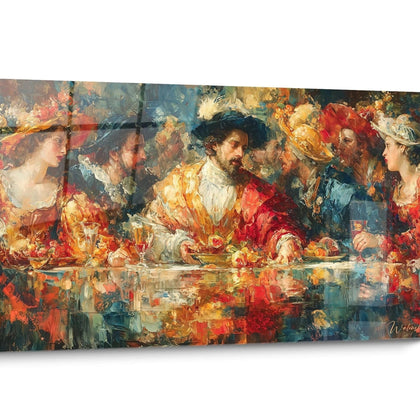
 Banquet Feast Opulent Painting - renaissance edition273,90 €
 Mysterious Sfumato Portrait Painting - renaissance edition273,90 €
 Orange Flowers Symphony Wall Art - renaissance edition273,90 €
 Male Portrait Painting Muse of the Arts - Renaissance Edition273,90 €
 Master Contemplator Portrait Painting - renaissance edition273,90 €
 Noble Lord Autumn Warmth Painting - renaissance edition228,90 €
Explore further
In Golden Renaissance Painting


All about Golden Renaissance Painting
- Presentation Painting Renaissance Gilded
- Gilded Renaissance Aesthetics
- Gilded Mythological Scenes
- Luxury Decor Integration
A Renaissance painting gilded embodies the artistic opulence of an era when gold symbolized spiritual transcendence and earthly magnificence. These large-scale wall art pieces reinterpret the visual codes of Italian and Flemish masters, where each application of gold leaf recalls ancestral pictorial enhancement techniques. The combination of allegorical compositions and gilded chromatic treatment creates an unparalleled visual presence in contemporary interiors aspiring to an aristocratic atmosphere.
The Art of Gilding in Renaissance Compositions
The gilded Renaissance painting is distinguished by its strategic use of gold tones that transcends simple wall decoration. Unlike standard reproductions, these monumental creations exploit the nuances of aged gold, patinated amber, and antique bronze to recreate the atmosphere of princely curiosity cabinets. The gilded areas generally frame the central figures according to the iconographic conventions of the Cinquecento, creating visual hierarchies that naturally guide the eye towards the essential narrative elements.
Why do gold backgrounds dominate Renaissance aesthetics?
The prevalence of gold in these compositions responds to a medieval cosmological symbolism perpetuated during the Renaissance. Golden backgrounds create a timeless pictorial space, detaching mythological or biblical scenes from any specific earthly reference. This technique confers a sacred or allegorical dimension on the subjects represented, transforming each gilded Renaissance painting into a visual portal to an idealized universe. The large dimensions allow for full appreciation of the subtle chromatic variations between pale gold and vermeil.
Gilding techniques in monumental formats
Large-format creations exploit several gilding techniques simultaneously. The nimbuses of sacred figures often receive applications of bright gold, while textiles and draperies benefit from translucent gilded glazes creating luxurious moiré effects. Armor, crowns, and royal attributes display a relief gilding technique, simulating the metallic repoussé of Florentine goldsmiths. This stratification of gilding techniques generates exceptional visual depth, particularly striking in reception areas benefiting from alternating direct and indirect lighting.
The influence of Italian and Flemish schools
The compositions draw direct inspiration from the divergent pictorial traditions of Northern and Southern Europe. The Italian approach favors architectural gilding – columns, arches, palatial ornaments – integrated into rigorous mathematical perspectives. The Flemish influence is manifested by the microscopic gilded details of jewelry, embroidery, and botanical elements. A Baroque Renaissance painting further develops these ornamental codes, but the Renaissance version maintains a relative sobriety where gold structures rather than overwhelms the composition. This distinction guarantees timeless elegance suitable for refined contemporary interiors.
Mythological Iconography and Gilded Symbolism
How do mythological scenes exploit the gold palette?
The golden renaissance paintings favor mythological narratives where Olympian deities embody human virtues and vices. Divine attributes – Jupiter's thunderbolt, Mercury's caduceus, Athena's aegis – consistently receive a gilded treatment that immediately designates them as objects of transcendent power. Golden twilight skies evoke the celestial Olympus, while earthly elements retain more subdued tones. This chromatic dialectic creates a narrative tension between divine and mortal spheres, particularly effective in formats exceeding standard dimensions.
Allegories of virtues and their gilded representation
The Renaissance allegorical tradition personifies abstract concepts into majestic female figures adorned with gilded symbolic attributes. Justice holds her scales with golden plates, Temperance pours from a golden vase, Prudence contemplates her mirror framed in gold. These personifications transform each painting into a visual moral program intended for spaces of power – patrician libraries, state rooms, executive offices. The monumental scale lends these allegories a quasi-architectural presence, structuring the atmosphere of the room around timeless aristocratic values.
Scenes of triumph and celestial processions
Processional compositions – imperial triumphs, processions of muses, heroic apotheoses – masterfully exploit the horizontality of large formats. Golden chariots, gleaming musical instruments, golden laurel wreaths rhythmically punctuate these narrative friezes that can extend for several meters. The golden chromatic continuity visually unifies these abundant compositions where dozens of characters coexist. Placed above monumental consoles or in longitudinal reception rooms, these golden renaissance paintings create a visual dynamic that amplifies the impression of space and magnificence.
The gilded botanical iconography and its meanings
Beyond human figures, the Renaissance flora holds a complex symbolism amplified by the gilded treatment. Golden pomegranates symbolize resurrection, golden lilies virgin purity, golden oaks dynastic strength. Golden garlands and festoons framing the main scenes reprise the motifs of the grotesque Roman decorations rediscovered during the Quattrocento archaeological excavations. This gilded vegetal ornamentation softens the solemnity of the main subjects while maintaining overall chromatic coherence, creating a visual richness that fully justifies the investment in imposing formats intended to indelibly mark the identity of an interior.
Integrating a Golden Renaissance Painting into Prestigious Contemporary Interiors
What architectural environments enhance these gilded creations?
The golden renaissance paintings of large dimensions find their optimal expression in generous volumes with classical proportions. Double-height entrance halls, grand staircases, formal dining rooms are privileged locations where their verticality or horizontality can fully unfold. Neo-Haussmannian interiors with moldings, cornices and rosettes naturally dialogue with the ornamental aesthetic of these works. Even in minimalist contemporary architectures, the strategic insertion of such a piece creates a dramatic contrast that elevates the entire space to a multi-layered sophistication.
Strategies for association with exceptional furniture
Harmonizing with furniture requires a thoughtful approach, prioritizing either stylistic concordance or controlled contrast. Lacquered Venetian furniture, gilded Louis XIV consoles, velvet emerald or ruby capitone armchairs create coherent ensembles evoking European aristocratic residences. Conversely, pairing with contemporary furniture in brushed steel, Carrara marble, or ebony wood creates a productive aesthetic tension where each element enhances the other. The imposing dimensions of the painting allow it to visually dominate the space without being overwhelmed by the surrounding furniture, unlike modest formats that risk disappearing in richly decorated interiors.
Lighting adapted to monumental gilded compositions
Gilded surfaces react dramatically to variations in lighting, requiring a sophisticated lighting design. Lateral grazing light reveals the micro-reliefs and textures of the gilded areas, creating changing shadow and light effects depending on the time of day. Directional spotlights with warm temperature (2700-3000K) enhance the amber and copper tones, while indirect lighting diffuses an enveloping luminosity that avoids aggressive reflections. Installing dimmers allows you to adjust the light intensity according to the time of day and the room's uses, transforming the Renaissance gilded painting into a dynamic element of the overall ambiance.
Real estate enhancement and identity signature
Acquiring such a piece constitutes a heritage investment that transcends simple decoration. In high-end real estate, the presence of exceptional wall art directly contributes to the perceived and actual valuation of the property. These creations immediately signal the owner's cultural status and refinement, functioning as social markers in professional environments – law firms, corporate headquarters, private clubs. The memorial dimension is also essential: a large-scale Renaissance gilded painting becomes the identity element around which the visual memory of a place is organized, creating a recognizable signature that endures beyond successive furniture rearrangements.
Does a Renaissance gilded painting suit modern minimalist interiors?
Absolutely, the contrast between the ornate gilded Renaissance and contemporary sobriety creates a highly sophisticated aesthetic tension. In a purified space with clean lines, such a work functions as an exclusive focal point that immediately captures attention without visual competition, allowing for a full appreciation of its iconographic and chromatic subtleties.
What is the optimal viewing distance to appreciate a large Renaissance gilded painting?
Monumental formats require a minimum distance of three to five meters to embrace the overall composition, while also allowing for a close approach to examine the technical details of the gilded areas. This double reading justifies their placement in passageways or large reception rooms where natural circulation offers these variations in distance.
How to durably maintain the gilded surfaces of a Renaissance painting?
Gilded areas require minimal but specific maintenance: monthly dusting with a soft brush with natural bristles, avoidance of aggressive chemical products, maintaining a stable humidity between 45-55% to prevent cracking. Direct exposure to sunlight should be avoided to preserve the color stability of the organic pigments coexisting with the metallic gildings.
Further reading
Our articles on this topic
- Renaissance or Baroque Painting: How to Choose Based on Your Interior
- How to Choose a Renaissance Painting to Decorate Your Dining Room
- Gilded Renaissance wall decor for a home entrance: creating a sumptuous welcoming effect
- How to Choose an Italian Renaissance Painting for Your Interior: The 4-Filter Method
- Do Gold Leaf Paintings Add Elegance to a Living Room?
- Which colours dominate Italian Renaissance paintings in interior decor
L'art qui suscite l'envie
Maison belge d'art mural grand format
14 jourspour changer d'avis*
Protection Walenskyincluse
Fabriquéen Italie
FormatXXL
Kit de fixationtoujours fourni
* Hors tableaux personnalisés et tailles personnalisées


