


Renaissance Portrait Wall Art
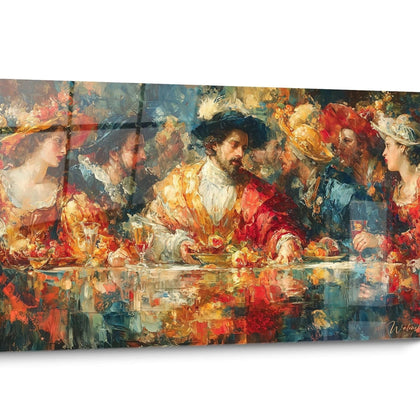
Our Renaissance Painting Portrait collection celebrates the golden age of European art with works inspired by the great masters. Each Renaissance Portrait classic captures the elegance and nobility of this fascinating era. These refined creations highlight the beauty of period costumes, subtle plays of light, and the expressiveness of faces. Perfect for lovers of Historical Renaissance Art, these paintings bring an aristocratic touch to your interior decoration.
 Woman Beauty Introspective Painting - Renaissance Edition273,90 €
 Mysterious Sfumato Portrait Painting - renaissance edition273,90 €
 Male Portrait Painting Muse of the Arts - Renaissance Edition273,90 €
 Master Contemplator Portrait Painting - renaissance edition273,90 €
 Woman with Flowers Passion Incarnate Painting - renaissance edition273,90 €
 Noble Lord Autumn Warmth Painting - renaissance edition228,90 €
 Face Reverie Ochre Painting - renaissance edition228,90 €
 Woman Refinement Pictorial Painting - renaissance edition228,90 €
Explore further
In Renaissance Portrait Wall Art


All about Renaissance Portrait Wall Art
- Renaissance Portrait Painting Presentation
- Artistic Styles and Movements
- Decorative Integration
- Characteristics and Authenticity
Reproductions of Renaissance portrait paintings represent the perfect embodiment of European classical art to elevate your living spaces with sophistication. These masterful works capture the essence of court portraiture, Italian and Flemish nobility, offering an incomparable historical and aesthetic dimension to your wall decoration. Our XXL formats allow you to appreciate every detail of Renaissance faces in their original splendor, revealing the finesse of expressions and the rich clothing characteristics of this pivotal period in art history.
The Legacy of Renaissance Portrait Masters
The Renaissance portrait painting draws its excellence from the tradition of great Italian and Flemish masters who revolutionized portrait art between the 15th and 16th centuries. This exceptional artistic period witnessed the birth of human representation techniques with unprecedented realism, where every corner of the lips, every reflection in the gaze reveals the psychology of the subject.
Why choose a Florentine-style portrait for your interior?
The Florentine school distinguishes itself through its mastery of anatomical drawing and sculptural modeling of faces. A portrait inspired by Botticelli or Ghirlandaio brings the refined elegance characteristic of the city of the Medici, with its typical architectural backgrounds and representations of Florentine patricians. These compositions are particularly suited to private libraries, reception rooms and executive offices where intellectual authority must transpire.
The Venetian tradition of ceremonial portraiture
Venetian portraits, particularly those influenced by Titian and Veronese, are characterized by their exceptional chromatic richness and sumptuous fabrics. Crimson velvet, golden brocades and ermine furs create incomparable visual depth. A Venetian Renaissance portrait painting instantly transforms a space into an aristocratic gallery, particularly suited to formal dining rooms and vestibules where first impression counts.
The innovations of Northern Flemish portraiture
The Flemish tradition with Van Eyck and Van der Weyden introduces photographic realism ahead of its time, with microscopic details visible in jewelry, skin textures and background landscapes. These works often present more intimate formats with dark neutral backgrounds that concentrate attention on the psychological intensity of the gaze. To explore further this fascinating period, discover our complete Renaissance Baroque painting collection which extends this aesthetic towards the dramatic compositions of the 17th century.
- Three-quarter portraits revealing spatial depth
- Allegorical symbols subtly integrated into the composition
- Luminous treatment of sfumato creating soft transitions
- Inscription of Latin mottos reinforcing the intellectual dimension
Integrating a Renaissance Portrait into Contemporary Spaces
The installation of a large Renaissance portrait painting creates a dramatic focal point that dialogues masterfully with contemporary architecture. This juxtaposition between old and modern generates an aesthetic tension particularly sought after in industrial lofts, renovated Haussmann apartments and daring architectural residences.
How to enhance an aristocratic portrait in a minimalist living room?
In a refined environment with geometric lines, a Renaissance noble portrait brings the humanity and historical complexity that balances the coldness of contemporary design. The contrast between immaculate white walls and warm tones of a gold-background portrait creates immediate visual hierarchy. Position your work facing the main entrance so it welcomes your guests with grandeur, as did portrait galleries in Florentine palaces.
Association with classical and transitional furniture
A Renaissance portrait naturally harmonizes with Louis XVI, Directoire or Empire style furniture, creating refined historical coherence. Marquetry chests of drawers, gilded consoles and medallion armchairs are ideal companions. However, association with mid-century modern furniture also produces spectacular results: an Eames chair facing a Venetian doge portrait generates a fascinating temporal dialogue between 20th-century rationalism and Renaissance humanism.
Which professional spaces benefit from a period portrait?
Law offices, notarial practices, private banks and cultural institutions find in the Renaissance portrait immediate historical legitimacy. These environments requiring trust and permanence benefit from the symbolic authority embodied by a 16th-century dignitary. Boardrooms and executive offices gain in prestige with these testimonies of European artistic excellence.
- Placement above a restored fireplace to recreate the ambiance of Italian studioli
- Installation in stairwells as a gallery of symbolic ancestors
- Association with gilded wall sconces reproducing candlelit lighting
- Creation of thematic gallery walls around princely dynasties
Recognizing the Authentic Characteristics of Renaissance Portraiture
Acquiring a quality Renaissance portrait painting requires an understanding of the visual and technical codes specific to this major artistic period. Faithful reproductions scrupulously respect the iconographic conventions, chromatic palette and geometric compositions that characterize the originals preserved in the great museums of Europe.
The symbolic attributes of power portraits
High Renaissance portraits systematically incorporate codified elements revealing the social status, profession or virtues of the subject. Delicately held gloves signal aristocratic refinement, open books manifest humanist erudition, while architectural columns in the background evoke stability and moral strength. A portrait of a Florentine merchant will display business letters, whereas a condottiere will exhibit damascene armor and a baton of command.
What importance should be given to hand position in the composition?
Hand gesture constitutes a language unto itself in Renaissance portraiture. Crossed hands suggest temperance, an index finger pointing to heaven indicates piety, while a hand placed over the heart expresses sincerity and commitment. Painters devoted as much attention to hands as to faces, as they revealed the artist's technical skill and the social distinction of the patron.
Significant architectural and landscape backgrounds
Unlike medieval neutral backgrounds, the Renaissance introduces elaborate settings: idealized Tuscan landscapes with characteristic cypress trees, open loggias overlooking urban views, or precious hangings creating illusionistic depth. These elements contextualize the portrait within a specific social environment and demonstrate mastery of atmospheric perspective, a major innovation of this era.
How to identify different regional schools?
The Roman school favors monumentality and idealization influenced by ancient statuary, while Leonardo's Milanese school introduces mysterious sfumato. French Clouet portraits present distinctive graphic precision with unified backgrounds, whereas German masters like Holbein integrate meticulous descriptive realism of textures. Recognizing these regional particularities allows you to orient your choice according to the desired atmosphere.
- Verification of anatomical accuracy of facial proportions according to humanist canons
- Observation of the quality of material rendering: velvet, silk, precious metals, furs
- Analysis of historical coherence of clothing and hairstyles according to dating
- Evaluation of the psychological depth of the captured gaze
Where to place a large-scale Renaissance portrait painting in a historic residence?
In period properties, position your portrait in the main reception rooms: grand salon, dining room or library. Respect the historical eye level, approximately 160 cm for the portrait center, allowing direct face-to-face with the represented character. Galleries and hallways also constitute traditional locations creating majestic visual paths.
Is a Renaissance portrait suitable for modern eclectic decoration?
Absolutely, the mixing of eras precisely constitutes the signature of successful eclectic style. A Renaissance portrait brings the historical and cultural depth necessary to anchor otherwise overly contemporary decoration. The essential lies in balancing proportions and creating intentional visual dialogues between old and modern, classical and avant-garde.
How to maintain an XXL format Renaissance portrait painting?
Large-format reproductions require regular dusting with a dry microfiber cloth, avoiding any chemical products. Maintain stable humidity between 45-55% to prevent deformation, and protect the work from direct sun exposure which would alter the pigments. Annual inspection of wall mounting ensures safety for these monumental pieces whose weight requires reinforced hanging systems.


