


Geometric Basenji Dog Wall Art
The Painting Basenji Dog Geometric transforms your space with a striking contemporary aesthetic. This collection celebrates the elegance of the Basenji through colorful geometric compositions that capture the essence of this noble breed. Each work combines clean lines and abstract shapes to create a modern canine wall art unique. Perfect for lovers of contemporary art and dog enthusiasts, this set brings sophistication and character to your interior decoration.
 Geometric Basenji Dog Painting Coral and Turquoise - Crystalline Joy - Basenji Edition273,90 €
 Geometric Dog Canvas with Egyptian Symbols - Golden Mosaic - Basenji Edition273,90 €
 Geometric Russet and Beige Dog Painting - Modern Portrait - Basenji Edition228,90 €
 Red and White Dog Wall Art Art Deco Patterns - Geometric Portrait - Basenji Edition228,90 €
 Basenji Dog Painting with Geometric Collar on Brick Wall - Urban Portrait - Basenji Edition228,90 €
Explore further
In Geometric Basenji Dog Wall Art
-
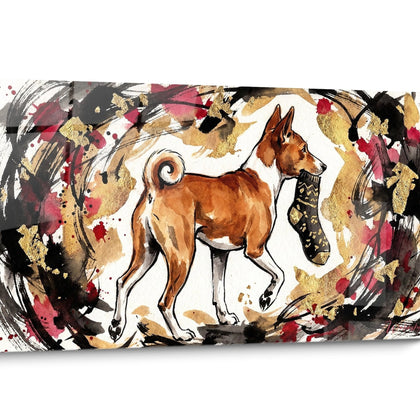 Basenji Dog Wall Art50
artworks
Basenji Dog Wall Art50
artworks
-
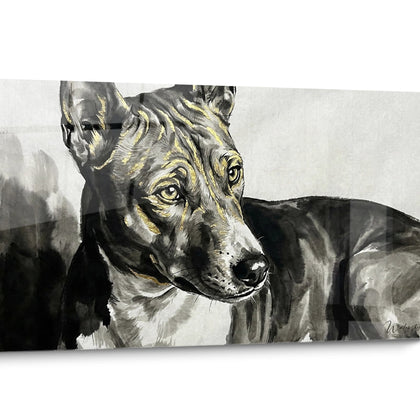 Black and White Basenji Dog Canvas4
artworks
Black and White Basenji Dog Canvas4
artworks
-
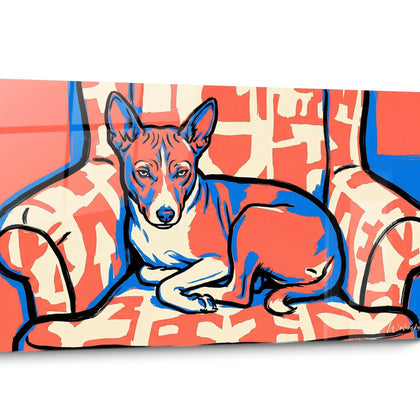 Basenji Dog Pop Art Canvas6
artworks
Basenji Dog Pop Art Canvas6
artworks
-
 Watercolor Basenji Dog Painting3
artworks
Watercolor Basenji Dog Painting3
artworks
-
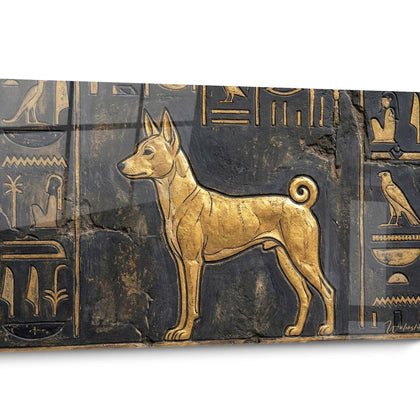 Golden Basenji Dog Wall Art14
artworks
Golden Basenji Dog Wall Art14
artworks
-
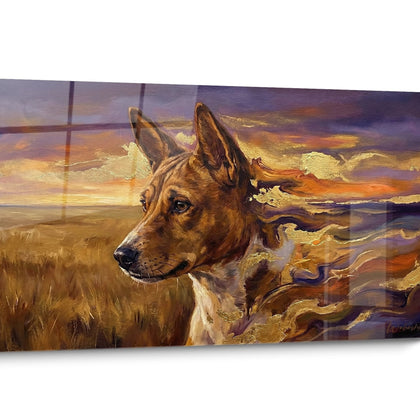 Basenji Dog Canvas Sunset4
artworks
Basenji Dog Canvas Sunset4
artworks
-
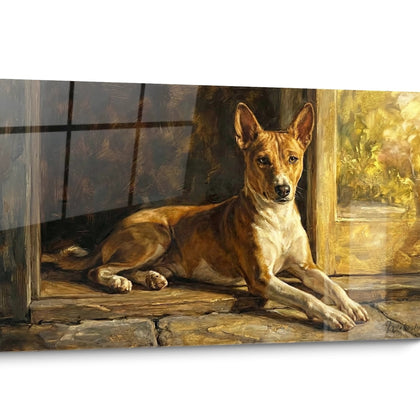 Vintage Basenji Dog Wall Art3
artworks
Vintage Basenji Dog Wall Art3
artworks
-
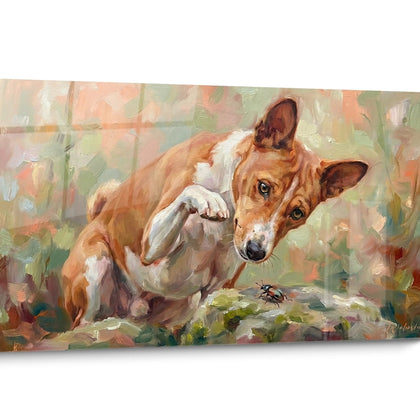 Realistic Basenji Dog Painting10
artworks
Realistic Basenji Dog Painting10
artworks
All about Geometric Basenji Dog Wall Art
- Presentation Painting Basenji Geometric
- Shapes and Angular Structures
- Modernity and Contemporary Design
- Visual Impact and Architecture
The painting Basenji dog geometric represents the perfect alliance between the natural elegance of this African breed and the mathematical abstraction of contemporary design. This wall art transforms the characteristic lines of the Basenji into a composition of polygons, angular shapes, and superimposed planes that create a striking visual depth. Perfectly suited for large, modern spaces, this type of representation enhances architectural volumes with its structured visual constructions and calculated perspectives.
The Polygonal Architecture of the Basenji in Wall Decor
The Basenji geometric dog painting transcends classic representation by decomposing the sleek silhouette of this African dog into angular facets that capture the light differently depending on the time of day. This visual fragmentation creates areas of shadow and light that animate the composition, transforming a static wall into a dynamic surface evolving with the ambient lighting.
How do triangular shapes enhance the morphology of the Basenji?
The decomposition into triangles and polygons remarkably highlights the fine musculature and the proud posture characteristic of the Basenji. Sharp edges emphasize the distinctive back curve, the iconic erect ears, and the wrinkled forehead that defines the intelligent expression of this breed. Each facet becomes a sculptural element that translates frozen movement into visual architecture, creating an aesthetic tension particularly suited to minimalist interiors and industrial lofts.
The superposition of geometric planes and the perceived depth
The stacking of geometric shapes generates an illusion of relief without resorting to traditional perspective. This Low Poly or Wireframe approach transforms the Basenji into a two-dimensional sculpture where each polygon seems to float at a different distance from the wall. For professional reception areas or large contemporary living rooms, this artificial depth brings a mathematical sophistication that dialogues with the surrounding architectural lines.
The interaction between limited chromaticism and angular structure
Color palettes typical of geometric style – monochromatic tones, grayscale gradients, black and white contrasts, or touches of primary colors – reinforce the readability of the angular structures. This chromatic economy allows shapes to take precedence over color, creating a visual hierarchy where the geometry of the Basenji emerges as a structuring element of the space. If you are looking for other stylistic interpretations of this breed, explore also the Basenji watercolor paintings which offer a fluid approach opposed to geometric rigor.
Geometric compositions work particularly well in environments where raw materials such as polished concrete, brushed steel, or glass predominate, creating an aesthetic coherence between wall decor and interior architecture.
The Geometric Basenji in the Universe of Contemporary Design
What interior spaces best enhance a Basenji geometric painting?
Residential open spaces, executive offices, entrances to technology companies, and urban apartments with a clean design are the preferred environments for this type of decoration. The Basenji geometric painting naturally integrates into spaces dominated by straight lines, sharp angles, and smooth surfaces. Its mathematical structure resonates with modular sofas, asymmetrical bookshelves, and sculpted lighting fixtures that characterize contemporary aesthetics.
The influence of Cubism and geometric abstraction
This artistic approach is in line with the avant-garde movements of the 20th century that deconstructed reality into elementary volumes. Applied to the Basenji, this visual philosophy transforms the animal into a graphic icon where each facet participates in global recognition without superfluous details. For those who appreciate bold artistic interpretations, the painting Basenji Pop Art offer another form of stylization that plays more on chromatic saturation.
The monumentality of formats adapted to large volumes
The large dimension versions of these geometric compositions transform the Basenji into a true wall installation that structures the architectural space. On surfaces of several square meters, the multiplication of facets creates a visual complexity that captivates the eye and becomes the focal point of an entire room. This monumentality is particularly suitable for double heights, stairwell walls and coworking spaces seeking a strong visual identity.
The geometric approach also allows for monochrome variations that adapt to corporate graphic charters, unlike the Basenji sunset painting whose natural palette imposes its own chromatic constraints.
How does the geometric style dialogue with Scandinavian furniture?
The contemporary Nordic aesthetic, with its clean lines and natural materials, finds a perfect echo in the geometric compositions of the Basenji. Light woods, neutral textiles and functional shapes characteristic of Scandinavian design create an ideal backdrop where the angular structure of the painting introduces a welcome graphic tension without breaking the overall harmony.
Architectural Impact and Spatial Perception of the Geometric Basenji
The visual enlargement effect in constrained spaces
Paradoxically, a geometric Basenji painting of large size can visually enlarge a space by creating a virtual vanishing point through its guiding lines and superimposed planes. Compositions using isometric perspectives or triangular grids generate a spatial dynamic that counteracts the feeling of confinement, particularly effective in hallways, narrow entrances or windowless offices.
Why is the Basenji particularly well suited to geometrization?
The Basenji's naturally angular morphology – with its perfectly erect triangular ears, its tapered muzzle, its straight back and its curled tail forming a geometric spiral – offers an ideal basis for decomposition into elementary shapes. Unlike other breeds with more rounded contours, the Basenji has a bodily architecture that naturally translates into polygonal language without losing its immediate recognition. This particularity explains why digital artists prefer this breed for geometric experiments.
The complementarity with other styles of Basenji representation
To create a coherent gallery wall around this iconic breed, the geometric style can be combined with contrasting approaches. Black and white Basenji paintings offer a photographic sobriety that dialogues with angular abstraction, while realistic Basenji paintings create an interesting figurative counterpoint. For a luxurious approach, gold Basenji paintings add a precious dimension, and vintage Basenji paintings introduce a nostalgic dimension. All of these variations can be explored in the general collection of Basenji paintings.
Adaptation to technological biophilic design trends
The current trend seeking to reconcile nature and technology finds a perfect expression in the Geometric Basenji: the animal (natural element) meets the algorithm (mathematical construction). This hybridization meets the expectations of next-generation workspaces that want to humanize technological environments without sacrificing modernity. XXL formats allow you to create virtual green walls where the animal presence is evoked by geometry rather than realism.
Would a Geometric Basenji painting suit traditional interiors?
Although primarily intended for contemporary spaces, a Geometric Basenji painting can create a striking contrast in a classic interior, provided you play with a monochrome palette that dialogues with the existing woodwork and moldings. This stylistic tension brings a touch of controlled modernity without upsetting the decorative balance.
What is the difference between a Basenji Low Poly and Wireframe?
The Low Poly style uses colored, filled polygons that create solid facets, while the Wireframe only shows the edges in the form of lines, leaving the faces transparent. Low Poly generates a more substantial presence suitable for large walls, while Wireframe offers an airy lightness ideal for spaces that are already visually busy.
How to integrate a Geometric Basenji painting into a professional space?
In corporate environments, the Geometric Basenji acts as a marker of innovation and pioneering spirit, qualities historically associated with this breed of independent hunter. Its technological aesthetic reassures clients about the modernity of the company while introducing an animal dimension that humanizes the space and stimulates team creativity.


