


Minimalist Crane Wall Art
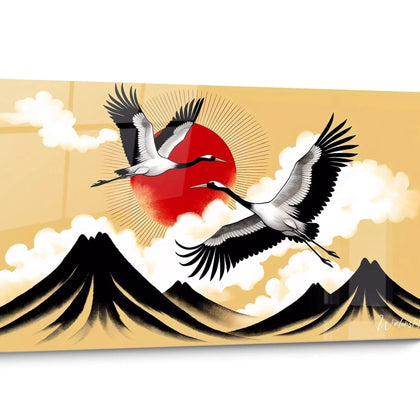
The Crane Painting Minimalist embodies the essence of Japanese simplicity and timeless grace. This collection celebrates the symbolism of the crane, a sacred bird bearing longevity and wisdom, through a refined Japanese minimalist art . Each work captures the delicacy of lines and the harmony of empty spaces, creating a zen atmosphere and contemplative. Perfect for lovers of Japanese-inspired minimalist decor, this artistic universe brings serenity and sophistication to any modern interior.
 Wall Art In the Silence of the Reeds - Japanese Asia Edition273,90 €
 Crane Guardian of Waters Wall Art - Crane Edition228,90 €
 Crane Mirror of Souls Wall Art - Crane Edition228,90 €
Explore further
In Minimalist Crane Wall Art


All about Minimalist Crane Wall Art
- Description Painting Crane Minimalist
- Purification and Symbolism
- Integration into Contemporary Spaces
- Selection and Visual Impact
The minimalist crane painting embodies a subtle fusion between the millennial symbolism of the sacred bird and the pure codes of contemporary design. This large-format artistic representation favors the essential: clean lines, restricted color palette, and airy composition that transforms the natural elegance of the crane into a powerful visual statement. Unlike traditional ornamental compositions, these wall creations play on the contrast between negative spaces and essential lines to magnify the anatomical grace of the wading bird. Collectors seeking a balance between cultural refinement and contemporary aesthetics prefer these interpretations where each graphic element justifies its presence, creating a soothing focal point without decorative clutter.
The Art of Visual Reduction in the Minimalist Crane Painting
The minimalist crane painting rests on a fundamental principle: eliminate all superfluity to reveal the very essence of this mythical bird. This radical approach transforms the crane's long silhouette into pure geometry, where each curve of the elongated neck, each angle of the graceful legs becomes a study of proportion and balance. Color palettes often limit themselves to two or three dominant hues, creating a visual harmony that facilitates integration into contemporary architectures with sober lines.
Why does minimalism magnify the symbolism of the crane?
Formal reduction paradoxically amplifies the symbolic charge of the bird. In Asian traditions, the crane represents longevity and wisdom, values that graphic purification translates into timeless visual permanence. A minimalist crane painting in a large dimension eliminates anecdotal details to focus attention on the characteristic meditative posture, this zen verticality that inspires contemplation and serenity. This economy of means creates a visual breathing space particularly sought after in spaces where concentration and calm are paramount.
The graphic codes specific to purified representations
Minimalist creations favor several distinctive visual techniques. The single continuous line evokes Japanese sumi-e calligraphy, where the mastery of the brush captures the vital energy in a fluid gesture. Neutral monochrome backgrounds – off-white, pearl gray, sand beige – amplify the presence of the avian silhouette by contrast. Some compositions exploit calculated asymmetry, positioning the crane in the upper or lateral third to create dynamic tension despite the apparent simplicity. This compositional approach is directly inspired by the principles of ma (negative space) of Japanese aesthetics, where emptiness possesses as much importance as fullness.
The alliance with contemporary artistic movements
The minimalist crane painting naturally fits into the lineage of Scandinavian hygge style and modern japonism, two movements valuing functional purification, collectors who also appreciate the geometric compositions of the 1920s-1930s, exploring a Art Deco crane painting allows you to discover how this same avian motif is expressed through the graphic opulence and color blocks characteristic of this period. Panoramic horizontal formats create wall friezes that visually structure long hallways or open spaces, transforming a simple wall into an architectural element.
Optimize the Placement of a Minimalist Crane Painting in Contemporary Housing
The successful integration of a minimalist crane painting in a large size requires precise spatial reflection. These purified compositions function as space amplifiers: their restricted color palette and airy composition visually expand volumes, particularly effective in urban apartments with optimized surfaces. Unlike saturated works that fragment attention, these representations create a unique anchor point that unifies the spatial reading of a room.
How does the minimalism of the crane painting dialogue with interior architecture?
Spaces with a dominant concrete-rendered finish, blond parquet flooring, or natural stone cladding find an ideal complement in the minimalist crane painting. The bird's natural verticality resonates particularly in double-height environments or mezzanines, creating a visual continuity between levels. Large bay windows benefit from an adjacent placement: the streamlined silhouette establishes a dialogue with the exterior trees or the sky, extending nature indoors without imitation. This visual permeability reinforces the biophilic connection sought in contemporary habitats concerned with well-being.
Strategies for highlighting in professional spaces
Tertiary environments – medical offices, architects' offices, coworking spaces – are massively adopting these representations for their soothing qualities. A panoramic minimalist crane painting installed in a waiting room noticeably reduces anxiety thanks to its pacifying horizontality and neutral tones. Open spaces exploit these formats as subtle visual separators: strategically positioned, they delineate concentration zones and collaborative spaces without physical partitions. The large dimension then becomes a zoning tool, structuring flows without material obstacles.
Which complementary decorative elements should be prioritized?
Purism imposes rigor in associations. Furniture with sculpted lines – Eames armchairs, String shelving units, Noguchi coffee tables – share this philosophy of less is more. Raw natural materials amplify the effect: crumpled linen for textiles, artisanal ceramics with subdued glazes, driftwood objects. Avoid multiplying focal points: a single asymmetrical vase containing a few cherry branches is enough to create a dialogue with the wall composition. Suspended wire lighting or washi paper lamps extend this aesthetic without overload, their transparent design preserving the essential visual breathing of minimalist interiors.
Selection Criteria for a High-Impact Minimalist Crane Painting
Acquiring a large-format minimalist crane painting requires evaluating several technical and aesthetic parameters. The quality of the print determines the subtlety of the nuances: high-end giclée technologies faithfully reproduce the subtle gradations and texture variations essential in these streamlined compositions. A deep black without color cast, neutral grays free of greening, pure whites guarantee the visual longevity of the artwork against daily light variations.
Why is the format-motif ratio crucial?
In a minimalist composition, the ratio between total surface area and space occupied by the subject creates the visual balance. A crane that is too imposing in its frame generates oppression despite the graphic simplicity. Conversely, a motif lost in space loses its impact. Panoramic formats of 120x60 cm or larger allow for generous negative spaces that amplify the subject's presence by contrast. This lateral breathing imitates the compositions of Chinese literati painting, where emptiness structures as much as the line. Verify that the composition respects the golden proportions or the rule of thirds for a naturally soothing balance.
The importance of the support in minimalist perception
Printing surfaces radically influence the final rendering. Matte finishes absorb light, creating a contemplative depth ideal for cocooning atmospheres. Satin finishes offer a slight reflection that dynamizes the composition without glare, particularly suitable for spaces receiving variable natural light. For a minimalist crane painting intended for a high-traffic environment, prioritize UV and water-repellent treatments that preserve color intensity. Mountings without traditional framing – back paneling on a rigid aluminum or dibond support – amplifies the impression of contemporary floating, the artwork seeming to levitate against the wall.
How to assess overall stylistic consistency?
Analyze the purity of the minimalist approach: some compositions subtly introduce bamboo or prunus floral motifs, while others maintain a strict isolation of the subject. Your choice depends on the desired degree of aesthetic radicalism. Monochrome black-and-white-gray palettes suit Nordic interiors, while variations including ochre, rust, or blue-gray harmonize with wabi-sabi atmospheres that favor natural patina. Check the consistency between graphic technique and dimensions: a fine line may disappear on a very large format, while a massive block can saturate a reduced space.
Is a minimalist crane painting suitable for small spaces?
Paradoxically, large dimensions work remarkably well in compact spaces. Visual purification and light tones perceptibly enlarge the room, while a substantial format positioned on a focal wall creates an illusory depth. The key lies in choosing compositions with a dominant light tone and a high proportion of negative space.
What is the difference between a minimalist crane and a naturalistic representation?
Naturalistic versions faithfully reproduce plumage details, aquatic reflections, and the complete environment. The minimalist crane painting eliminates these elements to retain only the characteristic silhouette and iconic posture, creating a graphic icon rather than an ornithological illustration. This partial abstraction facilitates decorative integration while preserving immediate recognition of the motif.
How to maintain a large-size minimalist crane painting?
A monthly dusting with an antistatic microfiber cloth is generally sufficient. Avoid direct exposure to sunlight, which can alter the subtle nuances essential to purified compositions. For treated surfaces, a semi-annual cleaning with slightly damp demineralized water preserves the brilliance without the risk of streaks. Humid environments require waterproof supports to guarantee dimensional stability.
Further reading


