


Japanese Crane Wall Art
The Japanese Crane Wall Art embodies the elegance and spirituality of Japanese culture. A symbol of longevity, fidelity, and happiness in Japanese tradition, the crane inspires a refined Asian décor that transforms your spaces into peaceful sanctuaries. This collection captures the majestic beauty of this sacred bird through delicate and authentic artistic compositions. Perfect for creating a zen and sophisticated ambiance, each Japanese wall art celebrates the harmony between nature and tradition, bringing a unique cultural touch to your interior.
 Wall Art In the Silence of the Reeds - Japanese Asia Edition273,90 €
 High Perch Wall Art - Asia Edition273,90 €
 Under Japan's Sky - Japanese Asia Edition Wall Art273,90 €
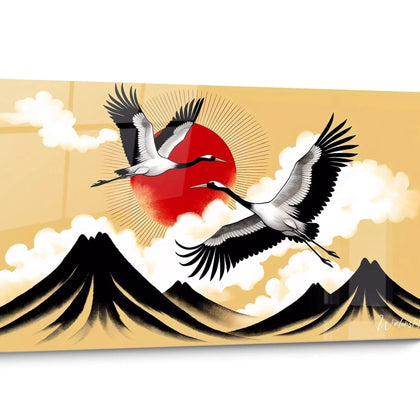
 Flight Toward the Sun Wall Art - Asia Edition273,90 €
Explore further
In Japanese Crane Wall Art



All about Japanese Crane Wall Art
- Japanese Crane Wall Art Presentation
- Traditional Japanese Symbolism
- Aesthetic Codes and Composition
- Integration into Contemporary Interiors
The Japanese crane wall art embodies one of the most revered motifs in Japanese iconography, combining visual refinement with symbolic depth. These large-scale mural compositions capture the natural elegance of the tsuru, the sacred bird that has traversed traditional prints and folding screens for centuries. Unlike Western representations of decorative birds, the Japanese crane wall art is rooted in a codified aesthetic tradition where each curve of plumage and bodily position conveys a precise cultural message. Collectors particularly seek monumental formats that restore the majesty of this mythical wader to contemporary living spaces, creating a visual bridge between ancestral artistic heritage and modern architecture. Acquiring such a decorative element transcends simple wall decoration to constitute a genuine investment in Japanese art, where immediate recognition of the motif by connoisseurs transforms your interior into a personal gallery dedicated to Japanese culture.
The millennia-old symbolism of the tsuru in Japanese imagery
The Japanese crane wall art draws its power from the symbolic layers accumulated by this venerated bird since the Heian period. In Shinto cosmogony, the tsuru embodies exceptional longevity and absolute marital fidelity, these cranes forming lifelong monogamous couples. Acquiring a large-scale mural representation allows you to visually anchor these fundamental values in domestic space, particularly sought after for master bedrooms where this symbolism resonates with matrimonial commitment.
Why are cranes represented in groups of a thousand?
The tradition of senbazuru, these thousand folded-paper cranes, echoes in pictorial compositions where multiple waders coexist. The authentic Japanese crane wall art exploits this sacred numerology by visually suggesting multiplicity without graphic saturation, creating narrative tension between the main subject and secondary silhouettes. Discerning buyers favor asymmetrical compositions where three or five cranes structure the space according to wabi-sabi principles, avoiding symmetrical Western arrangements that would betray unfamiliarity with Japanese aesthetic codes.
Chromatic attributes in traditional representation
Unlike saturated palettes, the traditional Japanese crane wall art favors diluted inks and subtle washes evoking morning mists of wetlands. Immaculate white plumage contrasts with the carbon-black accents of the flight feathers and the distinctive vermillion touch at the crown, a trichromatic arrangement respecting the aristocratic restraint of the Kanō and Tosa schools. For contemporary minimalist interiors, this chromatic restraint offers a sophisticated focal point without visual aggression, while the gold leafing reserved for noble versions amplifies ambient luminosity through indirect reflection.
Inscription within Japanese seasonal cycles
The Japanese crane wall art traditionally associates with New Year celebrations and spring prosperity wishes, when these migratory birds return from wintering zones. The most prized representations integrate seasonal botanical elements such as gnarled pine branches (matsu) symbolizing resilience, or plum blossoms (ume) announcing renewal. This botanical contextualization allows purchasers to create seasonal decorative rotations depending on chosen compositions, a practice common in traditional dwellings where wall scrolls changed according to the lunar calendar. To discover different stylistic approaches to this motif, explore our Japanese crane Art Deco wall art collection, which reinterprets these codes with Western geometrization.
Compositional principles of Japanese master printmakers
Exploiting empty space as narrative element
The Japanese crane wall art derives its visual power from the concept of ma, this deliberate spatial interval that structures the composition. Unlike Western paintings saturating the visual field, Japanese masters strategically position waders in restricted action zones, leaving vast blank areas suggesting infinite sky or expansive lakes. This sophisticated management of emptiness requires generous mural formats to produce optimal contemplative effect, which is why small reproductions systematically betray the original artistic intention. Buyers seeking authentic experience favor dimensions exceeding 120 centimeters so that ma fully operates its respiratory function in visual perception.
How to recognize balanced composition according to Japanese canons?
The authentic Japanese crane wall art rigorously applies the principle of odd numbers and dynamic asymmetry. A crane positioned in the upper right third finds its visual counterweight in vegetative elements in the lower left foreground, creating an implicit diagonal that the eye naturally traverses according to traditional Japanese vertical reading. Mediocre commercial versions awkwardly center the subject, canceling this essential compositional tension. Connoisseurs also examine the orientation of the avian gaze: a crane fixing space beyond the frame invites the viewer to mentally extend the scene, a sophisticated narrative technique of the Rinpa schools.
Calligraphic gesture in plumage rendering
The representation of feathers in traditional Japanese crane wall art reveals the artist's technical mastery through the treatment of the fude, this brush whose variable pressure produces characteristic gradations. Primary flight feathers are executed in one continuous downward gesture, capturing movement and vitality according to shodō calligraphic principles. This gestural approach radically distinguishes Japanese aesthetics from Western photographic rendering: the artwork does not seek naturalistic mimesis but the spiritual essence of the bird, its quintessence captured in a few synthetic strokes. For contemporary interiors valorizing raw artistic expression, this economy of means resonates with Scandinavian minimalist aesthetics while maintaining affirmed cultural identity.
Integration of seals and poetic inscriptions
The complete Japanese crane wall art traditionally includes calligraphic cartouches presenting haikus evoking migration, fidelity, or transcendence. These textual insertions, far from being merely decorative, function as semantic counterpoints enriching visual reading. Vermillion seals (hanko) authenticating the artist position strategically to balance composition without disrupting primary visual flow. Western collectors often underestimate this literary dimension, privileging immediate graphic impact, but cultivated buyers recognize that this text-image hybridization constitutes the heart of ukiyo-e print and folding screen painting aesthetics.
Integrating traditional iconography into modern residential architecture
Creating a focal point in transitional spaces
The Japanese crane wall art finds its privileged destination in intermediate zones of contemporary habitat: generous entrance halls, panoramic corridors, stairwell landings where its pronounced vertical dimension naturally embraces the slender architecture. Unlike horizontal landscapes, the upright posture of the tsuru in flight or balanced on one leg perfectly accommodates the narrow but tall walls characteristic of modern urban construction. This architectural compatibility explains why interior designers specializing in cultural fusion systematically recommend this motif to energize circulation without visual clutter, the bird appearing to traverse space in weightlessness.
What chromatic environments enhance this type of composition?
The Japanese crane wall art deploys maximum potential against mural surfaces in earth umber, anthracite gray, or off-white slightly ivory tones. These neutral backgrounds reproduce the effect of traditional washi paper or natural silk supports, allowing subtle inks and translucent washes to project their delicacy. Saturated colored walls annihilate this chromatic subtlety: authentic artwork requires this environmental restraint so that its infime nuances emerge progressively according to daily luminous evolution. Japanese-influenced interior architects frequently create slightly recessed alcoves recalling tokonoma, these sacred niches of traditional houses where the work benefits from a dedicated architectural setting.
Association with Western contemporary furniture
Contrary to common assumptions, Japanese crane wall art does not require an entirely Japanese environment to operate visually. Its refined geometry dialogues harmoniously with light-wood Scandinavian furniture, Bauhaus lines, and even certain sober Art Deco pieces. The essential element lies in respecting coherent restraint: eclectic decorative accumulation dilutes the work's impact, which operates optimally as a unique focal element in its immediate visual field. Stylists recommend clearing a two-meter radius around the artwork, creating spatial breathing that amplifies its presence without competing decorative distraction.
What lighting preserves authenticity of perception?
Traditional Japanese crane wall art was conceived for diffuse natural light from shōji, these translucent partitions filtering solar luminosity. Reproducing this ambiance in modern habitat requires avoiding aggressive directional lighting in favor of indirect sources: wall sconces oriented toward the ceiling, LED strips concealed in cornices, spotlights oriented toward adjacent reflective surfaces. This enveloping light preserves subtle gradations and avoids overexposed zones that would flatten delicate tonal values. For rooms benefiting from generous solar light, positioning perpendicular to windows prevents accelerated fading while allowing optimal visibility from main circulation zones.
Why choose Japanese crane wall art over other Japanese animal motifs?
The tsuru occupies a superior hierarchical position in the Japanese symbolic pantheon, surpassing the koi carp associated primarily with male perseverance or the tiger connoted with warfare. Its semantic versatility allows integration into all domestic spaces without gendered or restrictively functional connotation, unlike dragons traditionally reserved for reception halls or phoenixes confined to wedding chambers.
Is Japanese crane wall art suitable for contemporary professional spaces?
Absolutely, particularly in sectors valorizing cultural sophistication and partnership longevity: law offices, corporate headquarters, high-end reception spaces. The motif subliminally transmits values of fidelity, elegance, and refinement without the aggressive ostentation of certain Western success symbols, creating an atmosphere conducive to lasting business relationships.
How to identify museum-quality reproductions of this motif?
Examine the depth of carbon blacks which must present absolute opaque density without grayness, verify the presence of subtle tonal variations in white plumage areas avoiding uniform flatness, and check contour sharpness which should display slight organic irregularity characteristic of brushstroke rather than computer vector perfection betraying low-end digital production.


