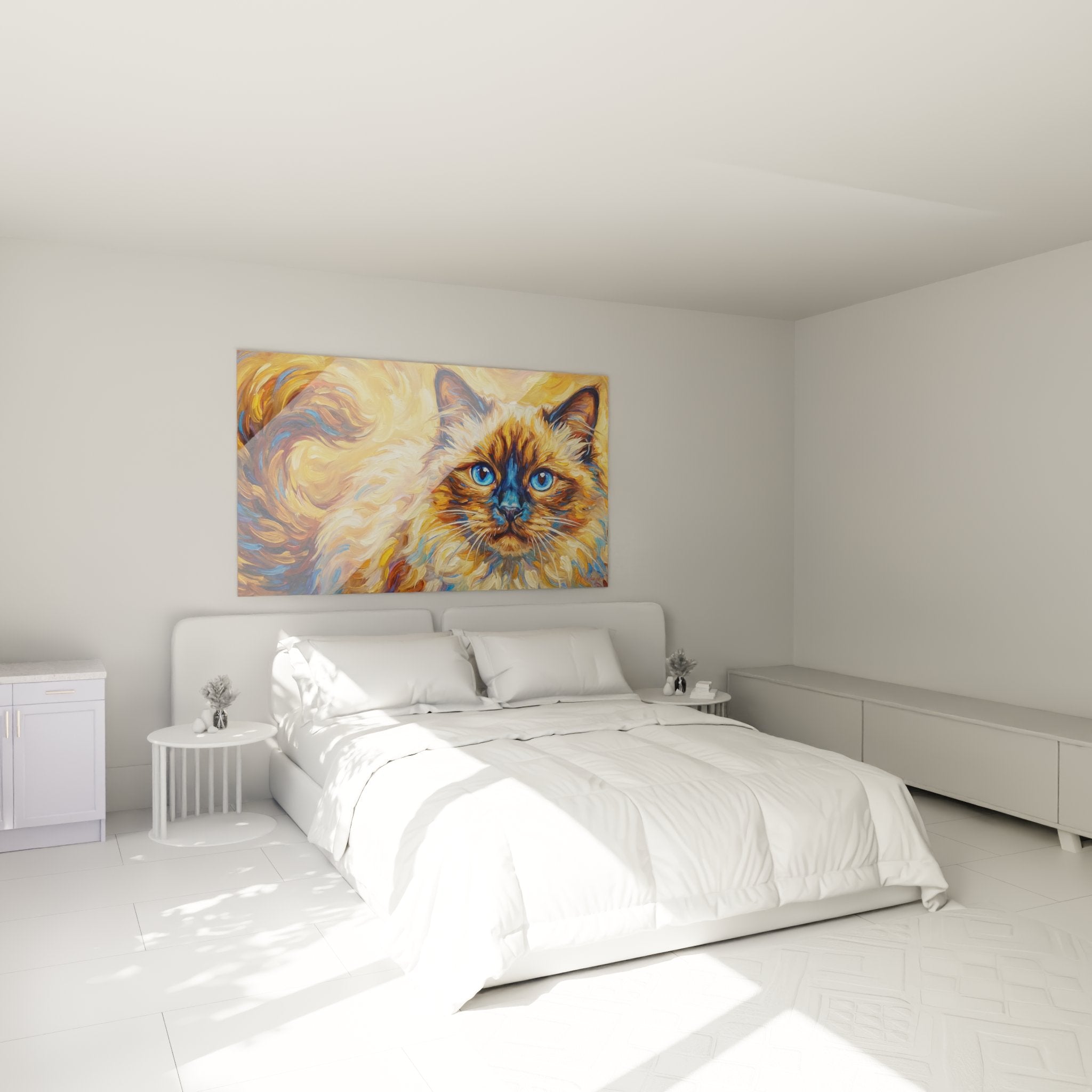
The Birman cat wall art celebrates one of the most captivating feline breeds in the world. Instantly recognizable by its profound sapphire blue eyes and colorpoint coat with delicately shaded extremities, the Sacred Birman embodies a natural grace that translates perfectly into mural art. Lovers of this majestic breed discover in these large-format representations a unique way to honor their four-legged companion or simply their fascination with this exceptional feline. Whether you own a Birman with immaculate white gloves or are an admirer of this characteristic medium-length silhouette, explore how these monumental works transform your living space into a true feline sanctuary.
Birman Cat Wall Art: The Art of Capturing the Sapphire Blue Gaze
The Birman cat wall art finds its quintessence in the representation of these legendary eyes that made the breed world-famous. This intense sapphire blue, as deep as a mountain lake, constitutes the most striking artistic element in any representation of the Sacred Birman. Large-format mural works allow total immersion in this hypnotic gaze that seems to follow the observer across the room.
Why does the Birman's gaze fascinate artists so much?
The optical particularity of the Birman lies in this uniform azure hue, without variation or veining, which creates an almost supernatural mirror effect. Unlike other blue-eyed breeds that often display variable nuances, the Birman showcases a constant and deep blue from adulthood onward. This unique genetic characteristic offers artists an incomparable emotional palette to create truly captivating works.
Large-format representations of cat wall art allow appreciation of every nuance of this mysterious gaze. On a surface of 120 centimeters or more, the subtleties of the Birman iris reveal unsuspected depths. The effect produced on visitors is immediate: this gaze seems to establish a silent, almost spiritual connection.
Colorpoint contrast magnified by mural art
The natural framing formed by the Birman's dark facial mask marks around these sapphire eyes creates a natural artistic enhancement effect. This striking contrast between the creamy body coat and seal, blue, chocolate, or lilac extremities constitutes a visual composition that classical painters would have envied. Mural works masterfully exploit this chromatic opposition to create pieces of maximum impact.
The Birman cat wall art in extra-large format transforms this play of contrasts into a true decorative statement. The progressive demarcation between light and dark zones of the Birman coat offers a smooth chromatic transition that soothes the eye while maintaining focused attention on these extraordinary eyes.
Which artistic style best magnifies the Birman's eyes?
Hyper-detailed realistic representations capture every light reflection in the Birman iris, creating a striking impression of life. The contemporary approach focuses more on emotional intensity, using sparse backgrounds to isolate this magnetic gaze. Some works adopt subtle Oriental aesthetics, recalling the legendary origins of the breed in ancient Burmese temples.
- Close-up portraits capture the intensity of the Birman's gaze with remarkable precision
- Compositions on dark backgrounds accentuate the natural luminosity of sapphire eyes
- Profile representations reveal the characteristic almond shape of Birman eyes
- Contemplative scenes show the Birman in its typical meditative posture
The emotional impact of large-format Birman gaze
Installing a mural artwork depicting a Birman's gaze in your living space creates a permanent, soothing presence. Owners of this breed instantly recognize this gentle and intelligent expression characteristic of their companion. For breed admirers, it's a daily invitation to contemplation and serenity.
The generous dimensions of these mural works allow the Birman gaze to truly become the focal point of a room. This artistic presence establishes a particular atmosphere, blending domestic warmth with Oriental mystery. The visitor immediately perceives the owner's passion for this exceptional breed.
How does the printing medium influence the rendering of blue eyes?
Premium supports like acrylic glass or Dibond aluminum offer unparalleled color depth to restore this iconic sapphire blue. The glossy surface of acrylic glass creates reflections that literally animate the depicted gaze, giving it its own life depending on ambient lighting. Brushed aluminum, meanwhile, brings contemporary dimension while preserving chromatic intensity.
Choosing a Birman cat wall art on premium support guarantees the chromatic fidelity essential for this particular blue. Museum-quality prints preserve every nuance for decades, ensuring that this captivating gaze retains its full intensity over the years.
Birman Cat Wall Art: Sacred Atmosphere and Mystical Heritage
The Birman cat wall art draws its evocative power from the ancient legends surrounding this extraordinary breed. According to tradition, the ancestors of the Sacred Birman lived in Burmese temples alongside the monks of Kittah, guardians of the goddess Tsun-Kyan-Kse with sapphire eyes. This legendary origin confers upon each artistic representation a unique spiritual dimension that resonates deeply with feline art lovers and Oriental decoration enthusiasts.
The legend of the Lao-Tsun temple
The story recounts that a white cat named Sinh stood beside the high priest Mun-Ha when he was assassinated by invaders. Upon placing his paws on his dying master facing the golden statue of the goddess, Sinh witnessed his coat transform: his eyes took the sapphire blue of the goddess, his body became golden as the statue, while his paws remained white, symbol of purity.
This mythic transformation explains the unique characteristics that Birman mural art seeks to capture: the contrast between the purity of white gloves and the richness of the colorpoint coat, all crowned by this celestial gaze. A mural artwork representing the Sacred Birman shows not simply a feline, but tells this story of devotion and divine metamorphosis.
What Oriental symbolism to integrate into your interior?
Birman representations naturally fit into a Zen or Asian aesthetic. Works showing this feline in a contemplative posture evoke the serenity of the monasteries where its ancestors may have lived. This spiritual connection makes the Birman cat wall art much more than a simple decorative element: it becomes a daily reminder of values such as meditation, loyalty, and grace.
The integration of elements evoking pagoda architecture, Zen gardens, or traditional Burmese patterns considerably enriches the visual impact of these works. Certain representations place the Birman in an environment subtly suggesting its temple origins, creating an atmosphere both authentic and contemporary.
The Birman as spiritual guardian of the home
In Asian tradition, cats are often considered protectors of the home. The Birman, with its history linked to sacred temples, perfectly embodies this role of benevolent guardian. Installing its large-format portrait in your entryway or living room perpetuates this millennial tradition while affirming your sensitivity to exceptional feline art.
- The Birman represented in a sitting position evokes the meditative posture of temple statues
- Works in golden tones recall the legend of divine transformation
- Sparse compositions reflect the Zen aesthetics of Oriental monasteries
- Contemplative portraits capture the ancestral wisdom attributed to the breed
How to create a Burmese temple atmosphere at home?
Combining a Birman mural artwork with Oriental decorative elements creates remarkable visual coherence. Natural materials like bamboo, textiles with Asian patterns, and subtle golden touches compose an environment where the feline artwork naturally finds its place. This decorative approach particularly appeals to Zen interior enthusiasts and Asian culture passionate fans.
The large format of these mural works allows a genuine presence, comparable to divine representations in traditional temples. The Birman's blue gaze, directed toward the living space, creates that sensation of protective benevolence that homeowners concerned about their interior atmosphere seek.
The royal heritage of the Sacred Birman in contemporary art
Beyond temple legends, the Birman was long reserved for European aristocracy after its introduction to France in the early twentieth century. This association with refinement and exclusivity persists in contemporary artistic representations. The Birman cat wall art inherits this historical nobility, making each work a collection piece intended for the most distinguished interiors.
Contemporary artists reinterpret this heritage by fusing Oriental references and modern aesthetics. The resulting works honor tradition while integrating perfectly into current living spaces. This adaptability makes the Birman portrait a timeless choice for discerning collectors.
Birman Cat Wall Art: Symbol of Elegance for Refined Interiors
The Birman cat wall art establishes itself as the natural choice for decorators and homeowners seeking an exceptional feline artwork. The graceful silhouette of the Sacred Birman, its aristocratic bearing, and its silky coat with subtle nuances make it an artistic subject of rare sophistication. The generous dimensions of these mural representations allow full appreciation of every detail of this natural beauty recognized worldwide.
Why does the Birman embody feline elegance par excellence?
The Birman's morphology presents harmonious proportions that immediately seduce the eye. Its moderately long body, carried by robust legs with famous white gloves, emanates an impression of contained power and natural grace. The medium-long, silky coat without dense undercoat, hugs the body's forms with remarkable fluidity that translates magnificently into mural art.
The Birman's white gloves constitute its most distinctive visual signature. These immaculate marks, perfectly symmetrical in show specimens, create a natural focal point in any artistic representation. A large-format artwork allows appreciation of the precision of this unique demarcation in the feline world.
The integration of the Birman in high-end contemporary interiors
Interior architects recognize the exceptional decorative value of Birman portraits. The breed's natural palette, declined in seal point, blue point, chocolate point, or lilac point, offers chromatic harmonies adapting to all decorative styles. The warm tones of seal complement classical interiors while the cooler nuances of blue point perfectly complete contemporary spaces.
- Seal point portraits bring warmth and depth to rooms with neutral tones
- Blue point representations create a soothing and sophisticated atmosphere
- Chocolate variations reveal appetizing and enveloping nuances
- Lilac Birmans offer a touch of subtle softness and femininity
Which format to choose to magnify the Birman?
XXL dimensions, 150 centimeters and beyond, allow near life-size representation that immediately captures attention. This monumental scale suits particularly generous living spaces where the Birman cat wall art can fully express itself. Lofts, cathedral-style living rooms, and majestic entryways ideally welcome these large-scale works.
The panoramic format highlights the slender appearance of the reclining Birman, revealing the elegance of its silhouette in full splendor. The portrait format, more classical, concentrates attention on the expressive face and this characteristic sapphire blue gaze. Each configuration responds to a specific decorative intention and particular spatial arrangement.
The Birman as centerpiece of a feline collection
Animal art collectors often place the Birman at the apex of their feline hierarchy. Its relative rarity, combined with its exceptional aesthetic qualities, makes it a subject sought after by the most talented artists. Acquiring a high-end Birman portrait represents a durable decorative investment testifying to an affirmative taste for feline excellence.
The association of multiple Birman representations in different colorpoint variations creates a coherent and visually spectacular collection. This curatorial approach appeals to enthusiasts wishing to dedicate an entire space to their preferred breed.
How to authenticate the quality of a feline mural artwork?
Anatomical fidelity constitutes the first evaluation criterion. The Birman possesses precise morphological characteristics: a slightly curved Roman nose, full cheeks, medium-sized rounded ears. A quality representation respects these breed standards recognized by international feline federations.
The coat rendering also differentiates premium works from ordinary productions. The Birman's silky texture, with its subtle reflections and progressive coloration toward extremities, demands technical mastery that only high-end printing supports can faithfully restore.
Which coat colors are available for a Birman cat wall art?
The Birman comes in numerous officially recognized colorpoint varieties. The four traditional colors are seal, blue, chocolate, and lilac. Newer varieties include red, cream, as well as tortie and tabby versions of these base colors. Each variation offers a distinct artistic palette for your mural decoration.
How to maintain a Birman cat wall art on premium support?
Works on acrylic glass or Dibond aluminum require minimal maintenance. Regular dusting with a microfiber cloth suffices to preserve color brilliance. These supports naturally resist humidity and UV rays, guaranteeing exceptional longevity without alteration of the original chromatic rendering.
Does a Birman cat wall art suit all interior styles?
The aesthetic versatility of the Birman allows it to integrate harmoniously into varied environments. Classical interiors appreciate its aristocratic allure, contemporary spaces value its pure lines, and Zen atmospheres find in it an echo to their Oriental inspirations. The choice of artistic style and framing adapts the work to your specific decorative universe.
What Birman cat wall art size to choose for a living room?
For optimal visual impact in a living room, formats starting from 120 centimeters in width create an affirmed presence without dominating the space. Rooms larger than 30 square meters advantageously welcome works of 180 centimeters or more. The general rule suggests that the artwork occupies between two-thirds and three-quarters of the width of the main piece of furniture positioned below.