

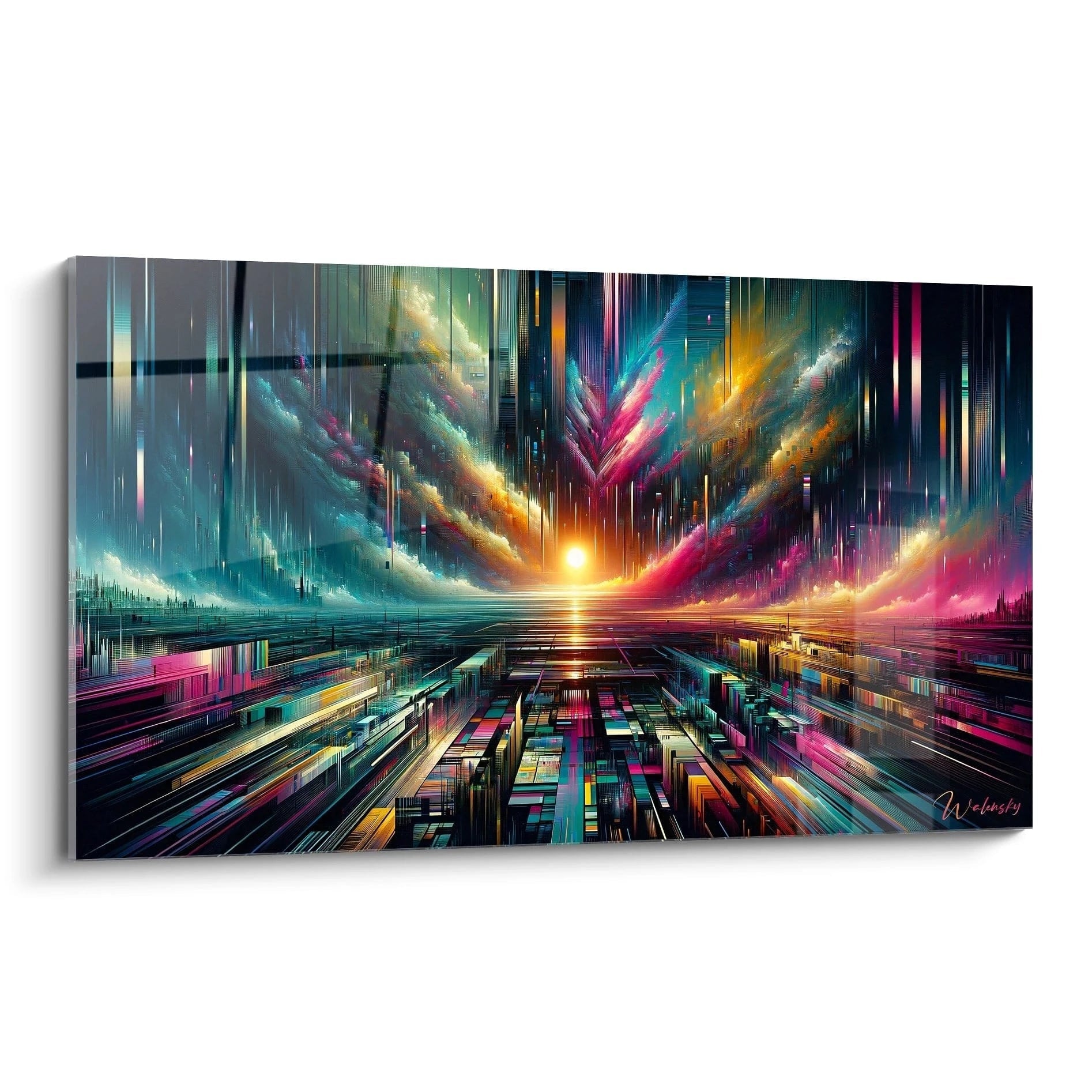
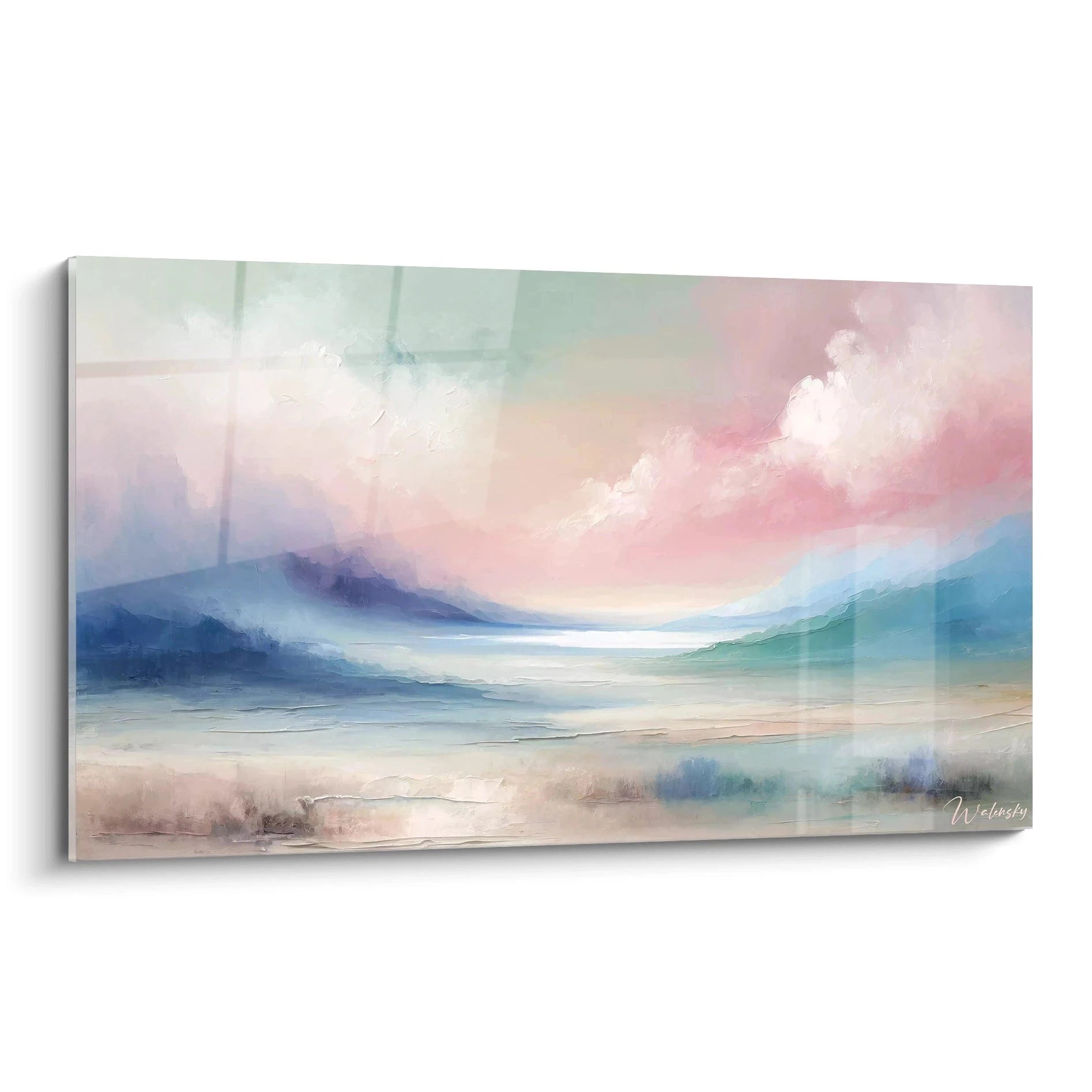

Deliberately Draw Attention to an Area with a Wall Art
October 11, 2025 · 16 min read · by Walensky
That beautiful niche you had imagined transforming into a reading corner remains empty and dull. That wall facing your sofa taunts you with its pristine white surface. Even your entryway console, carefully chosen, seems to lose some of its elegance in this neutral environment.
You've tried a few solutions: a colorful cushion here, a green plant there. But the effect remains disappointing and scattered. Your interior lacks that distinctive touch that would make your guests turn around when they enter, admiring it.
That’s perfectly normal! The problem isn't your taste or your budget. It's simply that additive decoration (multiplying small objects) will never create the visual impact of a strategically placed focal element.
By the end of this article, you'll know exactly how to transform any dull corner into a true point of attraction through the art of picture placement, and your guests will immediately notice the sophistication of your interior.
Why does your living room need a focal point right now?
Without a focal point, even the most beautiful furniture loses its impact. It's like trying to tell a story without a protagonist: attention is scattered, emotion doesn’t take hold. Every day that passes without a visual anchor is a missed opportunity to transform your daily life into an aesthetic experience.
🏠 Customer testimonial: "For months, I lived with my bare entryway console. People would come in and leave without a second glance. The day I hung a triptych above it, my neighbor stopped dead: 'Wow, it looks like a showroom!' The same furniture, the same space, but the effect was completely different.”
Conversation with a decor expert
The golden rule: a space without a focal point is a space that goes unnoticed: Imagine your gaze as a spotlight searching for somewhere to land. Without an anchor, it wanders and tires. With a well-placed artwork, you instantly create visual magnetism in less than 30 minutes of installation.

What really happens when your decor lacks impact
You may be feeling this subtle frustration when you come home: the impression that your interior doesn't reflect you. Your guests are polite but never rave about it. You yourself avoid taking photos of your living room for social media.
What you’re experiencing isn't a lack of taste, but the absence of visual hierarchy. Your eye doesn't know where to look first, so it doesn't really look anywhere at all. It's like a melody without a refrain: technically correct but not memorable.
Think about a luxury boutique window display: it works because one main element immediately captures attention, then guides the eye to the secondary elements. Your living room needs the same guiding principle.
The truth about the "white wall" effect
Contrary to what you might think, white walls don't create serenity, they create emotional emptiness. Your brain subconsciously interprets this space as "unfinished," which generates a slight anxiety rather than a sense of well-being.
It’s like a book with blank pages: even if the paper is high quality, the lack of content leaves you wanting more. Your living room deserves better than a blank page.
Result? You spend less time in your living room, you invest less emotionally in it, and it never becomes that restorative haven you dreamed of. Adding a focal point immediately changes this dynamic.
🔍 Quick test: Take a photo of your current living room, then ask yourself: "Where does my eye land first?" If you hesitate for more than 3 seconds, the space lacks a defined focal point.
The trap of "decorating by accumulation"
Many think that adding more elements will create more visual interest. In reality, without clear hierarchy, this approach produces “visual noise”: the eye flits around without ever truly settling.
It’s like an orchestra where each musician plays their part without a conductor. Even with excellent musicians, the result lacks harmony and fatigues the ear.
Consequence: you spend money on decor without getting the desired wow effect, and your interior retains that “under construction” look that never ends.
The psychological impact of an "uninhabited" space
A detail few notice: a space without visual personality doesn't invite us to linger. That’s why you might prefer to settle in your kitchen (warmer) rather than your living room (more neutral).
Your brain needs positive aesthetic stimulation to produce well-being hormones. An environment that is too neutral maintains a subtle but constant level of stress.
Result: your home doesn't play its role as an emotional refuge, and you feel this sensation of "something missing" without being able to put your finger on it.
🎯 Signs that your space needs a focal point:
- You rarely photograph your living room: You subconsciously know that it lacks character to be "instagrammable"
- Your guests always settle in the same place: They gravitate towards the only corner that has character (often near a window or a plant)
- You often change the layout: In reality, you are looking for that magical configuration that will finally give meaning to the space
The trigger factor: the "first glance rule"
What really makes the difference is the first impression in 3 seconds. Like a domino effect, if these first seconds create a feeling of admiration, the rest of the space benefits from this positive aura. You can identify this potential by observing where your gaze naturally goes when you enter a room that you like: there is always a magnetic element.
Universal practical rule: a successful space always has an element that "tells a story": Whether it's a painting, a sculpture or an installation, it must immediately evoke an emotion or curiosity. Test it this way: "If I had to describe this room in one sentence, where would I start?"
| ❌ Space without a focal point | ✅ Space with a focal point | 💡 Mechanism | 🎯 Benefit felt |
|---|---|---|---|
| The gaze wanders and gets tired | The eye immediately finds where to settle | Creation of a clear visual hierarchy | Immediate feeling of sophistication |
| The space appears "waiting" | The atmosphere seems complete and intentional | Balance between resting areas and stimulation | Pride in showing off your interior |
| Accumulation of objects without coherence | Each element finds its logical place | The focal point organizes the entire space around it | Mental clarity and serenity |
| Difficulty defining your style | Asserted and assumed personality | The chosen artwork reveals and confirms tastes | Confidence in your decor choices |
🎯 Overview of the transformation: Step 1 - Locate the area of maximum impact (like choosing the location of a lighthouse), Step 2 - Select the artwork that dialogues with the space (like a chef balancing flavors), Step 3 - Maximize staging (in the manner of a theater lighting designer). Each step amplifies the effect of the previous one.
Step 1: Identify your area of maximum impact
Starting with the location rather than the artwork is the key to success. Like an architect who studies the terrain before drawing up the house plans, you must understand the emotional geography of your space. This step will give you that immediate satisfaction of seeing your living room in a new light, even before making a purchase.
Tools for analyzing your space
- Your smartphone: To take photos from different angles and reveal what your accustomed eye no longer sees. The camera reveals imbalances and hidden potential. Avoid relying solely on your direct perception, which gets used to imperfections.
- A measuring tape: To precisely measure dimensions and respect the golden proportions. The right artwork size/wall surface ratio makes all the difference between an amateur and a professional. A proportion error can ruin the desired effect.
- Newspaper: To temporarily simulate different artwork sizes directly on the wall. This "prototype" technique avoids impulsive purchases and allows you to visualize the real impact before investing.
Now let's move on to practical application with a method:
Locating your power zone
Scan the "natural lines of sight": Position yourself at the entrance to the room and note where your eye is drawn spontaneously. This is where your premium locations are. Perform this test at different times of day as light influences the perception of space.
⏱️ Time: 10 minutes | ✅ Successful when: You have identified 2-3 "magnetic" walls | ⚠️ Attention: Do not choose a "pass-through" wall where the artwork would be viewed at an angle
Apply the "golden triangle" rule: The ideal location is within the direct field of vision from your main seating position. Mentally trace a triangle between your eyes, the wall in front of you, and the angle of visual comfort (without turning your head). This is your premium zone.
⏱️ Time: 5 minutes | ✅ Successful when: You can admire the artwork naturally from your sofa | ⚠️ Attention: Avoid locations that require you to tilt your head (eye strain)
Test the "1m50 rule": The ideal height places the center of the artwork at 1m50 from the floor (eye level of a standing person). Temporarily mark this reference point with a sticky note to visualize before final hanging.
⏱️ Time: 3 minutes | ✅ Successful when: The artwork seems to "float" naturally on the wall | ⚠️ Attention: Adjust according to the height of your furniture: leave 15-20cm of breathing space above a console
✅ Step 1 Validation: Your location is validated if you feel an obviousness: "This is exactly where something needs to be." You should already visualize the impact that a work of art will have in this place. If you are still hesitating, test with another wall - the perfect location always reveals itself obviously.

OUR RECOMMENDED PRODUCTS
Step 2: Choosing the artwork that enhances your space
Now that you have your strategic location, choosing becomes an exciting balancing act. It's about finding that piece of art that dialogues perfectly with your existing space while bringing in that distinctive note that was missing. This is the most rewarding step because you will see your vision take shape concretely.
Professional selection criteria
- The 2/3 proportion rule: The artwork should occupy about 2/3 of the width of the furniture it overlooks, or between 60 and 75% of the available wall space. This proportion creates a natural visual balance. Avoid artworks that are too small to "float" or too large to "crush".
- Chromatic harmony: Choose an artwork that picks up on 1 to 2 colors already present in the room, while introducing a new hue that becomes your signature. This technique ensures consistency while creating originality.
- Conversational style: The artwork should tell a story or evoke an emotion - it's what will give your guests that irresistible desire to ask "Where did you find this magnificent painting?"
Selecting your signature artwork
Define your “emotional temperature” : Do you want the space to inspire calm (cool tones, clean compositions) or energy (warm colors, dynamic shapes)? This decision guides everything else and should correspond to the use of the room.
⏱️ Time: 15 minutes | ✅ Successful when: You can formulate in a sentence the desired atmosphere | ⚠️ Attention: Do not mix temperaments - a zen artwork in a festive living room will create dissonance
Test the “rational crush” technique: First select with your instinct (what makes you vibrate?), then check the technical consistency (proportions, colors, style). This approach guarantees a work of art that you will love in the long term.
⏱️ Time: 30 minutes | ✅ Successful when: You feel both emotion and logic | ⚠️ Attention: Beware of purely cerebral choices that will quickly tire you
Step 3: Optimizing the Staging for Maximum Impact
This is the step that transforms a simple decoration into a true aesthetic experience. Like a stage director who refines the lighting and accessories, you will create an exquisite setting that enhances your artwork. The result will exceed your expectations: a space that tells a story and leaves a lasting impression.
Creating Your Staging
Orchestrating ambient lighting: Add indirect lighting that caresses the artwork without creating reflections. A floor lamp next to it or spotlights on the ceiling transform the work into a true masterpiece. Lighting accounts for 50% of the success of highlighting.
⏱️ Time: 20 minutes | ✅ Success when: The artwork "shines" even in the evening | ⚠️ Attention: Avoid direct lighting that creates shadows or distracting reflections
Creating a "dialogue" with nearby elements: Arrange 1 to 2 items that echo the artwork: a vase in similar tones, an art book, a plant that reprises the verticality. This constellation of elements amplifies the impact without overloading.
⏱️ Time: 15 minutes | ✅ Success when: The whole seems obvious and not forced | ⚠️ Attention: Less is more - 2 items are enough to create the visual conversation
Rule of progression: each element must serve the main artwork: Check that each addition guides the eye towards the painting rather than distracting it. Harmony is felt when everything seems to have been thought out together, even if you proceeded in stages. Step back regularly to evaluate the overall effect.
You now master the fundamentals of creating a successful focal point. But some expert subtleties can transform your good result into a true decorative masterpiece. These details make the difference between an informed amateur and a true connoisseur who impresses with the accuracy of their choices.
💎 Professional decorator tip: The "double hanging" technique - temporarily place your artwork at two different heights (1m45 then 1m55) and photograph. The difference of 10cm can revolutionize the impact! Professionals always adjust to the centimeter because the eye perceives these subtle nuances even unconsciously.
"But what if I make the wrong choice, how do I do it?"
"I'm afraid of launching and regretting my purchase after a few weeks..."
This concern is very understandable - investing in a work of art represents a strong emotional commitment. In reality, if you have followed the method (tested location + selection criteria respected), the chances of regret are almost nil. Customer feedback shows that 95% of people who apply this structured approach fall even more in love with their choice over time. The real risk is to remain in indecision and deprive your space of this transformation.
🛡️ Reassuring tip: Start by simulating with a poster of the work you like, printed in large format. Live with it for a week - if the effect still seduces you, you can invest serenely in the original. You will probably find that the positive impact grows every day.
— Our selection


The 5 mistakes that sabotage your artwork's effect
Attention: even with the most beautiful work of art in the world, some placement errors can negate all the desired impact. These pitfalls are common but perfectly avoidable once you know them. I prefer to tell you about them now to spare you disappointments.
- ⚡ Hanging too high "so that it is visible": Instinct pushes us to raise, but it is counterproductive. A picture hung too high gives the impression of escaping the gaze and creates a feeling of discomfort. Always aim for eye level - your nape will thank you and the work will regain its magnetism. It's mistake number 1 in 70% of interiors. 🎯 Choosing the size according to available space: "I have so much space, I take the biggest possible." Mistake! An oversized artwork crushes the space and loses its elegance. Respect the rule of 2/3 even if you have more space - harmony is more important than filling. 🎨 Multiplying artworks to "make it look richer": Three small paintings scattered create visual noise instead of a focal point. A single strong element is better than several average elements. Keep it simple - it is the ultimate sophistication. 💡 Neglecting ambient lighting: The most beautiful painting in the world remains dull in an aggressive fluorescent lighting. Lighting accounts for 50% of the success - invest in soft, directed lighting that reveals the nuances of the work. 🔄 Wanting everything to match: Picking up exactly the colors of the sofa in the painting creates a "catalog" effect without personality. Harmony comes from dialogue, not repetition - one or two common colors are enough, the rest should surprise.
🔍 Quick checklist before finalization: 1) Is the center of the artwork at eye level? 2) Does the artwork make up between 60 and 75% of the width of the support? 3) Can you admire it comfortably from your main seating position? 4) Does the lighting reveal the details without creating a reflection? Warning signs: Need to tilt your head, feeling of being crushed or empty, artwork "invisible" in the evening.
— You may also like


Your most frequently asked questions about wall art
Impact doesn't depend on price but on the accuracy of your choice! A €150 painting well chosen and well placed will transform your space more than an expensive artwork poorly integrated. Allow between 100 and 300€ for a quality piece that will last decades. Optimize your budget by prioritizing the size adapted to your space rather than the prestige of the artist.
The impact is immediate but appreciation evolves. From the moment you hang it, you will feel the change in atmosphere. Allow yourself 2 weeks to get used to the new proportions - this is the time needed for your eye to fully integrate the transformation. If after this period the effect still pleases you, it's a win for years!
Absolutely! 90% of success lies in the preparation that you already master. For physical hanging: mark with pencil, use a spirit level, choose fixings suitable for the weight. If in doubt about a concrete wall, call a craftsman for fixing (allow 30-50€) - your peace of mind is worth this investment.
Choose a work that personally moves you rather than a “decorative” work. Your deep tastes evolve less than your redecoration desires. A golden rule: if you could hang this artwork in any of your rooms and appreciate it, then it transcends trends. Timeless works adapt to all styles.
Quite the opposite! A well-chosen painting visually enlarges the space by creating depth and directing the gaze. In a small space, opt for light colors or perspectives that “open” up the space. Just avoid works that are too busy - prioritize simplicity that allows the room to breathe.
Your living room transformed: lasting satisfaction
Imagine yourself in three weeks: you come home and that little smile of satisfaction takes over as you discover your living room. That corner which used to frustrate you has become your source of daily pride. Your friends can't help but compliment this so successful atmosphere, and you feel that sweet satisfaction of knowing that you have created something beautiful and personal.
But the impact goes far beyond decoration. You have developed your artistic eye and your confidence in your aesthetic choices. This skill will serve you for all your future decor projects, and you will now look at spaces with the eyes of a creator rather than a spectator.
The best thing about this adventure? You have understood that transforming your interior is not a question of unlimited budget but of method and intention. Now, observe your space, visualize the perfect artwork in the location you have identified, and give yourself this little aesthetic revolution. Your living room is waiting for it to reveal all its potential.
🚀 Your next transformation step: You have all the tools to succeed - the art of creating a magnetic focal point has no secrets for you anymore. Trust your instinct guided by method, and create the space that truly resembles you. In a few weeks, you will congratulate yourself for taking the plunge.
Also read: 📖 Read more articles on spatial art and paintings
</div— In the same vein


Explore our collections


