

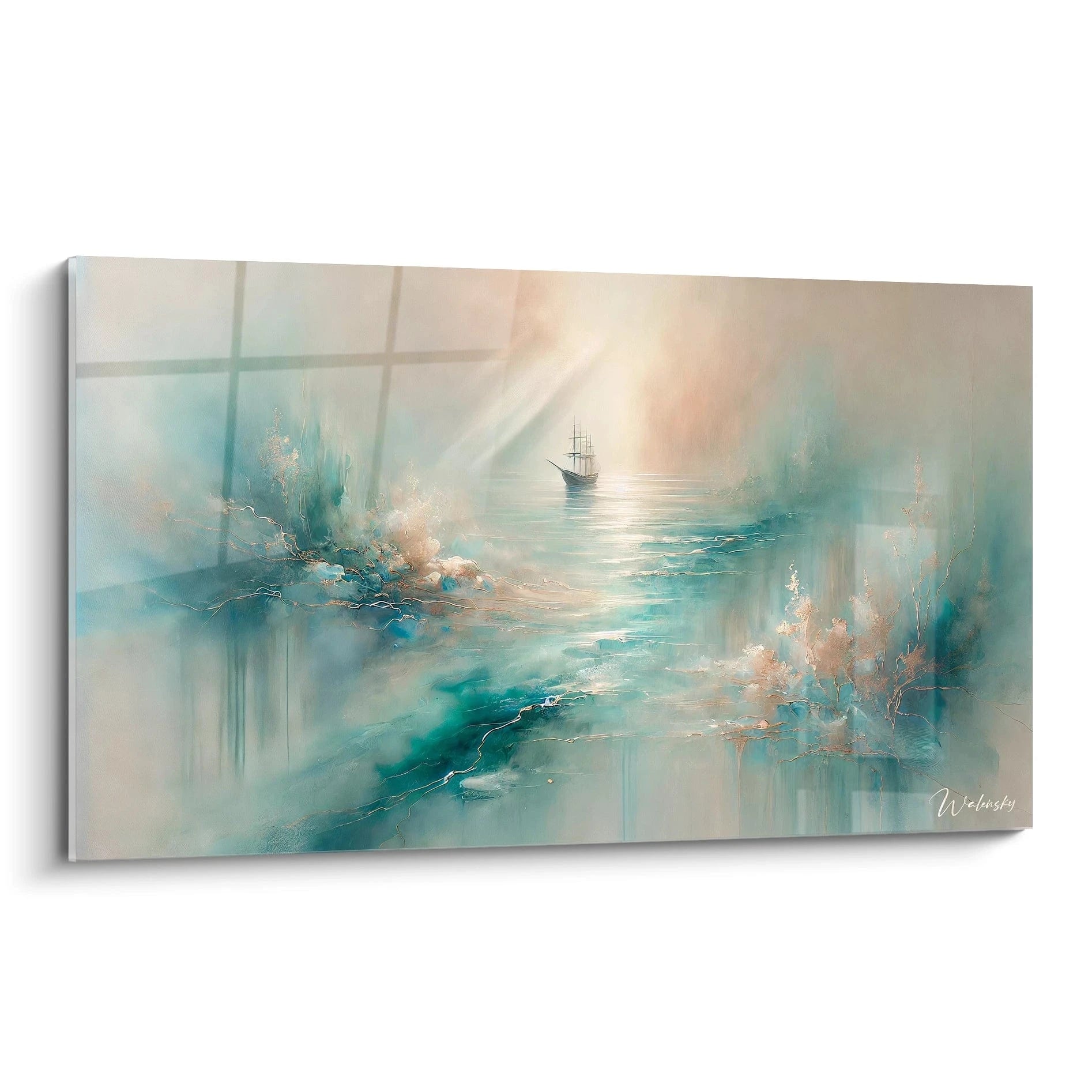






A Well-Placed Artwork is Enough to Structure an Empty Room
October 11, 2025 · 17 min read · by Walensky
Why can’t your brain “see” the layout?
This difficulty in structuring an empty room is not a lack of creativity. It's a neurological mechanism: without visual cues, our brains struggle to create imaginary zones. It's like trying to organize a library without shelves - impossible to know where to start!
🎨 Architect’s testimony: “I remember a client who was paralyzed in front of her 40m² living room. As soon as we hung an abstract artwork on the main wall, she immediately knew where to place her sofa, her coffee table... The artwork had created a magnetic pole that organized the entire space.”
Conversation with a decor expert
The principle of visual anchoring: An artwork instantly creates a visual hierarchy in the space. Within 48 hours, you will naturally begin to visualize the layout of your room.

Our highlight
Sinuosities Meditation Ochre Painting - modern abstract edition
232,90€
Discover this artwork →These signals that show your room lacks structure
Do you recognize these three situations? You avoid walking past this room, you constantly postpone decorating decisions, or you feel drained just thinking about it.
The situation you're experiencing is called "decision paralysis." Your brain subconsciously refuses to process a space without structure. This isn't your fault - it’s our mental architecture that works this way.
Imagine your brain as a GPS: without starting coordinates, it's impossible to calculate a route. The artwork becomes your starting point, your ground zero.
The first hidden cause: the lack of a focal point
Contrary to popular belief, it’s not the lack of furniture that’s the problem, but the total absence of visual hierarchy. Our eye needs a dominant element to understand the space.
It's like entering a bookstore where all the books are scattered on the floor: even if the books are there, you don’t know where to start. The artwork becomes your "favorite section" that organizes everything else.
As a result, you spend hours going around in circles mentally, whereas with just one anchor point, you could structure the space in 10 minutes.
🔍 Quick test: Close your eyes, visualize your empty room. Impossible? Now imagine a large colorful painting on the main wall. The space already looks better, doesn’t it?
The second illusion: believing that you need furniture to create zones
Many people think that space is defined with furniture: a sofa for the living area, a table for the dining area. In reality, art creates territories, and furniture simply inhabits them.
Think about public squares: it’s not the fountain that follows the benches, but the benches that organize around the fountain. Your artwork becomes that fountain that attracts and organizes.
Without this landmark, you live in a "neutral" space that inspires no decor action, no desire to settle in permanently.
The “filler decoration” trap
The fatal error? Accumulating decorative objects hoping they will create an atmosphere. Result: a chaotic jumble that clutters more than it structures.
You can spot this trap when you buy decor “to fill space” without an overall vision. Each purchase worsens the feeling of chaos rather than creating the desired harmony.
The impact? Your decor budget explodes, your space becomes overloaded, and you still don’t get that feeling of an organized space that you're looking for.
4 signs that your space lacks structure:
- You naturally avoid this room: Your subconscious avoids spaces without visual landmarks, like avoiding a road without signs
- You always postpone the layout: Without a clear starting point, your brain refuses to make decor decisions
- You never know where to sit: The lack of an attraction pole leaves you without spatial reference
- The space mentally fatigues you: An unstructured environment requires constant cognitive effort to be "decoded"
The trigger element: the power of art as a spatial organizer
What changes everything is that art instantly creates meaning in an empty space. Like a magnet organizing iron filings, a well-placed artwork naturally structures your perception of space and guides your future layout choices. You can identify it when you enter a room and your gaze is immediately drawn to a specific point.
The golden rule of focal point: A room with a strong artwork instantly becomes easier to decorate and more enjoyable to live in. Test it by temporarily hanging any large format image on your main wall.
| ❌ Unstructured space | ✅ Space with focal point | 💡 Mechanism | 🎯 Immediate benefit |
|---|---|---|---|
| I don't know where to look when I enter | My eye immediately finds a reference point | The brain prioritizes organized information | Feeling of calm and clarity |
| I hesitate on every decor choice | I instinctively know what goes together | Art gives a clear aesthetic direction | Time saving and confidence in your choices |
| The space feels cold and impersonal | The room immediately has character | The artwork conveys emotion and style | Environment that truly resembles me |
| I postpone the layout indefinitely | I feel like acting and harmonizing the rest | The focal point triggers decor motivation | Immediate and natural action |

The 3-step method to structure your space with art
You are reassured: the solution exists and it is simpler than you imagine! We will proceed like an interior architect: first create the soul of the space, then inhabit it gradually. At each step, you will feel your room come to life and your confidence grow.
🗺️ Overview of your transformation: Step 1 - Create the magnetic pole (your master artwork), Step 2 - Define living zones, Step 3 - Harmonize the whole. In 3 weeks, your empty space will become a place that resembles you and works perfectly.
Step 1: Create your magnetic pole - The master artwork
We start with the essential: give a soul to your space. This first step is crucial because it lays the foundations for all your future decoration. Once your artwork is in place, you will immediately feel that satisfaction of seeing your room "make sense".
What you need to get started
- A work of significant size (minimum 60x80cm): It should be imposing enough to create a real visual impact in the empty space. Avoid small formats that would get lost on a large wall. You will find them in specialized galleries or online art shops. Make sure the colors really move you - this is the most important quality criterion. Don't give in to the temptation of a low-end poster that would lack presence.
- A professional hanging system: Invest in wall fixings suitable for the weight of your work. The principle? Distribute the weight over several anchor points to guarantee safety and stability. Recognize the quality of the materials (stainless steel) and load certifications. A solid mounting will give you confidence in your installation and enhance your artwork.
- Optimal hanging height: The center of the work should be 1.50-1.60m from the floor, at eye level. This universal rule allows for comfortable viewing of the work from all over the room. The visible benefit? Your painting naturally dialogues with the space and guides the eye harmoniously.
Now, let's move on to practice with confidence
How to proceed serenely
Identify the main wall: Choose the wall you see first when entering the room. It is this one that will naturally capture attention and create maximum impact. Technically, avoid walls with windows (backlighting) or doors (passage). This step requires no particular skills - trust your instincts.
⏱️ Time: 5 minutes | ✅ Successful when: You feel that this wall "calls" naturally to the eye | ⚠️ Attention: Do not overload your reflection - the first wall that comes to mind is often the right choice
Mark the location: Use a pencil and level to discreetly trace the location. This step avoids placement errors and gives you confidence to drill. The important detail: measure from the floor AND from the ceiling to check perfect horizontality. Take your time, this precision will make all the visual difference.
⏱️ Time: 15 minutes | ✅ Successful when: Your markers are clear and your artwork will be perfectly centered | ⚠️ Attention: The eye immediately detects a tilted painting - the accuracy of the tracing is essential
Install carefully: Drill with an appropriate drill bit for your wall material, insert your dowels and fix the hanging system. This secures your artistic investment and guarantees durability. Crucial technical point: always test the solidity before permanently hanging your artwork. It's a simple gesture that will reassure you completely.
⏱️ Time : 20 minutes | ✅ Successful when : The system doesn't move a millimeter when you pull on it | ⚠️ Warning : Underestimating the weight is the classic mistake - always check the load specifications of your fixings
✨ Success Check : Your artwork is hung and it immediately "magnetizes" your gaze when you enter the room. You can check the correct placement by stepping back 3 meters: the work should naturally dominate the space. If you feel any hesitation, that's normal at first - give yourself 24 hours to get used to it before adjusting. Congratulations, you have just fundamentally transformed your space!
— Our selection


OUR RECOMMENDED PRODUCTS
Step 2: Defining Living Zones Around Your Focal Point
Now that your magnetic pole is in place, you'll notice something magical: your brain spontaneously begins to organize the space. This step becomes much more intuitive because you finally have a visual reference point. The snowball effect begins: each choice becomes more obvious and more satisfying.
Materials for Structuring Space
- An appropriate quality rug : It should measure at least 2x3m to effectively define a living zone. Its role? Create a "territory" on the floor that dialogues with your wall artwork. Find it in specialty interior decoration stores. The quality criterion: choose a material that doesn't pill and whose colors harmonize with your work. Avoid entry-level thin rugs that wouldn't create enough presence on the floor.
- Appropriate ambient lighting : Opt for light sources that highlight your artwork while creating ambiance in the space. The technical principle? Combine direct lighting on the work and indirect lighting for the general atmosphere. Recognize quality by the color temperature (2700K to 3000K for a warm atmosphere). Visible impact: your space gains depth and character, even without furniture.
Define the main zone : Position your rug facing the artwork, leaving about 50cm between the wall and the edge of the rug. This distance creates a visual breathing space and allows for future furniture installations. Technically, the rug should be centered relative to the axis of your work to create perfect harmony. This step immediately structures your perception of space.
⏱️ Time : 10 minutes | ✅ Successful when : You naturally visualize a living room or conversation area | ⚠️ Warning : A rug that is too small would create a "post office stamp" effect rather than a real delimitation
Create ambient lighting: Install lighting that enhances your artwork (spotlights or adjustable wall lights) and add indirect light sources to warm up the atmosphere. This combination radically transforms the perception of your empty space. Important technical point: avoid shadows on the work which would impair its readability. Your space immediately gains sophistication and visual comfort.
⏱️ Time: 45 minutes | ✅ Successful when: Your artwork is perfectly lit and the space exudes a warm atmosphere | ⚠️ Attention: A light that is too white (above 4000K) would create a cold and unwelcoming ambiance
🎯 Step validation: Your space is beginning to have a true identity and you feel like spending time in it. Check by mentally settling in: can you imagine reading, receiving friends, relaxing in this space? If the answer is yes, perfect! Otherwise, adjust the lighting which is often the missing key. You are creating the foundations of an authentic living space.
You now reach the level of mastery of space! Your room has found its soul and organization. The difference with an amateur? You now know how to dose the elements without overloading, create a sophisticated coherence that will impress your guests and provide you with lasting daily pleasure.
Elements for expert finishing
- A limited number of decorative objects: Choose 3 to 5 elements maximum which echo the colors or spirit of your artwork. Their function? Create visual echoes without competing with your main focal point. Select them in noble materials (ceramics, wood, metal) for qualitative consistency. The criterion of excellence: each object must bring its own personality while serving the overall harmony. Resist collections of similar objects which would create repetition rather than richness.
- A plant or vegetation composition: It brings the natural life that perfectly complements wall art. Choice principle: its size should create a dialogue with your work without hiding it. The quality is recognized by the health of the leaves and the balance of the shape. Guaranteed effect: your space gains freshness and balance of elements.
Arrange finishing elements: Place your decorative objects creating a visual triangle with your artwork as the main vertex. This composition rule naturally guides the eye and creates a soothing dynamic. Technically, vary the heights and distances to avoid the "soldiers' row" effect. Your space reaches a level of sophistication worthy of a decoration magazine.
⏱️ Time: 30 minutes | ✅ Successful when: Each element seems in its natural place and contributes to the overall harmony | ⚠️ Attention: Accumulation is the enemy of elegance - it's better to remove an element if in doubt
Fine-tuning the final balance: Step back and observe the whole from different angles of the room. Adjust positions to optimize visual harmony from each viewpoint. The technical secret: your eye should never "bump" into an element, but flow smoothly through the space. This attention to detail makes the difference between a successful decoration and an exceptional one.
⏱️ Time: 20 minutes | ✅ Success when: The space exudes immediate serenity and a sense of obviousness | ⚠️ Attention: Don't seek absolute perfection - harmony often arises from a slight natural asymmetry
Expert progression rule: You can consider your space mastered when you immediately feel calm and inspiration in it. The objective criteria: color harmony, volume balance, smooth flow of the gaze. Be patient for fine adjustments and dare to trust your aesthetic feeling which improves with practice.
Congratulations! You now master the art of structuring space with elegance. These expert subtleties give you a considerable advantage: you know how to create interiors that mark and inspire, even with a controlled budget.
🎯 Pro tip - The "gallery" effect: To maximize the impact of your artwork, create a slight contrast with ambient lighting. This museum technique naturally focuses attention on your work and enhances its colors. Concrete example: illuminate your painting at 80% power and the general ambiance at 60% - the sophistication effect is guaranteed!
Reader question
"I'm afraid my guests will find it strange to have a single painting in an almost empty room..."
I perfectly understand this apprehension - we all have been conditioned to associate "successful decoration" with "full space". In reality, your guests will be impressed by this sophisticated minimalism that exudes a rare serenity. It's exactly the approach of high-end decorators: prioritize the impact of a masterpiece over accumulation. Your space will breathe refinement and confidence in your aesthetic choices - a real plus for your image!
💡 Confidence test: Invite a friend for a first visit after installation. Observe their natural reaction when entering - you'll be surprised by the spontaneous compliments on the soothing and modern atmosphere of your space.
— You may also like


The 5 mistakes that sabotage your space structuring
Now that you know the method, let's protect your success! These mistakes are tempting and frequent, but perfectly avoidable when you know them.
- ⚠️ Choosing a piece of art that's too small out of fear of it being too prominent: This excessive caution stems from good intentions, but completely sabotages the desired structuring effect. Consequence: your artwork gets lost on the wall and creates no focal point. The solution? Dare to choose a generous size (minimum 80x60cm) - it will look natural once in place. Rest assured: it's better to adjust towards larger than remain ineffective!
- ⚠️ Multiplying focal points by adding other artworks too quickly: The desire to "complete" things quickly is natural, but it dilutes the strength of your initial composition. Concrete result: the eye doesn't know where to settle and the structuring effect disappears. Expert alternative: let your main artwork reign alone for a minimum of 2-3 weeks. This patience is part of the process - it’s a very common beginner mistake!
- ⚠️ Neglecting lighting by relying solely on central ceiling lights: This apparent economy literally kills your artistic investment. Direct impact: your artwork becomes dull, and the atmosphere remains cold despite the decoration. Corrective method: invest in dedicated lighting even basic (adjustable spotlights). This is an essential step that even experienced professionals never neglect.
- ⚠️ Trying to perfectly harmonize all elements: This search for total coordination paradoxically creates a bland and impersonal result. Visible consequence: a space lacking character and emotion. Winning approach: accept 20% of "creative tension" between your elements - that's what gives relief to your decoration. Many beginners fall into this perfectionist trap!
- ⚠️ Rushing the furniture once the artwork is hung: Enthusiasm pushes you to "finish" quickly, but that’s exactly the opposite of spatial logic. Damaging result: hasty furniture choices that don't take advantage of your artistic structure. Recommended strategy: first live in your structured space for a few weeks to understand its real needs. This impatience costs money in purchase errors - a lesson many learn at their expense!
🛡️ Anti-error verification system: Each week, ask yourself these questions: Does my artwork immediately attract the eye? Does the space make me want to spend time in it? Does the lighting highlight my work? Have I resisted the urge to add too many other elements too quickly? Warning signs: If you constantly feel like adding things, if the space seems "empty" despite the artwork, or if you hesitate about your next choices - it's time to pause and consolidate what already exists.
— In the same vein


Your questions about structuring space with art
The impact is immediate upon hanging, but full appropriation takes 2-3 weeks. To optimize: change your habits in the room (have your coffee in the morning facing the artwork, read in that space). A concrete example from a customer: "From the first evening, I instinctively placed my armchair facing the artwork - my brain had already organized the space!"
For a professional effect, allow €300-800 (artwork + lighting + quality rug). The optimization? Invest 60% in the artwork, 25% in the lighting, and 15% in complementary elements. This allocation guarantees maximum impact even with a tight budget.
No advanced DIY skills required! Knowing how to use a drill and level is enough. The psychological key: prepare carefully (measurements, markings) to drill with confidence. Reassuring point: even errors of a few centimeters can be easily corrected with modern hanging systems.
Absolutely! The principle of visual anchoring is universal, only the intensity changes. Living room: imposing and colorful artwork. Bedroom: softer and more soothing artwork. Office: art that inspires and motivates. The adaptation happens naturally according to the use of each space.
Excellent question! Start with your emotions rather than styles. Failproof technique: browse online galleries and note the artworks that instantly make you smile or soothe you. Your style will naturally emerge from these authentic favorites - trust your spontaneous feelings!
Your transformation: from an empty space to a structured living area
In 3 weeks, imagine yourself entering your transformed room. Your gaze immediately settles on the artwork that reflects you, your body instantly relaxes in this organized and harmonious space. You feel that discreet pride of someone who masters their environment and has designed it with taste and intelligence.
This achievement goes far beyond simple decoration: you have developed your aesthetic eye and your confidence in interior design. These skills will serve you for all your future decor decisions, from buying a cushion to choosing a new home. Your entourage will notice this newfound assurance in your habitat choices.
You now know that structuring a space isn't rocket science - it just takes starting with the right trigger element. Your first move? Choose today the artwork that moves you, the one that will give soul to your space. Tomorrow, you might already see your room in a completely new light!
🚀 Your moment has arrived: You have all the elements to succeed in this transformation that will change your daily life. The art of living begins with the art of structuring your space - and this skill now belongs to you for life!
Also read: 🎨 Read more articles about wall decoration
</div
More selected pieces
Liquid Marble Eternity Blue Canvas - Modern Abstract Edition
232,90€
Discover this artwork →Explore our collections


