


Normandy Watercolor Painting
The Normandy Painting Watercolor celebrates the softness of the Norman landscapes through remarkably fine artworks. This collection captures the essence of the coasts, cliffs, and countryside of Normandy in a delicate and luminous pictorial style. Each creation evokes the maritime and rural atmosphere of this iconic region. Perfect for lovers of Normandy watercolor art and painting Norman landscape, this artistic ensemble brings a touch of timeless elegance to your decoration.
 Honfleur Harbor Artwork - Colorful Reflections on the Old Basin - Normandy Edition273,90 €
 Norman Fishing Boats Painting - Port Watercolor Marine - Normandy Edition273,90 €
 Honfleur Port Painting - Watercolor of the Old Norman Basin - Normandy Edition273,90 €
Explore further
In Normandy Watercolor Painting



All about Normandy Watercolor Painting
- Normandy Watercolor Painting Presentation
- Norman Light and Atmospheres
- Watercolor Techniques and Landscapes
- Integration and Harmonization
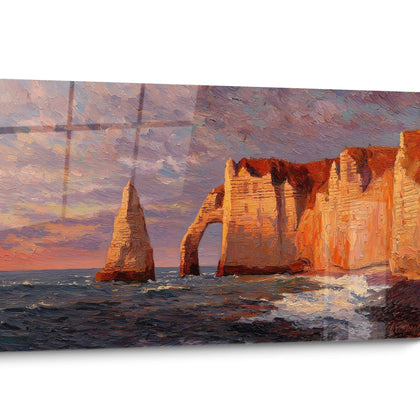
A Normandy watercolor painting captures the misty and ever-changing essence of Norman coasts with unparalleled delicacy. This pictorial technique perfectly translates turbulent skies, the Étretat cliffs shrouded in sea spray and verdant meadows swept by ocean mist. The large dimensions of these wall artworks allow you to immerse your space in the vaporous atmosphere so characteristic of this maritime region, where filtered light transforms each landscape into a living painting.
The Watercolor Translation of Norman Skies and Their Ephemeral Nuances
The Normandy watercolor painting excels in rendering the dramatic skies typical of this coastal region. Overlaid washes faithfully reproduce the rapid cloud formations that characterize the Norman maritime climate, where multiple weather conditions succeed one another within a single day. This atmospheric volatility, captured by the subtle gradations of watercolor, imparts remarkable depth to representations of white cliffs beneath a stormy sky or flax fields under raking light.
How does watercolor convey the luminous variations of the Norman coast?
The inherent transparency of watercolor allows chromatic layers to be superimposed to create these effects of light filtering through low clouds, so typical of Norman mornings. Pure white reserved areas evoke the spectacular light breaks that suddenly pierce cumulus clouds, illuminating a portion of sea or meadow. This capacity to play with white reserve becomes essential to translate the striking contrast between shadowed zones and piercing rays that sculpt Norman landscapes, particularly visible during rising tides or in estuaries like that of the Seine.
Signature tones of maritime Norman watercolor
A Normandy watercolor painting favors a palette dominated by nuanced grey-blues, deep greens of salt marshes and ochres of chalk cliffs. These specific tonalities, obtained through wet mixtures, faithfully restore the chromatic identity of the region: the verdigris of Trouville shutters, the chalky beige of capes, the slate tones of half-timbered roofs. Norman watercolor artists particularly master transitions between leaden sky and marine horizon, creating those atmospheric fusions where sea and sky seem to merge, an optical phenomenon frequent on the Côte Fleurie or at Barfleur.
The natural granulation of watercolor pigments amplifies the textural effect of Norman surfaces: the grain of grey sand at Deauville, the roughness of Yport pebbles, the porosity of Caen stone. These controlled accidents of the aqueous medium enrich the representation of mineral and vegetable matter, adding a tactile dimension to panoramic views of Norman bocage countryside or oyster ports like Saint-Vaast-la-Hougue.
Norman Landscape Signatures Magnified by Watercolor
Why is watercolor particularly suited to Norman maritime scenes?
The fluidity of watercolor finds natural resonance with the Norman aquatic environment. The Normandy watercolor paintings exploit this affinity to represent marine phenomena specific to this coast: waves crashing against Ouistreham breakwaters, shifting reflections in fishing ports like Honfleur, or shimmering mudflats in Mont-Saint-Michel bay at ebb tide. The wet-on-wet technique perfectly reproduces gradual transitions between damp sand and salt water, between mist and precipitation, between foam and wave.
Large formats allow full appreciation of the atmospheric gradations characteristic of Norman panoramas. A generously sized watercolor painting restores the breadth of D-Day beaches or the expanse of Pays d'Auge meadows, creating a contemplative window onto these emblematic landscapes. Zones of chromatic fusion evoke the morning fogs that regularly envelop the valleys of the Orne or Risle, while bold contrasts translate the sudden clarity that follows maritime showers.
Norman architectural motifs interpreted in watercolor
Beyond natural landscapes, the Normandy watercolor painting captures the essence of regional built heritage. Half-timbered houses in Rouen or Beuvron-en-Auge, with their exposed beam structures, lend themselves admirably to the precise lines of architectural watercolor, contrasting with the vaporous washes of backgrounds. Similarly, the Normandy sunset paintings in watercolor magnify the silhouettes of Romanesque churches and abbeys, whose thousand-year-old stones capture the last orange rays above the English Channel.
Norman rural scenes and their watercolor rendering
Apple orchards in bloom, an iconic Normandy theme, find poetic expression in watercolor. Delicate touches of pink and white reproduce the floral clouds of Norman spring, while tender greens evoke freshly irrigated meadows. Watercolor compositions of sunken lanes bordered by bocage hedgerows, typical of the Cotentin or Bessin, exploit contrasts between illuminated zones and shaded passages to create remarkable spatial depth, inviting the eye to venture into these intimate and preserved landscapes.
Integrating a Normandy Watercolor Painting into Contemporary or Traditional Surroundings
What decorative atmosphere to favor with a Norman watercolor painting?
A large-scale Normandy watercolor painting naturally becomes the focal point of an arrangement inspired by coastal aesthetics. In an interior with neutral tones evoking ecru linen or bleached sand, the watercolor artwork introduces the subtle nuances of the Norman landscape without overwhelming the visual space. The faded blues and pearl greys of these representations harmonize particularly with natural materials: driftwood, limestone, plant fibers, creating decorative coherence evoking the charming houses of Cabourg or Villers-sur-Mer.
Large-scale watercolors function remarkably well in generous volumes with high ceilings, where their visual lightness avoids a crushing effect while affirming a strong artistic presence. Unlike opaque techniques, watercolor retains a luminosity that preserves spatial airiness, particularly appreciated in north-facing rooms where natural light remains diffuse, much like that bathing Norman coasts for much of the year.
Chromatic associations that enhance Norman watercolor
To magnify a Normandy watercolor painting, favor a chromatic environment that dialogues with its palette without duplicating it. Soft terracotta or pale terracotta tones recall old Norman farm tiles and create warm contrast with the cool dominants of watercolor skies. Touches of sage green or eucalyptus echo salt meadows without competing with the more saturated greens of the artwork itself.
How to optimize the visual perception of a large-scale Norman watercolor?
The spatial arrangement of a large-format watercolor painting requires sufficient viewing distance to appreciate the overall composition and the subtlety of chromatic transitions. Position the artwork on a clear wall, facing a circulation or rest area allowing this distanced contemplation. Norman watercolors also benefit from being appreciated under indirect natural lighting, which reveals the transparency of washes without creating bothersome reflections on the surface.
In contemporary multifunctional spaces, a Normandy watercolor painting introduces contemplative breathing room, a reminder of preserved nature and the soothing rhythms of the coast. Its evocative yet non-literal character allows personal projection, with each viewer finding their own memories of Norman beaches, seaside walks or excursions into the rolling countryside.
FAQ - Frequently Asked Questions about Normandy Watercolor Paintings
Is a Normandy watercolor painting suitable for humidity-exposed spaces?
Although Norman landscapes are intimately linked to humid maritime environments, watercolor artworks require appropriate protection against excessive humidity. Favor placement in rooms with stable hygrometry, avoiding unventilated bathrooms. Large watercolor paintings framed under glass benefit from additional protection against humidity fluctuations while preserving visibility of delicate nuances.
What durability does a large-format Normandy watercolor painting offer?
Watercolors created with professional-grade artist pigments retain their chromatic intensity for several decades when preserved from direct ultraviolet exposure. For a large-scale painting depicting Normandy, choose artworks using pH-neutral paper guaranteeing temporal stability and resistance to yellowing.
How to identify an authentic Norman watercolor from a reproduction?
A genuine original watercolor presents subtle variations in saturation, areas where pigment has naturally accumulated in paper depressions, and the slightly irregular texture characteristic of the aqueous medium. These particularities, visible up close, distinguish the original artwork from digital reproductions, however faithful. Authentic Normandy watercolor paintings typically bear the artist's signature and sometimes an indication of the place of creation, testifying to their territorial anchoring.


