


Normandy Maritime Wall Art
Our Painting Normandie Maritime collection celebrates the soul of the Norman coasts and their maritime heritage. Discover works that capture the essence of Normandy's maritime landscapes, from the authentic ports of Honfleur to the majestic cliffs of Étretat. Each creation evokes the changing light of the English Channel, the Norman port scenes and the unique atmosphere of this maritime region. Explore this artistic universe where maritime tradition and the natural beauty of the Norman shores blend together.
 Honfleur Harbor Artwork - Colorful Reflections on the Old Basin - Normandy Edition273,90 €
 Raging Waves Painting - Marine Storm - Normandy Edition242,90 €
 Norman Fishing Boats Painting - Port Watercolor Marine - Normandy Edition273,90 €
 Honfleur Port Painting - Watercolor of the Old Norman Basin - Normandy Edition273,90 €
 Tetrapods Painting Normandy - Blue Coastal Defenses - Normandy Edition273,90 €
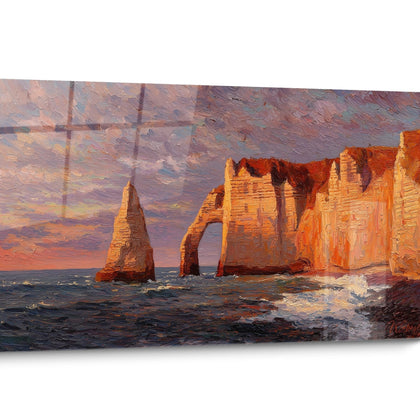
 Étretat Cliffs Painting - Majestic Arch and Sailboat - Normandy Edition273,90 €
 Étretat Cliffs Painting - The Needle and the Porte d'Aval - Normandy Edition228,90 €
 Marine Arch Panel - Storm over the Cliffs - Normandy Edition228,90 €
Explore further
In Normandy Maritime Wall Art



All about Normandy Maritime Wall Art
- Presentation Painting Normandy Maritime
- Norman maritime decor
- Coastal atmosphere and naval heritage
- Choice and decorative integration
A painting Normandy maritime celebrates the unique nautical identity of this region shaped by the English Channel, its historic ports and its centuries-old naval heritage. These large-format creations capture the essence of the Norman coasts, from the cliffs of Etretat to the basins of Honfleur, through the beaches of the D-Day and the emblematic lighthouses that line the coast. Each representation evokes the particular atmosphere of the changing Norman skies, the spectacular tides and the characteristic port architecture that defines the maritime soul of the region.
Norman naval heritage in your interior
A painting Normandy maritime brings the unique atmosphere of historic Norman ports directly into your living spaces. Honfleur with its Old Basin with slate facades, Cherbourg and its imposing military harbor, Dieppe and its past as an elegant seaside resort, are all sources of inspiration for these large-format representations that capture the deep maritime identity of the region.
Which Norman heritage elements to prioritize in a maritime decor?
The visual codes specific to the Normandy maritime region clearly distinguish themselves from other French coastal regions. Fisherman's huts with characteristic colors, the ochre sails of traditional fishing boats, handmade lobster ropes and traps, the typical grey pebbles of the beaches of the English Channel, are strong identity markers. Norman architecture is recognizable by its half-timbered houses near the ports, its Caen stone quays, its jetties battered by westerly winds that create this particular light sought after by the Impressionists.
The connection between naval tradition and contemporary aesthetics
Integrating a Norman maritime painting into a modern interior creates a fascinating dialogue between naval past and current design. The clean lines of compositions representing the lighthouses of Gatteville or Cap Lévy harmonize perfectly with minimalist spaces, while the silvery grey hues of the English Channel under cloudy skies bring atmospheric depth to contemporary rooms. This specific Norman aesthetic, less saturated than the Mediterranean, more architectural than Brittany, offers a sober elegance particularly appreciated in urban lofts and second homes.
For those seeking a softer approach to Norman landscapes, Normandy watercolor paintings offer a delicate interpretation of the same maritime horizons, with a chromatic sensitivity complementary to the more graphic compositions.
Marine compositions adapted to large spaces
Imposing formats allow to recreate the immensity characteristic of Norman panoramas, where the sky often occupies two-thirds of the visual composition. A Norman maritime painting of large dimension recreates this feeling of infinite space typical of the vast sandy expanses of the bay of Mont-Saint-Michel or the horizons visible from the cliffs of Varengeville. This visual amplitude radically transforms the perception of a stay or an entrance hall, imbuing it with this characteristic maritime breath.
Capturing the changing atmosphere of the English Channel
How do Norman variations in light enrich a composition?
The light of Normandy possesses unique optical characteristics that attracted Monet, Boudin, and the entire Impressionist school. This atmospheric quality, resulting from the interaction between low clouds, maritime humidity, and the metallic reflections of the English Channel, creates chromatic atmospheres impossible to reproduce elsewhere. A Normandy maritime painting of quality restores these subtle gradations between pearl grey, slate blue, and off-white that define authentic Norman aesthetics.
This specific palette naturally integrates into interiors seeking discreet sophistication. Unlike Mediterranean seascapes with stark contrasts, Norman compositions offer a nuanced tonal richness that evolves according to ambient lighting, creating a living painting that dialogues with the natural light of your space throughout the day.
The rhythm of the tides as a narrative element
The exceptional amplitude of the tides in Normandy, among the highest in Europe, profoundly shapes the region's maritime identity. Representations of ports at low tide, with their stranded boats on the mudflats, the exposed tidal flats scattered with seaweed and rocks, the stake beds aligned as far as the eye can see, constitute powerful visual motifs specific to this coastal geography. These compositions evoke the passage of time, natural cyclicity, concepts that particularly resonate in contemporary living spaces seeking a connection with organic rhythms.
Port architecture and Norman naval heritage
Norman maritime infrastructures tell a centuries-old naval history. Historic dry docks, 19th-century port cranes, hull shaping forms, floating basins surrounded by paved quays create architectural compositions of exceptional visual richness. A painting capturing these heritage elements brings a historical and cultural dimension that goes beyond simple decorative evocation, transforming your wall into a temporal window onto Norman maritime heritage.
Representations of Norman naval heritage also integrate authentic fishing villages such as Barfleur or Saint-Vaast-la-Hougue, whose granite grey houses and narrow streets opening onto the quays create fascinating architectural perspectives. These urban-maritime compositions offer a sophisticated alternative to purely coastal natural landscapes.
Selecting and enhancing your Norman maritime painting
Criteria for choosing an authentic representation
The authenticity of a Normandy maritime painting is recognized by its fidelity to the region's specific visual codes. Look for compositions that integrate the identity elements: characteristic chalk cliffs, slate architecture of the ports, typical diffused light, a restrained chromatic palette dominated by grey-blues and mineral tones. Generic seascape representations may lack this Norman specificity that makes all the difference between a simple nautical decoration and a true cultural evocation.
Generous formats allow you to fully appreciate the architectural details of lighthouses, the texture of port facades, the atmospheric nuances of Norman skies. An imposing dimension restores the monumental scale of the cliffs of Étretat or the extent of the port installations of Le Havre, creating a visual immersion impossible to achieve with reduced formats.
Where to install a Norman maritime composition for maximum impact?
The strategic placement of a large-scale nautical painting determines its decorative impact. Reception areas particularly benefit from these panoramic compositions that instantly create a conversational focal point. A wall facing the entrance featuring a view of a Norman port immediately establishes the atmosphere of your interior. Professional offices, medical practices, and reception areas also enhance these maritime representations that evoke the horizon, openness, and serenity.
Norman coastal residences themselves gain by integrating artistic representations of their environment, creating a visual continuity between interior and exterior. This mise en abyme reinforces the territorial anchoring and regional identity of your living space, particularly appreciated in family homes passed down through generations.
Decorative associations and stylistic complementarities
A Norman nautical painting is enhanced by thoughtful decorative associations. Patinated wood furniture, natural linen elements, and stoneware ceramics evoking traditional Norman pottery create a coherent harmony. Avoid stereotypical nautical clichés (decorative ropes, ornamental anchors) in favor of a restrained elegance that allows the pictorial composition to visually dominate.
Lighting deserves particular attention for these representations with subtle nuances. Indirect lighting highlights tonal variations without creating parasitic reflections, while directional lighting can emphasize certain architectural or atmospheric details according to your aesthetic preferences.
What style of decor best suits a Norman nautical painting?
Scandinavian interiors, with their light palette and minimalist aesthetic, constitute an ideal setting for these Norman maritime compositions. The contemporary minimalist style also perfectly enhances these representations with marked architectural lines. Industrial atmospheres, with their generous volumes and raw materials, create an interesting contrast with the natural and maritime dimension of the Norman compositions.
How to maintain and preserve a large-format nautical painting?
Optimal preservation requires positioning away from prolonged direct sunlight exposure, which could alter the pigments over time. Regular dusting with a dry microfiber cloth is sufficient for routine maintenance. In actual coastal environments, ambient humidity requires adequate ventilation to prevent deterioration, particularly for large formats with a large exposed surface area.
Can multiple Norman nautical paintings be combined in the same space?
A wall composition combining several complementary Norman maritime views creates a coherent visual narrative, provided that a stylistic and chromatic unity is maintained. Prioritize varied formats arranged according to a gallery logic to avoid monotony, ensuring sufficient intermediate spaces that allow each composition to visually breathe without saturating the space.
Further reading
Our articles on this topic
- Which Nature Artwork to Choose to Enhance a Coastal Decor?
- Marine scenes paintings: ocean breeze and soothing horizon
- Harbor painting: which mood to choose for your seaside living room
- Normandy watercolor painting: finding the perfect farewell gift for a Normandy expat
- Normandy cows and apple trees painting: the perfect duo for a warm kitchen
- Do Fishing Boat Paintings Evoke Authenticity and Maritime Life?
L'art qui suscite l'envie
Maison belge d'art mural grand format
14 jourspour changer d'avis*
Protection Walenskyincluse
Fabriquéen Italie
FormatXXL
Kit de fixationtoujours fourni
* Hors tableaux personnalisés et tailles personnalisées


