


Futuristic Architecture Wall Art
Our Futuristic Architecture Painting collection celebrates the innovation and boldness of visionary architectural structures. Each artwork captures clean lines, avant-garde geometric shapes, and dizzying perspectives that redefine modern space. Perfect for enhancing a contemporary interior, this futuristic architectural wall decor transforms your walls into true manifestos of modernity. Explore creations that blend urban design and technological imagination.
 Futuristic Architecture Crystals Painting - Luminous Fragments - Architecture Edition273,90 €
 Futuristic Urban Highway Painting - Architectural Flow - Architecture Edition228,90 €
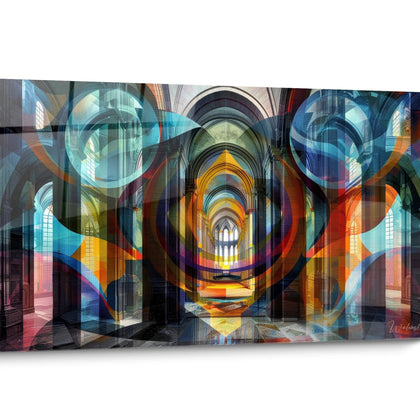
 Futuristic Architecture Painting - Infinite Perspective - Architecture Edition273,90 €
Explore further
In Futuristic Architecture Wall Art



All about Futuristic Architecture Wall Art
- Futuristic Architecture Wall Art Presentation
- Aesthetic and Architectural Vision
- Integration and Contemporary Spaces
- Visual Impact and Emerging Technologies
A futuristic architecture wall art radically transforms the perception of an interior space by projecting avant-garde urban visions and impossible structures that defy the laws of physics. These large-scale mural creations capture the essence of tomorrow's megacities, from organic skyscrapers to suspended infrastructures that characterize contemporary architectural science fiction. Each visual composition deploys vertiginous perspectives where vanishing lines converge toward unexploited technological horizons, creating a monumental window into parallel urban universes. Acquiring a futuristic architecture artwork responds to a quest for spatial anticipation in innovative professional environments, converted industrial lofts, and residential spaces that claim a decidedly future-oriented identity.
The Prospective Aesthetic of Tomorrow's Architectural Structures
A futuristic architecture wall art materializes architectural concepts that exist only in the imagination of urban visionaries and speculative design studios. Large-format compositions reveal vertical superstructures with organic silhouettes, suspended bridges between dimensions, and modular complexes that seem to defy terrestrial gravity.
What visual characteristics define futuristic architecture in large format?
Large-scale mural representations exploit dramatic overhead or worm's-eye perspectives that amplify the monumentality of imaginary structures. Non-Euclidean geometries create fascinating architectural impossibilities: DNA spiral towers, interconnected spherical residential modules, translucent walkways traversing interstellar voids. The chromatic palette favors contrasts between luminescent neons and anthracite metallic surfaces, reproducing the nocturnal ambiance of cyberpunk metropolises.
The symbolism of anticipated urban megastructures
These works convey a fascination with unlimited vertical expansion and extreme urban densification that characterize prospective scenarios. An abstract architecture wall art can also explore these themes from a more conceptual angle, but the futuristic approach maintains narrative readability of structures. Recurring elements include:
- Self-sufficient city-towers reaching the stratosphere
- Aerial transportation networks integrated into architecture
- Intelligent facades with programmable luminous patterns
- Vertical ecosystems combining vegetation and technology
The influence of parametric and generative design
The most sophisticated compositions integrate forms derived from parametric algorithms, generating structures with mathematically optimized curves. These continuous surfaces recall Zaha Hadid's architecture projected decades forward, with built envelopes that undulate according to complex equations. For office spaces in technological sectors or innovation showrooms, a futuristic architecture wall art affirms a prospective identity aligned with values of avant-garde and disruption.
Spatial Integration in Ambitious Contemporary Environments
Installing large-scale futuristic architecture wall art requires reflection on the dialectical relationship between real space and represented space. These works function as visual portals that temporarily dissolve a room's physical boundaries to project infinite urban depths.
Where to position a representation of futuristic megastructure?
The entrance halls of technology companies particularly benefit from these architectural visions that immediately communicate a culture of innovation. Walls facing elevators in office buildings create moments of waiting transformed into contemplation of possible futures. In residential spaces, positioning behind minimalist furniture avoids visual competition and allows architectural complexity to dominate without interference.
Compatibility with existing interior architecture
Interiors with pronounced architectural vocabulary – exposed beams, raw concrete, exposed metal structures – establish a fascinating dialogue with represented futuristic structures. This temporal juxtaposition between industrial architecture of the present and urban visions of tomorrow generates productive creative tension. Spaces with radical minimalism offer a neutral setting where the visual complexity of the artwork can unfold without dilution.
Which professional environments value these urban visions?
Architecture and urban planning agencies naturally use these representations as visual manifestos of their prospective approach. Video game studios specializing in science fiction, virtual reality companies, and technology startup incubators find in futuristic architecture wall art a cultural expression aligned with their DNA. Innovation-oriented coworking spaces integrate these works to signal their differentiating positioning against conventional work environments. The monumental dimension becomes a spatial argument for reception areas where immediate impact on visitors builds the decisive first impression.
The relationship of scale between spectator and megastructure
Imposing mural formats deliberately exploit the scale contrast to evoke a sensation of technological sublime. Facing towers represented kilometers high, the spectator experiences an urban version of romantic sublime – a mixture of fascination and vertigo before constructions exceeding ordinary human scale. This perceptual experience radically distinguishes these works from traditional architectural representations.
Visual Impact and Anticipated Technological Language
A futuristic architecture wall art functions as a system of visual signs borrowing from the vocabulary of emerging technology and intelligent infrastructures. Graphic elements encode imaginary functionalities: holographic panels, materialized data flows, light interfaces integrated into built facades.
Visual codes of speculative urbanism
Compositions systematically integrate recognizable technological markers: visible automated circulation networks in transparency, standardized residential modules stacked according to modular logic, apparent energy systems suggesting alternative sources. These narrative elements transform each work into a fragment of a coherent world where technological evolution has radically redesigned the built environment. Overlaid infrastructure layers evoke the vertical slice cities of Blame! or the stratified megalopolises of Blade Runner.
How does artificial light amplify these urban representations?
Architectural lighting directed from below accentuates the verticality of represented structures and reinforces the impression of monumentality. LED spotlights with cool color temperature (5000-6500K) amplify metallic tones and neon accents characteristic of cyberpunk aesthetics. Indirect lighting systems create a peripheral halo that visually detaches the artwork from the bearing wall, simulating increased depth of field.
The narrative dimension of prospective urban environments
Each futuristic architecture wall art implicitly suggests a civilizational narrative: demographic expansion requiring extreme verticalization, ecological catastrophe imposing sealed cities, technological advances enabling structural feats impossible today. This underlying narrative charge engages the spectator's imagination far beyond simple aesthetic appreciation, transforming observation into an exercise in speculative foresight. Collectors seeking conversational works find in these urban visions catalysts for discussions about the future of metropolises, urban sustainability, and the impact of emerging technologies on our living environments.
Perceptual evolution through repeated viewings
The informational density of these compositions progressively reveals initially imperceptible details: miniature vehicles suggesting scale, futuristic inscriptions adorning facades, structural variations between residential modules. This visual richness maintains interest beyond initial impact, unlike minimalist compositions whose interpretation is exhausted quickly. For daily living spaces or regularly frequented professional environments, this perceptual depth constitutes a decisive advantage.
FAQ - Frequently Asked Questions about Futuristic Architecture Wall Art
Is futuristic architecture wall art suitable for traditional residential spaces?
These works integrate ideally into industrial lofts, contemporary apartments, and residences with minimalist design where interior architecture dialogues with the prospective vision represented, creating aesthetic coherence rather than discord with traditional décor.
What furniture palette accompanies large-scale futuristic architecture wall art?
Furnishings with clean lines, technical materials like brushed steel or tempered glass, and integrated architectural lighting naturally extend the futuristic visual language without creating stylistic disruption, while organic elements provide welcome warm counterpoint.
How does perception of futuristic architecture wall art evolve over time?
Visual density continually reveals new architectural details during repeated observations, while real-world technological evolution creates a fascinating dialogue between represented anticipations and concrete realizations, enriching the artwork's interpretation over the years.


