


Black and White Symbolist Canvas
The Symbolist Painting Black and White reveals the depth of a fascinating artistic movement. These works capture the essence of symbolism through enigmatic compositions where dream and reality blend.Monochrome symbolist art transcends color to explore the human soul, myths, and spirituality. Each creation evokes a universal poetic language, inviting contemplation. Our collection of symbolist paintings in black and white enhances your interior with elegance and mystery.
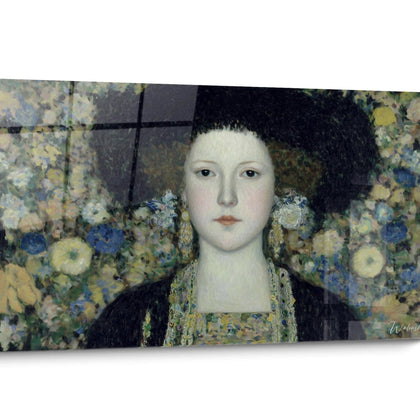
 Woman Portrait Timeless Grace - Symbolist Edition228,90 €
 Woman Precious Jewelry Painting - Symbolist Edition273,90 €
 Woman with Poetic Languor Painting - Symbolist Edition273,90 €
 Woman Floral Crown Painting - Symbolist Edition228,90 €
Explore further
In Black and White Symbolist Canvas




All about Black and White Symbolist Canvas
- Presentation Symbolic Painting Black and White
- Monochromatic Symbolic Aesthetics
- Spirituality and Abstraction
- Visual Impact and Composition
The symbolic painting in black and white embodies a form of artistic expression where chromatic duality becomes the privileged vector of metaphysical exploration. This monochrome approach to symbolism rejects the seduction of colorful palettes to focus attention on the very essence of visual archetypes, allegorical figures, and representations of the collective unconscious. In this radical aesthetic, every shade of gray, every contrast between shadow and light, functions as a coded language intended to awaken spiritual awareness in the viewer. Symbolist artists who embraced this chromatic restriction sought to transcend the visible to reveal the invisible, using the absence of color as a metaphor for the existential quest. This movement today finds a particular resonance in contemporary spaces where aesthetic sobriety meets conceptual depth, offering an alternative to conventional decorative compositions.
Symbolic Expression Through Chromatic Restriction
The symbolic painting in black and white represents an artistic approach where the voluntary suppression of color intensifies the symbolic charge of each visual element. This chromatic reduction is not a limitation but rather an amplification of the esoteric meanings and mystical narratives inherent in the symbolist movement. Iconic figures – fallen angels, mythological creatures, dreamlike landscapes – acquire a spectral and timeless presence when stripped of all naturalist chromatic references.
Why does black and white reinforce the symbolic message?
The absence of color in symbolic representations creates a distance from reality that facilitates access to the metaphysical dimensions of the work. This monochrome aesthetic functions as a meditative filter, eliminating sensory distractions to focus attention on universal archetypes and underlying narrative structures. Pronounced contrasts between shadow and light become visual metaphors for the fundamental duality of human existence – life and death, matter and spirit, conscious and unconscious.
Iconographic motifs favored in black and white
Monochrome symbolic creations exploit a specific visual repertoire: enigmatic female figures with indecipherable expressions, impossible architectures evoking dream temples, hybrid creatures from syncretic mythologies, and interior landscapes representing psychological states. These elements gain in mystery and ambiguity when rendered in shades of gray, allowing each viewer to project their own interpretations without being guided by conventional color associations. For lovers of symbolic universes exploring other visual registers, a symbolic aquatic painting offers a complementary perspective where the liquid element conveys distinct symbolism.
The psychological impact of absolute contrast
Symbolic compositions in black and white generate a particular visual tension that stimulates contemplative activity and promotes introspection. This extreme chromatic polarity creates a purified visual environment where subtle details – textures, tonal gradations, material effects – become perceptible and meaningful. In contemporary residential spaces seeking an intellectual and spiritual atmosphere, these works bring an incomparable conceptual depth, transforming walls into portals to inner dimensions.
Spiritual Dimension and Visual Transcendence
The black and white symbolic painting serves as a privileged medium for exploring the spiritual themes and existential questions that characterize the Symbolist movement. This minimalist chromatic approach establishes a direct connection with esoteric traditions and ancestral contemplative practices, where formal simplicity opens the way to metaphysical revelations. Symbolist artists considered black and white as primordial colors, anterior to creation itself, carrying a purer truth than derived hues.
Correspondences between monochrome and mysticism
The exclusive use of black and white in Symbolist art finds its roots in dualistic philosophical systems and ancestral cosmologies where these two poles represent the fundamental forces governing the universe. This bichromy simultaneously evokes emptiness and fullness, absence and presence, creating a visual space conducive to meditations on the nature of existence. Symbolic monochrome compositions often integrate esoteric symbols – pentagrams, mandalas, labyrinths, spirals – whose reading becomes more intuitive in the absence of chromatic distractions.
How do these works transform living space?
Installing a large-scale monochrome symbolic artwork in a residential or professional environment instantly creates a meditative focal point that alters the energetic quality of the space. These compositions function as windows into inner dimensions, inviting contemplative pauses in the incessant flow of daily life. Unlike conventional decorative works, these symbolic creations in black and white do not seek to please but to question, to destabilize aesthetic certainties in order to open up new avenues of reflection.
References to sacred iconographic traditions
The visual repertoire of monochrome symbolism draws abundantly from religious and mystical iconographic traditions: hieratic figures inspired by Byzantine art, geometric compositions evoking Gothic architecture, allegorical representations inherited from medieval illuminations. This lineage with sacred arts confers on contemporary symbolic paintings a spiritual legitimacy and a historical depth that particularly resonates with collectors seeking works that carry meaning rather than simple decoration. Monumental formats amplify this immersive dimension, creating almost ritualistic visual experiences.
Composition and Architectural Presence
The black and white symbolic painting in large format possesses a unique ability to visually structure an architectural space while preserving an atmosphere of intellectual intimacy. This duality between immediate visual impact and invitation to detailed examination constitutes one of the essential characteristics of these creations. The symbolic composition strategically exploits voids and solids, areas of graphic density and visual breaths to guide the gaze through complex reading paths.
The balance between readability and mystery
Symbolist artists mastering black and white develop compositions that progressively reveal their multiple layers of meaning. An initial reading allows one to grasp the general structure, the main masses, and the formal balances. A more sustained observation then reveals the symbolic details, the hidden iconographic references, the games of textures, and the subtle tonal variations that continuously enrich the visual experience. This interpretative depth transforms each contemplation into a discovery, definitively distancing these works from decorative compositions that exhaust themselves at first glance.
What environments enhance these monochrome compositions?
Contemporary spaces with clean lines, raw materials, and neutral palettes are the ideal setting to welcome a large-scale monochrome symbolic wall art piece. Minimalist interiors, industrial lofts, private libraries, and spaces for reflection particularly benefit from the presence of these works, which add a conceptual dimension without disrupting the chromatic harmony. The absence of color also facilitates integration into environments with strong aesthetic principles, where a colorful work might create visual tension.
Monumentality in the service of symbolism
Imposing formats allow symbolic compositions to fully deploy their immersive and contemplative potential. A monochrome work of several meters creates an almost physical presence, establishing a spatial dialogue with the surrounding architecture. Symbolic details can be developed on a scale allowing their appreciation without requiring excessive proximity, while the overall view from a greater distance reveals the compositional structures and formal balances. This multiplicity of viewpoints enriches the experience and justifies the investment in generous dimensions.
Is a black and white symbolic painting suitable for professional spaces?
Absolutely. Professional environments seeking an intellectual and cultivated image – consulting firms, law firms, galleries, cultural spaces – find in these works a way to assert a sophisticated aesthetic identity. The chromatic sobriety avoids any visual aggression while creating a memorable focal point that distinguishes the space from conventional corporate environments.
How to maintain the readability of a monochrome symbolic painting?
Preserving contrasts and protecting against dust accumulation are the main concerns. Indirect lighting enhances the nuances of gray without creating disturbing reflections, while delicate regular dusting maintains the clarity of the details. Distance from direct light sources prevents any alteration of the black pigments that could lose their intensity.
Can multiple black and white symbolic paintings be combined?
This approach works particularly well to create coherent narrative or thematic ensembles. The chromatic uniformity facilitates visual associations, allowing the development of diptychs or triptychs exploring different facets of the same symbolic concept. The key is stylistic consistency and the complementarity of the compositions to avoid redundancy while creating an enriching visual dialogue.
Further reading
Our articles on this topic
- Black and white candle painting: the flame as a symbol of minimalist decor
- Silent Paintings with Powerful Symbolism
- Color Symbolism: Each Hue Carries a Wall Message
- Black and White Artwork: When Contrast Creates Elegance
- White dove painting: the symbol of peace that elevates a modern living room
- Black and white woman painting: which mood to choose for each room
L'art qui suscite l'envie
Maison belge d'art mural grand format
14 jourspour changer d'avis*
Protection Walenskyincluse
Fabriquéen Italie
FormatXXL
Kit de fixationtoujours fourni
* Hors tableaux personnalisés et tailles personnalisées


