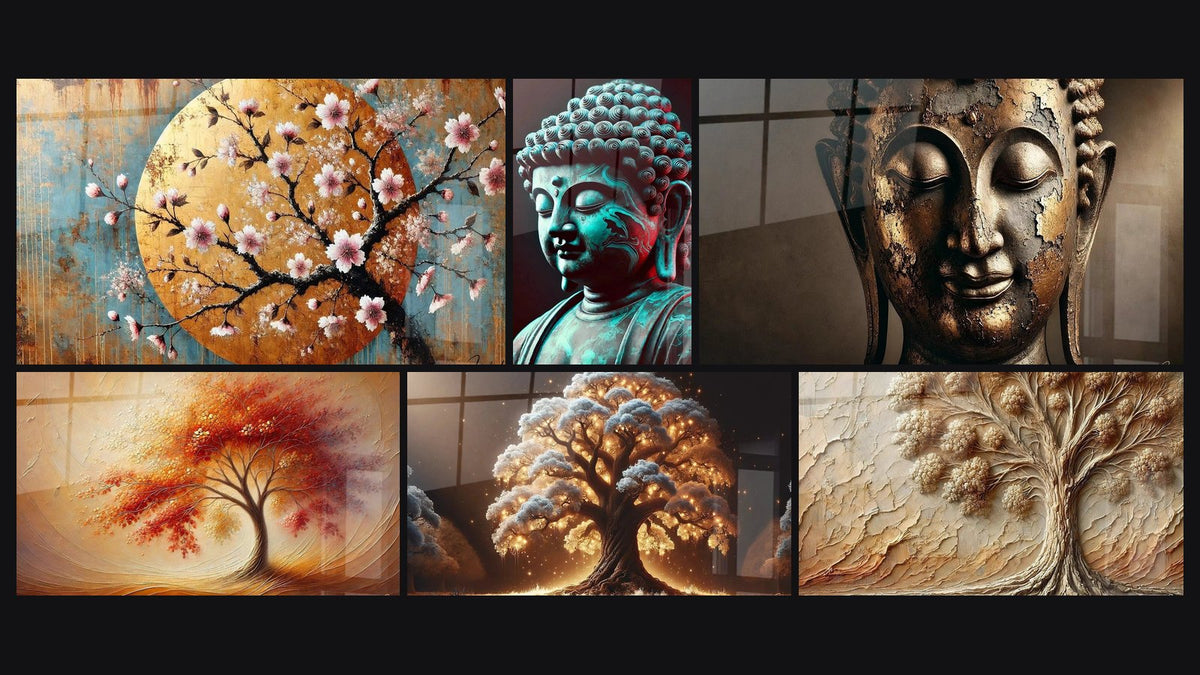
Zen meditation painting for a Japandi living room: where and how to place it according to your space
8 min read · by Walensky
ZEN MEDITATION PAINTING FOR LIVING ROOM
You have the beige linen sofa, the raw wood coffee table, perhaps even an incense diffuser smoldering in the background. The Japandi style is there. And yet something feels off: the wall above the sofa stays empty, or worse, holds a painting that clashes with everything else. The problem is almost never the choice of artwork. It's where it's placed.
The direct answerIn a Japandi living room, a zen painting is placed according to the function of the area: above the sofa with the center of the artwork 145-150 cm from the floor, in a reading corner at eye level when seated, or slightly offset from the TV unit so it doesn't compete with the screen. The size should cover 60 to 75% of the width of the furniture or wall concerned.The Japandi style, that marriage of Scandinavian minimalism and Japanese wabi-sabi, rests on a simple principle: every object has its place, and nothing is there by chance. A poorly positioned painting breaks this balance as surely as a neon cushion on a natural linen sofa.
- The standard hanging height is between 145 and 150 cm from the floor, at the center of the artwork.
- The two-thirds rule: the painting covers 60 to 75% of the width of the sofa or wall.
- A small living room of 15-20 m² often suits one large piece better than a cluster of small formats.
Why the placement of a zen painting changes everything in a Japandi living room
The soothing effect of a zen painting doesn't depend only on its subject. A Buddha in meditation hung too high, poorly lit or out of balance with the furniture produces the opposite of what it promises: visual tension, a discomfort you can't quite name.
Feng shui, often cited alongside Japandi, insists precisely on this point: it is the circulation of the gaze through the space that creates calm, not just the object contemplated. A well-placed painting guides the eye, structures the wall, and lets the room breathe.
A zen painting in the wrong spot is never neutral: it draws attention to the flaw it was meant to conceal.
The 3 key zones of the living room for hanging a zen meditation painting
Every Japandi living room has distinct functional zones, and each calls for a different hanging logic.
Above the sofa: ideal height and proportions
This is the most common location, and also the one where mistakes show most. The two-thirds rule applies here without exception: the width of the painting should represent 60 to 75% of the width of the sofa.
For a 220 cm sofa, an XL 140x80 cm format works very well, placed 20 to 25 cm above the backrest. The Éclat de Sagesse painting - Bronze Zen Buddha Edition, with its bronze and golden tones, naturally finds its place in this setup without overwhelming the wall.

In a dedicated reading or meditation corner
An armchair, a throw, a small table for the teacup: this corner exists in many Japandi living rooms, even modest ones. Here the hanging height is calculated while seated, not standing. The center of the artwork often drops to 130-135 cm, so the gaze falls naturally on it from the armchair.
This is the ideal spot for a more contemplative format, such as the Calme Turquoise painting - Zen Edition, whose turquoise and red tones accompany a meditation session without distracting.

Alongside a TV unit without visual clutter
The modern Japandi living room rarely has an empty TV wall beside it. The temptation is to place the zen painting right above the screen: a bad idea, as the two elements compete visually.
Offset the painting onto an adjacent or side wall rather than aligning it with the screen. The eye needs a resting zone between entertainment and contemplation.
A panoramic format such as the Allée Zen painting - Zen Edition, with its alley of green and golden bamboo, fits well on a side wall, extending the visual line rather than confronting the screen head-on.

Favorite
Dawn over Infinity Painting - Starry Sky Landscape Edition
From €273.90
Discover this paintingSmall Japandi living room: how to choose size and format without overcrowding the space
A living room of 15 to 20 m² is not a problem, it's a creative constraint. The classic temptation is to multiply small paintings to 'fill' the walls. The result is the opposite of the intended effect: the space looks cluttered and restless.
In a small living room, one piece of good size is better than an accumulation. The smallest standard format available, the L (120x70 cm), remains present enough to structure a wall without overwhelming a modest room. For a truly narrow wall, made-to-measure from 80x46 cm lets you fine-tune the proportions precisely.
- A 2.20 m wide wall comfortably accommodates an L or XL format.
- Avoid hanging two paintings of different sizes on the same restricted wall.
- Prefer a palette of neutral and terracotta tones, which visually expands the space rather than weighing it down.
The Calme Abstrait painting - Zen Edition, with its stacked beige and orange pebbles, illustrates this principle well: a pared-back composition that doesn't need a large size to produce its calming effect.

— Our selection

Common placement mistakes that break the zen atmosphere
Certain pitfalls recur with striking regularity, whatever the living room.
| Mistake | Why it breaks the effect | Fix |
|---|---|---|
| Hanging too high | The gaze has to look up, breaking contemplation | Center at 145-150 cm, never higher |
| Too many reflections | Acrylic glass reflects light when facing a window | Prefer matt Dibond aluminum in full natural light |
| Painting too small for the wall | Loses all presence, floating effect | Respect the two-thirds rule for width |
| Too harsh a contrast with the furniture | The eye snags on color rather than on serenity | Choose a palette close to the tones of the sofa or the wood |
To go further on color pairings specific to the style, our article on the grey and white tones zen painting details how to compose a palette faithful to the Japandi spirit.

In the same spirit
Au Fil de l'Eau Painting - Jungle Landscape Edition
From €273.90
Discover this painting →Frequently asked questions
How high should you hang a painting above a sofa?
The center of the artwork should sit between 145 and 150 cm from the floor, roughly at the eye level of an average-height standing person. Above a sofa, one generally leaves 20 to 25 cm between the top of the backrest and the bottom of the frame.
How to decorate a small Japandi-style living room?
Favor a single wall piece of good size rather than several small formats. A palette of neutral and terracotta tones, combined with an L or XL format well proportioned to the available wall, structures the space without cluttering it.
Can you hang several zen paintings in the same room?
Yes, provided there is a consistent palette and generous spacing between the works, of at least 10 to 15 cm. Avoid mixing more than two different visual styles on the same walls, lest you blur the intended calming effect.
Which painting size to choose based on the wall size?
The reference rule is to aim for 60 to 75% of the width of the wall or furniture concerned. For a 2 m wall, this generally corresponds to an L or XL format among the sizes offered in the shop.
The right zen painting, in the right place, turns a Japandi living room into a true haven of calm, far more effectively than a multiplication of decorative objects. Size matters, height matters, and the room's light dictates the choice between acrylic glass and Dibond aluminum. To find the format that matches your exact setup, the zen and meditation painting collection remains the simplest starting point.
Explore our collections