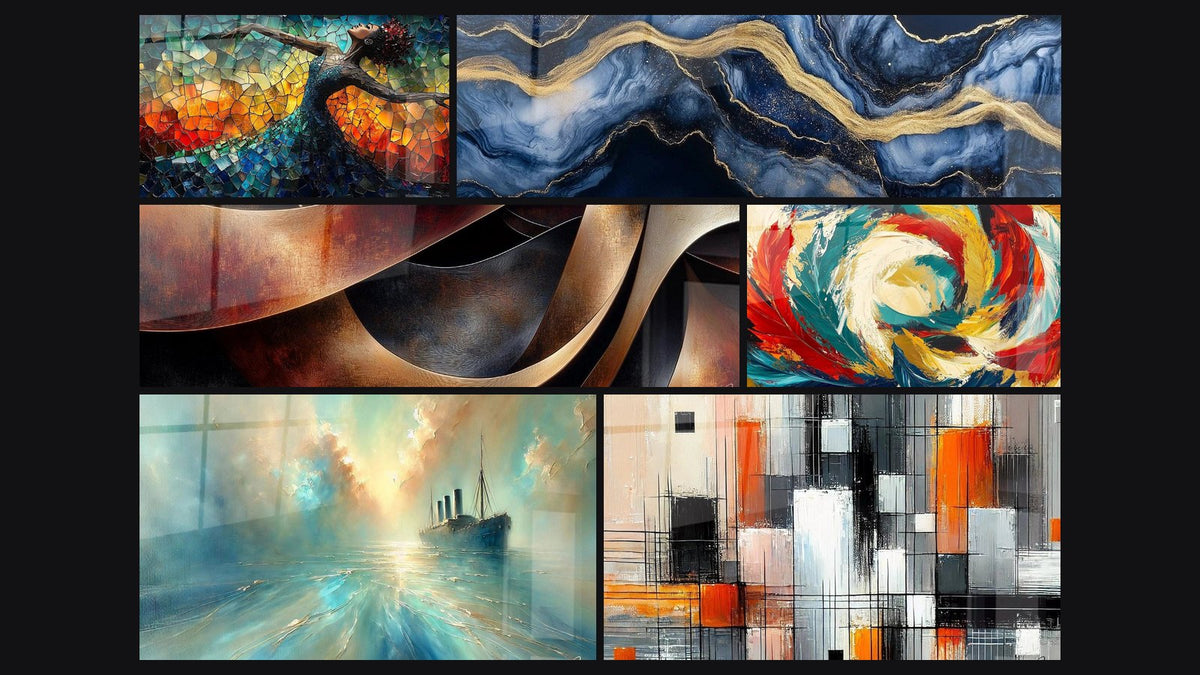
Create a flexible atmosphere with an artwork in a mixed room
October 11, 2025 · 17 min read · by Walensky
Yet, that large artwork you chose with so much attention now seems to create a permanent conflict. Too formal for your relaxation moments, or too casual for your important video conferences. You oscillate between wanting to take it down and being frustrated by not knowing how to harmonize these two worlds.
You may have tried changing the lighting, moving a few accessories, or even considered buying a second artwork. But nothing works: your room seems trapped in a fixed identity that never quite matches your needs at the moment.
This is perfectly normal, and it’s absolutely not a matter of taste. The real difficulty lies in the fact that most traditional decor advice assumes that a room has a single function. However, our modern lifestyles require spaces that adapt to our different activities.
In 8 minutes, you will know exactly how to choose and position an artwork that transforms the atmosphere of your room according to your needs, creating a stimulating office or a soothing living room, without ever creating visual conflict.
Why does your mixed space deserve a revolutionary decor approach?
Multifunctional spaces represent 85% of urban homes today. If you expect to master the art of classic decoration, you will miss simple solutions that will transform your daily life this week. It's like trying to learn how to drive on a highway by starting to memorize the traffic code: the traditional approach wastes your precious time.
🏠 Customer testimonial: "Sarah, an interior architect, says: 'I spent 6 months looking for THE perfect artwork for my living room office. I bought three different ones, thinking that you had to choose. Today, with just one well-chosen artwork and a few clever adjustments, my room transforms in 30 seconds according to my needs. My clients constantly ask me how I do it.'"
Conversation with a decor expert
The golden rule of flexible spaces: A painting becomes versatile when it creates an emotion rather than a function. Like a good perfume that makes you feel confident in the morning and soothes you at night, adaptive art works on your state of mind, not on your environment. Visible results in 24 hours.

Our highlight
Blue Floating Hope Canvas - Abstract Multicolor Edition
232,90€
Discover this artwork →Finally understand why your previous attempts failed
Do you recognize yourself in these situations? Your painting pleases you in the morning but irritates you in the evening. You hesitate to turn on certain lamps because the lighting completely distorts the work. You feel that your decor "pulls in all directions" without ever creating a global harmony.
What's really happening is that you are applying static decoration rules to a space that needs flexibility. The problem isn't your taste or budget, but your approach. It’s exactly like trying to do yoga in a suit and tie: even with the best intentions, the tool is not suited to the task.
The real solution lies in understanding that your room needs an evolving decorative system, not a frozen decor.
Hidden first cause: you confuse style and atmosphere
Most people choose a painting for its aesthetic style (modern, classic, colorful...) when in a mixed room, you must first think about its emotional impact. It’s the difference between choosing an outfit for a photo and choosing an outfit to feel good all day long.
Imagine that you choose a music playlist: you don't just select the genre you like, but also the effect you want to create on your mood. Decorative art works exactly the same way.
This awareness will completely transform the way you look at artworks. Instead of asking yourself "Do I like this painting?", you'll ask yourself "How does this painting make me feel, and is that feeling compatible with my different uses?"
🧪 Immediate test: Look at the painting you currently have. Close your eyes for 30 seconds, then open them focusing only on your first bodily sensation. Are you more tense or more relaxed? This instinctive reaction reveals its true impact on your space.
Many think that a good painting must "render well" in all lighting conditions. In reality, it’s your lighting system that must adapt to the work to create different atmospheres. The same painting can appear energizing under white light and soothing under warm light.
It’s like having a decorative chameleon: the art remains the same, but its character changes completely depending on the lighting environment you create around it.
This understanding explains why you can't seem to be satisfied with just one lighting setup: your room needs multiple luminous personalities that reveal different facets of your artwork.
The third cause: you’re searching for perfection instead of harmony
Here's the most subtle trap: you want your artwork to be "perfect" for every use, when it simply needs to be compatible with your different needs. The nuance is enormous, and almost no one notices it at first glance.
Observe your current space: if you spend more than 30 seconds adjusting decor details when you change activities, that’s a sign you're searching for perfection rather than fluidity.
This revelation will free you from enormous pressure and allow you to make faster and more effective decor decisions.
🔄 The 3 signals of a successful flexible space:
- Natural transition: You move from one activity to another without noticing any “visual friction,” like changing radio stations without interruption
- Immediate comfort: You feel instantly “at home,” whether you’re in work or relaxation mode
- Emotional coherence: The ambiance supports your state of mind rather than contradicting it, like a good friend who adapts to your mood
The trigger element: the “harmonious triangle” rule
What really makes the difference is creating a harmonious triangle between your artwork, your lighting, and a movable element (cushion, throw, decorative object). This approach works like a system of levers: each small adjustment to one influences the whole, creating a cascade effect that transforms the entire ambiance. You’ll recognize it when your eye stops searching for problematic focal points in the room.
The law of progressive adaptation: A successful flexible space doesn't abruptly change identity; it progressively reveals different facets of its personality. Check this by observing whether your usage transition is smooth or abrupt.
| ❌ Classic, rigid approach | ✅ Modern, flexible approach | 💡 Why it works | 🎯 Daily benefit |
|---|---|---|---|
| I’m searching for THE perfect artwork for everything | I choose an emotionally neutral and adaptable artwork | Adaptability trumps specialized perfection | Zero frustration, maximum pleasure |
| My lighting must highlight the art | My lighting creates the ambiance; the art complements it | Adjustable lighting transforms emotional impact | Same room, multiple personalities |
| I decorate once and for all | I integrate strategic movable elements | Micro-adaptation maintains freshness | Space always aligned with your needs | My room must have a defined style | My piece expresses different facets of my personality | Multiple authenticity replaces rigid consistencyYou truly feel at home

Our favourite
Blue Geometric Nostalgia Painting - Abstract Music Edition
233,90€
Discover this artworkThe 3-step method to create your chameleon atmosphere
Rassurez-vous, vous n'avez pas besoin de tout reprendre à zéro ni d'acquérir des compétences de décorateur professionnel. Cette méthode suit la logique naturelle de construction d'un écosystème décoratif : d'abord les fondations émotionnelles, puis les outils d'adaptation, enfin les automatismes de transition. À chaque étape, vous ressentirez immédiatement une amélioration de votre confort quotidien.
🏗️ Vue d'ensemble de votre transformation : Étape 1 - Choisir votre tableau "caméléon" (celui qui s'adapte), Étape 2 - Créer votre système d'éclairage modulable, Étape 3 - Installer vos "déclencheurs d'ambiance" mobiles. Comme construire une maison : fondations solides, installation technique, puis décoration finale qui fait toute la différence.
Étape 1 : Sélectionner votre tableau adaptable
Commencer par le choix du tableau peut sembler évident, mais c'est stratégique : c'est votre ancre visuelle qui donnera le tempo à tout le reste. Comme planter un arbre qui grandira avec votre jardin, cette décision va structurer harmonieusement votre évolution décorative. Une fois cette base posée, vous ressentirez immédiatement une sensation de cohérence apaisante.
Les critères de sélection essentiels
- Palette chromatique tempérée : Privilégiez des œuvres avec 60% de tons neutres (beiges, gris, blancs cassés) et 40% de couleurs plus marquées. Cette proportion crée un équilibre naturel qui s'harmonise facilement avec différents éclairages. Évitez les œuvres trop contrastées qui "crient" dans l'espace et limitent vos options d'ambiance. Composition équilibrée : Recherchez des tableaux où le regard trouve facilement un point d'ancrage central, mais sans élément trop dominant qui monopoliserait l'attention. Le principe : votre œil doit pouvoir "se reposer" sur l'œuvre sans être capturé par elle. Cela garantit la compatibilité avec le travail concentré. Texture subtile et profondeur : Optez pour des pièces qui révèlent des détails différents selon la distance et l'éclairage. Cette richesse discrète permet à l'œuvre de "vivre" avec vos activités plutôt que de rester statique. L'impact sur le résultat final : votre tableau devient un compagnon plutôt qu’un simple élément déco.
Passons maintenant à la pratique avec votre sélection :
Comment tester l'adaptabilité d'un tableau
Test de l'émotion neutre : Placez-vous à 2 mètres de l'œuvre et observez votre réaction corporelle pendant 30 secondes. Un bon tableau adaptable ne provoque ni tension ni excitement excessif, mais plutôt une sensation de bien-être stable. Cette neutralité émotionnelle est la base de l'adaptabilité.
⏱️ Time: 2 minutes per piece | ✅ Successful when: You feel a pleasant sensation but not strong emotion | ⚠️ Attention: Beware of the "love at first sight": it often indicates a work that is too emotionally specialized
Test of variable lighting: If possible, observe the piece under different lighting conditions (natural, warm, cool). It should reveal different nuances without losing its character. This is a sign of chromatic richness that will flourish in your space.
⏱️ Time: 5 minutes | ✅ Successful when: The piece remains beautiful but changes ambiance according to the light | ⚠️ Attention: If it becomes dull under certain lighting conditions, it will limit your ambiance options
Test of peripheral attention: Install yourself in a work position (computer, reading) with the piece in your peripheral field of vision. It should neither distract nor bother you. This compatibility with concentration is crucial for a mixed space.
⏱️ Time: 10 minutes of simulation | ✅ Successful when: You forget its presence without finding it bland | ⚠️ Attention: If your gaze constantly drifts towards it, it will disrupt your productivity
✨ Final validation of step 1: Your ideal painting makes you want to spend time in the room, whether for work or relaxation. You can look at it for 10 seconds without feeling the need to analyze it. If you are still hesitating between two options, choose the one that most easily "makes you forget" its presence. The next step will reveal all its potential!
— Our selection


OUR RECOMMENDED PRODUCTS
Step 2: Create your modular lighting system
Now that your painting is chosen, you are going to transform your relationship with space by mastering ambient temperature. This step changes the game because you no longer suffer from the lighting, you direct it according to your needs. This is where the magic happens: same furniture, same painting, but radically different ambiances depending on your light setting.
Your adaptive lighting kit
- Variable main lighting: A pendant light or ceiling light with integrated dimmer and adjustable color temperature (3000K-6500K). Look for the "CCT variable" mention which guarantees modulation between warm and cool light. This primary source creates the general ambiance of productivity or relaxation.
- Accent lighting: One or two directional light sources (track spotlights, adjustable desk lamps) to highlight your painting according to the desired effect. The principle: indirect light softens the work, direct light dynamizes it. Avoid overly powerful lights that create reflections.
- Mobile ambient lighting: Portable lamps (table lamp, LED string lights, ambient nightlights) that you can move to create areas of intimacy or openness. This flexibility allows you to visually redesign the space according to your activities.
Installing Your Lighting Scenarios
"Productive Focus" Scenario: Cool main lighting (5000K-6500K) at 80%, accent lighting on artwork at 60%, ambient lighting off. This configuration stimulates cognitive arousal and puts the artwork in visual background to avoid distractions.
⏱️ Time: 15 minutes of adjustment | ✅ Success when: You feel an immediate sense of working energy | ⚠️ Attention: If the atmosphere becomes emotionally cold, reduce the intensity rather than the temperature
"Cozy Relaxation" Scenario: Warm main lighting (2700K-3000K) at 40%, soft accent lighting on artwork, ambient lighting on. The artwork then becomes a soothing focal point that invites contemplation.
⏱️ Time: 10 minutes of adjustment | ✅ Success when: You feel like settling in comfortably | ⚠️ Attention: Avoid underexposure which would make the space sad rather than intimate
Step 3: Install Your Ambiance Triggers
This final step will sublimate your mastery of space by adding the tactile and sensory dimension. You create "ambiance rituals" that mentally signal your change of activity. It's the difference between a space that adapts mechanically and a space that accompanies you emotionally in your transitions.
Your Micro-Adaptation Tools
- Modular textile: A quality throw or cushion in a color that dialogues with your artwork. Present for relaxation, stored away for work. This simple gesture changes the perception of space by 70%. Choose a pleasant tactile material that makes you want to manipulate it.
- Mobile decorative object: A vase, candle, or sculpture that you move according to your needs. In work mode, it remains discreet. In relaxation mode, it becomes a secondary focal point that enriches the visual experience around your artwork.
- Plant element: A potted plant or fresh flowers that bring the living and seasonal dimension. This natural touch creates a different emotional connection depending on your mood and reinforces the adaptability of the whole.
The rule of natural progression: Move to the next step when your adaptation gesture becomes automatic and takes less than 2 minutes. The goal: that the ambiance transition is faster than making coffee. Patience in learning, efficiency in use.
Congratulations! You now master the fundamentals of flexible ambiance. But true connoisseurs go even further by exploiting subtleties that even professional decorators sometimes neglect. These expert finishes will give you that unique decor signature that instantly makes you feel good at home.
🔥 Master Decorator Tip: Create a "chromatic echo" by placing a small object in the dominant color of your artwork on the opposite side of the room. This "visual bounce" technique unifies the space without weighing it down and amplifies the emotional impact of the work. Visitors immediately notice the harmony without understanding where it comes from.
Frequent question from our readers
"How can I know if my artwork will really work before buying it definitively?"
This is a perfectly legitimate concern, especially when investing in a quality piece that will accompany you for years. The safest solution is to start by living with the artwork for a few days under different conditions. Many galleries offer an at-home discovery service, and online stores often provide trial periods. Take advantage of this to test your lighting scenarios and observe your spontaneous reactions at different times of the day.
💡 Decisive 48h Test: Photograph your room with the artwork in your two main ambiances (work/relaxation). If the photos make you want to be in that space, you've got it! The photo objective often reveals what our accustomed eye no longer sees.
— You may also like


The 5 mistakes that sabotage your flexible ambiance
Now that you know the method, let's protect your investment by avoiding common pitfalls that turn a promising project into an expensive frustration. These mistakes are so common that even experienced decorators fall for them.
- 🎨 Choosing an artwork "love at first sight" too specialized: It's tempting to crack for a work that moves you strongly at first glance, but intense emotions often create rapid fatigue or incompatibility of use. Prefer the artwork that makes you feel good rather than the one that makes you vibrate. The nuance changes everything in the long term. 💡 Neglecting natural lighting in your tests: Many test their configuration only in the evening under artificial lighting, then discover that daylight creates unexpected visual conflicts. Always observe your installation at different times of the day before validating it definitively. 📐 Placing the artwork at the wrong height for mixed use: The ideal height to contemplate standing is not the same as when watching while sitting and working. Find the compromise that works in your two main positions, even if you slightly prioritize your most frequent use. 🔄 Multiplying variable elements instead of prioritizing them: The desire to make everything modular paradoxically creates more rigidity. Choose 2-3 key elements to evolve and keep the rest stable. Too much variability is mentally exhausting and dilutes the visual impact.
- ⏰ Wanting transformations too quickly: It's normal to take 1-2 weeks to automate your new ambiance reflexes. Resist the urge to change everything if it doesn't work perfectly from day one. Give your habits time to adapt to your new system.
🛡️ Weekly self-check system: Ask yourself these questions every Friday: "Have I naturally used both of my ambiances this week?", "Do my transitions take less than 3 minutes?", "Am I still enjoying looking at my artwork?". If the answer to any is negative, adjust one element before the following week.
— In the same vein


Your practical questions about flexible ambiance
Implementation generally takes 2-3 weeks to become natural, with an initial investment of 150-400€ depending on your choices (artwork + modular lighting). The trick to optimize: start by perfecting the lighting of your current artwork before considering a change of work. Concrete example: Lucie transformed her living room-office with 180€ of smart lighting and has kept the same painting for 2 years.
In 80% of cases, your existing artwork can become adaptable with the right lighting and decor techniques. First test the method with your existing work: if it still creates ambiance conflicts after 3 weeks of optimization, then only consider a change. This approach saves you 200-500€ and teaches you to recognize the real criteria for adaptability.
Small spaces even benefit more from this approach! In 15-20m², each element has more visual impact, so ambiance transformations are more spectacular. The key: prioritize indirect lighting and medium-sized artworks (60-80cm) that structure without cluttering. Optimized budget: count 30% less than a large space because you need fewer light sources.
Excellent question! With children, prioritize wireless rechargeable lighting to avoid cables, and choose artworks with ultra-secure fixings. The advantage is that kids love participating in "mood transformations," turning it into a family game. For pets, avoid lightweight moving elements they could knock over, and opt for materials resistant to scratches if necessary.
Your new life in a space that reflects you
In a few weeks, you will no longer recognize your relationship with your interior. No more time when you were subjected to a fixed atmosphere that never quite met your needs at the moment. Now, your room breathes with your activities, naturally creating the optimal state of mind for each moment of your day. Your guests will immediately notice this unique "decor signature" that makes them feel instantly comfortable in your home.
This mastery of flexible ambiance goes beyond simple decoration: you develop an aesthetic sensitivity and an understanding of the psychological impact of spaces that will serve you in all areas of your life. This new confidence is felt in the way you approach other creative projects and even in your daily well-being.
You now know that creating perfect harmony was a matter of method, not budget or innate talent. The first step to take? Observe your current artwork under different lighting tonight. You have all the tools at hand to transform your everyday life starting today!
🚀 Your next step towards excellence: The space of your dreams is only a few adjustments away from your current reality. Start small, observe the changes, and let your sensitivity guide you toward the perfect configuration. Your future self will thank you!

More selected pieces
Color Explosion Painting - Dynamic Splatter - Abstract Colorful Edition
233,90€
Discover this artwork →