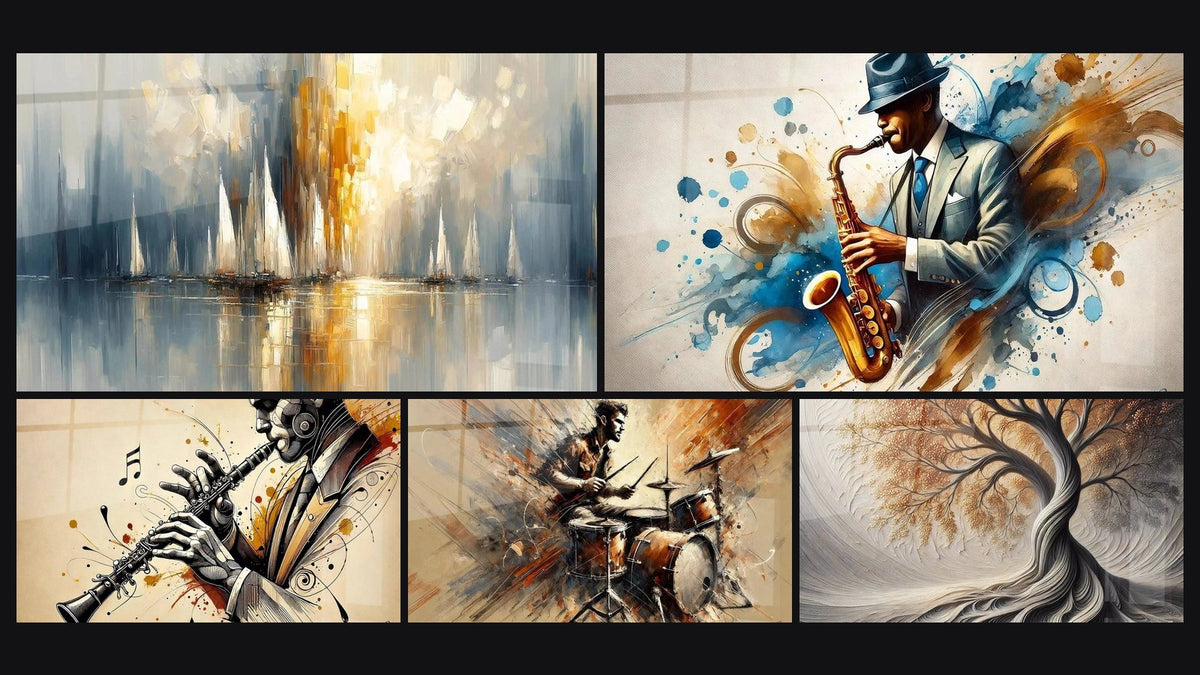
Tableau wall art size comparison: visual impact and technical constraints
October 11, 2025 · 15 min read · by Walensky
Why the size of your artwork determines the soul of your room?
The size of a wall painting doesn't just determine its price; it literally dictates the energy and atmosphere of your space. It’s like choosing between whispering and proclaiming: the emotional impact is all about that. If you wait to have “a bigger budget” for the right format, you risk missing out on this magical transformation of your interior.
🏠 Customer testimonial: "I bought three small 30x40cm paintings for my 45m² living room. They were beautiful individually, but completely drowned in the space. When I replaced them with a single large 120x80cm format, my guests immediately noticed the difference. My living room finally had personality!"
Conversation with a decor expert
The golden rule of harmonious proportions: Your painting should occupy between 60% and 75% of the width of the furniture it overlooks, creating a natural visual balance that your eye will immediately perceive as “just right”. Guaranteed results in less than 24 hours!

Our highlight
Modern Muse Canvas - Contemporary Abstract Painting Edition
233,90€
Discover this artwork →Decoding: what's really happening in your visual perception
Do you recognize these situations? You enter a room and something feels off without you knowing what, your gaze searches for an anchor but finds nothing satisfying, or you feel that your decor lacks "character" despite beautiful objects.
What's happening is that your brain instinctively seeks balanced proportions and coherent focal points. When sizes don't meet natural visual expectations, it creates an unconscious tension that makes you uncomfortable without you understanding why.
It's like listening to a melody with a false note: even without being a musician, you feel that something is wrong.
First revelation: the effect of relative proportion
Contrary to what many think, a painting doesn't have an "absolute" size but a relative one to its environment. An 80x60cm format can seem monumental in a 10m² bedroom and totally insignificant in a cathedral-like living room.
It’s exactly like wearing jewelry: the same ring can appear discreet or imposing depending on the morphology of the hand that wears it.
This discovery will revolutionize your approach to choosing: instead of focusing on centimeters, you'll learn to "read" the proportions of your space and create perfect harmony.
✨ Immediate test: Look at the wall where you want to hang your painting. Imagine it divided into 3 equal vertical bands: your artwork should ideally occupy the central band to create a natural balance.
Many believe that a small painting is more "safe" and that a large one is necessarily "bold". In reality, each format generates a specific emotion which influences the atmosphere of your room in a measurable way.
It's like the difference between an intimate conversation at a low voice and an inspiring speech: same message, totally different impact.
Understanding this psychological effect will allow you to consciously choose the atmosphere that you want to create: intimacy, grandeur, dynamism or serenity.
Third revelation: the rule of the visual triangle
Here's what no one tells you: your eye automatically creates triangles between the elements of your room to assess harmony. A poorly sized painting breaks these natural triangles.
You can verify this immediately by observing how your gaze navigates between your sofa, your painting and your other decorative elements.
This awareness transforms your way of seeing your space: you no longer suffer from imbalances, you anticipate and correct them.
🎨 The 4 signals of an unsuitable size:
- Scattered gaze: Your eyes don't know where to settle when entering the room (painting too small) Feeling of being crushed: You feel oppressed near the wall (disproportionate format) "Hole" effect: The wall seems empty despite the presence of the painting (under-sizing) Constant imbalance: You want to "rebalance" by adding other elements
The trigger element: the rule of thirds
The factor that really makes a difference is mastering the rule of thirds: your artwork should occupy about 2/3 of the available visual space above a piece of furniture. This is a powerful psychological lever effect that instantly creates a sense of harmony. You can check this by photographing your wall: on the photo, the balance (or imbalance) will immediately catch the eye.
The universal rule of proportions: Measure the width of your furniture, multiply by 0.65: you get the ideal width of your artwork. Test with a measuring tape against your wall to visualize the effect before purchasing.
| ❌ Common belief | ✅ Reality | 💡 Explanation | 🎯 Practical benefit |
|---|---|---|---|
| The smaller it is, the more discreet it is | The right format creates natural harmony | The eye seeks balanced proportions | Room immediately looks more elegant |
| A large artwork necessarily costs more | Price depends on technique and support | Format influences less than craftsmanship | Budget optimized for maximum impact |
| You have to match the color of the walls | Contrasts create depth | The game of complements energizes the space | Decoration that "lives" and evolves |
| It's better to have several small ones than one large one | A strong focal point structures the room | Dispersion dilutes emotional impact | Coherent and soothing atmosphere |

The 3-step method to choose the perfect size
Rest assured, you don't need any training in decoration to master this approach. It's like learning to cook: once you know the right proportions, the result is guaranteed. We will build your expertise step by step, from basic measurement to advanced optimization. At the end, you will have the assurance of creating the exact visual impact that you desire.
🗺️ Overview of your progress: First, you'll learn how to measure and calculate ideal proportions (the foundations), then adapt according to the use of the room (the structure), finally optimize for your personal style (the finishing). Each step will give you a concrete skill and a visible result.
Step 1: Mastering basic measurements and proportions
Starting with measurements is creating solid foundations for all your future decisions. It's like learning scales in music: once integrated, everything becomes more fluid. You will feel an immediate satisfaction seeing your calculations transform into visual harmony.
What you need
- A minimum 3-meter measuring tape: Choose a model with automatic locking to easily measure alone. Avoid rigid DIY tapes that don't adapt to curves. Check that the graduations are readable: this determines the accuracy of your final proportions.
- Newspaper or kraft paper: Newspaper is perfect because its flexibility allows you to visualize the effect on the wall without damaging the paint. The principle: cut to calculated dimensions to "see" before buying. A lighter sheet will give you a better approximation of light impact.
- A camera (smartphone is sufficient): The lens reveals imbalances that the accustomed eye no longer sees. Photograph your wall with the test paper: proportion defects will immediately appear on the screen.
Now let's move on to concrete practice:
How to proceed step by step
Measure your reference space: Measure the width of the furniture above which the painting will be hung (sofa, chest of drawers, bed...). This measurement becomes your "calculation base" because visual harmony is born from the relationship between these two elements. Note this dimension and add 20cm on each side to define the total visual space.
⏱️ Time: 2 minutes | ✅ Successful when: You have 3 measurements noted (furniture width, total space, ceiling height) | ⚠️ Attention: Don't forget elements that "overflow" like sofa armrests
Calculate ideal proportions: Multiply the width of your furniture by 0.65 to obtain the optimal width of the painting. For height, divide this width by 1.4 (classic landscape format) or multiply by 1.2 (portrait format). These ratios correspond to naturally soothing proportions for the human eye.
⏱️ Time: 1 minute | ✅ Successful when: You obtain consistent dimensions (no extreme format) | ⚠️ Attention: If your result exceeds 150cm wide, recalculate with 0.5 instead of 0.65
Visually test with paper: Cut out a rectangle to the calculated dimensions and temporarily attach it to the wall with masking tape. Step back 3 meters and observe the overall effect. This step immediately reveals whether your calculations translate your vision.
⏱️ Time: 5 minutes | ✅ Successful when: The whole seems balanced and the eye naturally rests | ⚠️ Attention: If it seems "strange", that's normal at first, allow 10 minutes for the eye to get used to it
✅ Validation of step 1: Your paper test gives an impression of harmony, the proportions respect the rule of thirds, and you already visualize the final effect. If you are still hesitating, take a photo: on the screen, the balance or imbalance will be obvious. Bravo, you now master the basics of proportions!
— Our selection


OUR RECOMMENDED PRODUCTS
Step 2: Adapt to the use and ambiance of the room
Now that you master the basic proportions, we will personalize according to your lifestyle. A bedroom and a living room do not have the same emotional needs. It's the difference between creating an atmosphere and creating AN atmosphere that resembles you. This step multiplies the impact of your investment.
Adjustments according to spaces
- Living room/lounge : Favor generous formats (minimum 120x80cm) because it is the space of representation. The impact must be immediate for your guests. Opt for +10% on your basic calculations if you often receive visitors.
- Bedroom : Reduce by 15% compared to the standard calculation because intimacy requires softer proportions. Above the bed, the ideal width = mattress width minus 20cm on each side.
- Office/workspace : Medium formats (60x40 to 80x60cm) to stimulate without distracting. Art should inspire without monopolizing visual attention.
Optimization by function
Analyze daily use : Note how much time you spend in this room and in what position (sitting, standing, passing through). A painting is chosen according to the main point of view : from your sofa for the living room, from the entrance of the bedroom, from your desk for the workspace.
⏱️ Time : 3 minutes of observation | ✅ Successful when : You identify THE position from which you will most often look | ⚠️ Attention : Do not neglect the "corridor" effect if one crosses the room
Adjust hanging height : The center of the painting should be at eye level from your usual position: 1m45 if you are often standing, 1m35 if you are watching while sitting. This height completely changes the perception of size and the intimacy of the work.
⏱️ Time : 2 minutes | ✅ Successful when : Your paper test is repositioned at the correct height | ⚠️ Attention : Measure from the floor, not from the furniture
✅ Validation of step 2 : Your choice of format and positioning corresponds to the actual use of the room. The painting naturally integrates into your daily routine and enriches the experience of the space rather than disrupting it.
Step 3: Stylistic optimization and emotional impact
You now have the perfect technical foundations. This final step transforms your expertise into an art de vivre. We will refine so that your painting is not only well proportioned, but becomes a reflection of your personality and creates exactly the emotion you want to feel at home.
Mastery of emotional impact
Define the desired atmosphere: Do you want to create serenity (opt for -5% on your calculations), energy (+10%), or sophistication (respect the calculated proportions exactly)? Each adjustment generates a different feeling that you can test with your sample paper.
⏱️ Time: 5 minutes of reflection | ✅ Successful when: You precisely visualize the desired effect | ⚠️ Attention: Remain consistent with the architecture of the room
Test the perspective effect: Look at your test from different angles and distances. A good format works both up close and far away. The artwork should reveal details as you approach while maintaining its overall impact at a distance. Photograph under different lighting conditions.
⏱️ Time: 10 minutes | ✅ Successful when: The effect remains harmonious from all viewpoints | ⚠️ Attention: Test with evening lighting, not just daylight
The rule of progression towards expertise: Start by strictly applying the calculations, then adjust in small increments (+/- 5%) according to your feeling. Trust your first impression after 24 hours of "cohabitation" with the paper test.
Congratulations! You have just gone through the path to mastering proportions. You now possess the keys to create perfect harmony between your artworks and your space. Here are a few expert subtleties that will make you a true connoisseur:
🎯 Pro secret: For maximum impact, choose a format that slightly "breaks" an existing horizontal line (shelf, edge of furniture) while respecting the calculated proportions. This small controlled "transgression" creates a visual dynamic that makes all the difference between correct decor and magical decor.
Frequent question from our readers
"What if I'm still wrong? I'm afraid of investing in a large format that I won't like anymore..."
This hesitation is perfectly normal and reveals your common sense! The beauty of this method is that you test before you buy with the sample paper. Keep it displayed for 48 hours: if the effect still pleases you after this period, then you have found the right size. Moreover, a well-proportioned format always ages better than an unsuitable format, even if your tastes evolve.
💡 Safety tip: Photograph your paper test and show it to 2-3 trusted people before final validation. An outside opinion objectifies your perception and gives you extra assurance.
— You may also like


The 5 mistakes that ruin the effect of your artwork
Now that you master the method, let's protect your investment! These mistakes are tempting because they seem logical, but they systematically sabotage the harmony you have just learned to create.
- 🚫 Choosing based on available storage space: "I only have room for a 60x40..." This economic logic kills the artistic impact. It's better to rethink the layout or choose another wall than to put up with an unsuitable format for years. 🚫 Copying the size seen at someone else's place: Every space has its unique proportions. A 120x80 that looks magnificent at your friend's place may be disproportionate in yours. Rely on YOUR calculations, not "it looked good there."/> 🚫 Giving in to the "fear of large format": "What if it’s too much?" This fear systematically leads you to undersize. Remember: a correct size can never be "too much," it creates natural balance. 🚫 Neglecting lighting when choosing: A perfect format in daylight can disappear in the evening if the lighting is poorly thought out. Test your sample paper under all lighting conditions before validating. 🚫 Wanting to "harmonize" with existing paintings: If you already have works that are badly sized, don't repeat the mistake! Start with a master piece in the right proportions; it will enhance the rest.
🛡️ Final verification system: Before purchasing, check that your format respects the 2/3 rule, that the effect is pleasing from your usual position, that the lighting reveals the details well, and that the whole inspires you positively. If one criterion is off, recalculate.
— In the same vein


Your most frequently asked questions about painting sizes
Your new expertise will transform your relationship with art
In a few weeks, when you enter your home, you'll feel that subtle pride of someone who masters their environment. Your guests will immediately notice "something different" without knowing what, and you'll know it's thanks to these perfect proportions that you learned to calculate. Never again that frustration of "it doesn't look like I imagined."
This skill goes far beyond choosing a painting: you develop your artistic eye and confidence in your tastes. You will notice imbalances in other spaces, you will immediately know if an arrangement "works" or not. It's a subtle superpower that enriches your daily life.
The most difficult thing was to understand the hidden mechanisms of visual harmony, and it's done! Now take action: grab your measuring tape, do your calculations, test with paper. Within 72 hours maximum, you will have absolute certainty of your choice and eagerness to see the perfect artwork take its place.
🚀 Your transformation starts now: You have all the keys to create the visual impact you dreamed of. No more hesitation, no more doubts: just the satisfaction of knowing exactly what you're doing. Your interior is waiting for that final touch!

More selected pieces
Dawn Over the Bay Wall Art - Abstract Boat Edition
233,90€
Discover this artwork →