

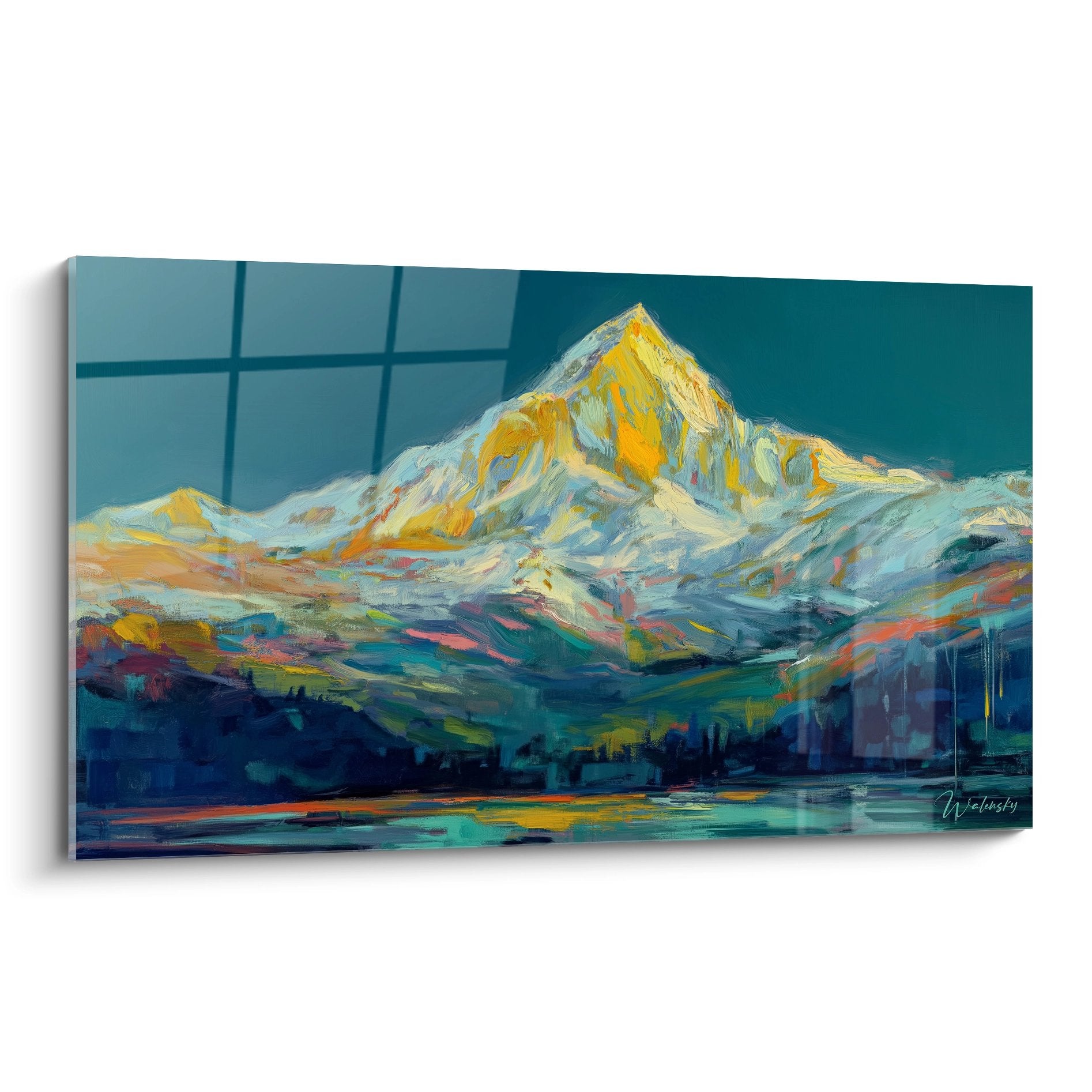






Abstract, Expressionist or Minimalist Art: What's the Difference for Your Decor?
7 min read · by Walensky
ABSTRACT WALL ART
You're standing in front of your living room wall, an online store tab open, and three words are taunting you: abstract, expressionist, minimalist. A salesperson will tell you they're all the same. They're not. A Rothko and a Pollock don't speak the same language, and hanging one or the other above your sofa won't create the same room at all.
This confusion isn't a matter of vocabulary alone. It determines whether your artwork will calm a room or make it vibrate, and whether your guests will stop to look at it or walk right past it.
The short answerAbstract art is a broad category that rejects faithful representation of reality; Expressionist abstraction is its energetic branch, gestural and driven by raw emotion (Pollock, de Kooning); Minimalism is its calm opposite, built on restrained flat areas and pared-down geometric forms (Agnes Martin). For a soothing decor, choose minimalism; for a room that feels alive, expressionism; for a controlled middle ground, pure abstraction.- Pure abstraction frees form from reality, without necessarily expressing a violent emotion or aiming for minimalism.
- Abstract Expressionism favors gesture, visible brushwork, raw energy and vivid colors.
- Minimalism relies on visual silence: few colors, geometric forms, an airy composition.
Three notions, one same confusion
The word "abstract" has become a catch-all label. In decor shops, "abstract painting" gets stuck on pretty much anything that isn't a recognizable portrait or landscape. The result: works that are worlds apart end up in the same section.
The trap is believing these three movements form a scale, from the busiest to the most sober. In reality, they are three different logics. Abstraction is the parent category. Abstract Expressionism and Minimalism are two offspring that turned their backs on each other.
A minimalist artwork never shouts. An expressionist artwork never whispers. In between, pure abstraction can do both at once.
The fundamentals: what truly sets these three movements apart
Abstraction: liberating form
Abstraction emerged in the early twentieth century, when Wassily Kandinsky decided a painting no longer needed to represent an object to exist. Shapes, colors and lines are enough to create a composition that stands on its own, with no identifiable subject.
It's a vast family: it includes highly constructed geometric works as well as nearly chaotic compositions. Abstraction says nothing about emotional intensity or the level of simplicity; it simply says, "what you see doesn't imitate reality."
Expressionism: emotion above all
Abstract Expressionism, on the other hand, places emotion at the heart of the painting, with a bold gestural touch. Jackson Pollock dripped paint onto the floor, in motion, almost in a trance. Mark Rothko layered broad, soft blocks of color to create an almost physical sensation in the viewer.
Thick texture, visible drips, bold contrasts: everything here signals a hand in motion, a tension at work. It's an art that occupies space and demands attention.
Minimalism: simplicity as a message
Minimalism reverses the logic. Agnes Martin painted nearly invisible grids, fine lines on a muted palette, to achieve an almost meditative visual silence. Here, geometric composition and monochrome are not a lack of inspiration: they are the very point.
Minimalism isn't necessarily abstract in the historical sense: it can depict a simple geometric form without ever seeking to convey a strong emotion. Its sobriety defines it, not its relationship to reality.

Favorite pick
Wall Art Interlaced Purple and Gold Bubbles - Blended Hues - Multicolor Abstract Edition
From €273.90
Discover this artworkComparison table: colors, forms, mood
Here's what actually changes, at a glance, to help you decide without rereading three art history definitions.
| Criterion | Pure abstraction | Abstract Expressionism | Minimalism |
|---|---|---|---|
| Palette | Variable, often high-contrast | Vivid, saturated, sometimes raw | Muted palette, few tones |
| Composition | Free or geometric forms | Chaotic, gestural | Geometric, pared-down composition |
| Perceived texture | Variable | Thick texture, visible movement | Smooth, calm surface |
| Emotion conveyed | Intriguing, thought-provoking | Intensity, energy | Calm, restraint |
As you've noticed, minimalism and expressionism sit at opposite ends of the spectrum. Pure abstraction, on the other hand, can draw from both sides depending on the artwork chosen.
— Our selection


Which style for which interior? Practical cases
Scandinavian living room or industrial loft
A Scandinavian living room, with pale walls and minimal furniture, naturally calls for minimalism or a geometric-leaning abstract. A pastel watercolor abstract wall art, designed to complement an already calm space without overwhelming it, fits right in.
An industrial loft, with its high ceilings and raw materials, on the other hand supports a more expressive artwork. Strong contrasts and architectural compositions find a natural resonance there, especially with urban subjects treated in abstraction.
These three architectural compositions play with geometric volumes and bold colors: they are especially well suited to an interior with a strong personality, such as a loft or a contemporary apartment.
Cozy bedroom or creative office
In a bedroom, the goal remains rest. Avoid harsh contrasts and overly energetic compositions. A visual with fluid forms and a soft palette, such as interlaced ribbons in pastel tones, adds visual texture without ever unsettling the room.
In a creative office, however, Abstract Expressionism has its place. An explosion of color at the center of a wall stimulates more than it distracts, as long as you don't multiply sources of visual agitation around it.
To explore abstraction and minimalism together in more depth, our guide to abstract and minimalist wall decor details the basics we only touch on here.
Can you mix styles in the same room?
Yes, as long as you don't mix intensities in the same spot. A living room can hold a minimalist piece near the window and a more expressive one on the bookshelf side, as long as the two zones remain visually distinct.
- Keep only one "strong" artwork per field of view to avoid visual clutter.
- Tie the styles together with a shared color, even a subtle one, to create cohesion.
- Avoid hanging a highly gestural abstract right next to a minimalist piece: the clash in rhythm tires the eye. For a panoramic abstract wall art on a long white wall, the horizontal format comes with its own placement rules.
Interlaced silhouettes and figures, halfway between figuration and abstraction, offer a neutral ground for linking two atmospheres without taking too strong a stance.
If you're still trying to tell abstraction and expressionism apart more precisely, our comparison of expressionist and abstract painting goes further on that pairing.

You might also like
Wall Art Between Two Worlds - Figurative Abstract Edition
From €273.90
Discover this artwork →Frequently asked questions
What is the difference between abstract and minimalist art?
Abstraction is a broad category that moves away from representing reality; minimalism is a particular style, often abstract too, but defined by its deliberate simplicity and muted palette.
Is Abstract Expressionism a minimalist style?
No, it's actually the opposite. Abstract Expressionism relies on gestural touch and emotional intensity, whereas minimalism seeks calm and visual restraint.
Which type of artwork should I choose for a minimalist living room?
Favor geometric minimalism or an abstract with a restrained composition, using two to three tones at most, so you don't disrupt the balance already set by the furniture.
Can you pair abstract and minimalist wall art in the same room?
Yes, by separating them physically within the space and linking them through a shared tone, rather than hanging them side by side on the same wall.
There's no right or wrong choice among these three movements, only an emotion to prioritize: calm, energy, or something in between that you alone will be able to name when looking at the piece. Your wall needs less a lesson in art history than an honest answer to a simple question: how do you want to feel when you walk into the room?
To find the piece that matches your own personal comparison, head to our collection of abstract wall art.
Explore our collections


