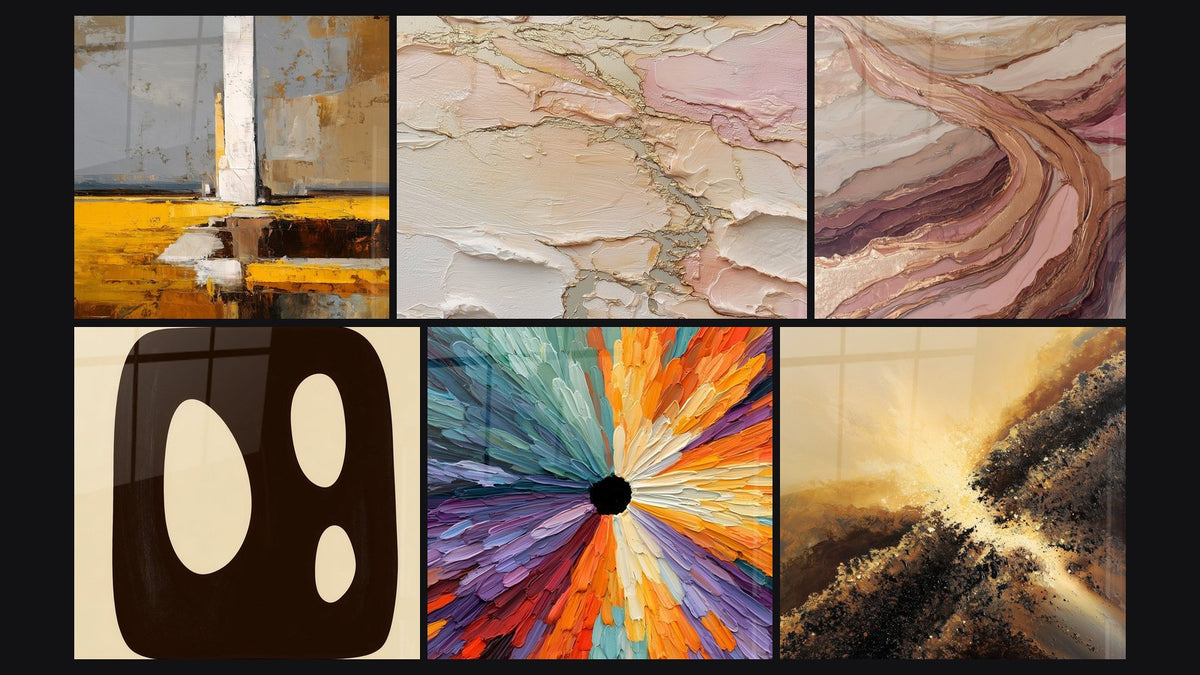
How to center a square painting alone on a large wall?
8 min read · by Walensky
WALL HANGINGS FOR PAINTINGS
A 100x100 cm square hung on a four-metre-wide wall. You fell in love with it on the virtual showroom, it looked stunning, and then it arrives at your home. And there comes the panic: where exactly do you put it, without it floating like a lost sticky note in the middle of a wall of polished concrete?
This is the classic problem of a lone square format. An elongated rectangular painting visually "fills" a width more easily. A square remains a compact block, and a compact block on a large empty surface immediately draws the eye to its edges — and to the emptiness around it.
The direct answerTo center a square painting alone on a large wall, place its geometric center 145-150 cm from the floor (eye level), and center it horizontally on the wall if no furniture is present, or on the dominant piece (sofa, bed, sideboard) if there is one. Choose a size representing 60 to 75% of the reference width to avoid the "postage stamp" effect.- The centre of the painting should sit 145-150 cm from the floor, regardless of its size.
- Centre it on the furniture if there is some, otherwise on the entire wall.
- A square that is too small on a large wall creates a "postage stamp" effect: aim for 60 to 75% of the reference width.
Why does a lone square painting on a large wall pose a particular challenge?
A square format does not guide the eye the way an elongated format does. A 120x70 cm landscape, for example, naturally stretches the view along the wall. The square concentrates everything into a single point — which makes it either very powerful or completely lost, depending on the space left around it.
Negative space is precisely the emptiness surrounding the artwork. On a three-metre-wide wall, a well-centred 100x100 cm square breathes. The same square poorly placed, offset, or too small for the surface becomes a visual accident: the eye searches for a balance that does not exist.
An isolated square painting has no room for proportional error: it has neither the length of a panoramic format to make up for a mistake, nor the company of other frames to mask a bad calculation.
The eye-level rule applied to a square format
The eye-level rule remains the same whether it's a square, a rectangle or a panoramic format: the center of the artwork should fall between 145 and 150 cm from the floor, roughly the eye height of an adult standing in a gallery.
Calculating the vertical centre at 145-150 cm from the floor
For a square painting, the calculation is almost simpler than for a rectangle: height and width being identical, simply halve the dimension and carry that value above and below the 147 cm reference mark (the most commonly used average).
- 100x100 cm format: the top edge of the painting sits at 197 cm, the bottom edge at 97 cm.
- 120x120 cm format: the top edge at 207 cm, the bottom edge at 87 cm.
- 140x140 cm format: the top edge at 217 cm, the bottom edge at 77 cm.
Adapting the rule to ceiling height
A 2.20 m ceiling does not forgive large square formats placed too high: the 140x140 cm, for example, would nearly touch the ceiling if the rule were followed to the letter. In that case, lower the centre slightly, to around 140 cm, to keep breathing room above the frame.
Conversely, under a ceiling of 3 metres or more, nothing prevents raising the centre slightly to 155 cm: the wall has height to offer, so make the most of it to give the room a sense of scale.

Our selection
Painting Brilliant Flower in Golden and Cream Tones - Floral Energy - Feng Shui Center Earth Edition
From €228.90
Discover this paintingHorizontal centring: relative to the wall or the furniture?
This is the question that divides most. The answer depends on a single criterion: is there a dominant piece of furniture beneath the painting?
Centring across the full width of the wall
On a bare wall, with no furniture below — a stairwell, a wide corridor, a living room wall with no sofa against it — centre the painting across the full width of the wall, not a portion of it. It is the only reference available, and it is what gives the sought-after impression of wall symmetry.
Centring on a piece of furniture or a focal point
As soon as a sofa, bed or sideboard sits beneath the artwork, it becomes the focal point — not the wall. A square painting centred on the entire wall but offset from the sofa will create an impression of imbalance, even if the wall measurements are correct.
If the furniture is itself off-centre on the wall (a sofa pushed to one side, for example), the furniture wins. The eye instinctively associates the painting with what it hangs above, not with the architecture behind.
A good example: a low sideboard in a dining room, topped with an artwork in warm tones such as the abstract painting in ochre and grey shades with a horizontal gold band. Even if the wall is wider than the sideboard, alignment with the sideboard is what matters.
— Also worth discovering


What square painting size avoids the postage stamp effect?
The postage stamp effect is that ridiculously small square that seems to have been forgotten in the middle of a wall far too large for it. It happens more often than one might think, especially when the available surface is underestimated — and choosing the format is all the more crucial for an abstract square painting intended for an adult bedroom.
The proportion rule to know: the artwork should represent 60 to 75% of the width of the reference furniture or wall. For a 220 cm wide sofa, a 140x140 cm square remains consistent. For a bare 3-metre wall, aim for an XL (120x120 cm) or XXL (140x140 cm) format to avoid a sense of emptiness around it. In a contemporary open-plan kitchen, a black and white square painting of large format produces exactly this structuring effect.
| Width of the wall or furniture | Recommended square format |
|---|---|
| 160 to 200 cm | L (100x100 cm) |
| 200 to 250 cm | XL (120x120 cm) |
| 250 to 300 cm | XXL (140x140 cm) |
| 300 cm and more | 3XL (160x160 cm) or larger |
For a very large wall, a format such as the Beige and Cream Swirls in Relief painting at 180x180 cm occupies the space confidently without ever feeling overwhelming, thanks to its curves that soften the mass.

— In the same spirit


Practical tools and tips for perfect centring
Theory is well and good. But on the wall, with a pencil and a tape measure, you need a method that leaves no room for error.
Kraft paper template and masking tape
Cut out a kraft paper template to the exact dimensions of the painting. Attach it to the wall with masking tape, move it until you find the position that "breathes" well, then step back two or three metres to judge the overall effect. This is the most reliable method for visualising a square format before drilling.
Spirit level or laser and symmetrical measurements
Once the template is approved, measure the distance between its edges and the limits of the wall (or furniture) on each side: they must be identical to guarantee true wall symmetry. A laser level then lets you draw a perfectly horizontal line to position the wall-hanging fixings without mishap.
The fixings supplied with Walensky paintings simplify this final step: no complex system needed, just precise marking and a straight hang on the first try.

Frequently asked questions
At what height should you hang a square painting on a large wall?
The center of the artwork should sit between 145 and 150 cm from the floor, regardless of its size. This rule still applies to very large square formats, provided you adjust slightly according to the ceiling height.
What Size Square Painting for a Large Empty Wall?
Aim for a format covering 60 to 75% of the width of the wall or reference furniture. On a three-meter wall, an XXL format (140x140 cm) or larger avoids the postage-stamp effect.
How to Tell If a Painting Is Properly Centered?
Measure the distances between the edges of the painting and the limits of the wall (or furniture) on each side: they should be equal. Then step back a few meters to check the overall visual balance.
Should a Painting Be Centered on the Wall or on the Furniture Below?
If a dominant piece of furniture occupies the wall (sofa, bed, sideboard), center the painting on that piece, not the entire wall. Without furniture, the wall becomes the only centering reference.
Conclusion
Centering a single square painting on a large wall isn't mysterious once you know the right benchmarks: eye height, focal point, proportion. But no formula replaces the moment when you step back a few paces to judge whether it truly breathes.
If you're looking for the format that will fill a large wall with elegance, the abstract painting in ochre and grey tones or the Beige and Cream Swirls painting offer a presence that never gets lost, even on the largest surfaces. And to finalize the hanging without missteps, head to our guide on wall painting hanging hardware, which details the systems suited to each format.
If you're still torn between several square paintings to pair rather than a single piece, our article on how to combine several square paintings on one wall could change your approach. And for a bedroom wall, our guide to the ideal square painting size for an adult bedroom perfectly complements this centering method.