







PAINTING FOR LIVING ROOM
You placed the square painting in the middle of the sofa, to the millimetre. And yet something feels off: it looks tiny, lost, like a postage stamp stuck on an oversized envelope. You didn't measure wrong. It's the square format that works against you.
The direct answerA square painting above a sofa is centred on the middle of the sofa itself (not on the whole wall, unless the sofa is perfectly centred in the room), at a height where its centre sits between 1.40 m and 1.50 m from the floor. Since a square never fills the full horizontal width of a sofa, it often needs a second element — another square painting, a lamp, a plant — so the composition doesn't look unbalanced.The difficulty comes from an obvious point we tend to forget: a sofa is a long horizontal line, and a square is a compact shape. The two don't naturally work together.
- Centre the square painting on the sofa, not on the wall, unless the sofa spans the full width of the wall.
- Aim for an artwork (or composition) width equal to 60–75% of the sofa's width.
- The centre of the painting should sit at eye level, around 1.45 m from the floor on average.
- A square on its own can look isolated against a long line: a pair or a side element restores the balance.
Why the square format poses a particular challenge above a sofa
A square never stretches to follow the width of a sofa. Unlike a landscape format that naturally echoes the horizontal line of the furniture, the square remains a compact mass, placed there, almost independent of what it hangs above.
On an empty wall, that same square would work very well: it becomes the room's single focal point, with no competition. But above a 2.20 m or 2.40 m wide sofa, it has to coexist with the armrests, the cushions, sometimes a wall light or a side table. The sofa imposes a horizontal scale that a lone square cannot fill without looking ridiculously small or, conversely, overwhelming if oversized.
A square painting above a sofa never has to handle just one dimension — it has to respond to a whole line of furniture, not just a wall.
Centring on the sofa or the wall: the question to settle
The general rule: centre on the sofa, not the wall, in the vast majority of living rooms. The eye instinctively associates the painting with the piece of furniture it hangs above, not with the architecture of the room.
When to favour centring on the sofa
If the sofa is offset from the wall — pushed into a corner, facing an asymmetrical window, or flanked by a bookcase on one side only — always centre on the sofa. This is the most common case, especially with a corner sofa where the right-hand section (the main backrest, excluding the chaise) serves as the reference for the calculation.
When to favour centring on the whole wall
If the sofa takes up almost the full width of the wall and is itself centred in the room, both centrings coincide anyway. In that case, work instead on the overall balance of the room: doors, windows, a mirror facing it.
For a corner sofa, measure only the width of the right-hand backrest (without the chaise): that section is what the eye uses as a visual reference, not the total length of the L-shaped piece.

Favorite
Abstract painting in orange and black tones with drips - Earthly Harmony - Feng Shui Earth Centre Edition
From €228.90
Discover this paintingThe step-by-step calculation method for a square painting
Here is the method, in order, so you don't get the proportions wrong.
Measure the usable width of the sofa
Take the width of the sofa between the two outer armrests. This measurement is the basis for the entire calculation, not the width of the wall.
For a 2.20 m three-seater sofa, this gives a composition roughly between 1.30 m and 1.65 m wide. A 100x100 cm or 120x120 cm square painting therefore occupies a good part of this range, but rarely all of it — hence the value of adding a second element, as we'll see below. This format is also a personalised housewarming gift much appreciated, easy to integrate into a newly furnished living room.
Calculating the ideal hanging height
The centre of the painting should sit at eye level, standing in the room — a rule borrowed from museums, which works just as well at home.
Above a sofa, leave generally 20 to 30 cm between the top of the backrest and the bottom of the painting, so the artwork doesn't visually touch the cushions.
Check the space with the armrests and cushions
A wide armrest or bulky decorative cushions reduce the width actually perceived for the sofa. Step back a few paces and look at the overall silhouette of the piece, cushions included, not just its bare frame.
— Our selection


Filling the horizontal space without losing the balance of the square
A lone centred square often leaves two large empty zones on either side — this is where the composition tips from 'lost' rather than 'lived-in'. Several solutions fix this imbalance:
- The pair of squares : two identical or echoing square paintings, spaced 5 to 10 cm apart, recreate a horizontal line that works better with the sofa than a single square.
- Square + lamp or wall light : an accent lamp or wall light on one side of the painting rebalances the composition without adding a second artwork.
- Square + plant : a tall floor plant placed at the end of the sofa visually closes the composition on the other side.
- Flanking wall shelves : two slim shelves on either side of the painting create visual symmetry without weighing down the wall.
Visual symmetry doesn't mean perfect symmetry down to the millimetre. It means the visual weight on the left and right of the painting answers each other, even with objects that differ in nature and size.
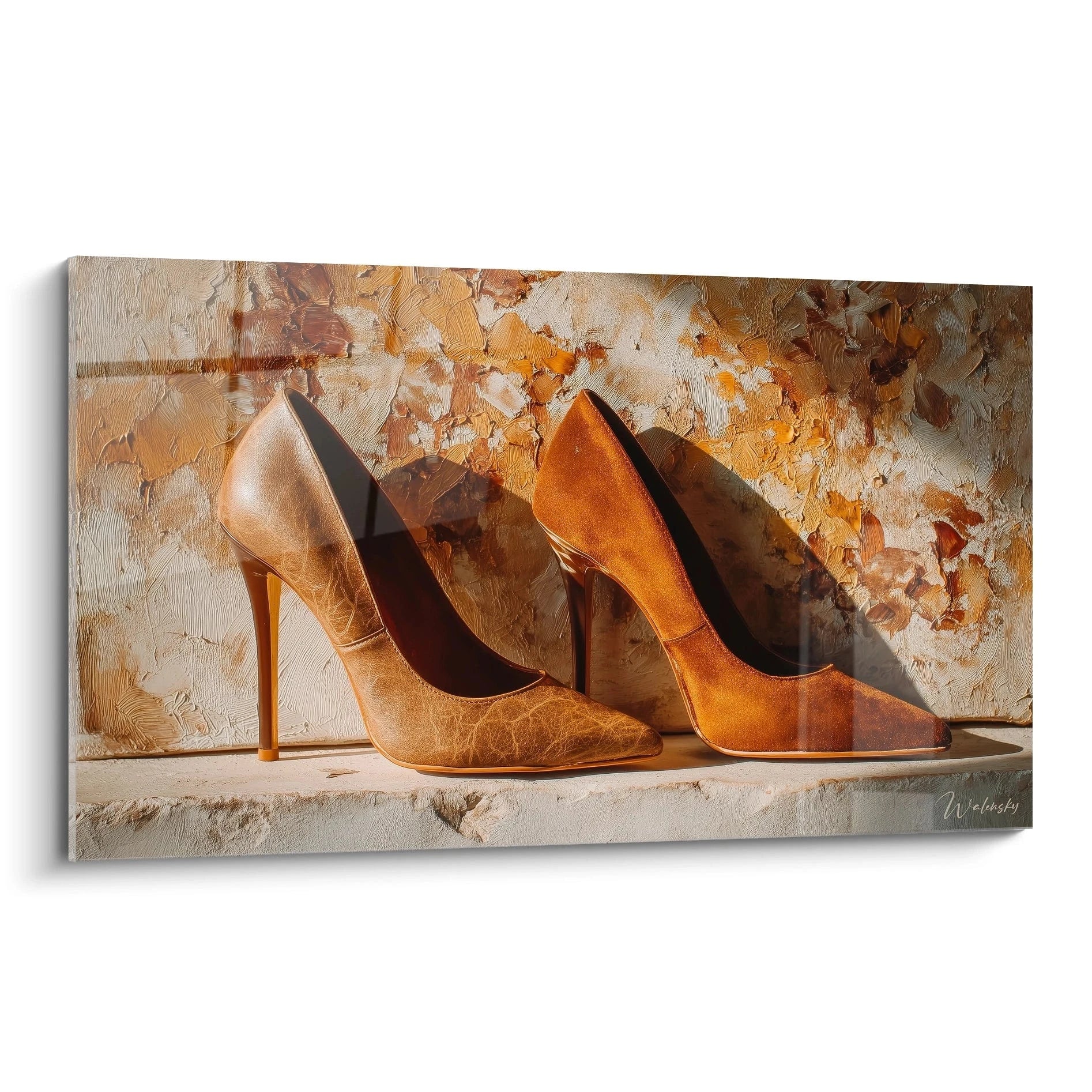
These two pieces, in close but differing tones and motifs, illustrate the idea of a pair that structures the space without being identical down to the line.
— Also to discover


Examples of compositions with an abstract square painting
For a classic three-seater sofa (about 2 m to 2.20 m), a 100x100 cm or 120x120 cm abstract square painting works well centred, provided you add a side element — lamp or plant — to furnish the remaining space. The aim is not to 'fill' at all costs, but to avoid the emptiness that gives an impression of unfinished work.
For a corner sofa, the calculation is made on the right-hand backrest only. An L or XL format from the product sheet is more than enough, and a second, smaller square painting can occupy the corner or the adjacent wall section, creating continuity between the two living zones of the room.
our guide to centring a single square painting on a large wallCompositions in mineral and organic tones lend themselves particularly well to this balancing exercise, as their soft nuances let the space breathe around them. A green botanical square painting is a good example, popular in both the living room and the dining room.

Frequently asked questions
What size square painting for a three-seater sofa?
For a 2 m to 2.20 m three-seater sofa, an L (100x100 cm) or XL (120x120 cm) format respects the 60 to 75% proportion of the width of the piece, especially when accompanied by a second decorative element.
Should the painting be centred on the sofa or on the wall?
On the sofa, in the vast majority of cases, since that is what the eye spontaneously associates with the painting. Centring on the wall only applies if the sofa already spans its full width.
Can you hang two square paintings above a sofa?
Yes, and it's even an excellent way to offset the compactness of the square format on a long horizontal line. Space the two artworks 5 to 10 cm apart and keep the same height alignment.
At what height should a square painting hang above a sofa?
The centre of the artwork sits around 1.45 m from the floor, leaving 20 to 30 cm between the top of the backrest and the bottom of the painting's visual frame.
Centring a square painting above a sofa is never just a matter of measurement: it is above all a matter of perception. The compact square against the long line of the sofa is a balance of forces you learn to even out, with a pair, a lamp, a plant, or simply by accepting that well-dosed emptiness is also part of the composition. To compose yours, the abstract square paintings in our living room painting collection offer a good starting point, and our article on the ideal size of a rectangular painting above the sofa usefully completes this reflection if you are still torn between the two formats.
Explore our collections


